The Temby Inquiry

The Temby Inquiry was a formal investigation, commissioned by the New South Wales Department of Gaming and Racing in 2004, into the governance and operations of Penrith Rugby League Club.

Conducted by former senior prosecutor Ian Temby QC, the Inquiry examined a range of matters relating to the administration of the Club and the conduct of individuals associated with it. Its report, delivered in December 2004, marked the culmination of a period of conflict that forms a central thread of this series.

While the Inquiry sits outside the early timeline of this series, it becomes an increasingly important reference point as the narrative unfolds.


To receive new Parts and occasional project updates by email, you may subscribe below.

Readers who hold recollections, documents, or material relevant to this history are welcome to contribute via the Commentary & Contributions page.

Project Updates

Receive updates when new parts are published.

The Footy Five

The term “Footy Five” was coined by Ron Mulock to describe a group of five directors who, during this period, generally adopted a shared position on a range of issues affecting the Panthers organisation.

Despite the name, the distinction between this group and the other directors was not based on differing levels of commitment to rugby league. Both groups were strongly invested in the future of football in Penrith.

The difference lay more in approach than in objective. One group tended toward a more fixed position on key issues, while the other favoured a more flexible approach in responding to changing circumstances.

The most significant point of divergence related not to football itself, but to broader questions of governance — particularly amalgamation and the future structure of the Panthers organisation.

As the Footy Five is referenced throughout the narrative, it is useful to identify the individuals within the group:

  • Geoff James: Private Enquiry Agent.
  • John Bateman OAM: Local solicitor. Mayor of Penrith (1998-2000)
  • Greg Evans: Owner of the Western Weekender, a local newspaper also prominent in the narrative.
  • Craig Terry: Financial controller at Liquorland.
  • Denis Coffey: Owner of successful engineering company. Ex-player.

Related Topics


Related Themes

Conflict · Governance


To receive new Parts and occasional project updates by email, you may subscribe below.

Readers who hold recollections, documents, or material relevant to this history are welcome to contribute via the Commentary & Contributions page.

Project Updates

Receive updates when new parts are published.

Major Player: Ron Mulock

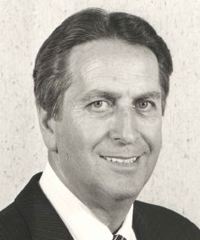
Ron Mulock
Source: Parliament NSW

Ronald J Mulock OA, KCSG

Deputy Premier of New South Wales; Founding Member and Patron, Penrith District Rugby League Football Club

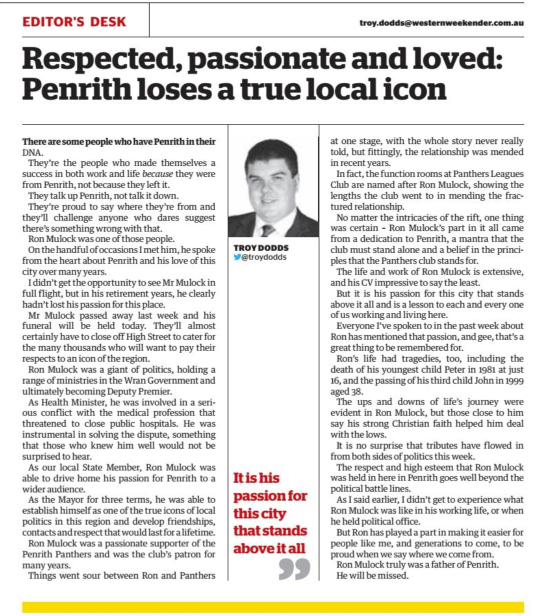
Ron Mulock was a long-serving member of the Australian Labor Party who served as councillor, mayor, state parliamentary representative, senior minister, and Deputy Premier of New South Wales. He was a founding member and Patron of the Penrith District Rugby League Football Club.

Role in the Narrative

Ron Mulock has a significant presence in the Panthers, Passion and Politics narrative.

His association with Panthers dates to the earliest days of the club, and he emerges as an influential figure during the conflicts that unfolded in the later years of Roger Cowan’s tenure. He also contributed to the efforts supporting the award of the Order of Australia Medal to Roger Cowan.

Background

Born: 1930
Died: 2014

Profession: Lawyer – admitted as Solicitor of the Supreme Court in 1955.

Public Roles:
• Mayor of Penrith: 1968–71
• NSW State Parliamentarian: 1971–1988
• Deputy Premier of NSW: 1984–1988

Honours:
• Officer of the Order of Australia (1988)
• Knight Commander of the Order of St Gregory the Great (2013)

Recognition by Panthers
• Life Membership, Penrith Panthers (1989)
• Ron Mulock AO Room, Panthers Events Centre (2012)

Relevance to Events Described

Mulock is closely connected to one of the central strands of this story.

During the late 1990s, he opposed aspects of the expansion strategy undertaken by Panthers and was aligned with the group of five directors who became known as the “Footy Five”. The four minority directors were referred to as “Roger’s Four Kinsmen” — a phrase that drew on the name of a well-known musical group closely associated with Panthers.1

Mulock’s long-standing connections within the Australian Labor Party, and his prominence in public life, contributed to a broader perception at the time that he was influential in political attention being directed toward Panthers.

Related Material


Related Themes:

Football Club · Governance


To receive new Parts and occasional project updates by email, you may subscribe below.

Readers who hold recollections, documents, or material relevant to this history are welcome to contribute via the Commentary & Contributions page.

Project Updates

Receive updates when new parts are published.


Editorial Note

This profile is presented as contextual background.
Additional material may be introduced as the narrative progresses.


  1. The Four Kinsmen were a popular Australian vocal group who performed regularly at Panthers over many years and developed a close association with the club. ↩︎

The Impact of a Turnover Tax

A turnover tax on gambling is a tax imposed on the total amount of money wagered or “turned over” in a gambling activity, rather than on the profits generated by the gambling operators.

For example, imagine you take $100 to the races, and you place a $100 on the first race, it wins and you now have $350. You continue to bet $50 on each of the 7 remaining races. So, if you add up the amount you bet it comes to $450 – your first bet of $100 plus 7 bets of $50.

A turnover tax on this activity means the tax is calculated on the total value of the the bets placed, $450. Yet, the amount spent by the punter was only $100.

This example shows the very best result for the betting provider would be for the punter to finish the day broke – and the provider would have a revenue of $100. But they would be paying tax on $450.

Of course, it would be possible for the provider to lose hundreds of dollars to this punter, yet still pay tax on the $450 turned over.

Industry opponents of turnover taxation argued that the structure materially reduced operators’ capacity to improve return-to-player rates.

The mathematics of a turnover tax make it extremely restrictive – and, in fact, for some gambling games (like blackjack) even a small turnover tax would mean the game would not be viable.

For example, poker machines in NSW have a minimum return to player rate of 87%.

At a theoretical level this means a couple of things:

  • Firstly, it means the theoretical revenue for the operator is 13% – that is the operator can expect to retain $13 in every $100 staked on their games.
  • Secondly, it means the theoretical turnover for the player is 3.42 times their orginal stake. So, starting $100 and playing until depleted will generate a theoretical turnover of $342.

In the case of a starting stake of $100, theoretically the operator will retain $13. If a 3% turnover tax is applied their obligation to the tax office will be 3% of $342, which is $10.25.

Now, imagine an operator wants to offer a better deal to their patrons with a 90% return to player. So $100 stake produces a theoretical $10 revenue for the operator. The turnover is $388 and a 3% turnover tax will produce a tax obligation of $11.74 – so the tax office will take all the operator’s revenue plus more.

Critics maintained that turnover taxation limited pricing flexibility and distorted game viability.


To receive new Parts and occasional project updates by email, you may subscribe below.

Readers who hold recollections, documents, or material relevant to this history are welcome to contribute via the Commentary & Contributions page.

Project Updates

Receive updates when new parts are published.

Introduction — An Industry Insight

This article forms part of the serialised republication of Panthers, Passion & Politics – The Roger Cowan Years.

Start · Reader’s Guide · All Parts


Because of Cowan’s deep involvement in the licensed club industry, the history of Panthers cannot be separated from the broader history of the NSW club movement..

Phil Bennett1 was an officer with the Liquor Administration Board2 for many years. He remembers some of the interesting episodes. He had first encountered Cowan in the early 1980s. When Treasury was pushing to use turnover as the basis for taxing poker machine revenue, it was Bennett’s job to sell the concept to the clubs. Until then, only gross revenue had been taxed. Bennett said:

The idea was to tax the money being spent by the gamblers — a turnover tax3 — taking it off the top. Roger had a great moral difficulty with this, and he was very vocal.

I wrote a whole lot of papers and reports, and had to present them to the industry. By then I was in the policy section of the Chief Secretary’s department. We used the analogy of liquor . . . Clubs were paying a tax on the purchase of their liquor — which is like a turnover tax. And I also brought out other examples. So, we were trotting out all these arguments, and Roger would come back to me and say ‘that’s completely ridiculous, and a false analogy’. And proceed to explain in detail why it was, and shoot all my arguments down in flames. There was one day I distinctly remember. I had put together this paper and sent it to him, and then we met to discuss it. We were sitting opposite each other in his office, talking about the issues.

Roger presented a different analogy. ‘Look, this is different to a liquor tax. If you go and buy a beer, you pay tax on it at that point. But then you go into the toilet, and you piss it up against the wall, and it goes down the drain and it’s all over. With gaming machines, if you put on a turnover tax, you’re taxing me when I spend it now, and then I get my money back when I get a payout. But then, if I bet it again you’ll make me pay another lot of tax, and when I win again you’ll tax it again, and again, and again.’

He was right, but we were saying that’s the way all gambling is taxed. At the races, the punter is taxed out of the turnover tax. But it was very funny. He sat there, looked across at me and said, ‘well, the person who wrote this paper obviously has no understanding of the club industry.’ He knew very well that I wrote it.

Cowan does not remember being so tactless:

When Phil asked me to discuss turnover tax I was appalled, and my body language was probably negative. I was convinced that one day we would have higher denomination machines and a turnover tax would restrict the return that we could offer the customers. The turnover tax they were proposing was only 3% and that sounded small enough to get acceptance from the industry. But I was concerned it would stifle the growth and eventually it would be unfair to players. I believed that higher denominations would eventually be part of the gaming market — and that should mean offering higher returns to the player. I knew for example that there were machines in the casinos in Las Vegas paying the player 99% — not many to be sure, but it would be impossible to do that under a turnover tax.

A turnover tax would force clubs to have machines set to the lowest possible return to players, and yet, it would be highway robbery to introduce high denomination machines at less than say, 94% return to players.

So, what I was trying to convey to Phil was that they were not looking at the future potential of the industry.

I was so concerned that I called a special meeting of several of the larger clubs and made a presentation to them of the dangers of a turnover tax. It was a long battle and finally the government saw the point and withdrew the proposal. Even though I was probably seen as the leader of the push to have it withdrawn, I never felt any sense of resentment from the government or the department officers . . .

If it had been a Carr/Egan government, I might have been facing a Royal Commission inquiry much sooner.

Bennett says:

You always knew that Roger would speak out if he believed that something was wrong. And he did his research, so he always knew what he was talking about.

Researching this book, I heard many words used to describe Roger Cowan, both positive and negative.

In recent years some have sought to attach another label to Cowan — dishonest.

Barrister Terrence Lynch4 says that from the start, he never believed that the inquiry would find any type of dishonesty in Cowan’s behavior.

I really was very relaxed about the inquiry. If a man is a crook, you don’t get staff five and six years in retirement still volunteering their time to assist him.

Dishonesty was just not consistent with any part of my exposure to what that place was like. My impression of Panthers is of a very internally open organisation. There never seemed to be the sense that if you disagree with Roger, there was going to be any discomfort or risk in doing that. You can’t operate dishonestly in such an open environment. And then, that flowed down through the organisation. I got the impression that he expected those people to be equally open with their own teams.

The events of 2004 have left permanent scars on Roger Cowan. There is no doubt that he sees Panthers as his life’s work, something that he could take pride in on his retirement. In his mind, the Inquiry, and the attendant headlines and publicity, altered that. That Inquiry, and the circumstances surrounding the events leading up to it, is a story that certainly needs telling.

The real story here is the growth of Panthers from a near-bankrupt suburban club into a significant force within the NSW club movement — and how that success eventually drew it into complex and contested political terrain.


To receive new Parts and occasional project updates by email, you may subscribe below.

Readers who hold recollections, documents, or material relevant to this history are welcome to contribute via the Commentary & Contributions page.

Project Updates

Receive updates when new parts are published.


  1. Phil Bennett worked in gaming-related departments within the NSW public service, including Treasury, the Liquor Administration Board, Casino Control and as Senior Policy Adviser in the Chief Secretary’s Department. In 1989 he established Phil Bennett Consulting, advising organisations in the gaming and liquor industries.
    ↩︎
  2. The Liquor Administration Board (LAB) has since undergone structural and naming changes. Its current successor body is the Independent Liquor & Gaming Authority (ILGA) of NSW.
    ↩︎
  3. A turnover tax is calculated on the total amount wagered rather than net loss. For example, if $10 is gambled and returns $100, and $40 of those winnings is wagered again, the tax applies to the total $50 wagered. For a fuller explanation, see The Impact of A Turnover Tax in Beyond the Book.
    ↩︎
  4. Terrence Lynch was a member of the legal team engaged to represent Panthers during the Inquiry. Senior Counsel for the Panthers legal team was Bernie Coles KC.
    ↩︎

Part 2 · All Parts · Part 4

Commentary and Contributions