
Editors Note: The tables reproduced in this article are based on Panthers’ internal working papers prepared during 1998 and 1999. They were management documents used to estimate the club’s position under the NRL Selection Criteria and were never intended for publication. While some financial measures necessarily relied on informed estimates, they provide a rare insight into the information available to Panthers’ leadership as critical decisions were being made.
The settlement that ended the Super League war did not guarantee the survival of every club. In fact, it guaranteed the demise of some teams.
Twenty-two teams competed in the 1997 Season — the split competitions season — twelve played in the Australian Rugby League and ten in Super League.
Before the new National Rugby League competition began in 1998, the South Queensland Crushers and the Hunter Mariners were wound up, leaving twenty clubs to compete in the frist season of a unified competition.
The unity was conditional.
The NRL would operate with twenty clubs during 1998 and 1999, but from the 2000 season the competition would be reduced to just fourteen. The peace agreement had ended one conflict while immediately beginning another — a contest for survival.
To determine which clubs would be admitted to the new fourteen-team competition, the NRL introduced a formal assessment process known simply as the Criteria. (Download PDF: Admission Criteria National Rugby League Competition )
The NRL described the Criteria as a “fair and reasonable” method of selecting the clubs that would comprise the future competition. They consisted of three separate components.
The Basic Criteria required clubs to demonstrate that they met, or had plans to meet, minimum standards relating to playing facilities, administration, solvency and development.
The Qualifying Criteria examined financial capacity, including minimum revenue requirements of $8 million together with five-year business plans demonstrating the ability to sustain those revenues.
It was the third component — the Selection Criteria — that attracted the greatest attention from Panthers and most other clubs.
Selection points were awarded across six categories:
- Home crowd numbers
- Away crowd numbers
- Competition’s points
- Home game receipts
- Sponsorship and other income
- Profitability
Not every club was required to compete under these Selection Criteria.
Brisbane, Newcastle and Auckland were given exemption, leaving seventeen clubs competing for the remaining eleven places.
There were two further provisos that influenced the process.
Firstly, any club created through the merger of two or more existing clubs would also receive automatic admission to the fourteen-team competition. The deadline for merger submissions was 31 July 1999 — a date that becomes critically important later in this story.
Secondly, there was to be a minimum of six Sydney-based clubs. Of the seventeen clubs still subject to the Selection Criteria, twelve were Sydney clubs. While there was no predetermined list of clubs to disappear, it was obvious that the greatest competition for survival would occur within Sydney.
After studying the Selection Criteria, Panthers pursued two parallel strategies.
The first was to prepare submissions challenging aspects of the Criteria that the club believed were flawed or unfair.
The second was to construct an internal model to estimate where Panthers ranked against the other clubs.
The Modelling
Of the six measured categories, three could be obtained directly from publicly available information – home crowds, away crowds and competition points. A fourth category, home gate receipts, could be estimated with reasonable confidence because it was closely related to attendance figures. The remaining two categories – sponsorship and other income, and profitability – required informed estimates based on the information available.
Points were then allocated according to each club’s ranking in every category, with bonus points applying in some areas.
Although the NRL never published progressive rankings, Panthers developed its own working model using the published Selection Criteria and the best information available at the time.
The following table is reproduced from a report for Panthers management explaining the modelling and its results — it shows the estimated rankings at the end of Season 1998. (Download PDF: Working Paper on NRL Selection Criteria – this is the Panthers working paper produced at the end of Season 1998)
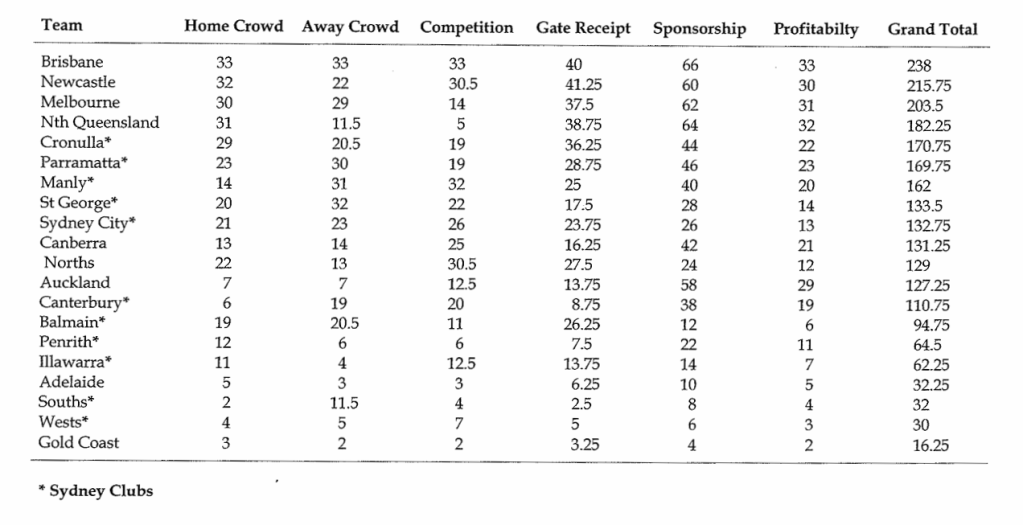
The purpose of the modelling was not to predict the future with certainty. It was more to provide information that might guide decision-making and strategy development leading into the final declaration of the 2000 NRL line-up … the merger deadline of 31 July, 1998 was another critical point in the calendar for which this information could prove useful.
Where did Panthers appear to rank? What categories could Panthers take action to improve? Could those areas realistically be improved?
If no potential improvement could be seen or planned, what strategic options needed to be examined before the 31 July 1999 merger deadline expired?
Despite relying on estimated figures in three categories, the analysis painted a concerning picture.
Panthers appeared to be ranked fifteenth — just below the 14-team cut-off. Significantly significantly the team hold fourteenth position, Balmain, was estimated to be around thirty points ahead. Even allowing for some estimation error, the modelling suggested that Penrith faced the genuine threat of being axed from the top rugby league competition.
The calculations did not stop there.
By the beginning of the 1999 season, the Gold Coast Chargers and Adelaide Rams had left the competition, while St George and Illawarra had merged to form the St George Illawarra Dragons.
Those changes did little to improve Penrith’s position.
Both the folded clubs had been ranked below Panthers, while the St George–Illawarra merger simply created another club guaranteed admission under the merger provisions.
So, the 1999 season began with seventeen clubs competing, four of them already guaranteed a place in the 2000 competition. That left thirteen clubs — nine from Sydney — competing for the remaining ten places.
The following table shows the standings as at Monday 26 July 1999 — after Round 21 of Season 1999 — five days before the merger submissions deadline.
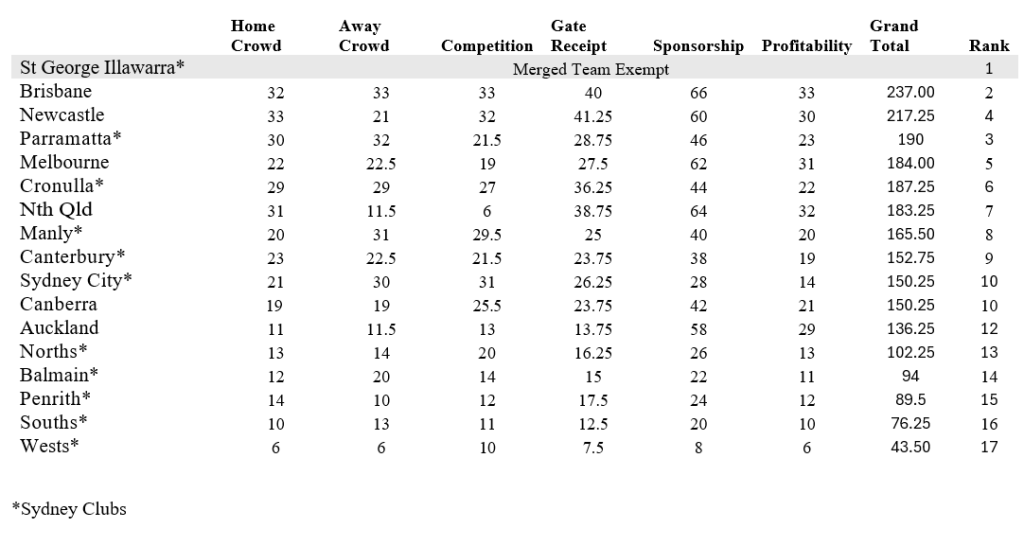
At this late stage of the process the modelling still had Penrith in fifteenth position.
However, the gap to fourteenth (Balmain) had been narrowed — from 30 points to 4.6 points. And Norths fortunes had them dropping from eleventh position to thirteenth, a reachable (though difficult) 12.75 points ahead of Penrith.
There were still five rounds of the season to be completed.
BUT …
The day after this table was distributed to Panthers management, Balmain and Western Suburbs announced a joint venture — the Wests Tigers were born and another place was taken.
To be sure, throughout 1998 and 1999 there was speculation about potential mergers, so this wasn’t a surprise. So, Penrith now had to close a gap of 12.75 points on North Sydney — given their slide and Penrith’s gathering momentum, there was hope.
However, no internal analysis could predict the final outcome. Some financial measures remained estimates and therefore likely had errors, more mergers could change the landscape and the NRL still retained discretion in applying the Criteria.
Nevertheless, the modelling consistently pointed to the same conclusion.
The Penrith Panthers were vulnerable.
The significance of the Panthers modelling and their companion working documents is not with their accuracy.
Their importance is that they demonstrate commitment by Panthers management to ensuring information was available to maintain their evidence-based approach to decision-making. It was not reacting to to rumours or speculation despite the fact that some influential people were.
Panthers had constructed a detailed assessment of its position using the published Selection Criteria and the best information available at the time. No other club had taken this approach.
That assessment suggested Panthers was outside the projected fourteen-team competition.
Whether the analysis ultimately proved right or wrong is almost secondary.
It explains why management believed the threat was real, why alternative strategies had to be considered before the merger deadline expired, and why simply waiting for the NRL’s final decision was never regarded as a responsible option.
Resources
Related Topics
- Part 29 — Joining Super League
- Part 30 — The Criteria
- Part 32 — Outlining the Risk for the Board
- Beyond the Book — Counting Crowds to Chase Survival
Related Themes
Conflict · Financial Management
To receive new Parts and occasional project updates by email, you may subscribe below.
Readers who hold recollections, documents, or material relevant to this history are welcome to contribute via the Commentary & Contributions page.
Project Updates
Receive updates when new parts are published.


One thought on “Survival Becomes a Numbers Game — The NRL Criteria”
Comments are closed.