
For most rugby league supporters, the Super League War is remembered as a bitter struggle between the Australian Rugby League and Rupert Murdoch’s News Limited.
That description is accurate—but it tells only part of the story.
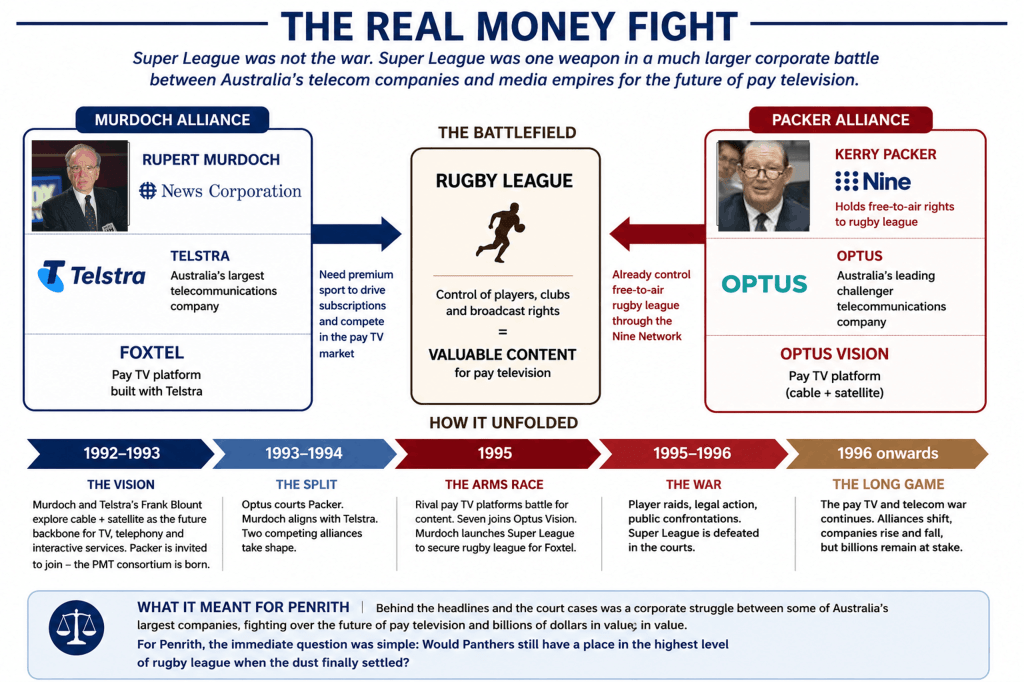
Looking back three decades later, it is easy to view the conflict simply as a battle over the control of rugby league. At the time, however, respected financial journalist Robert Gottliebsen argued that the game itself was not the real prize. In an article published in the Australian Financial Review in April 1996, he described Super League as just one front in a much larger corporate struggle involving Australia’s emerging pay television industry, the nation’s two largest telecommunications companies, and two of its most powerful media empires.
In Gottliebsen’s view, rugby league had become one of the weapons in “the real money fight.”
A Bigger Vision
The origins of that conflict can be traced back several years before the first Super League contracts were signed.
Around 1992, Rupert Murdoch and Frank Blount, the Managing Director of Telstra, began discussing the enormous potential of cable and satellite technology. Their vision extended well beyond television. They believed that broadband networks would eventually carry not only entertainment but also telephone services, banking, retailing, medical services, gambling and countless other forms of communication.
To pursue that vision, Murdoch suggested bringing Kerry Packer into the venture. The proposal became known as the PMT consortium—Packer, Murdoch and Telecom.
For a brief period, Australia’s two most influential media families appeared to be working towards a common future.
It did not last.
The Alliance Breaks Apart
As Australia’s telecommunications industry prepared for competition, Optus recognised the strategic value of Kerry Packer’s media interests and encouraged him to align with its own plans.
Murdoch, meanwhile, ultimately partnered with Telstra.
What had begun as a shared vision quickly evolved into competing alliances.
Telstra and Murdoch established Foxtel.
Optus assembled its own powerful consortium, supported by Kerry Packer and eventually the Seven Network.
Suddenly, the emerging pay television market had become a battleground between rival telecommunications companies, rival media organisations and rival strategic visions for Australia’s communications future.
Billions of dollars were now at stake.
Gottliebsen reported that Telstra’s own internal modelling suggested as much as $7–8 billion of corporate value could be affected depending on which side prevailed.
Why Rugby League Suddenly Mattered
Pay television needed something that could persuade Australians to subscribe.
Movies were important.
News was important.
But live sport was essential.
Existing broadcasting arrangements meant Kerry Packer’s Nine Network already held the free-to-air rights to rugby league. When Murdoch’s executives struggled to secure premium sporting content for Foxtel, creating a new national rugby league competition became a commercially attractive option.
From this perspective, Super League was far more than a football competition.
It became part of a much larger contest over subscribers, broadcasting rights, market share and ultimately the future of Australia’s communications industry.
This does not diminish the genuine rugby league issues that also existed. Questions about the game’s administration, its national expansion, club structures and commercial future were all real and important. However, Gottliebsen argued that these football issues had become intertwined with a much broader corporate struggle that most supporters could neither see nor fully appreciate while it was unfolding.
What It Meant For Penrith
None of these corporate manoeuvres were visible to most Panthers members or supporters.
They saw clubs changing sides.
Players signing confidential contracts.
Court battles.
Television cameras.
Public accusations of betrayal.
Behind those events, however, some of Australia’s largest corporations were fighting over far more than rugby league.
Understanding that broader context helps explain why events moved so quickly during 1995 and why the decisions confronting clubs became so significant.
For Penrith, the immediate question was never which media company would ultimately prevail.
Would Panthers still have a place in the highest level of rugby league when the dust finally settled?
That was the question management sought to answer in Part 29.
Continue Exploring the Super League Story
These companion Historical Context articles examine different aspects of Panthers’ decision to join Super League:
- The Panthers Move — How the Penrith Panthers came to join the new competition.
- When Panthers Faced the Community — How Panthers’ decision affected its members, supporters and the wider Penrith community.
- The Real Money Fight — The corporate battle that lay behind the Super League War.
Related Topics
Related Themes
To receive new Parts and occasional project updates by email, you may subscribe below.
Readers who hold recollections, documents, or material relevant to this history are welcome to contribute via the Commentary & Contributions page.
Project Updates
Receive updates when new parts are published.

