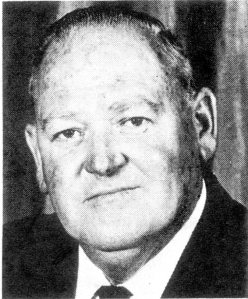
Major Player: Ken “Poker” Ausburn

Merv Cartwright

Ernest Kenneth “Poker” Ausburn

Foundation Member, Chairman and Long-time Penrith Clubman

Ken “Poker” Ausburn was one of the foundational figures of Penrith Rugby League Club and among the generation of local volunteers who helped transform Panthers from a small district football organisation into a major community institution.

A lifelong Penrith resident, Ausburn served the club across many years as a committee member, director and eventually chairman. Remembered for his humour, warmth and strong community spirit, he became one of the best-known personalities associated with Panthers’ formative decades.

Though he died in 1976 before the club’s later expansion into the entertainment giant it would become, Ausburn remained widely respected within Panthers history as one of the men who helped establish the culture and identity of the early club.

Role in the Narrative

Ken Ausburn appears within the early development period of the Panthers, Passion and Politics narrative — the years in which Panthers evolved from modest local beginnings into an increasingly ambitious football and licensed club organisation.

He represents the generation of volunteers and local administrators who laid the foundations upon which later Panthers success would be built.

Ausburn is closely connected to Panthers’ long campaign for admission to the NSW Rugby League first grade competition, and to the club culture that developed during the 1950s, 1960s and early 1970s. His involvement reflects an era when Panthers depended heavily upon local personalities willing to contribute time, energy and leadership to both football and licensed club activities.

His life and reputation also provide insight into the strong community identity that surrounded Panthers during its formative decades.

Background

Born: 9 February, 1921, Penrith
Died: 6 May, 1976, Penrith

Profession: Boilermaker; long-time employee at the St Marys Munitions Factory

Panthers Roles:
• Foundation member
• Director
• Chairman
• Hon. Secretary Penrith Rugby League Golf Club

Community Involvement:
• Supporter of local sporting and youth activities
• Associate with support for Police Boys Club initiatives.
• Long-time Penrith community volunteer

Recognition by Panthers:
• Life Membership, Penrith Panthers (1964)
Poker Ausburn Award – for most improved Panthers player (now discontinued).

In 2017 Penrith City Council named Ausburn Reserve — between Nepean St and Annett St, Emu Plains — to honour the contributions to the Penrith region from the Austbun family and specifically “Poker” and his brother, Bob.

Known As: “Poker” — a nickname reportedly derived from the poker face he adopted while telling stories, joking with friends or “spinning a yarn”.

Relevance to Events Described

Ausburn belonged to the generation that guided Panthers through its difficult formative years.

He witnessed — and helped contribute to — the club’s evolution from football played at very basic local facilities to the construction of larger licensed club premises and ultimately the development ambitions that would reshape Panthers in later decades.

Bruce Turner’s Footprints on the Banks of the Nepean reproduces the cover of Ausburn’s copy of the proposal supporting Penrith’s elevation to first grade competition in 1967. Although the full submission itself does not appear to have survived publicly, the surviving cover reflects the determination among local administrators to secure top-level rugby league representation for the growing Penrith district.

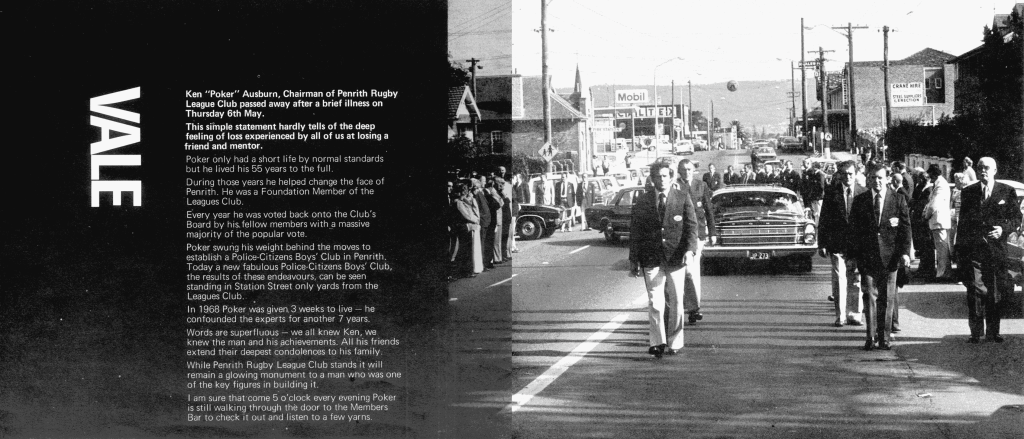
Contemporaries consistently remembered Ausburn not simply as an administrator, but as a personality. Family members and friends recalled his humour, generosity and capacity to engage people socially. Those qualities appear repeatedly in recollections of early Panthers culture.

His life was also marked by resilience. Following a serious motor vehicle accident, Ausburn endured long-term injuries and health complications, yet continued working and remained active in club affairs.

When he died unexpectedly in 1976 at the age of 55, Panthers tributes described him as one of the “small band of men who pushed the club onto its feet in the very beginning.”
Legacy

Ken “Poker” Ausburn is remembered as one of the local figures who helped give early Panthers its personality and community identity.

He represented an era when the club relied heavily upon volunteers, local businessmen, tradesmen and sporting enthusiasts whose commitment extended well beyond formal administrative duties.

Although later Panthers history would become associated with major commercial development, political influence and large-scale expansion, figures like Ausburn reflected the grassroots community culture from which the organisation originally emerged.

His reputation for humour, sincerity and loyalty ensured that his contribution remained warmly remembered long after his death.


Related Material


Related Themes

First Division Admission · Growth · Licensed Club · Governance · Football Club


Editorial Note

This profile is presented as contextual background.
Additional material may be introduced as the narrative progresses.


To receive new Parts and occasional project updates by email, you may subscribe below.

Readers who hold recollections, documents, or material relevant to this history are welcome to contribute via the Commentary & Contributions page.

Project Updates

Receive updates when new parts are published.
The Bid For First Division

This article forms part of the serialised republication of Panthers, Passion & Politics – The Roger Cowan Years.

Start · Reader’s Guide · All Parts


The financial stability that had recently been established allowed Penrith to pursue something that had previously been out of reach — entry into the NSW Rugby League First Division.  

Not long after Cowan took over as CEO1, the Penrith club had started making a push for one of two new spots that were being created in the First Division of the NSW Rugby League. It appeared that one of those holes had pretty much been filled by Cronulla. And while the credentials of the Penrith team were strong enough to give it a chance, the financial woes of the licensed club had to be overcome. Penrith needed to prove it had the resources to support a first division club. It also had to have sufficient player strength to be competitive.

The main rival for the position was Wentworthville. It was one of the most successful registered clubs in the state, had been the leading club in the Second Division competition for a number of years and was favoured to win the 1966 competition. It was a David and Goliath match up!

Early in 1966, Cowan advised the football committee that the club could confidently forecast a profit. The licensed club committee agreed it would support the bid for a place in the First Division competition. With a bit of extra money, the committee was able to pick up a number of established first grade players.

All stops were pulled out to build local support for the bid.

One of the more deliberate moves was the establishment of a monthly club magazine for members, largely written and produced by Cowan. Its aim was to push the First Division claim and stir up local support.2

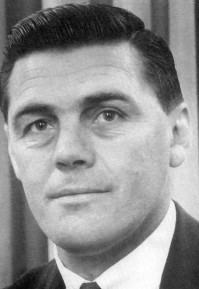
Cowan also began to foster ties with Penrith mayor Bill Chapman and the town clerk, Harold Corr, both of whom would play key roles in Penrith’s promotion to first division.

The football committee led by Secretary Merv Cartwright, had worked strongly throughout the campaign.3

Another factor in Penrith’s favour was that Jack Argent, the Parramatta delegate to the New South Wales Rugby League, didn’t want Wentworthville in there, and he was very influential in those days. Roger Cowan s

Halfway through 1966, Penrith was able to prove to the NSW rugby league that it was profitable. Many factors contributed to the success of the bid, but we would never have got into First Division if the club had remained in the financial state it was. It was a narrow decision and we made it by the skin of our teeth. Six months earlier we would have had no chance of showing we could finance it.

Looking back, it seems logical that Penrith would be a better choice than Wentworthville, situated so close to Parramatta and competing for supporters. It was different back then though.  Souths, Easts and Balmain were good examples of successful clubs competing in the same areas. The NSWRL showed great foresight in considering the geographical qualifications and Jack Argent made sure they did.

Penrith supporters today can reflect that it was a very close call. Just a couple of votes and Penrith would have remained in Second Division.

The entry of the Penrith Panthers into first grade was a time of great celebration in the young city of Penrith. The team would have mixed fortunes over the next 24 years. They first made the semi-finals in 1985 and won their first premiership in 1991.


To receive new Parts and occasional project updates by email, you may subscribe below.

Readers who hold recollections, documents, or material relevant to this history are welcome to contribute via the Commentary & Contributions page.

Project Updates

Receive updates when new parts are published.

  1. Cowan’s formal title was Secretary-Manager, the standard senior administrative role used by rugby league clubs at the time.
    ↩︎
  2. The monthjly Club Journal is the precursor to The Panthers Magazine – which later becomes central to a number of governance issues. See Beyond the Book — The Panthers Magazine
    ↩︎
  3. The campaign involved the efforts of many people, including club officials, local supporters and civic leaders such as Penrith mayor Bill Chapman and town clerk Harold Corr. Chapman and Corr were instrumental to the process. ↩︎

Part 6 · All Parts · Part 8

Commentary and Contributions

Major Player: Leo Trevena

Leo Trevena

Leo “Trapper” Trevena

Premiership-winning halfback / five-eighth (Wests,1952), Penrith Panthers first coach, Licensed club management team

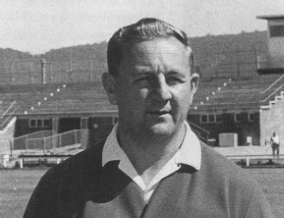
Leo “Trapper” Trevena was a highly regarded rugby league footballer and coach whose involvement with Penrith spanned both its formative years in the Parramatta District Junior League and its early seasons in the NSWRL competition.

A member of Western Suburbs’ 1952 premiership-winning side, Trevena brought first-grade experience and leadership to Penrith at a time when the club was beginning to define its identity and ambitions.

Role in the Narrative

Trevena’s presence in the Panthers, Passion and Politics narrative extends beyond the early development of the club into the period immediately preceding and following its entry into the NSWRL in 1967.

His recruitment as captain-coach — at a reported £500 for the season — reflected a willingness by the club to invest in experience and leadership well before its entry into the NSWRL competition. His time at Penrith coincided with the emergence of a more assertive and self-directed club culture.

He represents a continuity of leadership across eras — from the club’s emergence within the Parramatta district competition to its establishment as a first-grade entity, and into the early years of the licensed club.

Background

Born: 1929
Died: 2013

Playing Career:

  • Western Suburbs (First Grade) — 1950-53, Premiership winner, 1952
  • Canterbury (First Grade) — 1954
  • Young (Maher Cup) — Captain-Coach, premierships 1955–56

Penrith (Junior & District Era):

  • Captain-Coach, A Grade — 1957–1959
  • Premierships — 1958, 1959

Coaching (Senior Level):

  • Penrith — 2nd Division Premiership, 1966
  • Penrith Panthers — First Grade Coach, 1967
  • Penrith Panthers — First Grade Coach, 1973

Club Administration:

Assistant Manager, Penrith Leagues Club — 1968–1973

Recognition by Panthers
• Life Membership, Penrith Rugby League Club (1981)

Relevance to Events Described

An early and defining episode in Trevena’s time at Penrith occurred in 1957.

After just three matches with the club, he was called upon by Parramatta to return to first grade for a match against St George. Trevena refused, choosing instead to honour his commitment to Penrith. Parramatta responded by banning him from playing in the junior competition, a decision supported by the NSW Rugby League.

The consequence was that Trevena was unable to take the field for the remainder of the season, continuing only in his coaching role. Penrith were subsequently beaten in the final.

The episode highlighted an early tension between district authority and club autonomy, and reflected a developing sense of identity within Penrith — one grounded in loyalty and commitment.

Trevena returned to playing the following season, contributing to consecutive A-grade premierships in 1958 and 1959. His influence, however, extended well beyond this period.

As first-grade coach, he guided Penrith to a Second Division premiership in 1966 — an achievement that immediately preceded the club’s entry into the NSWRL competition. He then took on the role of first-grade coach in Penrith’s inaugural season in 1967, and again took the role in 1973.

In parallel with his coaching responsibilities, Trevena also served as Assistant Manager of the Penrith Leagues Club from 1968 to 1973, contributing to the early development of the licensed club during a critical phase of its growth.

Related Material


Related Themes

Football Club · First Division Admission · Milestones


Additional Material


Editorial Note

This profile is presented as contextual background.
Additional material may be introduced as the narrative progresses.


To receive new Parts and occasional project updates by email, you may subscribe below.

Readers who hold recollections, documents, or material relevant to this history are welcome to contribute via the Commentary & Contributions page.

Project Updates

Receive updates when new parts are published.

Major Player: Merv Cartwright

Merv Cartwright

Mervyn Earl Cartwright

Founding figure in Penrith rugby league; Secretary, Penrith District Rugby League Football Club (1967–1970)

Mervyn Earl Cartwright was one of the key figures in the early development of rugby league in Penrith. A local player, administrator, and advocate for the game, he played a central role in the campaign that led to the Penrith Panthers’ admission to the NSWRL competition in 1967.

He served as the club’s inaugural secretary and was widely recognised as a driving force behind rugby league’s establishment in the district.

Role in the Narrative

Merv Cartwright appears in the early phases of the Panthers, Passion and Politics narrative as a key figure in the club’s formation and early direction.

His contribution sits primarily within the “growth” stream of the story — the push to establish Penrith as a first-grade rugby league presence. At the same time, his period of influence overlaps with the emergence of tensions between football ambition and financial governance — a theme that would become increasingly significant as the club developed.

Background

Born: 1927
Died: 2011

Cartwright grew up in the Penrith district and was closely connected to local rugby league from an early age.

• Played junior and senior football in the district
• Became club secretary in the 1950s while still a player
• Continued as Secretary of the Penrith Rugby League Football Club from 1967 to 1970
• Returned to Club governance as a Board Member 1992 – 1998

He was one of the signatories to the formation of the Penrith Rugby League Club Ltd in 1967 .

Recognition by Panthers
• Life Membership, Penrith Panthers (1955)
Merv Cartwright Medal is awarded to the best player each season (named 2012)
• Named a Panthers Legend (2026)

Relevance to Events Described

Cartwright was a driving force in the campaign to bring Penrith into first-grade competition. He played a visible role in promoting the club, including maintaining a strong media presence during its early years .

During his time as secretary, the club operated in an environment where expectations between football operations and financial governance were not aligned. By the end of the 1960s, these pressures had intensified. Expenditure on football activities exceeded agreed limits, and tensions developed between football operations and the licensed club board over financial oversight and decision-making.

In 1971, Cartwright resigned from his role as Secretary of the Football Club. The circumstances surrounding his resignation were more complex than this summary suggests, particularly in relation to the Club’s financial position and governance arrangements at the time.

This conflict echoes through later sections of the Panthers, Passion and Politics narrative.

Related Material


Related Themes

Conflict · Football Club · First Division Admission


Editorial Note

This profile is presented as contextual background.
Additional material may be introduced as the narrative progresses.


To receive new Parts and occasional project updates by email, you may subscribe below.

Readers who hold recollections, documents, or material relevant to this history are welcome to contribute via the Commentary & Contributions page.

Project Updates

Receive updates when new parts are published.