
Contemporary newspaper coverage from the Western Weekender, July- September 1998
Editors Note: The articles selected for this Beyond the Book entry are those that best illustrate the major stages in the public debate as it evolved between July and September 1998.
The following newspaper articles are presented in chronological order. Together they allow readers to follow one of the most significant episodes in Panthers’ history as it unfolded during 1998. Rather than viewing events with the benefit of hindsight, they invite readers to experience the uncertainty, competing arguments and rapidly changing public debate that surrounded the proposed merger discussions.
These articles illustrate how the debate gradually expanded — from Board deliberations, to community campaigns, to local government, to the wider media — before eventually reaching the public information meeting that proved to be a turning point in the story
24 July 1998 — Stand Alone
Commentary
This was one of the first major reports after discussion of a possible merger became widely known. The article captures the immediate emotional response within the Penrith community and reflects the strength of the emerging “Stand Alone” campaign.
At the same time, it provides readers with Roger Cowan’s explanation of why management believed every contingency needed to be examined if Panthers was to maximise its chances of remaining in the National Rugby League.
Reading the article today, one feature stands out. The emotional and practical arguments were already beginning to diverge. While much of the public discussion centred on loyalty and identity, management continued to focus on risk, planning and the long-term survival of the club.
Despite Cowan and his management team being as passionate and loyal — as emotionally invested — as the most fervent supporter, these qualities were already being overshadowed by the emerging public narrative.
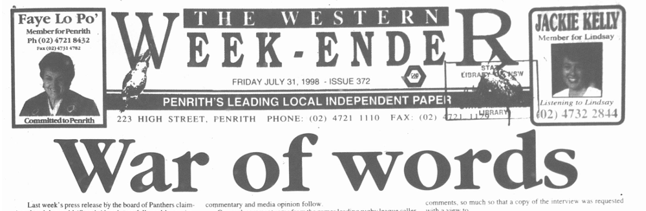
31 July 1998 — War of Words
Commentary
Within a week the debate had expanded well beyond Penrith itself. Sydney’s leading radio commentator, Ray Hadley, had broadcast damaging misinformation about Panthers prompting the Club to respond with an open letter published in the Sydney Morning Herald and the Western Weekender.
This exchange illustrates how quickly the discussion moved from private Board deliberations to public debate. Importantly, it also demonstrates that Roger Cowan’s explanation of the club’s position was being expressed publicly at the time. The account presented throughout Parts 29–35 is therefore not a reconstruction created years later, but reflects the position being articulated as events unfolded.
Readers may wish to compare this article with the discussion in Part 33 of The Series — A Good Story Trumps Truth — where the relationship between public perception and documented fact is explored in greater detail.
7 August 1998 — Merger Decision Deferred
Commentary
This article is significant because it records Panthers’ management describing its decision-making process while events were still unfolding. It’s headline — Damned if you do … — echoes the difficulties being encountered by those responsible for the Club. Roger Cowan repeatedly emphasises that the Board was analysing the risks, considering several possible scenarios and attempting to avoid making decisions based purely on emotion.
It is also a reminder that the future remained highly uncertain. Today it is easy to assume that Panthers’ eventual survival was inevitable. In August 1998 it was anything but certain — indeed, the uncertainty persisted until North Sydney and Manly announced their merger more than a year after the events chronicled here.
21 August 1998 — Council Enters the Debate
Commentary
By late August the merger debate had expanded well beyond Panthers’ Boardroom. Penrith City Council formally resolved to urge the club to remain a stand-alone participant in the National Rugby League, arguing that the Panthers name had become an important part of the city’s identity and economic development.
The article is of particular significance because it captures the complex position occupied by Deputy Mayor John Bateman, who was both a Panthers director and a councillor. Speaking in his capacity as a councillor, Bateman publicly praised the professionalism of Panthers’ management, confirmed that no merger agreement had been reached and acknowledged that the economic case being examined by management was a strong one. At the same time, he explained why he personally believed the socio-economic arguments for retaining an independent Penrith team were ultimately more compelling.
With hindsight, the article demonstrates that the debate had become far more sophisticated than a simple contest between “for” and “against”. Competing economic, governance and community considerations were all being weighed, even by people who ultimately reached different conclusions.
The relationship between the football team and the identity of Penrith had much earlier found an unusual expression when PENRITH CITY appeared across the Panthers jersey in 1988.
11 September 1998 — The Passion … The Practical
Commentary
The public information meeting marked an important turning point in the merger debate. As described in Part 34, Roger Cowan later recalled the meeting as having become an “ambush”, while many supporters regarded it as the defining moment in the campaign to remain a stand-alone club.
The reporting that followed is interesting for another reason. Rather than simply recording the arguments presented, the article framed the debate as one of “Passion” versus “Practical”. Ron Mulock’s position appeared under the heading The Passion, while Roger Cowan’s appeared under …the Practical.
Whether intentional or not, this framing invites an interesting question. Was the debate really between passion and practicality, or were both men expressing different forms of commitment to the same objective — the long-term future of Panthers?
Readers who have followed Parts 29–35 may notice a striking irony. Throughout those chapters, management’s practical approach — risk analysis, contingency planning and exploring every available option — was itself driven by a determination to preserve Panthers’ place in the National Rugby League. The practical and the passionate were not necessarily opposing ideas; they were different philosophies for pursuing what each believed was in the club’s best interests.
It is obvious that both sides of this debate were driven by people holding strong loyalty and devotion to the Penrith Panthers.
Looking Back
Reading these articles nearly three decades later, several observations stand out.
The uncertainty of the time is unmistakable. Decisions that now seem obvious were anything but obvious in 1998. Much of the debate took place before supporters had access to the information available today.
The articles also reveal how rapidly public narratives developed. As discussions moved from the Boardroom into newspapers, radio and public meetings, the story acquired a momentum of its own. Perceptions often became as influential as documented facts.
Perhaps most interesting of all is the consistency of Roger Cowan’s public position. Whether speaking through interviews, open letters or Board statements, the central themes remained remarkably consistent: the risks were real, the future uncertain, and management had a responsibility to examine every realistic option before events overtook the club.
These articles go beyond being simple contemporary newspaper clippings. They are historical documents that allow readers to experience events as they unfolded, before hindsight shaped later interpretations.
The Panthers Merger Debate Newspaper Collection (PDF Download)
Readers wishing to explore these articles in full can download the accompanying PDF containing the complete Western Weekender collection reproduced in this Beyond the Book entry.
Resources
The Panthers Merger Debate Newspaper Collection (PDF)
Related Topics
- Part 29 — Joining Super League
- Part 30 — The Criteria
- Part 31 — Preparing for the Worst
- Part 32 — Outlining the Risk for the Board
- Beyond the Book — Counting Crowds to Chase Survival
Related Themes
Conflict · Financial Management · Media
To receive new Parts and occasional project updates by email, you may subscribe below.
Readers who hold recollections, documents, or material relevant to this history are welcome to contribute via the Commentary & Contributions page.
Project Updates
Receive updates when new parts are published.
 Panthers, Passion & Politics - The Roger Cowan Years