The Walls Come Down

This article forms part of the serialised republication of Panthers, Passion & Politics – The Roger Cowan Years.

Start · Reader’s Guide · All Parts


Clubland in the fifties and sixties was overwhelmingly a male domain — more a bastion than a business.

When Roger Cowan arrived, the ‘Long Bar’ extended the length of the building, and it was for men only. There was also the Sports Lounge, with its dartboards and pool tables. It too was restricted to men.

As in most clubs and hotels in those days there was The Ladies Lounge.  This small room was the only place in the entire club where women — or couples — could go.  It had poker machines and couches but didn’t have its own bar. The women were served by stewards from the other bars. In those very early days of the women’s liberation movement, the room had acquired the unflattering nickname, the ‘sow pen’.

Women were only admitted to the club as associate members. Full membership was restricted to men. Keith Rhind, who was a young director at the time, recalls:

One of Roger’s early pushes against the Board was to allow women into the bar, but there was a lot of resistance. One of the directors at the time was Lou Brown. Lou was real old school, a man’s man, and he used to growl, “Women! They’re like white ants. Once you let ‘em in, you’ll never get rid of ‘em”.

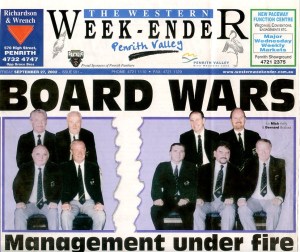
Contemporary attitudes within the licensed club industry could still be remarkably conservative. A 1971 Sydney Morning Herald article captured some of the prevailing assumptions of the era:

Read the full article: PDF

Bryn Miller also remembers that time.

Cowan had analysed the figures — the men’s bar took up 80 per cent of the space but only brought in 20 per cent of the revenue.

By 9 o’clock at night, there might be only three people in the men’s bar and the ladies area would be full to overflowing to the point that some couples would just leave and go to the RSL.

This was especially so on Saturday night — traditionally the time for couples to have a night out – or on big trading nights like New Year’s Eve.

The revenue figures were common knowledge, but the men were very possessive of their space, and this certainly carried through to most of the directors.

Roger used to wander around every night, often quite late, keeping an eye on things. One late Thursday night after the trots at the local showground, he and a duty manager were watching a couple of men. One had big pockets inside his coat, the other was keeping watch while he cleaned out the drawers. They caught them and went to their car which was full of calico bags filled with ten and twenty cent pieces.

Kevin McGrath recalls how this played out in practice,

When a football game was on, it was stand aside or be swept up in the rush.

On game days they would pull the shutters down in the men’s bar so that the drinkers would go over the road to the game. After the game was finished, they would pour dozens and dozens of half schooners and have them lined up. There would be a mad rush from the football ground as hundreds of thirsty fans descended on the bar.The schooners were filled and the shutters went up. If you only wanted a middy — or perish the thought, a scotch — you just had to wait.

Cowan later said the changes were not a conscious move to overcome discrimination, but simply, a commercial reality.

We were trying to make ourselves more popular. We had to be all the time working out what was needed and then responding. The demand at the time was for much bigger accommodation for mixed company. We were squeezing them into one tiny corner of the club, where they were uncomfortable. There was no space, people were pushing and shoving each other, and often there would be fights in there.

I always thought that to run a club, or any business, you have to give the people what they want. At that time, it was being run for the convenience of a fairly small group of men who wanted to protect it for themselves.

The real shift came one New Year’s Eve — Cowan had convinced the Board to do a one-off and allow women into the Long Bar.

The Board finally relented, at first creating a small, partitioned area of the bar where women could go. “Roger persisted, and they were eventually persuaded to have a proper mixed bar, and the sales increased dramatically”, says Rhind.

“It took women a while to really want to go in there,” Miller says, “because that whole male bastion thing was all so entrenched. But the barriers were starting to come down.”

As those barriers began to shift, the club was changing not just who it welcomed, but what it offered — and how people experienced it.


To receive new Parts and occasional project updates by email, you may subscribe below.

Readers who hold recollections, documents, or material relevant to this history are welcome to contribute via the Commentary & Contributions page.

Project Updates

Receive updates when new parts are published.


Part 9 · All Parts · Part 11

Commentary and Contributions

Eliminating Scams with Innovation and Systems

This article forms part of the serialised republication of Panthers, Passion & Politics – The Roger Cowan Years.

Start · Reader’s Guide · All Parts


With control of both clubs established, attention turned to strengthening the systems that underpinned the operation.

Taking responsibility for both clubs gave Cowan far greater control over the finances. As the club began to show consistent profits, attention turned to planning improvements.  

A significant part of the club’s early success in 1966 involved attacking the internal and external scams that were rife in the club industry at the time, particularly around gaming machines.1

Kevin McGrath, who worked in the club’s poker machine area during the 1970s, late recalled an early scam highlighting the brazenness of the scams operating within clubs at the time:

There was one syndicate that had worked out how to set up a jackpot on the Inca machines. They were laughing at us and getting a lot of jackpots. We knew it was not possible to get that many jackpots, but nobody knew how they were doing it.

By watching them, we worked out that you could see into the machine at the side, and, using a thin piece of steel, line up the bolts. So, we cut strips of cardboard and stuck them to the machines so that you couldn’t see inside.

The group walked in while we were doing it and they were very angry. One guy marched straight up to me and said, “What are you doing with my machine – you can’t do that!”

Max Connors remembers how serious these people were about what they were doing.

Some would get an imprint from the lock of the machine and make their own key.

Roger used to wander around every night, often quite late, keeping an eye on things. One late Thursday night after the trots at the local showground, he and a duty manager were watching a couple of men. One had big pockets inside his coat, the other was keeping watch while he cleaned out the drawers. They caught them and went to their car which was full of calico bags filled with ten and twenty cent pieces.

On another occasion, club management worked with the Liquor Administration Board2 on investigations of a scam by a group of the Club’s poker machine attendants who were later charged by police.

Over the next few years, Cowan introduced measures in the poker machine area to try to eliminate theft, and to streamline the process, both for staff and players. One of these was a conveyor belt. The coins would drop onto the belt and move along to a central bin, saving attendants from having to clear out individual machines and carry heavy coins.

Bryn Miller, later CEO of Merrylands RSL club, also worked in the Penrith club’s poker machine area at the time. He says the conveyor system predated the widespread use of nylon bearings, so everything had to be greased. Often the coins would come out covered in black grease. But he says it was a novel way of handling money, and it made it so much easier for the staff.

Miller recalls that Cowan was always open to new ideas and would do everything he could to put them into practice. He believed the club was probably the first to introduce computers into the club industry.  A particular system called Feeney Electronics3, introduced in the early 70s, met with mixed reaction from staff and directors.

This was an absolutely brilliant system so far ahead of its time. The poker machines had small electrodes on their reels, and when they lined up for a jackpot, it recorded in a computer system. This transmitted the details onto television monitors around the club. The supervisors on the floor could see the machine number, and the jackpot details. We would go straight there, check it and pay it.

It was state of the art stuff, unbelievable for the time — most clubs didn’t even have a computer. Colour television was only just around.

To put this into perspective, Penrith Council installed its first in-house computers in 1977. It was a system that used dumb terminals. Council got its first PCs in 1984, when the typing pool was replaced by a few word processors on secretaries’ desks.

Phil Bennett was an inspector with the Liquor Administration Board in the Feeney years. He agreed that the system was 15 years ahead of its time. He said it was innovative and visionary, but it came too early to get any useful information from the Liquor Administration Board’s point of view.

Although the system did not evolve the way it was envisioned, it delivered valuable information that supported other areas of the business.

Cowan later conceded that he may have convinced the Board to persist with Feeney longer than he should have. Had it succeeded, it would have been a major breakthrough. There was nothing like it anywhere in the world at the time4, and the commercial potential was significant. Ultimately it cost the club around $1 million.

Barry Hubbard said many on the board saw it as throwing good money after bad.

Bryn Miller saw it differently

It was one of the very important innovations. It took ten or fifteen years for the industry to even start working on it again. And at least twenty years for the systems to actually come out and be operating properly. It would be impossible to estimate the value of the savings we made because of the system.

Cowan also introduced a further innovation to Panthers members.Members were able to collect Panther Stamps; the club had a large gift room, and stamps could be used to purchase items. This was, of course, the forerunner of the incentive schemes operated by many clubs.5 But it was very likely the first.

Being different and leading the way was part of the Cowan psyche. Another Penrith first in poker machines was an increase to the jackpots. The standard jackpots paid on 5, 10 and 20 cent machines were 5, 10 and 20 dollars. The club increased this to 6, 12 and 24 dollars. By today’s standards, that extra $4 may not seem much, but with the average wage around that time about $60, it was a real bonus for the players.

But improving systems was only part of the challenge. The broader question was who the club was being built for — and that would require a different kind of change.


To receive new Parts and occasional project updates by email, you may subscribe below.

Readers who hold recollections, documents, or material relevant to this history are welcome to contribute via the Commentary & Contributions page.

Project Updates

Receive updates when new parts are published.


  1. The mechanical operations of poker machines in those days made them an easy target. See Beyond the Book: Wires, Magnets and Monitoring ↩︎
  2. The Liquor Administration Board (LAB) was the NSW regulatory authority responsible for the oversight of licensed clubs and gaming operations. It later became the Department of Gaming and Racing, and now is the Liquor & Gaming NSW.
    ↩︎
  3. Feeney Electronics developed an early electronic poker machine monitoring system that attempted to centralise jackpot and machine data – a concept well ahead of industry practice. See Beyond the Book: Feeney Electronics — Ahead of its Time
    ↩︎
  4. Electronic monitoring systems were emerging internationally during this period, several interviewees believed the Penrith system was unusually advanced.
    ↩︎
  5. Trading stamp reward systems were common in Australian retailing during the 1960s and 1970s. Penrith Rugby League Club adapted the concept into a club-based loyalty and reward program. See Beyond the Book: Panther Stamps. ↩︎

Part 8 · All Parts · Part 10

Commentary and Contributions

Divided Control: The Club and Football

This article forms part of the serialised republication of Panthers, Passion & Politics – The Roger Cowan Years.

Start · Reader’s Guide · All Parts


The licensed club was going from strength to strength despite ongoing problems between its board and the football committee. This conflict was to plague Cowan for fourteen years. He would tell every board member in those years,

This club is never going to be truly successful until we bring it all together – the club and the football. We have to be totally united.

There had always been two bodies. Merv Cartwright was the first secretary of the football club, while Cowan managed the registered club.1

Prior to the commencement of the 1967 season, the board of the licensed club had been asked to approve a budget of £40,000 to cover all rugby league-related expenses for the year. At the end of the season, Cartwright informed the committee that he would need £90,000.

The blow-out of more than 100 per cent was a huge impost on a club that was still struggling to establish itself. At that time it was easily the smallest registered club supporting a first grade team. Cowan was furious. So much hard work had been put into making the club profitable and Cartwright appeared to have little regard for budgets and financial controls. He seemed to have the view that there was a bottomless pit of money. Cowan says there were absolutely no controls over the football spending, with money continually wasted on unnecessary things.

When he took the job on the three-month trial, Cowan was confident that if he worked hard for a few months he would be on top of it all and then could take it easy. He was halfway through a university course as an external student of Armidale University. His plan was to get everything sorted out, and once that was done, “I’ll have plenty of time to study and take some time off”.

It did not quite work out that way. At the beginning of 1967, after 16 months of working 7 days a week, Cowan took his first day off since taking on the job. The Cowan family enjoyed a four-day break, driving to Broken Hill and returning via Mildura. The university course was never touched again.

Football expenditure in 1968 again exceeded the budget, and a couple of other problems had arisen with Cartwright during the year.

By 1969, the registered club Board had had enough. The events surrounding the removal of secretary and treasurer —Merv Cartwright and Ron Partrdige — are examined further in Beyond the Book: Removing the Football Club Secretary and Treasurer.

Eventually they called an extraordinary meeting of members. Realising the controversial nature of the event, they invited the mayor, Bill Chapman, to be chairman for the day. The Board’s recommendation was for the licensed club to cease rugby league funding unless Merv Cartwright resigned.2

Directors involved with the club during that period later described Cartwright in mixed but revealing terms.

Merv was an excellent PR man. He had the ability to influence and manipulate people. He did do a lot to build rugby league in the area and was very involved in the campaign for Penrith to join first division.

But he had lots of problems managing the money. Merv was always overspending, and Roger was trying to build a reliable business. That’s where a lot of the friction started.

The issues underlying that recommendation were more complex than this account suggests, particularly in relation to the Club’s financial position and governance arrangements at the time.

Around 1,000 of the club’s 6,000 members attended, with 80 per cent supporting the recommendation.

Cartwright did resign and moves were made to heal the rift between the two boards.

Sydney Morning Herald — Saturday, 20th March 1971

The District Club committee approached Cowan and asked him to take over as Secretary of the football club, a move that surprised him, given the history. The committee members said that they hoped such a move might help build a more co-operative relationship between the two clubs. 

Cowan decided to give it a try. The move gave him responsibility for both entities but after less than a year, the frustrations of managing both sides of the organisation while reporting to separate Boards with competing interests proved unworkable. So, Cowan began advocating his policy to unite them under one board and one CEO.

On two separate occasions after his removal as secretary, Cartwright ran foul of the board of the licensed club and had his membership suspended. The board was adamant that he would never be allowed back into the club. This issue remained unresolved for many years, and intensified, particularly when his sons started to show outstanding rugby league skills and were selected to play for the Panthers.

The board received regular written appeals to lift his suspension.

Long-time director Barry Hubbard (1973-85)3 told of the meetings in the years after Cartwright left:

Every AGM, Tom O’Connor, who was on the board at that time, would stand up and ask for the reinstatement of Merv Cartwright’s membership. This would get a very cool reception from the chairman, Ken [Poker] Ausburn, and the ensuing debates were the fieriest I experienced in my whole time on the board. Ausburn and O’Connor would scream at each other across the room, and O’Connor would invariably end the argument with the words, “It is not British justice that Merv Cartwright, who has done so much for rugby league in this area, is barred from this club”.

Hubbard says the resolution was always beaten, and Ausburn would rule that the matter was resolved and was not to be raised again for the rest of the year. Apart from O’Connor the entire board was against the reinstatement of Cartwright’s membership.

At times, the disputes became highly confrontational, even farcical. In a heated discussion at one of those AGMs, the deputy chairman, Murray Clarke, who was the most vocal critic of Cartwright, was told never to venture into St Marys. If he did, said the speaker, he would never get out alive. It was Clarke who had previously cited Cartwright to appear before the Board after allegedly abusing him and threatening him in public. 

The removal of Cartwright was to have ramifications for Cowan far into the future. The two had repeatedly clashed. Cartwright and his supporters blamed Cowan, not the board, for the loss of his membership. It was a festering antagonism that wouldn’t go away. In fact, it was one of the many small pieces in an intricate maze of events that would place Roger Cowan before Ian Temby in June 2004.


To receive new Parts and occasional project updates by email, you may subscribe below.

Readers who hold recollections, documents, or material relevant to this history are welcome to contribute via the Commentary & Contributions page.

Project Updates

Receive updates when new parts are published.


  1. At this time, both football and licensed club operated under the single entity of Penrith District Rugby League Football Club (PDRLFC). Separate committees had oversight of the football and licensed club operations. Penrith Rugby League Club Ltd was established in June 1967 to take responsibility for the registered club. ↩︎
  2. Related Board papers from 1968 and 1969 illustrate the growing conflict between the licensed club board and football administration. These papers are included in full in Beyond the Book: Removing the Football Club Secretary and Treasurer. ↩︎
  3. Barry passed away in 2021, aged 90. ↩︎

Part 7 · All Parts · Part 9

Commentary and Contributions

The Bid For First Division

This article forms part of the serialised republication of Panthers, Passion & Politics – The Roger Cowan Years.

Start · Reader’s Guide · All Parts


The financial stability that had recently been established allowed Penrith to pursue something that had previously been out of reach — entry into the NSW Rugby League First Division.  

Not long after Cowan took over as CEO1, the Penrith club had started making a push for one of two new spots that were being created in the First Division of the NSW Rugby League. It appeared that one of those holes had pretty much been filled by Cronulla. And while the credentials of the Penrith team were strong enough to give it a chance, the financial woes of the licensed club had to be overcome. Penrith needed to prove it had the resources to support a first division club. It also had to have sufficient player strength to be competitive.

The main rival for the position was Wentworthville. It was one of the most successful registered clubs in the state, had been the leading club in the Second Division competition for a number of years and was favoured to win the 1966 competition. It was a David and Goliath match up!

Early in 1966, Cowan advised the football committee that the club could confidently forecast a profit. The licensed club committee agreed it would support the bid for a place in the First Division competition. With a bit of extra money, the committee was able to pick up a number of established first grade players.

All stops were pulled out to build local support for the bid.

One of the more deliberate moves was the establishment of a monthly club magazine for members, largely written and produced by Cowan. Its aim was to push the First Division claim and stir up local support.2

Cowan also began to foster ties with Penrith mayor Bill Chapman and the town clerk, Harold Corr, both of whom would play key roles in Penrith’s promotion to first division.

The football committee led by Secretary Merv Cartwright, had worked strongly throughout the campaign.3

Another factor in Penrith’s favour was that Jack Argent, the Parramatta delegate to the New South Wales Rugby League, didn’t want Wentworthville in there, and he was very influential in those days. Roger Cowan s

Halfway through 1966, Penrith was able to prove to the NSW rugby league that it was profitable. Many factors contributed to the success of the bid, but we would never have got into First Division if the club had remained in the financial state it was. It was a narrow decision and we made it by the skin of our teeth. Six months earlier we would have had no chance of showing we could finance it.

Looking back, it seems logical that Penrith would be a better choice than Wentworthville, situated so close to Parramatta and competing for supporters. It was different back then though.  Souths, Easts and Balmain were good examples of successful clubs competing in the same areas. The NSWRL showed great foresight in considering the geographical qualifications and Jack Argent made sure they did.

Penrith supporters today can reflect that it was a very close call. Just a couple of votes and Penrith would have remained in Second Division.

The entry of the Penrith Panthers into first grade was a time of great celebration in the young city of Penrith. The team would have mixed fortunes over the next 24 years. They first made the semi-finals in 1985 and won their first premiership in 1991.


To receive new Parts and occasional project updates by email, you may subscribe below.

Readers who hold recollections, documents, or material relevant to this history are welcome to contribute via the Commentary & Contributions page.

Project Updates

Receive updates when new parts are published.


  1. Cowan’s formal title was Secretary-Manager, the standard senior administrative role used by rugby league clubs at the time.
    ↩︎
  2. The monthjly Club Journal is the precursor to The Panthers Magazine – which later becomes central to a number of governance issues. See Beyond the Book — The Panthers Magazine
    ↩︎
  3. The campaign involved the efforts of many people, including club officials, local supporters and civic leaders such as Penrith mayor Bill Chapman and town clerk Harold Corr. Chapman and Corr were instrumental to the process. ↩︎

Part 6 · All Parts · Part 8

Commentary and Contributions

The Bungool Picnic and Unpaid Players

This article forms part of the serialised republication of Panthers, Passion & Politics – The Roger Cowan Years.

Start · Reader’s Guide · All Parts


Penrith in the 60s was, in many ways, still a country town. Some of the trains were still steam hauled, and holidaymakers would pass through on their way to the Blue Mountains – or stop off and catch the Bales’ bus out to one of the many guesthouses at Wallacia, some ten miles out of town.

Through 1963-64, Roger Cowan continued teaching while acting as honorary treasurer of the football committee. What started out as an amicable relationship with Merv Cartwright gradually deteriorated into frequent clashes.

The registered club’s main function in those days was to finance rugby league.

In 1964, the registered club committee had agreed to a football budget of £10,000 and player contracts were agreed within that budget. Payday for the players was planned for the traditional end of season picnic on the banks of the Hawkesbury River — Bungool1.

When Cowan went to the club administration to organise the cheques for the players, he was informed that they didn’t have the money. He had no warning of the problem. Merv Cartwright who sat on the registered club committee and was also secretary of the football club, would known much earlier that the Club was in financial trouble — yet the football club had been allowed to proceed on its merry way without any warning.2

Before this Cowan had never thought about getting into club politics. It was this failure — the inability to meet its obligations to the players — that first motivated him to stand for election onto the committee of the licensed club – ‘to understand how £10,000 could be promised and not paid’.

He was elected, and soon after asked to take on the role of treasurer. It quickly became apparent that the club had virtually no systems of control. Dishonesty was widespread, enabled by the absence of basic procedures.

I started to look into why the club wasn’t making any money. We were losing money hand over fist. The bank was threatening to take action. One of the first things I did was to install control systems for poker machines.  This included a monthly analysis of each of the 26 machines to ensure they were operating within carded percentages.

I also put as much time as I could into getting some systems operating. There was no system for stock control, no cash systems, there was nothing. I began with cash systems. We started to count the money, and balance it against the cash register tapes, and so on. Basic stuff, but it had never been done.

 Cash control was a simple system before then. When trading finished for a shift, the cash would be taken to the vault and tipped into a large container with all the cash from other cash registers. Nobody checked the cash register tapes to see if there was a balance. Each morning the money in the container would be counted and banked.

Rumour has it that one employee boasted that he never bothered taking less than a twenty pound note when he wanted some cash. He bought a new car in less than 12 months working as a bar steward.  After getting a system started, I came in one Sunday morning and discovered a £1,700 discrepancy between the cash register tapes and the money we had. That was a lot of money in those days for such a small club.’

At a special meeting, the board decided that the Secretary-Manager Rocky Davis wasn’t managing things properly, and asked for his resignation. There was no suggestion of dishonesty, only mismanagement.

The Club immediately advertised for a replacement. But the small size and low profile of the Club meant that the quality of candidates was not very high. After three months of advertising, they had still found nobody suitable. In the meantime, Cowan continued holding things together in his spare time – evenings and weekends – and continued to improve the systems.

I was doing the job anyway, as well as teaching. I was convinced in my own mind that I could put systems in place to make the place work. So I just said to the committee one night, “I’m prepared to resign from teaching. I’ll take the job for a trial period if you want to give it to me. And I’ll give you a guarantee that if I’m not making a profit within three months, I’ll resign and you can keep looking”. I agreed to commence on a very low salary.

That was October 1965. The Board agreed, and Cowan remained in the position continuously for almost 40 years.

There is a logical question here, of course. Here is a young man – 29 years old, married, four young kids. He’s a schoolteacher, which is a reasonably secure job for life. He suddenly decides to turn his whole life upside down. There is no contract, no security of tenure – just ‘give me three months to make a success of it. If not, I’ll go’.

Phyllis Cowan says it was the challenge.

He loved school teaching, he was an excellent teacher, but he didn’t like the system. I don’t think he wanted to be doing that for the rest of his life. Many people advised him against it at the time. But he always could have gone back to teaching, she said –- it was easier back then.

It was the challenge that attracted him, and kept him there, she said. He was being successful, the club was making money, it was growing, and he was introducing all these new measures. She spoke of a couple of nights in the early days when he took a blanket and pillow and sat on a roof where he could watch for the people that he knew were stealing stores from the club.

Under Cowan’s stewardship, the club began to more stable financially. The systems he implemented, some while acting as treasurer and others when he took the management role, had already begun to have an impact on the profitability of the business.

Within a year, the club had moved out of the red. For the first time, it had the financial stability needed to think beyond survival.


To receive new Parts and occasional project updates by email, you may subscribe below.

Readers who hold recollections, documents, or material relevant to this history are welcome to contribute via the Commentary & Contributions page.

Project Updates

Receive updates when new parts are published.


  1. Bungool’s location was at Cattai on the Hawkesbury River where Riverside Oaks Golf Resort is today. ↩︎
  2. This failure became evident at the end-of-season Bungool picnic, when players could not be paid in full.
    See Beyond the Book: The Bungool Picnic. ↩︎

Part 5 · All Parts · Part 7

Commentary and Contributions

Roger Cowan

This article forms part of the serialised republication of Panthers, Passion & Politics – The Roger Cowan Years.

Start · Reader’s Guide · All Parts


Note for readers:
This Part presents a narrative portrayal of Roger Cowan as part of the unfolding story. A structured biographical overview is available on the Roger Cowan profile page.

Roger Cowan was born in 1935. His father, Norm, was one of seven children who grew up on a farm in Victoria. Norm married Mary Jamieson from West Wyalong, who was also raised on a farm. Mary had two sisters and five brothers. Both parents had left school early and had experienced the ravages of the Great Depression.

Norm was a proud man. Cowan says his Dad often recounted the humiliation of the day that he lined up to apply for a job to dig trenches with pick and shovel, and had to show his hands to the people recruiting the workers. If they were calloused sufficiently, it proved he was used to hard work. That someone had treated his father with such indignity stayed with Cowan. Even as a young boy, he knew it was a disgraceful thing to do. Most of the important values of an adult are developed in the earliest years. He made up his mind he would never act like that.

One of the main influences on the young Cowan was the dedication of both parents to make sure he was given better educational opportunities than they had. They coached and encouraged him to read and learn beyond what was being taught at school. Both were intelligent people who had succeeded in their studies as far as they were allowed to go. Norman Cowan could have been a professional working out of an office and earning a good wage had he been given the opportunities.

The Jamieson boys were horse breakers. They had a reputation for liking a bit of a brawl now and then, even within the family if nothing better was available. In an indirect way that would also influence the values developing in Cowan.

His mother had very strong values and she passed these on to her children at every opportunity. On the one hand she had a revulsion for fighting and violence. She was close to her brothers and was distressed by their willingness to resolve things with their fists. On the other hand, she was against any show of weakness. No matter what challenges might arise, they had to be met with determination and strength.

Cowan remembers one example of his mother’s attitude towards developing a tough approach. The Cowan family – Mary, Norm, Roger and his sister Clare – were living in the village of Hampton near the Jenolan Caves. On a cold winter day, his mother asked him to ride his bike to the shop to pick up some butter. He was nine years old.

As he rounded the bend near the school, an icy wind blew him off his bike. Sleet mixed with wind seemed to cut into his bare face, legs and hands. He picked up the bike and battled his way to the shop, walking it when he was unable to control it against the wind. He arrived home cold, sore, and distressed. He was in tears when his mother met him at the door.

But Mary was not about to encourage that sort of weakness. She told him she was surprised he wasn’t tougher than that. Instead of sympathy, it was a scolding and a reminder that he would have to face worse adversity than that in his life, and he had better get used to it.

Mary was a nagging but enthusiastic teacher, and her impact was considerable. Cowan remembers the principles that mattered to her – never start a fight, but never back away from adversity. Never deliberately hurt another person unless in defence. Be strong no matter what. And learn everything you can.

Norm’s constant struggle with asthma was another one of the influences that shaped Roger Cowan’s life. Norm was a labourer and there were no sickness benefits back then. Hearing their Dad sitting in a chair all night struggling for breath was distressing for Roger and his sister.

When he was sick, the loss of wages became an unbeatable handicap. He fared better in some climates than others, and his condition sometimes worsened if the family stayed too long in one place.

The move from Bathurst was detrimental to his education, but there were other effects that were not so obvious at the time.

The school at Bathurst was of a high standard, and there was plenty of competition to push the brighter kids to extend themselves. Cowan and another boy had competed for top position in the class all through second grade and were still locked in friendly competition in third class. When he heard of the plan to move him to a one teacher school in the bush, Roger’s teacher expressed his concern that a bright future would be jeopardized. Mary and Norm were concerned but had no choice.

Roger was nine years old and was just beginning fourth class when his mother became aware that the teacher sometimes asked him to take younger children out on the school verandah and help them learn to read. His younger sister Clare remembers that it was Roger who taught her to read when she was at the Hampton school.

Mary complained to the teacher that she was sending Roger to school to be educated, and not to educate others. The teacher agreed, but said he was a boy that needed to be challenged. Teacher and mother decided that he would do fourth class and fifth class in the same year. The effect of that decision was that he entered high school just after his eleventh birthday and completed his final year of school at fifteen.

It made a big difference, he says. He feels that with that the extra year, he would have been more mature and would probably have handled it better. Despite being quite a lot younger than most of his final year classmates, he was elected vice captain of the school.

He also captained the school’s first grade rugby league team and finished dux.

Cowan has some good memories of Hampton. It enabled him and his father to develop a closer relationship, he says.

Norm was a hard worker when he was free of asthma and was a contract timber cutter at Jenolan State Pine Forest. He was also a strong advocate of having a go. At one time, the family traveled out to the forest where Norm was working. In those days, timber cutting was very much a physical activity. Chain saws were still a long way off. Trees were felled by axe, and sawn into lengths using a bow saw. A horse pulled the logs onto tracks and men lifted them onto the back of trucks for transport to the sawmill.

By the time he was ten, he was using the bow saw to prepare the trees that his father felled for the sawmill. Often they would camp in a hut near the forest. Most days, they would have the first tree falling by 7am and return to the hut in time to cook an evening meal and sharpen the tools.

The family was renting a house eight miles from the forest. Norm would load up his pushbike with his tools and carry enough provisions for a week in a hessian bag roped over his back. He would ride to the forest early Monday morning and return Friday night.

After a year or so, he was offered a 1927 Chevrolet that was sitting on blocks in a local farmer’s shed. The old car was affordable, and they bought it.

One day the boy sat in the car studiously watching his father drive. The Chev had a crash gearbox and a gear stick from the floor. He said to his father, ‘I reckon I could drive this car.’ They were on a bush track and Norm’s response was ‘OK. Let’s see you try’.

Sitting on a cushion so that he could see over the steering wheel, the eleven-year-old put the car into gear and released the clutch. It took off like a kangaroo, the gears crashed, and his father’s patient lessons started. In a few weeks he was driving regularly, collecting loads of wood in the bush, driving when he went to work with Norm and grabbing every opportunity to get behind the wheel.

A personal reflection around this moment — From a Child’s Eyesis available in the Beyond the Book section.

Those who know Roger Cowan would find it difficult to equate the confident, articulate man of later years with the extremely reticent and shy boy he once was. The move from Bathurst had allowed his natural shyness to become more pronounced. In the larger school, he would have been competing with many other pupils of his own age and taking part in development exercises under experienced teachers. Hampton had less than thirty pupils. Their ages spread from the five-year-olds in kindergarten to a few who were fourteen and studying high school by correspondence. In that situation he became even more introverted and shy. To this day he is uncomfortable in the spotlight. Being the centre of attention embarrasses him.

At the age of ten, he was encouraged by his teacher to enter a competition conducted by the NSW Police. On the day of the award presentation the schoolroom filled with all the parents and the pupils of the school. A number of police sitting at the front seemed to have ribbons and medals all over them. The head policeman gave a speech of congratulations and made the award. The teacher asked the young Roger to stand and respond. He stood. He was right in the spotlight now. The whole world seemed to be looking at him expectantly. He froze solid. Not one word would come out of his mouth.

The next time would be much worse. At the end-of-year farewell at high school Roger, as vice-captain of the school, was on the program to make a speech. The room was full of fourth and fifth year students and teachers. As he stood, again, he froze. Not a word. He still shudders when he remembers the embarrassment of that moment.

When he started high school, Roger’s parents moved to a small house near the forest. It was unlined and erected from pine cut at the local sawmill. Water came from a creek about fifty metres from the house. They carried it in large kerosene tins converted into buckets. Young Roger would bang the tins together in case there were snakes in the creek bed. He didn’t know at the time was that the snakes would have been aware only of the vibrations of his footsteps and not the banging of the tins.

In that first year of high school, he boarded in Lithgow during the week. On Sunday afternoon, he would either hitchhike to Lithgow or catch one of the buses that took tourists to the Jenolan Caves. Most weekends and holidays he worked with his father. If it wasn’t timber cutting, it was share farming in potatoes or peas.

It was not an ideal situation for education. At the end of the first year, Mary decided it would be better if she moved to Lithgow. The family had no money and there were no houses available for rent anyway. They moved into a room in a house where they shared the kitchen and bathroom. Some weekends they returned to Hampton for share farming or timber cutting, other times they all lived in the one room in Lithgow.

Towards the end of third year at high school, Cowan’s family had the chance to rent a housing commission home on the outskirts of Lithgow. It had two bedrooms and was very small, but it was a palace compared to sharing other people’s homes. Clare had the second bedroom. At the back of the house was a small alcove just large enough to squeeze in a single bed. It was under the roof but otherwise exposed to the elements, and at Lithgow that meant snow, sleet and rain if the wind was blowing the wrong way. But Cowan remembers it as ‘the best little snuggle hole in the world’. It had privacy, fresh air and plenty of warm blankets to burrow under if the conditions got too harsh.

There was never any spare money but there was never any whinging about it either, as far as the kids knew. Only once was there a very big disappointment. During his second year at high school, Roger spent many weekends helping his father clear about ten acres so that they could plant a crop of potatoes. The owner of the land would get a share of the crop and would also end up with an improved paddock.

All the clearing was done with axe, saw, fire and a draught horse. It was a slow job, taking several weeks. After that there was the monotonous task of walking around behind a tractor for ten hours a day, dropping a seed potato at every step and throwing blood and bone into the furrow turned over by the plough pulled by the tractor. The two of them, father and son, could keep the tractor moving continuously.

The harvest was magnificent. Bags and bags of potatoes were sent to market and it looked like their luck had turned at last. Mary started to see a chance to get a larger home – maybe they could even buy one. All they needed was another good crop the following year. Some of the money was reinvested into seed, fertilizer, and a contractor with a tractor. Again, they watched the field covered with rows and rows of healthy green plants. When the small potato nodules started to appear, Norm expectantly dug in beside some of the plants to see how they were developing. Another good crop was on the way.

One day it all ccollapsed. The crop became infected with blight and not one potato got to the market. That was the last hurrah for share farming. Norm moved into Lithgow where he could work in the mine and be with his family seven days a week.

Cowan says that many of his attributes were handed down from father. The ability to work long days without complaining, driven only by the need to get a job done, was one. He worked through most school holidays. He can only remember going on a family holiday once. When he was 14 they rented a holiday cottage at The Entrance for two weeks.

At the end of fourth year, just a few days after his fifteenth birthday1, he applied to the local brickworks for a job. The money was good. He convinced the manager he was 18. The first job was in the loft shoveling sand into a pipe that fed a brick-making machine directly below. The pipe could not be allowed to run out of sand. It was boring repetitious work and quite physical. A lot of men quit after one day. Roger Cowan was promoted after a while to wheeling bricks – even harder work, but more money. He stayed until school started again and he went into fifth year.

He only remembers hearing one argument between his parents. It was a clash of ideas about what would be best for his future. He was eleven years old and had worked with his father every day of the school holidays. Mary was accusing Norm of turning the boy into a labourer who would rather be doing physical work than study. Norm responded that it would do him good and help him appreciate what hard work was like. It was another defining moment, an incentive to study even harder.

After school, Bathurst Teachers College was ‘a life of luxury’. The government allowance for student teachers was certainly adequate for his needs. He could not understand why some of his friends needed to draw from their parents on top of the allowance.

Students spent time each year at local schools practicing their teaching skills and learning to put theory into practice. Standing in front of a class, under the observation of an experienced teacher and thus becoming the centre of attention, was an ordeal at first. Such challenges just had to be overcome.

By the time Cowan started at Panthers, few people would have realised that there was still a problem. He joined a local Toastmasters Club, and that experience would make the problem even more difficult for outsiders to see. But the preference to avoid the spotlight remained with him throughout his life.

Childhood experiences, and the things that our parents do, and instill in us, shape the people that we become. That seems relevant to many events described in this book.

In the Cowan home, financial matters were never discussed. Such things were between the parents and kept private. There was never any feeling in the Cowan kids that they were deprived in any way, although they were aware that their friends had homes and other material things that they didn’t. Those things were never discussed. If they needed something they would ask. If it was unaffordable at the time the answer would be no and that was the end of it.

The person who took on the management of Penrith Rugby League Club in 1965 had a belief that if something had to be done you just got on and did it. Planting potatoes for 10 hours when others were enjoying their weekends just had to be done, and it felt good to achieve completion. Working 12-hour days every day for more than a year to get Panthers on track was just another thing that had to be done, and that felt good too.

Cowan suspects that one aspect of his mother’s values has had a negative twist. She taught him that the first step in every dispute was to try to talk your way out of it. The last resort is to take a fighting stance. Once forced into that, you do your utmost.

This teaching has created several difficult moments in his life. He describes it as reaching a threshold in a conflict. When he reaches the point where he believes that all further talk is useless, there is a sudden change of posture. Caution goes out the window and from that point, obstinacy takes over from logic or self-preservation.

An injury when he was eighteen meant Cowan missed the first few weeks of training in his compulsory National Service training. At his first parade, his rifle slipped to the ground and he picked it up. The drill corporal told him to kiss it. Cowan thought he was joking and laughed. The corporal insisted and Cowan again tried to pass it off as a joke. A second corporal came around and stood behind him. Now both of them were demanding that the order be obeyed.

To Cowan it was a silly request and worse still, it was making him the centre of attention in an environment where he knew nobody. He had tried to reason his way out of it but now the curtain came down. It felt like a red blanket suddenly dropped around him. The time for reason and logic had passed. Now there was only anger and the grim determination to fight no matter what the cost. He told them angrily that they had better understand that there was no way he was going to kiss that rifle. He added that he did not care what they thought they could do about it or how many of them tried to force him. He says he ended up washing a lot of dishes, and he never got back onto good terms with those corporals.

When he stormed out of a Panthers Board meeting one night, the feeling was the same. Pent up anger had built to breaking point during unsuccessful efforts to talk through issues logically. It could well have been one of his most costly and damaging explosions but, he says, whenever that red blanket drops, caution is the victim.

The man who would later take over the management of Panthers possessed characteristics that would help him succeed — and others that would, in time, bring him into conflict.

One side of his personality was a workaholic who was not bound by conventional thinking and who welcomed ‘getting out of the square’. He believed that everybody is equal given equal opportunity, and that all should be treated with respect and dignity; also that the feelings and welfare of people are important elements of every decision.

On the other side was a tendency to delay, sometimes for too long, decisions that would hurt others. Then there was the ‘red blanket’ waiting far beneath the surface and making its risky appearance at inopportune times. Crucially, there was the desire for privacy in his personal and financial affairs, a strong degree of introversion, and a determination to push for what he believed was the right thing to do, even if it meant trying to convince others again and again and again.

Some of these tendencies would make life very difficult in time.

His perspective that everyone is potentially equal — depending on circumstances and opportunity rather than birthright – made Cowan extremely protective of confidentiality of salaries, especially his own. Being paid so much more than others who were helping him achieve success for the club seemed unfair, and he preferred that the difference was not part of public information. Adding weight to those feelings was his own experience growing up in circumstances some might describe as poverty. It is a description he strongly denies.

There is no way I grew up in poverty. We had no money, no house and an old car most of the time, but I had a fantastic family. We helped each other. My sister and I never went without the necessities although we probably did not appreciate the sacrifices made by our parents to provide them. I was a strong and healthy kid and very willing to work at any task to earn money in the holidays and on weekends. I had lots of friends who could not care how much money we had or what sort of car we drove. I grew up in riches, not poverty.

In January 1954, Cowan married Phyllis Snape. Phyllis was a teacher who also attended Bathurst Teachers College. Cowan’s first appointment in 1954 was to Blacktown Boys Primary. They built a small house in Cambridge Park in 1958 and moved to the Penrith area.

In 1962, Cowan commenced teaching at Nepean High School.2


A personal reflection connected to this chapter — From a Child’s Eyesis available in the Beyond the Book section.


To receive new Parts and occasional project updates by email, you may subscribe below.

Readers who hold recollections, documents, or material relevant to this history are welcome to contribute via the Commentary & Contributions page.

Project Updates

Receive updates when new parts are published.


  1. Roger Cowan’s birthday is 9 November. He spent most of his fourth year at high school aged fourteen but turned fifteen late in the school year. He completed his Leaving Certificate examinations the following year while still fifteen.
    ↩︎
  2. Nepean High School did not formally open until 1963, initially operating from classrooms at Penrith High School. Its permanent campus at Emu Plains opened in 1964, at which point Cowan resumed classroom teaching. Between 1958 and 1964, he had been engaged in a series of small business ventures, including a fruit shop in High Street, Penrith, and an ice-cream run servicing the Richmond area.
    ↩︎

Part 4 · All Parts · Part 6

Commentary and Contributions

From Small Beginnings – Rugby League Takes Off In Penrith

This article forms part of the serialised republication of Panthers, Passion & Politics – The Roger Cowan Years.

Start · Reader’s Guide · All Parts


Just over twenty years after the First Fleet arrived at Port Jackson, the first land grant in the Penrith district was awarded to Captain Daniel Woodriffe. As the colony grew, the town, with its strategic location on the Nepean River, became an important stop on the Western Road over the mountains, and later on the rail route to Katoomba and beyond.

Some readers may even remember taking the steam train to the Blue Mountains and having a cuppa or a snack while the train paused for ten minutes at Penrith, midway through the journey.

Rugby League came to Penrith around 1912, following the code’s breakaway from the traditional rugby union game. A regular competition was in operation by 1913 but there was reportedly friction in town between the two codes.

The first Penrith team was called the Waratahs, but for much of its history the Club simply played under the name of Penrith. The name ‘Panthers’ was adopted in 1964, after a public competition.

During the First World War times were sometimes tough for the club. One year, when the club was unable to buy shorts for the players, they ran onto the field in cut-down trousers.

Like many country clubs of the period, Penrith rugby league survived largely through the enthusiasm of local volunteers and the loyalty of its players and supporters.

The struggles continued through the 1920s, and in 1926 the club was reformed as the Penrith Rugby League Club. It was at this time that it applied for entry into the Western Division [Country] League, although there was some local opposition due to the travel demands involved.

Rugby League continued to grow in Penrith through the 1940s and 50s — and was, by all accounts, not a game for the faint-hearted. These were hard, tough men, and there was plenty of ‘biff’.  They were paid little, or nothing and played for the honour of their town — and also because they obviously enjoyed it.

Max Connors was first a committeeman, and later a director at the club, in the years between 1956 and 1981. He says football games used to be played on a paddock just out of town.

They moved to the showground around ’42-43. Cricket was played there in the summer, and the pitch had to be broken up each year so rugby league could be played. It eventually got to be a problem between the two groups.

Connors speaks of his boyhood in Penrith when the guesthouses at Wallacia were a popular holiday destination for city people. When the steam trains would pull in, he and his friends would descend on them and offer to carry the travelers’ bags to the bus to earn some money.

In the early 1950s, Penrith was still a small town on the outer fringes of suburbia. Its one department store was Western Stores — later to become Myer1. The largest other business in town was Max Young’s produce business, which supplied feed, saddlery and other farming essentials to the district’s many rural properties.

In 1955, the first electric train service came to Penrith2. and former player Merv Cartwright became secretary of the football club. Two other players came onto the scene around the same time — Leo “Trapper” Trevena and Reginald Ronald “Rocky” Davis. Both would have an impact on the growth of the club.

The mid-50s also saw the advent of the ‘district club’. Penrith was part of the Parramatta District and competed in the Parramatta A Grade Competition against clubs from Parramatta, Guildford, Merrylands, Liverpool, Richmond and other teams from a huge geographical area. This large area would later be broken up when Penrith became a District Club in its own right in 1967. Today Penrith and Parramatta have the largest rugby league districts of any Sydney team.

Even in 1956, the Penrith club was already showing its potential as an innovator. It was the first junior rugby league club to be granted a liquor license, and its first licensed club building was completed the same year. It was located in a back street of Penrith.3 It had two regular rooms, and a larger function room that was used for Saturday night dances and presentations, etc. 

For almost 20 years, the club also doubled as a boys’ club, and the club funded boxing and gymnastics activities for local youngsters. Its activities were transferred when the club agreed in the early seventies to jointly fund, with Penrith City Council, the Police Citizens Boys Club.

Connors remembers the first club as pretty much just a large garage in Station Street. He says they also bought the house next door, and that was where they held their meetings. The house had previously been a riding school — perhaps an indication of just how ‘country’ Penrith was in those days.

In an ironic twist, the first club building was financed by a gambling venture. Josie Haining — the wife of Bill Haining, a former player – won £100,00 in the Tasmanian Golden Casket, and the club was built using voluntary labour and a loan from Mrs Haining.

Don Feltis has a long history with the Club. He has been a player, football committeeman, football CEO, and is now junior league boss and a director on Panthers’ group board.

He remembers the day that a group of volunteers met to start digging the foundations for the new club:

We decided that the fairest way to work out who would have the honour of turning the first sod was to draw straws. So there we are, standing around organising the straws and sorting out lengths when we hear a ruckus behind us. We turn around and here’s one of the group — a fellow called Nobby Hunter — throwing a pick on the ground and very proudly showing us a hole the size of a bucket he’s just dug.

The building at first had six poker machines — three sixpenny and three one-shilling machines4.

Through the early sixties the club industry was just beginning to show its potential. St George Leagues Club was known as the Taj Mahal, and clubs like Easts Leagues and Souths Juniors were already an established part of the Sydney entertainment scene.

The Penrith Leagues Club, on the other hand, was a very small player. It had a couple of hundred members. It had never really been the mythical ‘tin shed’, but Max Connors, a director between 1956 and 1981, provided some insight into how the story came about.

The tin shed that people talk about was actually a kiosk on the showground where they used to play. It was run by the ladies, and the players used to get three free tickets each, and the supporters could buy three tickets for two shillings.

The kiosk doubled as a dressing-shed for players.

As the 1960s arrived, the club committee began pushing to join the league’s new inter-district competition — later to become Second Division. There was strong opposition from the club’s junior league. It was around this time, Trevena and Davis, along with Cartwright were joined on the football committee by a young high school teacher and player named Roger Cowan.

In 1962, the club joined the new competition, along with nine other Sydney clubs, including two much larger clubs, Ryde Eastwood and Wentworthville. Five years later, Penrith would leapfrog both these clubs to take a spot in the First Division competition.

The following year the licensed club underwent a major refurbishment, at a cost of £150,000. The new club had 26 poker machines. The 27 year old Cowan retired from playing football, but became football club treasurer. It was a move that would change his life.

It was the responsibility of the licensed club to fund rugby league, but at the end of the 1964 season Cowan was astounded to discover there were insufficient funds to pay the players. That year he stood for election for the licensed club committee, and became club treasurer, while still working as a teacher. He immediately began to implement controls and measures to improve the club’s finances. The club had embarked on an association with the man who would define its future.

What were the influences that made Panthers’ future CEO the person he turned out to be? What were the drivers behind the culture he encouraged at Panthers? And why much later did he allow conflict to escalate rather than backing away when the odds were stacking against him?


To receive new Parts and occasional project updates by email, you may subscribe below.

Readers who hold recollections, documents, or material relevant to this history are welcome to contribute via the Commentary & Contributions page.

Project Updates

Receive updates when new parts are published.


  1. The store referred to was Fletcher’s, which opened in 1941 as a gentleman’s outfitter. By the late 1950s and early 1960s it had become the largest department store in Penrith, employing more than 100 people. Fletcher’s became part of the Myer group in 1962.
    (Source: John Carvan, Standing Under the Weir: Penrith Memories.)
    ↩︎
  2. The electrification of the railway line to Penrith in 1955 was a major local event. Prior to this, services had been operated by steam trains. The town formed an “Electrification Committee” to organise celebrations for the arrival of the first electric service. Dave Fitzgerald, President of Penrith Rugby League, served on that committee.
    ↩︎
  3. Although described as a “back street” at the time, the club was located on the corner of Park and Station Streets. Park Street branched off Station Street roughly opposite the southern end of the swimming pool (near the showground). The area now forms part of the Nepean Village precinct.
    ↩︎
  4. Other accounts place the initial poker machine fleet at ten machines, split evenly between sixpenny and one-shilling machines. See Bound for Glory (Greg Prichard and Gary Lester, p.30). ↩︎

Part 3 · All Parts · Part 5

Commentary and Contributions

Introduction — An Industry Insight

This article forms part of the serialised republication of Panthers, Passion & Politics – The Roger Cowan Years.

Start · Reader’s Guide · All Parts


Because of Cowan’s deep involvement in the licensed club industry, the history of Panthers cannot be separated from the broader history of the NSW club movement..

Phil Bennett1 was an officer with the Liquor Administration Board2 for many years. He remembers some of the interesting episodes. He had first encountered Cowan in the early 1980s. When Treasury was pushing to use turnover as the basis for taxing poker machine revenue, it was Bennett’s job to sell the concept to the clubs. Until then, only gross revenue had been taxed. Bennett said:

The idea was to tax the money being spent by the gamblers — a turnover tax3 — taking it off the top. Roger had a great moral difficulty with this, and he was very vocal.

I wrote a whole lot of papers and reports, and had to present them to the industry. By then I was in the policy section of the Chief Secretary’s department. We used the analogy of liquor . . . Clubs were paying a tax on the purchase of their liquor — which is like a turnover tax. And I also brought out other examples. So, we were trotting out all these arguments, and Roger would come back to me and say ‘that’s completely ridiculous, and a false analogy’. And proceed to explain in detail why it was, and shoot all my arguments down in flames. There was one day I distinctly remember. I had put together this paper and sent it to him, and then we met to discuss it. We were sitting opposite each other in his office, talking about the issues.

Roger presented a different analogy. ‘Look, this is different to a liquor tax. If you go and buy a beer, you pay tax on it at that point. But then you go into the toilet, and you piss it up against the wall, and it goes down the drain and it’s all over. With gaming machines, if you put on a turnover tax, you’re taxing me when I spend it now, and then I get my money back when I get a payout. But then, if I bet it again you’ll make me pay another lot of tax, and when I win again you’ll tax it again, and again, and again.’

He was right, but we were saying that’s the way all gambling is taxed. At the races, the punter is taxed out of the turnover tax. But it was very funny. He sat there, looked across at me and said, ‘well, the person who wrote this paper obviously has no understanding of the club industry.’ He knew very well that I wrote it.

Cowan does not remember being so tactless:

When Phil asked me to discuss turnover tax I was appalled, and my body language was probably negative. I was convinced that one day we would have higher denomination machines and a turnover tax would restrict the return that we could offer the customers. The turnover tax they were proposing was only 3% and that sounded small enough to get acceptance from the industry. But I was concerned it would stifle the growth and eventually it would be unfair to players. I believed that higher denominations would eventually be part of the gaming market — and that should mean offering higher returns to the player. I knew for example that there were machines in the casinos in Las Vegas paying the player 99% — not many to be sure, but it would be impossible to do that under a turnover tax.

A turnover tax would force clubs to have machines set to the lowest possible return to players, and yet, it would be highway robbery to introduce high denomination machines at less than say, 94% return to players.

So, what I was trying to convey to Phil was that they were not looking at the future potential of the industry.

I was so concerned that I called a special meeting of several of the larger clubs and made a presentation to them of the dangers of a turnover tax. It was a long battle and finally the government saw the point and withdrew the proposal. Even though I was probably seen as the leader of the push to have it withdrawn, I never felt any sense of resentment from the government or the department officers . . .

If it had been a Carr/Egan government, I might have been facing a Royal Commission inquiry much sooner.

Bennett says:

You always knew that Roger would speak out if he believed that something was wrong. And he did his research, so he always knew what he was talking about.

Researching this book, I heard many words used to describe Roger Cowan, both positive and negative.

In recent years some have sought to attach another label to Cowan — dishonest.

Barrister Terrence Lynch4 says that from the start, he never believed that the inquiry would find any type of dishonesty in Cowan’s behavior.

I really was very relaxed about the inquiry. If a man is a crook, you don’t get staff five and six years in retirement still volunteering their time to assist him.

Dishonesty was just not consistent with any part of my exposure to what that place was like. My impression of Panthers is of a very internally open organisation. There never seemed to be the sense that if you disagree with Roger, there was going to be any discomfort or risk in doing that. You can’t operate dishonestly in such an open environment. And then, that flowed down through the organisation. I got the impression that he expected those people to be equally open with their own teams.

The events of 2004 have left permanent scars on Roger Cowan. There is no doubt that he sees Panthers as his life’s work, something that he could take pride in on his retirement. In his mind, the Inquiry, and the attendant headlines and publicity, altered that. That Inquiry, and the circumstances surrounding the events leading up to it, is a story that certainly needs telling.

The real story here is the growth of Panthers from a near-bankrupt suburban club into a significant force within the NSW club movement — and how that success eventually drew it into complex and contested political terrain.


To receive new Parts and occasional project updates by email, you may subscribe below.

Readers who hold recollections, documents, or material relevant to this history are welcome to contribute via the Commentary & Contributions page.

Project Updates

Receive updates when new parts are published.


  1. Phil Bennett worked in gaming-related departments within the NSW public service, including Treasury, the Liquor Administration Board, Casino Control and as Senior Policy Adviser in the Chief Secretary’s Department. In 1989 he established Phil Bennett Consulting, advising organisations in the gaming and liquor industries.
    ↩︎
  2. The Liquor Administration Board (LAB) has since undergone structural and naming changes. Its current successor body is the Independent Liquor & Gaming Authority (ILGA) of NSW.
    ↩︎
  3. A turnover tax is calculated on the total amount wagered rather than net loss. For example, if $10 is gambled and returns $100, and $40 of those winnings is wagered again, the tax applies to the total $50 wagered. For a fuller explanation, see The Impact of A Turnover Tax in Beyond the Book.
    ↩︎
  4. Terrence Lynch was a member of the legal team engaged to represent Panthers during the Inquiry. Senior Counsel for the Panthers legal team was Bernie Coles KC.
    ↩︎

Part 2 · All Parts · Part 4

Commentary and Contributions

Introduction — On Myths: The Author’s Perspective

This article forms part of the serialised republication of Panthers, Passion & Politics – The Roger Cowan Years.

Start · Reader’s Guide · All Parts


Writing any book that attempts to record contested events is a daunting prospect.

Although the main purpose of this book is to document some important phases in the life of Panthers (the business), it is impossible to do it justice without also including some of the history of a CEO who served it for 40 years.

What was challenging about this story was that there are so many versions of Roger Cowan in people’s minds.

That was no surprise to him.

He says he came to the realisation many years ago that within each person there is a multiplicity of personalities. Each of us appears different in the eyes of everyone who knows us. A mother looks at her son and sees a very different person to the one his wife sees — or his mates, or his teacher. Cowan’s view of Ron Mulock would be poles apart from that of Mulock’s sons or friends. The same would apply to Mulock’s view of Cowan.

The task of setting a background for this book through an understanding of its characters is fraught with difficulty. It can only be completely reliable where indisputable facts are available. Many beliefs are based on opinions and will have to remain just that. Nevertheless, telling this story is important for two major reasons.

Firstly, the Panthers journey is interesting on a number of levels. Its growth, in many ways, runs parallel to that of the club industry in NSW. Standards and systems initiated at Panthers have been adopted by the industry, and sometimes even by government. The fact that one man was at the helm for forty years through that growth is also quite unusual in this country.

Secondly, and just as importantly, was the need to delve as deeply as possible into a story that must be told because of what it reveals about government and justice in NSW.

I first heard of Roger Cowan around 30 years ago1 through two of my sons who were best mates with his youngest son, Phillip. My boys would often spend time at what they called the ‘round house’ — Roger’s and Phyllis’s residence on a hill overlooking the river at Emu Heights near Penrith. Roger was a ‘good bloke’, they told me. Roger and Phyllis Cowan still live in that same ‘round house’ that my sons used to visit. From my sons’ descriptions, it hasn’t changed all that much.2

I knew that Roger was secretary-manager of the Penrith League Club in Station Street, where I used to attend the odd concert. That was the extent of my knowledge. As a shop assistant in Penrith and later, when selling advertising, I watched the little local club grow and saw in 1984 the birth of Panthers World of Entertainment on Mulgoa Road in Penrith.

I did not meet the man until 1989 when I began work in the marketing department of Panthers. The atmosphere I encountered was unlike anything I had come across in 20 odd years in the workforce. I had always had a passion for writing but had been too busy working and raising kids to do much about it. Suddenly, writing became part of my working life. The Panthers environment was one that allowed people to develop their talents – to grab the ball and run with it.

In that situation you come to believe that anything is possible.

In 1992, around my 50th birthday, I knocked on Roger Cowan’s office door (it really was always open). I told him I had decided to apply for university and if accepted I would like to keep my job but reduce my hours significantly. We came to an agreement but after I got my degree, I moved on and became a journalist/editor in a small publishing company. Panthers continued to grow.

On visits back to Penrith, I would wonder at what was happening on Mulgoa Road. The club had now become the hub of a thriving business district.

When I visited Bathurst — or Newcastle — I found Panthers there also.

On an overseas trip, in 2003, I met an American couple who told me they had stayed at Panthers on a recent visit to Australia.

A seed was growing in the back of my mind – there is a good story here and somebody should write it one day.

In 2004, I began to read headlines that alarmed me. They were telling me things that I did not believe. Later, I heard an interview in which Roger Cowan said that one day he might write a book. Early in 2005 I contacted him. If he thought a book was worthwhile, but was unlikely to write it himself, I would like to try. I knew there were writers who were more experienced – and already published — who would have been more attractive options, but there was no harm in asking.

Roger’s answer was positive. He would tell his story. His only stipulation was that I would do the research, leave no stone unturned, talk with ALL the players and write as honest and objective a story as was possible with the time and the resources available. Some of the research was easy. Many people wanted to talk — even some from 40 years ago – and they had interesting tales to tell. Others declined, which was a pity.

As an author, I was starting from a certain position. I was also determined to present a balanced picture and try to sort out the myths from reality. The myths and stories were in abundance. Some played a big role in the events that unfolded.

Long before I ever went to work at Panthers, I had heard the stories. The man was a visionary. Well, that was pretty obvious — look what was growing on that big cow paddock on Mulgoa Road I used to pass as a kid, on the way to Wallacia in my school holidays.

There were stories about how he’d bought that land himself and sold it back to the Club at some outrageous profit. And rumours that said you don’t cross Roger Cowan, because ‘he’ll get you’.

That larger-than-life character was very far from what I found when I joined the Panthers marketing team in 1989. This was a very approachable man who not only listened — he also heard what you were saying. I found Roger Cowan a fair and honest person with an absolute passion for Panthers.

But old mythologies linger.

Someone from my own family was horrified that I was writing this book and took every opportunity to tell me what an evil person this man was. Who told you this stuff? I asked. Let me talk to them. Show me. If there’s something out there, I want to hear it. When I was eventually put in touch with one of the sources of her information, he said, I’ve got nothing bad to tell you about Roger. He was always fair in his dealings with me.

Rumours are passed on and accepted by many as truth. People said to me:

Jennie, I would love to talk to you — but I’m not about to tell you anything about Roger. He gets people. My response was, OK, give me an example. Give me the name of someone he’s “got”. Let me contact them and see whether they’ll talk to me.

Quite a few said, I don’t have any examples, but I’ve heard plenty of stories. A couple said, why don’t you speak to so-and-so, he can tell you lots of stories about Roger; or talk to Joe Bloggs, he hates Roger Cowan!

So, I spoke to those people. And yes, some may have had a beef with Roger at some time but in each of them there was high respect, regard and, in some cases, real affection for the man. They are some of the characters in this tale.

Roger Cowan has some real enemies, and a couple of them did speak to me. Their stories are told in the book. They are certainly not part of the mythology. Myths have ogres and dragons and assorted bogey men but as we tell our children, they can’t really hurt you. Enemies can.

When Roger first took over as Panthers CEO, he had a plan to work in every job in the club for a set amount of time. Could have been two or three weeks — maybe a month — but he did it because he didn’t want to ask the employees to do any job that he wouldn’t, or couldn’t do, himself. He did it all, things like cleaning, picking up glasses, bar work, poker machines, etc.

More than one person who worked at the Club in those early days offers this story as fact; they were there and saw it happen.

Cowan’s version differs:

I often worked with staff in informal ways, but it is an exaggeration to say I did every job as part of any plan. For instance, in the early days I did some cleaning so that I could know what reasonable times could be allocated to different tasks.

This is how myths grow. From the mouths of people who were there, they are believable. They are usually based on some element of fact and the facts are embellished as the story grows. This principle applies to the negative stories as well as the positive ones.

In a 1999 article in the Leadership Victoria Journal, Rod Myer observed that our tall poppy syndrome results from feelings of inadequacy, and envy of successful people. They then think that those high-fliers “couldn’t have done that without help or money or stomping on people or doing something underhanded”.

The story that Cowan profited from selling the Mulgoa Road land is an example. It has never been sold3. A government official remembers being involved in an investigation:

I saw the documentation. It showed that within a matter of days, or maybe even on the same day, the property was sold at a huge profit. Of course, the word going around at the time was that Roger Cowan had benefited from that.

In fact, neither Cowan nor any other intermediary bought or sold the land. Cowan says the story relates to the site of the original club in Station Street. And yes, there was a huge profit, but not for him or Panthers. This story will be told later.

Roger Cowan walked away from Panthers in 2005 with many friends, a few sworn enemies and a trail of myths and stories. He also left a legacy. The tiny club he walked into in 1965 is now a giant enterprise that is a positive part of the lives of multitudes of people.


To receive new Parts and occasional project updates by email, you may subscribe below.

Readers who hold recollections, documents, or material relevant to this history are welcome to contribute via the Commentary & Contributions page.

Project Updates

Receive updates when new parts are published.


  1. Panthers, Passion and Politics was first published in 2007. At the time of this republication, nearly fifty years have passed since the author first heard of Roger Cowan.
    ↩︎
  2. The family home was sold in December 2011, following the events covered by this book.
    ↩︎
  3. Portions of the Mulgoa Road property have since been sold to a developer. The sale occurred after Roger Cowan’s retirement. Stage 1 of the residential development has been completed, with Stage 2 underway at the time of this note.
    ↩︎

Part 1 · All Parts · Part 3

Commentary and Contributions

Introduction — The Rise of Panthers: Success, Excitement & Conflict

This article forms part of the serialised republication of Panthers, Passion & Politics – The Roger Cowan Years.

Start · Reader’s Guide · All Parts


WHAT A STRANGE TALE this turned out to be!

The chronicle of a business — a struggling back-street club in a semi-rural town that grew to have assets worth more than half a billion dollars.

A story of well-intentioned people working together to achieve great results.

A story that adds significantly to the history of registered clubs in NSW.

And yet the story of building great success and positive culture gives way to a troubling tale of relationships falling apart.

There are elements that will trouble those who assume democratic governments are immune from overreach — that they are above persecuting its citizens. Readers who believe in free speech and the obligation of the media to report the truth may also wonder at some of the events described here.

One of the main players is Roger Cowan, who spent 40 years as CEO of Panthers and led the Club through incredible growth, and finished his career in the most difficult and disappointing circumstances.

Roger Cowan circa 1968

The Club’s journey from a tiny club first licensed in 1956 to the giant enterprise1 it is today included some great successes and excitement — and plenty of disappointment and failure. When Roger took the reins the tiny Club was close to closing. Under his stewardship it grew to include 14 clubs and their lands, various playing fields, bowling greens and other facilities, a ten-pin bowling centre and a mobile-home village near the Nepean River.

The growth and expansion of the Panthers enterprise was accompanied by the nurturing and development of an enormous wealth of talent, skills and a culture that has grown and spread throughout the entire New South Wales club industry.

Cowan recalls the years from 1997 until his retirement in 2005 as being easily the most difficult and frustrating in his 40-year tenure. The final outcome was an unnecessary and deeply damaging Government Inquiry.

During this eight-year period the principal actors included a group who became known as the Footy Five2; past and present members of the NSW Labor government; Ron Mulock, a former NSW deputy premier; and The Sydney Morning Herald. These influences would extend beyond the Club, ultimately converging in the events that led to the Temby Inquiry.

But history extends more than eight years.

To understand those years, we need to look at the entire journey of Panthers.

In 1967 it was, by far, the smallest of all the clubs supporting a first-grade rugby league team. Today, it is the largest.3 We also need insight into the demarcation between the two club entities — football club and registered club4 and the men that controlled them.

Cowan’s conviction that a single management structure was essential to the success of both clubs created great animosity and indirectly led to a police investigation and the charging of Cowan with fraud.5

The Super League disputes of the late 90s, and Penrith’s difficulty in qualifying for a place in the new NRL competition divided a city and led to a bitter conflict within the cloisters of Panthers.

The growth of Panthers, through amalgamations with struggling clubs caused even more serious relationship difficulties, despite its success in building the assets of Panthers.

Eventually open hostility broke out between Board and Management.6

In the background were other influences. The Treasurer of the NSW government and the state’s gaming minister had both condemned the growth of large clubs, singling out Panthers; the government was planning crippling taxation increases; a local council election was looming in Penrith; and the city hosted several events when the Olympic Games came to Sydney in 2000.

For Roger Cowan, things would converge in June 2004.

Strict mechanisms were already in place to regulate the club industry but faced with massive protests over new gaming taxes, the government introduced legislation that would enable it to mount Royal Commission-style inquiries into clubs and their officials, on the basis of mere allegations. The move was unprecedented. Royal Commissions are almost sacrosanct and to instigate one against an individual was previously unheard of. Cowan and Panthers endured six months of inquisition under Commissioner Ian Temby — high profile veteran of ICAC inquiries, such as the one which had ousted Premier Greiner.

No charges were laid. No action was taken.

The monetary costs — to Panthers, Cowan, and to the NSW taxpayer — were enormous.

But there were other costs.

Temby was directed to investigate six allegations about practices at Panthers. Beneath the public posturing lay what Cowan regarded as a profound misuse of power — a government prepared to violate our systems of justice for its own ends.7

Not one of the allegations was based on evidence that could possibly survive a court hearing and lead to criminal charges. Not one.

The outcome was bloody,

  • The Footy Five were removed from the positions they had fought so hard to preserve,
  • Panthers incurred huge costs,
  • Cowan’s reputation, health (physical and mental) and finances were battered.
  • The NSW Labor Government demonstrated a strange code of justice and,
  • The lack of balance in the coverage by the Herald8 will probably go unnoticed in the flood of exaggeration, beat-ups and lies that are evident in the media every day.

Roger Cowan admits that he handled several events badly. Given the time over, he says, there would be a lot of changes. It is possible that other participants would say the same, but many were unwilling to provide information.


To receive new Parts and occasional project updates by email, you may subscribe below.

Readers who hold recollections, documents, or material relevant to this history are welcome to contribute via the Commentary & Contributions page.

Project Updates

Receive updates when new parts are published.


  1. Panthers Passion and Politics was published in 2006. Since that time, the size and structure of Panthers has changed considerably. Today Panthers includes the Penrith Panthers NRL team, the flagship registered club at Penrith, Cables Wakeboard Park (leased to an operator), and clubs at North Richmond, Port Macquarie, and Glenbrook. Several previously amalgamated clubs and properties have since been divested, and portions of the Penrith site have been sold for redevelopment. A Convention Centre has recently been completed at Penrith and leased to Pullman, and a Panthers Rugby League Academy has been established.
    ↩︎
  2. “The Footy Five” was a label applied to five Panthers directors who held a majority on the Board during the years of conflict. According to former director John Bateman, the term emerged toward the end of the dispute and may overstate the extent to which the five directors acted as a unified voting bloc throughout the period. See – Beyond the Book – The Footy Five.
    ↩︎
  3. This claim reflects the position at the of publication in 2006. While Panthers remains one of the largest clubs supporting a first-grade rugby league team, its relative size and standing within the NSW Club Industry has diminished since that time.
    ↩︎
  4. The two entities are Penrith District Rugby League Football Club (PDRLFC) and Penrith Rugby League Club Ltd (PRLC). The first is the football club; the second is the licensed club.
    ↩︎
  5. Roger’s persistence with this belief contributed to a later claim that he was anti–Rugby League. That perception was also influenced by his criticism of excessive spending by some Rugby League committees. The fraud charges referenced here were subsequently dismissed. The circumstances surrounding those charges are explained later.
    ↩︎
  6. This sentence may suggest that such conflict was inevitable. Some degree of tension exists in all organisations, and when managed constructively it can generate energy and growth — a dynamic evident throughout much of Roger’s 40 years at Panthers. The escalation in this period, however, required a particular convergence of personalities and circumstances, and proved unusually destructive.
    ↩︎
  7. This episode resembles what is now sometimes described as “lawfare” — the strategic use of legal or quasi-legal processes in political disputes. The mechanisms employed raised questions about the practical operation of the separation of powers within the Westminster system. These constitutional issues are discussed later.
    ↩︎
  8. The Sydney Morning Herald – a Sydney daily broadsheet newspaper. ↩︎

Part 0 · All Parts · Part 2

Commentary and Contributions