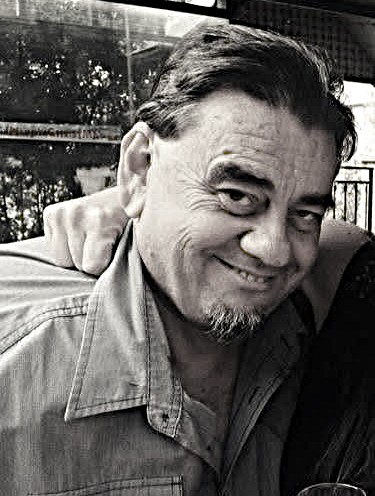
Keith Rhind speaks about the personalities in the boardroom.
John Bateman was a great stickler for procedures. He had been on council, where things are often deferred over and over again. He thought that things should be tabled, discussed, and directors should go away and come back and resolve it the following meeting.
Roger would bring things to meetings, usually on paper, but sometimes supported verbally, but they were always well put together, and well prepared. There were times when he asked for a matter to be treated with some urgency and this did not go down very well with some of the directors. But sometimes it was very important, if a decision needed to be made immediately to save money or secure a business opportunity.
A classic example of this was the purchase of The Mekong Club in Cabramatta.
The Mekong Club had a bad reputation. Its founding chairman, Phuong Ngo, was eventually convicted of masterminding the assassination of local MP John Newman and sentenced to life imprisonment. The club had also been associated with a number of serious licensing breaches, and a shooting had occurred on the steps of the club. Other crime in the area had attracted intense media coverage.
One Friday, Cowan and John Wilson were travelling to a function with John Gould, then with Aristocrat poker machines, and The Mekong Club came up.
John told us that the owner of the building had recently made the decision to sell it and close the club. He said that after paying rent of $350,000, the club’s operating profit was currently about $500,000 per year. The asking price for the building was $1 million.
On the face of it, it seemed like an unbelievable opportunity. But we had to act fast. We phoned from the car to see if it was still available and made an appointment to see the Mekong club manager that same afternoon.
The Mekong’s receivers had already made approaches to about 14 clubs, and Gould said he felt that somebody was sure to grab it in the next few days.
The next morning Cowan sent an email to the directors informing them of the opportunity and giving then some preliminary information. He said management would present a recommendation at the next board meeting, only three days away.
That Saturday night, Cowan and a number of other managers did a tour of clubs in the area and then visited the Mekong club. They became even more excited about the opportunity. The team worked on Sunday to have a report ready for the board meeting the following Tuesday.
Cowan could not recall whether particular responses came from Geoff James or Craig Terry, but remembers the exchange going something like this:
Cowan:
Clubs in that area are amongst the most successful in the state, and they were all busy on Saturday evening. We visited the Mekong Club around midnight, assuming that if there were to be any problems they would be more likely later in the evening. In fact, we were impressed by the customers and by the staff. Our inquiries indicated that there have been no serious behaviour problems there for a long time.
‘f we move quickly, we can buy the premises for $1 million, and the Mekong Club will become a tenant paying $350,000 per annum. The club appears to be well managed, and profits are around $500,000 per annum. We don’t have to commit to amalgamation at this stage, but I want to forecast the likelihood that there will be a recommendation later.
James or Terry:
This is unsatisfactory. We have not been given sufficient notice to make a decision involving $1 million. It should be deferred to the next meeting.
Cowan:
If we can’t make a quick decision, it is almost certain we will miss out. A property investment showing a return of 35% a year is not going to hang around forever. The return could be 85% if we go to the amalgamation. There are other clubs looking at it as we sit here.
James or Terry:
We should have been given more notice.
Cowan (starting to show impatience):
We were not aware of the opportunity until last Friday afternoon.
James or Terry:
It is management incompetence rushing things this way.
Cowan:
You don’t seem to understand. We found the opportunity at 5 pm on Friday afternoon. Since then a team of managers has inspected the club, visited other clubs around it, talked to management and staff, and written a report for the board. It was simply not possible to give any more notice.
Terry:
Well, if we had better relations with the auditors, we would have been told about it sooner. So it’s still management incompetence.
Craig Terry apparently believed that because there had been a connection in the past between Panthers and the company that audited Mekong, Panthers should have known earlier what was happening.
James and Terry both voted against the proposal. The other members of the Footy Five did not join them, and the purchase was approved.
The purchase proceeded, and The Mekong Club subsequently amalgamated with Panthers.1
To receive new Parts and occasional project updates by email, you may subscribe below.
Readers who hold recollections, documents, or material relevant to this history are welcome to contribute via the Commentary & Contributions page.
Project Updates
Receive updates when new parts are published.
The Mekong Club operated as Mekong Panthers from 2001 until 2012. The club (and the building) was then sold to the Mounties Group as part of a broader financial restructuring of the Panthers Group aimed at reducing debt. ↩︎
When Cowan returned to the boardroom on 6 June, the immediate confrontation was over, but the issue that had provoked it remained.
The Board passed a resolution requiring the executive to report on Cowan’s contract.1 The aim was to determine if his package was appropriate, in line with industry benchmark figures, and with companies of a similar size. The exact details were to remain confidential to all but the executive and the auditors — accepting, at least implicitly, the pre-existing confidentiality conditions of Cowan’s contract.
An important point needs to be made here. Members of the Footy Five began to joined the Board of Panthers from late 1995; all departed in late 2002. In those seven or so years, this was the only resolution ever passed on the subject of Cowan’s contract, either in relation to the remuneration itself, or the confidentiality clauses.
For at least three of those years, they had a majority. Yet, they told the Inquiry they only raised it at the second last board meeting they attended as directors.
There was certainly knowledge among directors that Phyro Holdings existed and was associated with Cowan. Evidence presented at the Temby Inquiry was inconsistent with the suggestion, made by some, that there was a knowledge vacuum within the Board around Phyro.
But, to be fair, knowledge that Phyro existed was not necessarily the same as knowledge of the nature and extent of its financial dealings with Panthers. That distinction would later become an important issue in the Temby Inquiry.
A number of meetings followed, between the board executive members themselves, and between Cowan and the executive. The second meeting, was held at the Lone Star restaurant in Penrith. An issue at the Temby Inquiry was whether Geoff James, a member of the Five and the newest member of the board executive had sighted the three Phyro contracts. Keith Rhind maintains they were on the table at the meeting, and Cowan says there is no way that he would attend such a meeting, given its purpose, without presenting all the relevant documents.
Geoff James told the Inquiry that he did not see the contracts. He did admit being told the total figure, at which, according to Rhind, he commented, ‘I thought we would be paying him much more than that’. He also scribbled the figure on one of the documents he had with him.
Temby was unable to resolve the conflicting evidence. After examining the contemporary documents and the recollections of those involved, he said he could not confidently determine whether James had been told of the Phyro agreements, shown copies of them, or both.
Temby also questioned James’ actions in faxing documents relating to the meetings and the executive’s enquiries to John Bateman. James said that when Bateman had called him to ask how everything was going, he had offered to ‘fax him some details’. Various draft copies of the report that the executive was preparing for the board were also faxed.
The written report to the Board on the remuneration package took eighteen months to be presented. . For Cowan, the delay added weight to his belief that the directors had all the information they wanted and, for the most part, must have been satisfied.2
In fact, only one member of the board expressed dissatisfaction at the package. Greg Evans says he felt it was ‘an extraordinarily large amount’, particularly since at the time, there was no mechanism in place for a performance review.
We were trying to make management in general come under the direction of the board, says Evans.
But he asks, how much direction can a board give?
Yes, it should give policy direction, but these days, it should do more. Directors have much more liability now. So they need to take more responsibility for what goes on in the company. A director of a company was put in jail because scaffolding fell down and a worker died.
For management, however, increased Board involvement could itself become a source of frustration. Glenn Matthews says the situation often got beyond frustrating and frequently cost the Club money.
Once we had an opportunity to introduce some kind of equity funding, or quasi equity funding into the group. We wanted to reduce our reliance on debt. We spoke to Westpac, our banker, who said it had a department that could take on such a project. It operated completely independently from the one that held our loans.
The proposal was carefully analysed by the management team and then a recommendation was made to the board. The Board agreed to proceed with a feasibility study at a cost of $60,000. They resolved that providing it all stacked up, we would go ahead. We spent a lot of time, and the $60,000.
The Westpac report was positive. Matthews recalls that it concluded between $20 and $35 million could most likely be raised in a retail bond issue, with minimal risk to the Club. Matthews says it would have been ‘sticking our toe in the water’. If it was successful, it would open the door to other opportunities. They took the report to the board, feeling reasonably optimistic.
The night we presented it, Craig Terry just threw his hands up in the air and said, “What are we doing this for? They’re just fucking junk bonds”.
That was it. They had the majority, of course, and that was the end of it.
No rational questions or debate, just an emotional reaction. The money, time and effort had all been a waste.
The resolution had been passed months before – if it stacks up, go ahead. Now they were asking, “Why are we dealing with Westpac?” That issue had also been dealt with before we spent the money.
And they talked about corporate governance!
That was $60,000 just thrown out the window!
Matthews concluded,
I think that might have been the night I threw the papers at him.3
To receive new Parts and occasional project updates by email, you may subscribe below.
Readers who hold recollections, documents, or material relevant to this history are welcome to contribute via the Commentary & Contributions page.
Project Updates
Receive updates when new parts are published.
Temby records that the Board resolved on 6 June 2000 that the Executive should consider whether Cowan’s contract was relevant to the position, in line with industry benchmark figures and comparable with companies of a similar size. The resolution arose from the governance policy work undertaken following the Kilmister workshops. ↩︎
Temby noted that the Chairman’s report was not presented to the Board until 18 or 19 December 2001, more than eighteen months after it had been requested, adding: “I do not know why so much time went past.” He subsequently described the report as “belated” and “inaccurate”, identifying errors concerning the structure and date of Cowan’s agreements and the provisions governing annual increases. ↩︎
2000 and 2001 should have been years of high optimism for Panthers. The Club had emerged from the tumultuous 1998-99 years without its rugby league team being eliminated from the competition or being forced to merge with Parramatta.
The new NRL competition was underway, and the club was about to complete its first two amalgamations.
But the situation in the boardroom was still tense.
In 1996, Cowan had negotiated a new contract with the Board Executive, which would take him to his planned retirement date of 2006. The same confidentiality over his remuneration arrangements that he had insisted on since 1965 was written into the contract. In 2000, that confidentiality would become another catalyst for conflict.
It would ultimately become one of the major criticisms levelled at Cowan, and a significant issue at the Temby Inquiry. But it was only one element in a Board-management relationship that was becoming increasingly dysfunctional.
During the amalgamation program, there were many important decisions to be made, and a lot of business to be dealt with at Board meetings.
On many occasions decisions were held over to the next meeting, and then another, and another, over what were just petty points. When it takes 12 months to make a relatively straightforward decision that is of ‘real time’ importance to the business, there was evidence of dysfunction. It took that long for the Board to agree on a policy governing amalgamations with other clubs.
I can’t remember any important decision that we needed to make in that period that we didn’t make eventually. But time – and more importantly – opportunities, can be lost.
A push by management to decrease membership fees was an example.
In 2001, Panthers membership was set at $22 a year, but many of the club’s competitors were advertising their fees at around $5.50. There was great concern in the management team that membership numbers at the Penrith site were decreasing.1
There was also confusion over trying to implement a system that would allow the members of amalgamating clubs to continue to pay the lower fees they were paying before amalgamating, but without breaching the 50% regulation.2
Having one lower membership fee right across the group was felt to be a good solution. It could also be used to push a more aggressive membership drive. It took well over a year – and some drastic measures – for the Board to agree to a reduction in fees.
Beyond the Book: The membership issue was considerably more complicated than the fee reduction alone suggests. Amalgamation had created questions about membership categories, voting rights and representation within the expanding Panthers Group. Read: Why Cutting the Membership Fee Wasn’t So Simple.
We eventually did get the fee down to $8.80, but it was a very complicated process.
In the meantime, our market was diminishing, and everyone knows that lost market share is not easy to recover. Once it was done, I think we increased the membership at Penrith by about 15,000. There were obvious benefits to our business, and the reasons they came up with for the delays were just not logical.
At one stage one of the Five came out and said that management wanted to lower the fees to get more members so we could get rid of those directors.
The membership fee deadlock was broken using tactics that would never have been considered in the open environment of the old Panthers. It demonstrated how confrontational life in the boardroom had become by July 2002. In the week leading up to a home game, Cowan asked Rob Weaver, the club’s media manager, to prepare a press release. A Board meeting was scheduled for the morning before the game3.
The release was very strongly worded, and it spelt out the situation in detail. In part, it read:
“Five out of the nine directors have shown that they care more about their seats on the Board than they do about our members and the focus of our organisation. It brings a new meaning to the phrase ‘bums on seats’, Mr Cowan said. “I will not stand by and watch them destroy what previous boards and managers have built, which is why I am going public to let members know what is going on.”
Cowan took the document to the meeting, held it up and told the Board part of what it said. He told them that Rob Weaver was already at the football ground. He had 30 copies of the release in his briefcase, and it would be handed out to every journalist at the game unless they agreed to the new fee. They demanded that Cowan show them the release, but he refused.
Rob Weaver recalls that day:
I was sitting in the media box in the western grandstand with a briefcase full of press releases, watching the board box on the other side of the ground through binoculars. As soon as I saw Roger arrive, I was to call him for instructions.
But he called and said they had agreed to reduce the fees.
To receive new Parts and occasional project updates by email, you may subscribe below.
Readers who hold recollections, documents, or material relevant to this history are welcome to contribute via the Commentary & Contributions page.
Project Updates
Receive updates when new parts are published.
There was also concern about members in regional areas being resistant to any increases. This was expressed strongly at regular meetings of venue General Managers. ↩︎
Section 30(9)(a) of the Registered Clubs Act required a “majority” of the clubs full members must be eligible to vote for the Board. Social Members were legally classed as a subclass of Ordinary Members and therefor were included as “full members”. In 2006 the ratio was reduced to 25% provided this was approved by a majority of full members. ↩︎
The game was Penrith v Melbourne which Penrith won 36-16. ↩︎
Greg Evans was a prominent Penrith businessman, newspaper proprietor, local councillor and Panthers director who became one of the central figures in the Board conflicts of the late 1990s and early 2000s.
Already well known within the Penrith community when he joined the Panthers Board in 1997, Evans became increasingly involved in disagreements over the future of the football club, the respective roles of the Board and management, and the exercise of authority within Panthers. On these and other issues, he increasingly found himself in opposition to Roger Cowan and eventually became one of the five directors who were known as the “Footy Five”.
His significance to the story, however, extends beyond that label. Evans’ business and civic standing, his ownership of The Western Weekender, and his strongly held views about the respective authority of the Board and management gave him an unusually influential position during one of the most divisive periods in Panthers history.
Role in the Narrative
Greg Evans enters the narrative during a period of considerable change on the Panthers Board.
Greg Evans joined the Panthers Board in 1997 after having previously stood unsuccessfully for election. His arrival was part of a period of unusual turnover on the Panthers Board, during which Craig Terry and Denis Coffey also joined.
Evans, Terry and Coffey subsequently became aligned with existing directors Geoff James and John Bateman. Ian Temby later described the emerging group as being determined to make management accountable. From Roger’s perspective, they increasingly represented an opposition to management.
Evans was instrumental in developing division.
He features prominently in the debate surrounding Panthers’ survival as a stand-alone NRL club in 1999, in the later disputes over the respective authority of the Board and management, the cancelled 2002 election and in the events that ultimately developed into the Board wars.
He was subsequently identified as one of the “Footy Five”, alongside John Bateman, Craig Terry, Geoff James and Denis Coffey.
Background
Evans had established a substantial business and community profile well before joining the Panthers Board.
Beginning his career as an analyst programmer, he moved into business management and became involved in computer distribution. After purchasing and operating a computer company, he took over the distribution business of a failed multinational supplier at the invitation of Apple Computer Inc. A later account of his career records that within two years the business had become Apple Australia’s largest distributor.
In 1991 he founded The Western Weekender.
Evans believed Penrith was often unfairly portrayed by the metropolitan media and saw an opportunity to establish a newspaper presenting the district from a local perspective. Under his ownership the Weekender developed into a significant independent local newspaper. Evans remained its owner and Chairman until 2008.
His media interests later extended to other publications and, briefly, local radio through Kick FM. He also owned the Sydney Spirit basketball team.
Evans was also active in civic and economic affairs. He served for nine years as a Penrith City Councillor, chaired the Penrith Economic Development Board for many years and served on a number of other local and regional bodies, including the University of Western Sydney and Western Sydney Institute of TAFE. He was also appointed to the Greater Western Sydney Economic Development Board.
By the time he joined Panthers, therefore, Evans was already a substantial figure within the Penrith community, with business, political, economic development and media experience.
Leadership and Culture
Matthews has consistently acknowledged Roger Cowan as the greatest influence on his development as a leader.
Working alongside Cowan during Panthers’ formative years exposed him to a management philosophy built upon trust, accountability and personal responsibility. Matthews has often recalled the lessons he learnt about treating people with respect, empowering staff to make decisions and responding to mistakes with honesty rather than blame.
One incident early in his career, when he admitted to a significant financial forecasting error, became a defining leadership lesson. Rather than reacting with anger, Cowan focused on solving the problem—an approach Matthews later identified as fundamental in shaping his own leadership style.
Those experiences would later influence Matthews’ own approach to leadership as he assumed increasingly senior responsibilities within the organisation.
Relevance to Events Described
One of Evans’ most important appearances in Panthers, Passion & Politics comes during the debate over Panthers’ future in the rapidly contracting NRL competition.
On 31 July 1999, the Board considered whether to sign a non-binding letter indicating that Panthers was prepared to investigate a possible joint venture with Parramatta. The proposal was intended to preserve an alternative while Panthers continued its efforts to survive as a stand-alone club.
Evans strongly opposed signing it.
He later explained his reasoning:
I really believed that signing that letter was signing to merge with Parramatta.
Despite the document being expressly non-binding, Evans believed that once Panthers entered the process the pressures being applied by the NRL would make amalgamation inevitable.
His position provides an important insight into the disagreement.
All of the directors wanted Panthers to survive as a stand-alone club. The division was over whether prudent planning required investigating alternatives in case that objective could not be achieved.
Evans genuinely appears to have believed that investigating the Parramatta option was itself an unacceptable risk. Others, including Roger, believed refusing even to investigate alternatives could place Panthers’ survival at greater risk.
The disagreement between Evans and Cowan, however, extended well beyond the merger question.
A deeper difference concerned the relationship between the Board and management and where operational authority should reside.
That difference became particularly evident during the crisis surrounding coach Royce Simmons in 2001. When Roger proposed returning responsibility for appointing and dismissing the football coach to management, Evans was vehemently opposed. The Board ultimately authorised Roger to deal with the matter, Simmons was dismissed and Evans resigned from the Board. He subsequently returned.
Evans later described the broader disagreement as an attempt by the group of five directors to get Roger to:
… come under the direction of the board, and to work within the parameters that they set.
Roger saw the governance issue differently. He believed the Board had an essential oversight role but that management needed sufficient authority to manage the organisation and remain accountable for the results.
The distinction was fundamental.
Both sides could argue for accountability and good governance while holding substantially different views about how those principles should operate in practice.
By 2002 Evans was firmly associated with the group that became known publicly as the “Footy Five”. The label would become an important feature of the Board election and subsequently of the way the conflict was remembered.
As explored elsewhere in this project, however, the name simplified a considerably more complicated history. The five directors did not begin as a formal group bearing that name, nor were they necessarily united on every issue. John Bateman later maintained that any real unison among the five developed much later, particularly during the licensed club amalgamation disputes of 2002.
The Publisher and the Director
Evans occupied another position that distinguished him from the other protagonists in the Board conflict: he was simultaneously a Panthers director and proprietor of one of Penrith’s most influential local newspapers.
The Western Weekender reported extensively on Panthers during a period when internal Board disputes were increasingly becoming public.
Roger became deeply concerned about confidential Board information finding its way into the media and believed the Weekender sometimes appeared to know of internal developments before management.
Evans’ dual roles inevitably complicated perceptions surrounding both the Board conflict and its public reporting.
The available material establishes Evans’ ownership of the newspaper and his role in setting its policy direction. It does not, by itself, establish the extent to which he personally influenced individual stories concerning Panthers.1
Nevertheless, the combination was unusual. Evans was simultaneously participating in an increasingly bitter governance dispute inside one of Penrith’s most important institutions while owning an influential newspaper reporting those events to the wider community.
Legacy
Greg Evans died in July 2025.
The tributes published following his death reflected a life and career extending well beyond the Panthers Board wars. He was remembered as a businessman, newspaper founder, councillor, community contributor and a significant figure in the civic and commercial life of Penrith.
The Western Weekender, which he founded in 1991, remains perhaps his most visible contribution to the district.
The tributes also demonstrated how strongly one interpretation of the Panthers conflict had become embedded in local memory.
Evans was remembered as one of the Footy Five who had prevented Panthers from being amalgamated with Parramatta. One obituary described him as a key figure in ensuring Panthers remained a stand-alone NRL club, while another tribute credited him with helping block a concerted drive for merger.
The events described in Panthers, Passion & Politics reveal a more complicated picture.
There was no Board proposal in July 1999 to amalgamate Panthers with Parramatta. There was a proposal to investigate an alternative while continuing the fight to remain independent. Evans sincerely believed taking that step would ultimately lead to merger. Others believed keeping the alternative available was prudent protection against the possibility that Panthers might otherwise be excluded from the NRL.
That distinction does not diminish Evans’ commitment to the football club. Rather, it helps explain the strength of his position.
Nor does the merger debate alone define his importance to this story.
Greg Evans was an independently successful businessman, publisher and civic figure who became a significant participant in the divisions that developed within the Panthers Board. His approach to the future of the football club, the respective roles of the Board and management, and the exercise of authority within Panthers increasingly brought him into conflict with Roger Cowan.
His role is therefore important not simply because he became one of the Footy Five, but because understanding Evans helps explain the very different perspectives from which the Panthers Board Wars developed.
To receive new Parts and occasional project updates by email, you may subscribe below.
Readers who hold recollections, documents, or material relevant to this history are welcome to contribute via the Commentary & Contributions page.
Project Updates
Receive updates when new parts are published.
Editorial Note
This profile is presented as contextual background. Additional material may be introduced as the narrative progresses.
The fact that the managing editor of the Western Weekender remians unamed throughout Panthers, Passion & Politics, demonstrates Jennie Bentley’s view of who was driving editorial policy on the Panthers issues during the Panthers conflict and throughout the Temby Inquiry. ↩︎
John Bateman, a Penrith solicitor, joined the board in 1995. He had previously stood unsuccessfully for the Board and his patience was rewarded when a vacancy occurred between elections. He was a local councillor. The Board considered he would be a valuable addition to the expertise available on the Board.
Around three years later, another seat became available on the Board, and Greg Evans was also invited to join. He owns a local newspaper, the Western Weekender. He had also served on council. He had stood for the Board two years in a row and had been unsuccessful. He confided in Barry Walsh, then a member of the Board Executive, that he could not afford to fail a third time. Walsh advised him that there was a vacancy coming up and that the Board would probably invite him to fill that.
So, a solicitor and a local businessman had been invited to fill vacancies on the Board – both experienced in local government – should have strengthened the board. Both were also sponsors of the rugby league team, and so were well known to the club management.
Four of the directors who became the Footy Five were actually invited to join, rather than securing their seats through a members’ vote. Craig Terry and Dennis Coffey joined In the latter part of 1998 and early 1998. Terry’s credentials were in accountancy and it was thought he would be a suitable replacement for the retiring Leigh Mawhood, also an accountant. Terry, too, had also stood unsuccessfully for the Board a couple of times.
The 90s saw Merv Cartwright back on the board after a hiatus of many years. Some of Cartwright’s history with the club is already documented, including the cancellation of his membership. When his sons began playing for the Panthers, he wrote letters to the Board asking that his membership be reinstated. He gave a written undertaking that he had no interest in becoming a director, and would not take any part in club politics.
The Board relented, and Cartwright was a member again. Soon after readmission he stood for the Board on a platform that criticised Cowan. When he eventually decided to stand down, he pushed for his son-in-law, Dennis Coffey, as his replacement.
Coffey is an ex-rugby league player for Penrith, and founder of Coffey Engineering, a successful Penrith-based industrial engineering company. He was a popular choice with all board members to fill the vacancy. Cartwright’s son John, one of the players in the 1991 premiership winning team, had married Dennis Coffey’s daughter.
Geoff James had been a director for several years as part of what had been a reasonably cohesive and productive board. James had a friendly relationship with chairman Leo Armstrong. They had been next door neighbours for many years and used to look after each other’s homes if one was away.
When Craig Terry arrived, he and James quickly established a good rapport. Cowan and the other managers came to believe an alliance was forming between them and Bateman, Coffey, and Evans. From that time, the dynamic on the board totally changed.
The situation in the boardroom began to deteriorate to become what has been described as ‘horrific’.
There is a lot of evidence of Cowan’s efforts – through Board management seminars, recommendations to Board meetings, and the employment of consultants to get the Board to clarify what it wanted from him and the management team.
Greg Evans says that members of the alliance of five were trying to get Cowan to ‘come under the direction of the board, and to work within the parameters that they set’.
He denies there was a hidden agenda, but says,
He’d been the boss for so many years, and things were going OK. Boards got used to going along with him. He always felt that his way was the right way; he just wanted to get things done. Any questioning by the board was just a nuisance, so he used to get impatient.
But Evans does not identify any of the ‘parameters’ that the Board wished to impose. The real problem was that the main protagonists in this drama saw their role – and the others’ – very differently.
It was a clash in values that caused me to walk out of a meeting in June 2000. I was angry that people saw nothing wrong with breaking a contract when it suited them.
I could not understand how they could even consider reneging on the amalgamation deal with Newcastle. It took more than a year to get the Board to make a decision about amalgamations. It is true that I used to get impatient. How can it take 12 months to make a simple decision about amalgamating with another small club? I could see great advantages for Panthers and I wanted to get started.
While we were talking around in circles we failed to take advantage of an opportunity to amalgamate with Kingswood Bowling Club and Eastern Suburbs snapped it up. Panthers’ management could see some big potential for that club but it was almost impossible to get the Board to look at proposals rationally and objectively.
Management and Board both have an important job to do. If I do a bad job, then the Board has to step in, but there has to be a line between Board and management, and that applies in any business.
I always insisted from the moment I started on that three month trial in 1965 that I would be totally in charge of all staff matters, all the hiring, firing, and all the discipline. It would be my responsibility. The Board was not to interfere in any of it. And they agreed with that.
It ultimately evolved into a strong part of the Panthers culture. As long as staff matters were my responsibility, I was able to oversee the day-to-day running of the place. I do know of some other clubs where board members interview and employ staff. They are even able to fire them.
In that kind of environment, the sailors are not taking their orders from the captain of the ship. They’re being told what to do by the owners of the shipping line.
Roger Cowan says the culture of an organisation is what sets it apart, and to be effective, it must be strong at all levels – from the chairman, all the way through to casual employees.
People have to know where they stand and feel good about the contribution they are making. He and most of the other managers were disappointed that the strong culture that had been built over many years was being eroded.
The problems in Panthers’ boardroom were exacerbated by the rugby league merger issue. Rumour had abounded about Cowan’s alleged plan to merge with Parramatta. Claims in Ray Hadley’s radio show that it was a ‘done deal’ added to the tension. Alliances that were initially tenuous now became solid.
The time was now right, says Cowan, and the group – Bateman, Coffey, Evans and Terry – made their move to unseat the chairman, Leo Armstrong.
Leo had been chairman for 14 years and was generally acknowledged as a fine figurehead for Panthers. He was respected and admired by the other directors and by management and staff. He was popular with the members and the general public, who recognised him from public appearances, and as the person who often presented cheques to community organisations on behalf of the club.
Leo often became quite angry with Bateman in Board meetings. But removing Leo was a problem for the Bateman camp. He had the support of four directors, and with his own vote could hold his position. They would need to shift the balance.
When Geoff James accepted the dangled carrot of the deputy chairman’s job, the die was cast.
Somehow the group managed to convince Geoff James to move against the chairman. Once Armstrong was removed from the chair, James moved into the position of Junior Deputy Chairman.1
Becoming a deputy chairman would automatically elevate him to the Board Executive. More importantly, even though many executive matters were supposed to be confidential, his appointment could open new doors for the alliance, and thus give it an added measure of power.
James would later admit faxing confidential executive material to John Bateman –an action questioned by Ian Temby in the Inquiry.
Once they knew that the alliance was solid, Bateman made his move. He first approached Keith Rhind, a deputy chairman at the time, telling him the Leo Armstrong was to be removed as chairman, and asking Rhind to take over the chair. Rhind refused the offer.
Bateman then went to deputy chairman Barry Walsh, making the same offer. Armstrong was going whatever happened, Bateman said. If Walsh also refused the chairman’s job, Bateman would take it himself.
Walsh, like Rhind, was a loyal Armstrong supporter. It was a terrible decision to have to make. Walsh opted for the lesser of the two evils and agreed to stand.
Preferring to avoid the ignominy of being voted out, Armstrong stood down. Cowan says he was bitterly disappointed to learn that his trusted neighbour had turned against him.
Cowan has some theories as to the motives of the group in putting Walsh in the chair instead of Bateman, who would be the logical choice.
They may have wanted to avoid the impression of a coup if both Armstrong and Walsh were deposed in one hit. Both were well known in the community, and popular with members, supporters, staff and management.
Also, there was the friendship between Barry and Bateman. Barry was godfather to one of Bateman’s children. Maybe Bateman hoped that that friendship would give his faction another supporter. I suspected it was just an interim measure.
Walsh stepped into the chair, but in many ways, he lacked the power of the position. In a very telling comment in the 41X inquiry, he told Department of Gaming & Racing (DGR) counsel Vickie Hartstein, ‘I never had control of the Board’.
The five had the numbers, and they used them.
Panthers’ group CEO Glenn Matthews described the board meetings as dysfunctional.
It often seemed that some of the Footy Five were being deliberately obstructive. They’d ask you for the same information again and again. Meetings usually went on till after midnight. I used to cop personal abuse all the time. Many times, I was called names, frequently a liar, in Board meetings. Often, we had the most trivial things to be approved by the Board, and they questioned every single item. Yet I can remember one night when they voted to spend over $100,000 on a player in some deal. There was no rhyme or reason. It was a nightmare.’
One night Craig Terry’s usual barrage of illogical, petty comments and accusations got the better of me. I became totally frustrated and in anger I hurled the papers I was holding in his direction. Later I was with John Wilson as we waited for the meeting to finish. I was regretful about losing my cool and I said to John, “I’m in for trouble when the boss gets out of the meeting. He is not going to like what I just did.”
One night Craig Terry’s usual barrage of illogical, petty comments and accusations got the better of me. I became totally frustrated and in anger I hurled the papers I was holding in his direction. Later I was with John Wilson as we waited for the meeting to finish. I was regretful about losing my cool and I said to John, “I’m in for trouble when the boss gets out of the meeting. He is not going to like what I just did.”
The meeting broke up and Roger came over to us. He said,
“Glenn, next time you throw something at Craig Terry make sure it is heavier than paper and make sure you aim better.”
We all laughed, and I was off the hook.
To receive new Parts and occasional project updates by email, you may subscribe below.
Readers who hold recollections, documents, or material relevant to this history are welcome to contribute via the Commentary & Contributions page.
Project Updates
Receive updates when new parts are published.
The Temby Inquiry records that in 1999 Leo Armstrong was replaced as Chairman by Barry Walsh and Geoff James became a member of the Board Executive. Temby noted that, according to Roger Cowan, these changes had been engineered by the group Cowan saw as opposed to him and had caused Armstrong “bitter disappointment”. See Ian Temby QC, Penrith Rugby League Club Inquiry: The Report, Chapter 2, “A Power Struggle”, p. 8. ↩︎
Early in 2001 the Board approved Mark Levy’s recommendation that Royce Simmons be re-signed for a further two years. The decision ultimately led to his departure in a way that, to Cowan, was both regrettable and unnecessary.
Royce Simmons was an icon in Penrith. He had come from the country as a young player and had shown enormous commitment to the club for close to twenty years. He was – justifiably – looked upon as one of the heroes of the Panthers’ 1991 Grand Final win. He was extremely popular with sponsors and supporters.
Levy approached the board in early 2001, saying that Simmons believed that some high-profile players would not sign new contracts until they knew Simmons’ contract had been extended. Cowan remembers there was mixed reaction from the Board. Significantly, the five directors who so often voted together were themselves divided on the issue.
Cowan believed the mechanisms that had previously allowed for detailed discussion and analysis were no longer operating in the same way, making the situation even more difficult. Most importantly, it had to be handled carefully. Because of Simmons’ popularity, if word leaked that the board was reluctant to extend his contract, a strong backlash was likely.
He had been quite successful as a coach, which increased the pressure. Although the club had been badly damaged by the Super League wars, Simmons had taken the team to the finals in 1997 and again in 2000. In 2000, the club had also broken records for attendance and sponsorship.
Taking all this into account, the Board agreed with Levy’s proposal and signed the two year contract. Cowan says the 2001 season was a disaster.
The team was not just losing; it was barely competitive in many games. It finished the season in last place. In Royce’s defence, he had been at the club for a very long time compared with the usual coaching careers. A rigid salary cap had prevented the club from adding any new players to the team. However, we still had a good solid base from the previous year, and we had faced the new season with high hopes.
But it does not work that way in rugby league. Having no new blood served to dampen the morale and enthusiasm of the coach, the staff, and the team. The continual losses hit Royce particularly hard. They sapped his confidence, which didn’t help the situation. By the middle of the season, it was obvious that we were in trouble.
In my own mind I was trying to work out how we could overcome the problem at the end of the year. Royce had a two-year contract, and the decision-making processes of the club were basically in the hands of five directors.
By the second half of the season, Cowan had reached the view that the only way to restore spirit to the team was to replace the coach and several members of the football staff.
He could see no value in making drastic changes halfway through the season. It was his plan to spend the remainder of the season collecting as much information as possible, and to work with some trusted staff to try to analyse the problems and come up with solutions.
Had things been different, part of the process would have been consultations with the Board, but he says that by this time, breaches of confidentiality were a fact of life at that level. The last thing the coach and team needed was to have their problems publicly debated in newspapers, and on television and radio. Cowan adds that it often seemed that Ron Mulock and the WesternWeekender knew things before he did.
Around the same time, and unbeknown to the rest of the Board, Dennis Coffey and John Bateman were meeting privately with some senior Panthers players. They later said that players had expressed dissatisfaction with the coach during those meetings.
To Cowan, the meetings presented a serious governance problem. He believed concerns of that significance should have been brought back to the full Board and management rather than pursued independently by individual directors. This was particularly difficult for him to reconcile with Bateman’s frequently expressed concerns about corporate governance.
It was also extremely naïve to think that the meetings would remain secret.1
Soon there was a blaze of publicity. Instead of being handled with discretion and objectivity, Simmons’ future became an emotional public issue that further undermined his position.There were divisions among sponsors and fans. The players, already suffering because of the bad season, were caught in the crossfire.
Cowan says he backed away from making a recommendation but suggested that they consider moving back to the old system, where the responsibility for hiring and firing rested with management.
Greg Evans was vehemently opposed to handing back this power. I was equally obstinate, believing that it was the only way to fix the problem without causing more conflict in the community.
Finally, the Board agreed that Cowan should handle the matter, effectively returning responsibility for the coaching decision to management. Royce Simmons was sacked as coach, to be followed soon after by most of the coaching staff.
As a result, Greg Evans resigned from the Board, to be reinstated about six months later.
Substantial changes followed within the rugby league operation. John Lang was appointed coach, and two seasons later Penrith won its second premiership.
Cowan reflects on the problem:
The phenomenon of coaches reaching a year of failure is not unusual. It is not because a good coach suddenly becomes a bad coach. Had Royce Simmons left Panthers one year earlier, he would have left on a very high note. He gave much to the club over many years. As a coach he was virtually a workaholic and would probably have cheerfully donated his right arm in return for a successful Panthers team. The way he left was sad and did not do justice to his service with the club. What is even more sad is that it could have been avoided.
Recognition should also be accorded to many others from that era, including Mark Levy and all of Royce’s coaching and support staff. Unfortunately, timing in these matters is all-important – a club full of heroes at the end of 2000 and most of them sacked by the end of 2001.
To receive new Parts and occasional project updates by email, you may subscribe below.
Readers who hold recollections, documents, or material relevant to this history are welcome to contribute via the Commentary & Contributions page.
Project Updates
Receive updates when new parts are published.
Max Cowan recalls speaking to some players about what was happening. “Some were furious that other players were, as they saw it, putting the skids under Royce; others were despondent at the prospect of continuing with him as coach. It seemed clear to me that Bateman and Coffey had unwittingly undermined the coach and added to the instability of the team. ↩︎
Solicitor; Penrith City Councillor and Mayor; Panthers Director; Member of the “Footy Five”
John Bateman was a highly prominent public figure in Penrith during the 1990s and early 2000s. A respected solicitor, local government leader and long-serving councillor, he combined legal expertise with extensive community and political experience. His appointment to the Panthers Board reflected both his professional standing and the growing stature of Panthers as one of Western Sydney’s largest and most influential organisations.
Within Panthers, Passion & Politics, Bateman emerges as one of the principal figures in the governance conflicts that reshaped the organisation during the closing years of Roger Cowan’s administration. Initially appointed to strengthen the Board, he later became one of the leading advocates of an alternative direction for Panthers during the Super League era, the merger debates and the internal disputes that followed.
Role in the Narrative
John Bateman’s involvement in the narrative spans much of the conflict that dominates the latter half of Panthers, Passion & Politics.
Appointed to the Panthers Board in the mid-1990s, he entered the organisation at a time when Panthers had grown from a successful licensed club into one of the largest community organisations in New South Wales. Board membership had become both influential and prestigious, attracting individuals whose professional experience and public standing could contribute to the increasingly complex governance of the organisation
Bateman quickly became an influential director. During the Super League conflict and the subsequent National Rugby League rationalisation process, he emerged as one of the strongest advocates for Panthers pursuing a stand-alone future rather than preparing contingency plans involving merger discussions. He became closely associated with the group of directors later known as the “Footy Five.”
As disagreements between management and sections of the Board intensified, Bateman became one of the central figures in debates surrounding merger negotiations, governance, Board authority and the future direction of Panthers — in particular the governance arrangements associated with Panthers’ club amalgamations. He was a prominent witness in the Temby Inquiry and he categorically denies playing any part in its calling. Bateman in one of the most significant individuals in the later chapters of this story.
Background
Profession: Solicitor
John Bateman established a legal practice in Penrith that became one of the region’s best-known firms. Admitted as a solicitor of the Supreme Court of New South Wales, he built a reputation in both legal practice and community leadership, later becoming a founding partner of Bateman Battersby Lawyers.
Community Leadership:
Bateman’s public life extended well beyond the legal profession. He served for many years as a Penrith City Councillor, Deputy Mayor (1997–98) and Mayor of Penrith (1998–2000), leading the city during preparations for and staging of the Sydney 2000 Olympic Games, when Penrith hosted rowing and canoe/kayak events.
His community involvement also included service with the Nepean Medical Research Foundation, the Penrith Valley Economic Development Corporation, the Joan Sutherland Performing Arts Centre, the Penrith Olympic Torch Relay Committee and numerous sporting and community organisations. He also served on the boards of Panthers, Penrith Rugby Club and the Western Sydney Academy of Sport, reflecting his long-standing commitment to the Penrith region.
Honours: • Australian Sports Medal (2000) • Centenary Medal (2001) • Penrith Citizen of the Year (2008) • Medal of the Order of Australia (OAM) (2018) • Western Sydney University Community Fellow (2019) • Honoured Citizen of the City of Penrith (2022)
Appointment to the Panthers Board of Directors:
By the mid-1990s Panthers had become the largest licensed club in New South Wales, one of the largest employers in Western Sydney and one of the region’s most influential organisations. An appointment to the Panthers Board had become one of the most prestigious voluntary positions in the Penrith region, reflecting the organisation’s extraordinary growth and influence.
Bateman was appointed to fill a casual vacancy on the Panthers Board rather than being elected by members. Board appointments increasingly reflected the need for professional expertise alongside traditional community representation. His appointment reflected the confidence directors placed in his legal expertise, political experience and public profile. He also had longstanding interests in sport and established relationships with several existing directors.
Bateman therefore arrived at Panthers not as an unknown community volunteer, but as one of the region’s best-known civic and professional leaders. The Board regarded his appointment as strengthening its capacity to deal with the increasingly complex strategic challenges confronting Panthers.
John Bateman was appointed because he was exactly the sort of director Panthers needed — and the appointment was exactly the sort of position Bateman desired.
Relevance to Events Described
John Bateman’s importance to Panthers, Passion & Politics lies not simply in the positions he held, but in the influence he exercised during one of the most turbulent periods in the club’s history.
During the Super League conflict he became a leading advocate for the view that Panthers should focus on remaining an independent club rather than pursue merger negotiations with another organisation. Although management regarded merger discussions as prudent contingency planning in response to an uncertain future, Bateman believed that even a non-binding declaration of intent could ultimately place Panthers on a path towards losing its independence.
His position reflected a fundamentally different assessment of the risks facing the club.
As the governance conflict deepened, Bateman became one of the most influential members of the group that became known as the “Footy Five.” Together they challenged aspects of the existing governance structure and increasingly opposed Roger Cowan’s leadership on several major issues.
Roger Cowan initially regarded Bateman as a valuable addition to the Board. Over time, however, their relationship deteriorated as their views on governance, strategic planning and the future direction of Panthers diverged. In later reflections Cowan came to believe that Bateman’s growing public profile and political ambitions influenced some of his decisions within Panthers. That interpretation forms part of Cowan’s perspective presented throughout this work rather than an established historical fact.
Bateman was also a key player in disputes centred on the governance of clubs amalgamating with Panthers and the subsequent Temby Inquiry making him one of the most consequential participants in the latter stages of the narrative.
Legacy
John Bateman’s contribution to Penrith extends beyond his involvement with Panthers. As a solicitor, councillor and Mayor, he played an important role in the civic development of the city and was widely recognised for his commitment to the local community.
Within Panthers, however, his legacy is inseparable from one of the organisation’s most divisive periods.
Some sections of the Penrith community regarded him as an independent director prepared to challenge existing leadership and defend the club’s independence during an uncertain period for rugby league. Others saw him as one of the principal figures behind governance disputes that consumed the organisation during the closing years of Roger Cowan’s administration.
Whatever view readers ultimately take, John Bateman’s influence on the events described in Panthers, Passion & Politics was substantial. His decisions, alliances and leadership helped shape the governance conflicts that defined a critical chapter in Panthers’ history.
Sources used to prepare this profile: Advocacy Australia Website; Bateman Battersby Website;
Few Board decisions carried greater significance than the one made late in July 1999. Panthers’ place in the national competition may have depended upon it. It was life or death in rugby league, says Cowan
Panthers losing its place in the NRL competition would have been a disaster, yet here we have a board refusing to talk about it, and refusing to sign something that would have given the club more time.
Sometimes I would have daydreams about the Footy Five attitude1. I imagined them deciding to dive into a pool from the high tower. They would climb to the top, look down and discover that all the water had drained out of the pool. This was new information. But they had already made a decision, and why would they change it just because of new information? So they had dived anyway. As they plummeted downwards, they were studying a book entitled Corporate Governance. It was open at the chapter about considering all the available information and making decisions in the best interests of the organisation.
There was only one downside to signing that letter. Extending the deadline would have allowed the media to continue its speculations, and this, in turn, would have continued to foster divisions in community attitude.
If it had been signed, it is certain that the subject would have been raised again in Penrith Council, perhaps with some questions to Bateman and aspiring councillor Evans, who had previously served and was known to many on council.2
If it had been signed, there would have been no Footy Five campaign, no full-page ads from Ron Mulock attacking Cowan and the other four directors. And there would never have been what Cowan regarded as the biggest myth of all — that the Footy Five and Mulock had saved the Panthers.
There would never have been a ‘Board Wars’ story on the front-page of the Western Weekender. And the Footy Five may never have lost their seats on the Board.
Panthers Board, management, and staff – including the Five themselves – would have avoided much pain.
It is also likely that Panthers would have been spared the enormous costs – in money, time, spirit and lost business – of the Temby inquiry. The NSW government might have been spared a useless exercise which cost it millions of dollars, and the respect of the club industry.
It never occurred to Cowan that there could have been any misunderstanding about the non-binding nature of the document.
Despite all the encouragement I had given the management team trying to have open minds and think creatively, and my own understanding of the powerful impact paradigms can have, it never entered my mind that anyone could fail to understand. I tried so hard to explain it. The document itself seemed so plain.
In September 1999, Ron Mulock sought to publish a full-page advertisement in two local newspapers. It supported his position on the merger situation and was highly critical of Cowan. The Penrith Press declined to run the ad, saying they considered it defamatory. The Western Weekender ran it.
The ad described a document that had ‘fallen off the back of a truck’ to come into his hands. It was a copy of the letter to NRL chairman Malcolm Noad, signed by Denis Fitzgerald – and with a space for Roger Cowan’s signature. The Mulock ad quotes from the document:
‘This submission creates no obligation on our clubs to conclude the joint venture’.
The ad also noted the document to be confidential.
Editor’s Note:Following the Board’s July 1999 decision, the merger issue unexpectedly returned to public debate — the full-page advertisment mentioned here was not what sparked the return, three weeks earlier a press release lit the fire. The Historical Context article — Resurrecting the Merger Debate— examines the exchange of letters and public statements between Roger Cowan and Ron Mulock and links to the Digital Archive containing the original documents.
So, how did this confidential document get from the Panthers boardroom into his hands?
Greg Evans told the Inquiry there had been a split in the Board between those who didn’t want to merge at any cost, and those that were willing to accept the merger. Ian Temby asked if ‘the former group would have rather seen the Panthers cease to compete in the top competition than merge?’
Evans answers: ‘I can’t speak for them, but I probably would have.’
Yet the theme that resounds through Evans’ evidence is his passion for rugby league. This, he claims, first prompted him to stand for the board, and to lobby board members when vacancies became available. Yet his evidence appears difficult to reconcile with that passion. He told the Inquiry he would probably have preferred Panthers to leave the competition rather than merge to ensure top grade games continues to be played by a Panthers team at Penrith Stadium.
Mulock’s attack in the Weekender initiated the myth of the Footy Five, as Cowan explains:
He divided the Board into two groups and labelled one group the Footy Five. He was claiming the high ground for them, saying it was they who would save the club. He denigrated the three directors who had voted in favour of signing the non-binding letter.
So the very concept of a Footy Five, from the first day it was invented, was a total misconception. I call it Mulock’s myth.
As for his other claims, there was no split on the Board about retaining our identity in rugby league. Chairman Barry Walsh has said many times, there was no vote on a merger. The only vote was about signing a non-binding letter.
What did Evans have in mind when he told the inquiry that there were some directors willing to accept a merger? Did he really believe something for which there is no evidence anywhere, or was he just having difficulty in breaking out of his paradigms?
A myth that Cowan had signed the letter grew in the wake of Mulock’s attack, linked to claims he wanted a merger and that Cowan was anti-rugby-league.
Roy Masters disagrees.
I saw that letter, and it was signed by one person, and it was not Roger Cowan. I don’t know how hard he pushed it, but he didn’t push it so far that he signed that document.
The claims by Mick Kelly and others that Ron Mulock and/or the Footy Five had saved the Panthers from extinction are not borne out by the events of the time. The dogmatic stance taken by the Five could easily have spelled the end for the Panthers team.
North Sydney’s misfortunes during 1999 ultimately played a decisive role in saving Penrith. Norths’ stadium on the Central Coast was supposed to open for the 1999 season, but it rained in Gosford almost non-stop for months. The club had vacated its home ground at North Sydney oval, so all its home games had to be played as away games. What should have been a bumper season became a financial disaster for them.
It had been a well-kept secret that North Sydney had financial problems. Towards the end of the 1999 Season, they announced they were going into receivership, and thus had no chance of competing in the NRL on their own. The club formed a joint venture with Manly, and Penrith moved into 14th position. That day, for the first time, Penrith became assured of its place. For some months Cowan had been aware that Norths’ misfortune was helping to close the gap for Penrith. It was a tight tussle on the criteria ladder.
Cowan remained apprehensive right up until the final decision that ensured Panthers’ place in the fourteen-team competition. Three possibilities worried him. Firstly, Norths could – and probably would – finish in front of Penrith on the criteria score. Secondly, even if Penrith was only slightly ahead, grants of $20 million by two governments — given the political push to have a team at Gosford – might have somehow been included in the formula to push the advantage back to Norths. Finally, if Norths merged with Souths it would create an entirely new entity to take the 14th spot.
Each of those possibilities would have been the end of Panthers.
Cowan finally breathed a sigh of relief when Norths chose Manly as its partner. Manly had long been assured of a place, and Norths’ place became vacant for Penrith.
Panthers had survived — but only because events entirely outside the club’s control had unexpectedly changed the criteria race.
To receive new Parts and occasional project updates by email, you may subscribe below.
Readers who hold recollections, documents, or material relevant to this history are welcome to contribute via the Commentary & Contributions page.
Project Updates
Receive updates when new parts are published.
Editorial note:Footy Five is used here — and elsewhere — as retrospective shorthand. The name became associated with these five directors during the later Board conflict and election, rather than during the events being described here. See Beyond the Book — The Footy Five: A Name That Rewrote the Story. ↩︎
This paragraph refers to John Bateman and Greg Evans two of the Panthers Board who were included, by Ron Mulock, in a group he called the Footy Five. ↩︎
A removed section from the original Chapter 11: A Strange Response to a Lifeline.The following section presents one theory Roger Cowan developed as he tried to understand decisions that had never fully made sense to him. It is an invitation into his thinking on the puzzle and should be read as his interpretation rather than an established historical conclusion.
Relatively speaking, John Bateman was a figure in the public eye in Penrith. In 1993, Sydney won the right to stage the Olympic Games in 2000. Just over a year later, John Bateman was elected to Penrith council. Soon after that he was appointed to fill a vacancy on the Penrith Rugby League Club board. At first glance these events appear unrelated. To Roger Cowan, however, they gradually formed part of a much larger picture.
Bateman, a member of the Labor Party, ran as an independent against Pat Sheehy – an endorsed Labor candidate. As a result, Bateman was expelled from the Party. Pat Sheehy is a long-time Penrith councillor. He believes there is little doubt that Bateman’s great ambition at the time was to be mayor at the time of the Olympics.
By all accounts, Bateman did an excellent job in that position.
Penrith councillor Jackie Greenow said the Olympics were a wonderful opportunity for Penrith, and Bateman was a good choice at the time.
John is a sporting nut, and he did an outstanding job representing council, Penrith and the entire community. He was meeting with dignitaries such as Princess Anne and Juan Antonio Samaranch, and he put in an enormous amount of work.
Roger Cowan agrees. ‘John Bateman was one of the best mayors we ever had’, he says.
While Pat Sheehy questions Cowan’s judgement on this point, he says ‘Other people could have done it, but probably not with the pizzazz that John Bateman did.’
For many years, mayors of Penrith had been restricted to a one-year term, following a ten-year stint by one mayor in the 70s. After Bateman had served his one year in 1999, he would normally have stepped aside for someone else.
Pat Sheehy explains.
John Bateman became mayor when he did simply because he had the numbers, and it was the year before the Olympics. There was a full council election in September 1999, and the Labor party effectively gained control. But the party decided that it was in the city’s best interest for John to continue as mayor in 2000, if that’s what he wanted to do, because of all the lead-up work he’d been involved in, and all the things that would carry over from September 1999 to the Olympics in September 2000. The other thing was that at that time, there was no-one else on council that could have done the job as well as he did it.
In my mind, there is absolutely no doubt that this is what John wanted more than anything in the world.
The events surrounding the emerging conflict in the Panthers boardroom naturally caused Cowan to search for reasons.
Over time I came to suspect that the real problem with signing it was that the media would start speculating again about ‘done deals’, for the purpose of grabbing headlines. It struck me that publicity indicating Panthers was about to merge with Parramatta, no matter how untrue, was not in the interests of either Bateman or Evans. With council elections looming and a decision to be made about who would be mayor in the Olympics year, it was probably the last thing they would want.
Statements that they believed signing the letter would have resulted in a merger leave a big question mark. How could it have ever led to a merger if the Five were against it? They had the majority vote.
I tried at the time to come up with an alternative to my growing belief that this whole rugby league issue, right from the time it was reported that Panthers was at serious risk, had been about political ambitions.
Their refusal to discuss strategies for reducing the risk generated powerful negative feelings in me. The feeling that it was all about politics and not about Panthers became a deep-seated festering sore in my psyche, even though I had no way of knowing if I was correct. It was this suppressed anger and frustration that caused me to explode in meetings from time to time.
Even in retrospect, I struggle to clean such a cynical view from my mind. I realise that if my interpretation had been correct, it would mean the catalyst for the enormous cost over the last few years to Panthers and to me had nothing to do with rugby league.
I can see one major flaw in my cynicism. To be a complete theory it would need an explanation of Mulock’s involvement. Having agonised over this one question for six or seven years, I could not find any explanation that made sense.
There is no solid evidence. The more objective view of a reader who was not closely involved may help find more generous conclusions.
With only days remaining before the deadline for NRL amalgamations, the club appeared destined to miss the cut for the new fourteen-team competition. Then, unexpectedly, a possible lifeline arrived.
It required nothing more than the signing of a non-binding letter.
The Board rejected it.
Through the first half of 1999, Penrith continued to sit at number fifteen in the NRL criteria. The deadline for amalgamations was midnight on 31 July.1
Commentators had labelled a merger between Parramatta and Penrith was a ‘done deal’. Community concern was mounting. Two Panthers directors with ambitions in local politics, John Bateman and Greg Evans, were sitting between a rock and a hard place.2
Late in July, Cowan received a call from rugby league headquarters concerning the deadline.
Penrith was still highly regarded in the Super League circles,3and they were trying to do anything possible to assist us. It was obvious to everyone that we were in dire trouble. We sat solidly at number fifteen, and that didn’t look like changing. Nobody knew what was happening at Norths.
The call suggested that we could at least maintain a fallback position if we were prepared to sign a letter saying that we were still considering a merger with Parramatta and requesting more time. The letter would very clearly state that it was not to be taken as any commitment to a merger. It would be a non-binding document, aimed solely at keeping our options alive.
In his evidence to the Inquiry, John Bateman spoke of the events of July 1999. He said that when Cowan presented this offer to the board on 31 July, the Board resolved not to sign the letter. Bateman also spoke of his frustration concerning a paper that Cowan presented to the Board on 20 July, with the latest information on joint ventures.
Bateman said:
In the previous September we had resolved to stand alone. That was our view, and then Roger tabled this paper giving us more information and basically telling us that we were in a risky position standing alone.
From a corporate governance perspective, directors are expected to receive and consider information that may materially affect the organisation. Why, then, would the presentation of updated information about such an important issue become a source of frustration? A CEO who withheld such vital information would be guilty of poor corporate governance.4
On 31 July Cowan called a special meeting to advise the Board that there had been an offer that would overcome the need to comply with the 31 July deadline. Panthers would simply need to sign a non-binding letter addressed to NRL Chairman, Malcolm Noad. Cowan suggested to the Board that there was nothing to lose by signing it.
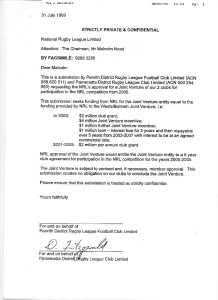
The document at the centre of the 31 July 1999 special Board meeting. Click image to read.
Bateman was not the only one who was angered by the presentation of the non-binding letter. The ex-wife of Greg Evans remembers how very stressed her husband was before leaving for that 31 July meeting.
Why these two directors reacted angrily to a non-binding proposal that would keep the Club’s options open remains a deep mystery. Cowan developed an interesting theory about it, which seems to be borne out by some seemingly unrelated events of the 1990s.
He came to believe that the concern could not have had anything to do with merging because it was a non-binding letter and the Footy Five had the numbers to prevent any merger any time they liked. He started to wonder if the problem was just the publicity.5
Greg Evans shed some unexpected light on the events of July 1999. He was adamant that none of the Five had believed that the document was actually non-binding.
I really believed that signing that letter was signing to merge with Parramatta. So did the others.
I believe if it walks like a duck, and quacks like a duck, then that’s what it is. It might have said non-binding, but once we signed it, we were going to merge. The NRL were putting enormous pressure on everyone, standing over teams, trying to force amalgamations. It was very bad PR for teams to die completely, so it was in their interest to push.
There was debate and discussion that night, but when the letter was discussed by the entire board, the fact that it was non-binding did not come into the discussion. Every member of that board believed it was an agreement to amalgamate.
Another of the Five, Geoff James, agreed with Evans, saying his view was ‘dead right’.
It might seem difficult for some readers to believe that anyone could misread such a letter. It was a simple one-page document. There it is on the opposite page! Leo Armstrong, Barry Walsh, Keith Rhind and Terry Heidtmann had no doubt that it really was a non-binding agreement.
The committee had representation from local councils, and from local community organizations and businesses, as well as people from Panthers management and Board. The purpose of the committee was to devise strategies that would convince the league decision makers that they could not drop Penrith.
The other three members of the Footy Five group were asked in writing if they agreed with Greg Evans’ view. Dennis Coffey did not respond.
Craig Terry says he had a different perspective on the incident. The document said non-binding, he recalls.
But my view was that signing that document would signal that we were prepared to reopen the issue
It was an important document, and we had no legal advice to say what it actually meant. It did say ‘non-binding’, but what it said was not the main issue. We had made policy determinations that said ‘no’.
Later John Bateman wrote that whilst the document was non-binding, he felt that signing it would bring about a merger. Cowan says it would be easy to jump to conclusion about Evans and James when they claimed that the document was a binding agreement, but he believes it is possible they actually believed what they were saying.
If Evans and James genuinely believed the document committed Panthers to a merger, then an obvious question follows. How could intelligent and experienced people read a document that repeatedly described itself as “non-binding” and nevertheless conclude it required a merger?
The contradiction is difficult to ignore. The letter before the Board imposed no immediate legal obligation and expressly preserved Panthers’ ability to make future decisions. Yet some directors clearly believed it represented something much more significant.
Before considering one possible explanation for this apparent contradiction, it is worth pausing to appreciate just how differently the same document was being interpreted.
Cowan suggests an explanation comes from the author Joel Barker whose book The Business of Paradigms, explains that people interpret information through mental frameworks — beliefs and patterns of thinking. These mental frameworks, or paradigms, cause people to fail to see evidence that goes against their beliefs.
Barker says that even experienced scientists sometimes fail to see clear evidence, although it might be right before their eyes, if it is in conflict with what they expected to see, or what they believed.6
According to Cowan if directors came to that special meeting with the firm belief that they were being asked to vote on merging with Parramatta they could have been “trapped by their own paradigms”.
My argument that it was non-binding and that we had nothing to lose would have fallen on deaf ears.
From the Footy Five point of view, a decision not to sign may have had certain advantages, no matter what different reasons each of them had for not signing. Perhaps it was just plain old-fashioned good luck — make a silly mistake and it comes back to reward you.
Had they analysed the situation and concluded there was nothing to lose except some unwanted media speculation, it would have been difficult to justify not signing it. As directors they had a duty to do what was best for the business, and what rational argument could there be against keeping all the options open for as long as possible?
To receive new Parts and occasional project updates by email, you may subscribe below.
Readers who hold recollections, documents, or material relevant to this history are welcome to contribute via the Commentary & Contributions page.
Project Updates
Receive updates when new parts are published.
Only the top 14 ranked teams were to be included, amalgamated entities were guaranteed a spot – so this deadline had great relevance for Penrith. ↩︎
Roger Cowan believed the political ambitions of both John Bateman and Greg Evans may have influenced the way they approached issues surrounding the merger debate. His reasoning is explored further in the accompanying Removed Section — Political Ambition. ↩︎
Although Roger refers to “Super League circles”, he is really referring to senior figures associated with News Limited and the Super League organisation. ↩︎
The Australian Institute of Company Directors identifies keeping directors informed of matters that may materially affect the organisation as one of the CEO’s fundamental governance responsibilities. ↩︎
Roger Cowan eventually developed an alternative explanation for why this apparently harmless document generated such strong opposition. It is explored in the accompanying Removed Section — Political Ambition. ↩︎
“Paradigms” was a subject often covered in training sessions at Panthers thoughout the 1990s. One of the videos consistently used is available on YouTube was Joel Barker’s Discovering the Future: The Business of Paradigms. It runs for about 40 minutes and shows how easy it is for thinking patterns to create perceptions that don’t match the evidence. ↩︎