An Information Night — Weaponised

This article forms part of the serialised republication of Panthers, Passion & Politics – The Roger Cowan Years.

Start · Reader’s Guide · All Parts

Two weeks later, Penrith Council joined the fight. A resolution was passed at a council meeting to send a letter to Panthers urging them to stand alone. Several councillors spoke in support of the motion, emphasising both the importance of the football team to Penrith’s identity and the economic value it brought to the city. One councillor suggested that the council ‘should let the NRL know where we are and urge Panthers to stand firm’.1

Council’s stance created a whole new dynamic. Two Panthers directors had council links. One, John Bateman, was already on council and it was common knowledge that he had his eye on the mayoral seat for the following year. His ally, Greg Evans had been a councillor in the early 90s, and was campaigning to be re-elected in the next council election.

Throughout most of the Penrith community, the issue sparked passion and emotion, and massive amounts of rhetoric, but there seemed to be little understanding or acceptance of the reality of the situation.

Ron Mulock, a former deputy premier of NSW and Penrith mayor, had been the club patron since its early days. He passionately opposed even the thought of a merger with any other team. He is quoted many times as saying he ‘would rather die on his sword’, than merge.

Through the club’s early days, Cowan had enjoyed a friendly relationship with Mulock. They were joint architects of the project to establish Penrith’s Police Citizens Boys’ Club as a joint venture between the council and the club. It was the first boys’ club of its kind in Australia to be built without the need for public fund-raising.

Board chairman Barry Walsh had also been a longtime friend of Mulock. When the Parramatta merger became an issue, this all changed. Walsh speaks of a day when Mulock arrived at his house, very upset and behaving in a rude and aggressive manner. It was a side to his character that Walsh had not seen. It was also a shock to Walsh’s wife who had always been a staunch Mulock supporter.

Walsh tried to explain the situation to Mulock. He understood the patron’s concerns, and wanted to reassure him. He suggested that if he would attend a board meeting, he would see for himself that the directors had no intention whatsoever of approving a merger. Mulock refused the invitation.

The Board decided to hold a public meeting to inform the members – and the team’s fans and supporters exactly what was going on. Its purpose was not to seek a decision, but to explain the situation facing the club and answer questions from members and supporters.

Cowan was to address the meeting held on 7 September 1998, but was quite unprepared for what happened.

I was aware of the controversy out in the community. We had just come through the whole Super League saga and people were very emotional about any possibility of merging with another club. But there was so much misinformation flying around. The board had agreed that our members and supporters should be given a factual analysis of the situation.

I decided to test my address on about eight of our managers. I was going to speak from notes to make sure that the message would not change on the night, no matter what. I asked them to look for any possible bias in what I was saying.  I wanted to present both sides of the problem. They needed to understand that it was essential to fully investigate the situation.

If we decided to remain as a stand alone club there was, at that time, a very strong chance we would have no team in the NRL competition. If we decided to merge with another club, there would be a different set of negative results. They needed to have the full story.

I made a few changes on the advice of the management team, but we were confident that the message was objective and honest.

Rather than reducing uncertainty, the meeting fundamentally changed the course of the debate.

Cowan has described the meeting as an ambush. He says he and the board executive were completely caught by surprise.  After Cowan addressed the meeting, Ron Mulock took the podium. Cowan says it was a moment he will never forget.

He was shouting and ranting about lies and corruption and saying all sorts of crazy stuff, and it seemed to be mostly aimed at me. He attacked four members of the board, carrying on that they had 80 years experience between them. He was even adding up their ages. The tirade went on and on. He made the “rather die on my sword” comment, and told the meeting that the league would never drop Penrith from the competition. Souths used the same questionable rationale and were dropped from the competition a few months later.

This was a public forum, and Cowan says he could not believe Mulock’s extraordinary behavior.

Later, I wondered about the reasons for the personal attacks. He was speaking as if he had come prepared for a debate, and it sounded as if he believed that I would be advocating a merger, and that I would be supported by some directors. If this really was the case, he had been badly misled.

This was the most troubling aspect of the whole thing. The Board had voted unanimously against any merger, but he was acting as if he had been told something very different.

His behaviour on that night was just another piece of a jigsaw puzzle.

There was another strange aspect to this forum.

John Bateman, responding to written questions sent in late 2006, said that the decision by members at the 7 September meeting was the reason he had continued his ‘stand alone’ stance.2

But this was not a proper members’ meeting.

A meeting of members for the purpose of making decisions would have required notices being mailed to all members three weeks in advance. This was nothing more than an information forum. Non-members were allowed to attend. Less than 350 people attended. There was no vote taken.

At the meeting the Five took the opportunity to declare their determination to stand alone despite a few weeks earlier having agreed to look at all options.

The following night’s board meeting virtually ensured there would be no further discussion on the subject. The continuing rationale for such a closed stance was that the members had spoken and that was what the members wanted. The fact is that many thousands of members would not even have been aware the meeting was held. The Board had taken no measure of members’ views.
.


To receive new Parts and occasional project updates by email, you may subscribe below.

Readers who hold recollections, documents, or material relevant to this history are welcome to contribute via the Commentary & Contributions page.

Project Updates

Receive updates when new parts are published.


  1. The position adopted by the Council was very interesting. Since at least 1994, research had been regularly done and the exposure and value the Penrith Rugby League team brought to the local community was an integral part of that research. Yet until this point the Council had failed to acknowledge that value in any way. In fact, it often seemed that certain councillors and council officers resented the thought that it was Panthers bringing Penrith growing visibility.
    ↩︎
  2. This belief was express in correspondence from John Bateman to Jennie Bentley dated 7th Januray 2007. On tis issue Bateman says:
    … it was my view that the members “had spoken” on 7 September 1998 and I was happy to uphold their direction to
    the board to “stand alone”
    . ↩︎

← Part 33 · All Parts · Part 35 →

Commentary and Contributions

A Good Story Trumps Truth

This article forms part of the serialised republication of Panthers, Passion & Politics – The Roger Cowan Years.

Start · Reader’s Guide · All Parts

As discussions quietly continued between Penrith and Parramatta, a very different story was beginning to circulate publicly.

It was not long after the two clubs began their talks that the media speculation began. Cowan says there was a great deal of misinformation, with many comments proving to be wide of the mark.

On one occasion someone announced on Ray Hadley’s rugby league radio show that the merger of Penrith and Parramatta was a ‘done deal’. There was no truth in that statement, but it stirred up a hornet’s nest in Penrith. People believed if they heard it on the Hadley program it must be true.

Denis Fitzgerald bears this out. ‘It was never a done deal,’ he says. ‘Far from it.’

As the old media adage goes, “don’t let the facts get in the way of a good story.” In this case, rumour was rapidly overtaking reality.

Editor’s Note: The merger debate was reported week by week through local newspapers, particularly the Western Weekender. Readers interested in following the controversy as it unfolded at the time can do so in the Historical Context article Following the Merger Debate.

Rumours flew that Cowan had already made a secret agreement with Parramatta. The rumours were soon repeated by others, including some who understood how football clubs operated and should have appreciated that no chief executive could make such a decision alone.

Perhaps the most surprising assumption was that I could somehow make such a decision on my own. Businesses simply do not operate that way. The board of directors has total power over decisions that affect the members they represent.

Mick Kelly, who writes for the Western Weekender, still pushes the story that I was the one who had to be defeated to avoid the merger.1 While the agendas of some people would later become obvious, Kelly’s rigid stance is still difficult to understand. He has some experience in the way clubs work, so he must have known that what he was saying was untrue. At the time of merger discussions, he was well aware of the alliance of five directors. This was the group who would later claim to be the Footy Five and it included the owner of the newspaper that employed him. They held a majority of five of the nine votes, so nothing could happen that they did not support. Kelly had to know that.

The truth is, they only needed four votes to stop a merger.

There is one little known fact about this episode. Cowan had suggested a further safeguard — instead of a decision by simple majority, the votes of at least six directors should be required for  a decision in favour of merging with another club. Of course, the alliance of five could have used its majority to strengthen this even further had they deemed it necessary — they could have made a unanimous vote as the safeguard.

It was a practical safeguard that made it even less plausible that a merger could occur without overwhelming Board support.

Kelly’s ‘rigid stance’ on the issue continues to this day. During the course of the research for this book, the author was told by a couple of people that he [Kelly] had some important evidence to present that would prove that Cowan wanted a merger with Parramatta. Apparently, the evidence is in the form of a taped interview in which the Panthers CEO had said he thought that a merger with Parramatta was the way to go.

Questioned on this point, Cowan says depending on the time of the interview, and the circumstances — and of course the context — it is very possible.

They were some very desperate moments during those years. I have said all along that a merger was preferable to seeing Panthers disappear from the rugby league scene altogether. I never stepped back from that belief. I could not understand the opposing belief that it would be better to “die on our swords”. When the board would not even discuss such an important issue, it made me very suspicious that something strange was going on behind the scenes.

Panthers group chairman Barry Walsh calls the merger story a ‘storm in a teacup’, because — as far as he and the rest of the Board was concerned — it was never going to happen. There was no need for the high drama and the media beat-ups. Attempts to investigate the options carefully, maintain a low profile and not raise controversy in the community were being undermined by media speculation that had no foundation in fact.

In July, the Western Weekender, a local newspaper owned by director Greg Evans, ran a story on its front page advocating a ‘stand alone’ position for the Club. On 2 August, the story broke in the Sunday Telegraph. It said that a merger between the two clubs was ‘set to become reality next year’. It said the team would be called the Parramatta Panthers, and would play in blue and gold, the Parramatta colours. The story featured quotes from Denis Fitzgerald, but none from Roger Cowan, or indeed anyone from the Panthers club. But it was enough to set things in motion in the city of Penrith
.


To receive new Parts and occasional project updates by email, you may subscribe below.

Readers who hold recollections, documents, or material relevant to this history are welcome to contribute via the Commentary & Contributions page.

Project Updates

Receive updates when new parts are published.


  1. Mick Kelly no longer writes for the Western Weekender. like many of the protagonists in this chapter of the Panthers story he undoubdtedly maintains his view. ↩︎

← Part 32 · All Parts · Part 34 →

Commentary and Contributions

Outlining the Risk for the Board

This article forms part of the serialised republication of Panthers, Passion & Politics – The Roger Cowan Years.

Start · Reader’s Guide · All Parts

Considering the possible contingency responses was one thing. Recommending a course of action to the Board was another. By early 1998 management believed it could no longer treat the issue as a theoretical exercise.

By early 1998, Cowan says he and Levy had reached an unavoidable conclusion.

We came to the conclusion – we just have to do something, otherwise Panthers is going to disappear off the face of the earth as far as rugby league is concerned

We were in a weak bargaining position because it was quite obvious that we could not make it under the criteria.  If we started negotiations early enough, we could use the strength of the Panther brand and our junior league to reinforce our position. Waiting until we missed selection would leave us nothing more than a takeover target. If we had to merge it should be as an equal partner. Then, at least, half of our games would still be played in Penrith and the Panther brand would continue to strengthen.

Together they prepared their first formal recommendation to the Board—that Panthers should at least begin exploring the possibility of a merger with Parramatta.

Every chief executive has a duty to advise the Board of risks that may threaten the organisation’s future. Failing to do so would represent a serious dereliction of responsibility. Equally important is the obligation to identify available options and make appropriate recommendations. If Panthers genuinely faced exclusion from the national competition, management had a duty to ensure the Board understood both the risks and the possible responses.

Management’s recommendation was not that Panthers should merge with another club. Rather, it was that the Board should investigate every realistic contingency before circumstances removed those choices. If the club’s worst fears were realised, directors would then be able to make an informed decision from a position of preparation rather than desperation.

Between 1995 and1999, the structure of the Panthers board changed dramatically. John Bateman, who had been elected to Penrith Council in 1995, was appointed to a board vacancy in the same year. He had worked well in what had been a strong and cohesive board. But between 1997 and 1999, three seats became available on the Board. They were filled by Craig Terry, Greg Evans and Dennis Coffey, some of whom had social and business ties with Bateman.

Cowan began to feel a change in the attitude of long-term director Geoff James who seemed to be developing a close alliance with the other four. Before long, the removal of long-serving Chairman Leo Armstrong would point to the existence of a faction for the first time in the Panthers history. In answer to a question in 2007, John Bateman insisted that there never was a faction, except in his final year on the Board, 2002.

Despite the changed board dynamics at Penrith, both Penrith and Parramatta
were willing to discuss all options in the early stages of negotiations. Neither board really wanted to amalgamate, as Cowan explains,

Had there been a vote at Parramatta the outcome may have been a small minority in favour. We know what the vote at Penrith would have been and there is absolutely no doubt about it – nine directors against amalgamation and none in favour. That never, ever changed.

So, if that was the case, what was the point of discussing it at all? And why was there a softer attitude towards amalgamation at Parramatta
than there was at Penrith? Probably, the main reason was that for Parramatta, it was never a life and death decision.

For us, it was. All the facts that Mark and I had presented to the board showed that we were in critical danger of not being in the competition. We were way behind in the criteria stakes and the teams would be only selected on the basis of criteria points. Confronted by such evidence, it would have been totally irresponsible for a board to sit back and do nothing. All the directors were prepared to look at options, but not one of them would have voted in favour.

Mark and I believed we had a responsibility to make sure the board was fully informed about the risks. We could keep putting off any decision until the last possible moment but if we had nothing planned by the time the axe started to fall it would be too late.

There was some strong logic behind the Penrith directors’ total opposition to amalgamation. Parramatta was in a much stronger negotiating position and some felt that it would be more of a takeover than an amalgamation.

My discussions with Denis Fitzgerald were never in that vein, however. In fact, our discussions were only ever about how we could set up a new club with equal ownership that would be the strongest club in the competition. If we were to be simply taken over, the option of buying naming rights would be a better commercial decision because it would leave open the possibility of fighting for reinstatement through the courts

So, all nine Panthers directors were adamantly opposed to any such idea, but they generally agreed that there could be no harm in opening discussions with Parramatta.

Significantly, there were no objections, even from the five directors who would eventually claim recognition as the ‘Footy Five’. A couple of joint board meetings of the two clubs were held around August that year. The first was hosted in the Panthers boardroom over dinner. Everything went reasonably smoothly, and it was decided that Parramatta would host the next meeting.

It was clear at these meetings that neither directors nor managers from either club were over the moon about the prospect of amalgamating. At that stage, both clubs were still prepared to examine the possibilities rationally. That would soon change.


To receive new Parts and occasional project updates by email, you may subscribe below.

Readers who hold recollections, documents, or material relevant to this history are welcome to contribute via the Commentary & Contributions page.

Project Updates

Receive updates when new parts are published.


← Part 31 · All Parts · Part 33 →

Commentary and Contributions

Preparing for the Worst

This article forms part of the serialised republication of Panthers, Passion & Politics – The Roger Cowan Years.

Start · Reader’s Guide · All Parts

By this stage, Panthers’ management believed it had three realistic contingency options. Their aim was to have each sufficiently developed before the NRL announced which clubs would survive. 1

One option was to negotiate a favourable merger with another club — a merger that would be a true partnership with equal rights. Half the home games would have to be played in Penrith and the team would have to be called Panthers. Years of consistent marketing had established Panthers as one of the club’s strongest commercial assets, giving it value in any merger negotiations.

Another option was to buy the naming rights of another club. It would have been little consolation to Panther supporters to have a Melbourne Panthers or a St George Panthers, but from a purely commercial point of view it would have been better than having the Panther brand completely eliminated from the competition.

The other option was to prepare for a legal fight based on the fraudulent activities of some clubs in their claims under the criteria. How could the criteria be used for selection if it could be proved that several clubs had blatantly cheated? And Panthers had that proof2. There were difficulties with this strategy. Court proceedings are inherently uncertain and can take years to resolve. Panthers would almost certainly have been excluded from the competition during that period, making the option financially and operationally damaging.

Although very different in their execution, each option had the same objective.

Management was not searching for reasons to abandon Panthers’ identity. Quite the opposite. Every proposal was an attempt to preserve the Panthers brand and ensure the club remained part of the national competition if the selection criteria ultimately went against them.

If exclusion proved unavoidable, management believed an equal-rights merger offered the best opportunity to preserve both the Panthers identity and a continuing presence in the national competition. But it would be difficult.  A merger could be stalled as long as possible, but the negotiations should not be left so late that they had to be rushed and driven by the desperation of any final decision to cut Panthers. 

The combination of Penrith and Panthers had brought valuable publicity to the city and a strong word association. The loss of that association became one of the strongest objections by those who opposed a merger. From management point of view it was better to salvage the Panthers brand than to finish with nothing at all. To some people, though, nothing at all was better than linking Panthers with another locality.

For management, preserving some future for Panthers was preferable to risking no future at all. For many supporters, however, the very thought of compromise was unacceptable.

There was also an inconsistency in the arguments of some. In their early days with Super League, the Board and management had been discussing the marketing disadvantages of the name Penrith Panthers. 

Some surveys had indicated that having Penrith in the name was detracting from support in nearby population centres such as St Marys, Mt Druitt, and Blacktown. Geographically, these should have been areas of support. Penrith junior league extended as far as Blacktown. Many players were coming out of those areas, yet many people from those areas supported other teams. The Board decided that it might help build support if a name were chosen that allowed people to believe they were supporting a team representative of their own area.

The unanimous decision of the Board was to register the name, ‘Western Sydney Panthers’.

Early in 1998, Cowan and football club CEO Mark Levy began to look closely at the merger possibilities. Options included Western Suburbs, Parramatta, and Balmain. Geographical remoteness was against a merger with Balmain, and for Wests, Canterbury seemed a more suitable choice.  However, the club did have discussions with Western Suburbs.

If the club were forced to merge, Parramatta had to be the most logical choice. It was geographically perfect and the combined strengths of Parramatta and Penrith would have created the most powerful club in the competition. 

Penrith had twelve months to compete for points. Two clubs – the Hunter Mariners and the South Queensland
Crushers – had already dipped out, leaving 20 teams vying for 14 places. 

Denis Fitzgerald agrees. He says that the Parramatta club’s preferred choice for a merger was Balmain.

They were going to struggle to make the criteria, and their district boundary comes to the Clyde/Carlingford railway line here, so it’s quite close to us. A lot of people who live around the Ryde area might support both Parramatta and Balmain. But some of the old Balmain stalwarts felt that we were too strong. I was disappointed when it fell down. I thought maybe Penrith would be too strong themselves, but there could have been a great future in a joint venture with Penrith.

If it had happened, it was going to dominate the whole of western Sydney and all those growth areas. Although there’s some growth in the south-west, the biggest area stretches from Granville/Rydalmere to the lower Blue Mountains. It is a massive area. Commercially, it had great sense, but it was football, where so many positions are not based on logical, commercial reality, but on emotion and tradition — and that’s what ultimately happened.’

Parramatta was interested in a joint venture for a number of reasons but had not made any decision other than to investigate the various options.

The Parramatta Chairman, Alan Overton, sent a letter to his club’s members outlining his reasons for considering the move. In part, it said:

I think all keen, long term Eels fans, like myself, would love the club to continue as we have for the past 50 years, and continue to be the Parramatta Eels, playing at Parramatta Stadium. But … whether we like it or not, there will be only 14 teams in the NRL in 2000.

He went on to say that,

… boards cannot afford to adopt a narrow minded or blinkered approach to joint ventures but rather should attempt to be as objective and professional as possible.

Although their club was safely ensconced in the fourteen, the Parramatta board saw benefits in a merger. The new league administrators were offering major incentives for teams to merge, both on a financial level and in various guarantees. Increased supporter base, sponsorship and gate receipts would be additional benefits. At that time there was great uncertainty about the potential for stand-alone clubs to compete with the joint ventures for more than a few years. Even clubs certain of selection, such as Parramatta, had the nagging doubt that their survival might be for the short term only. Parramatta was taking the responsible course examining all options for its future.

Fitzgerald said the early talks with Cowan were very informal, just chatting more than real discussions.

Roger was concerned with their position — making the criteria. They were in the worst position of any of the Super League franchises. When the curtain went down after one year of Super League and the NRL was formed, Penrith was in a pretty weak position.

For us, it was certainly about the money, and the risk. We had all spent money, but the ARL clubs had never had the type of subsidies that Super League had given its franchises. That funding was now being chopped off with the NRL starting.


To receive new Parts and occasional project updates by email, you may subscribe below.

Readers who hold recollections, documents, or material relevant to this history are welcome to contribute via the Commentary & Contributions page.

Project Updates

Receive updates when new parts are published.


← Part 30 · All Parts · Part 32 →

Commentary and Contributions

The End of Season Drinks That Weren’t So Cordial

A removed section from the original Chapter 8: A Taste of Injustice.

The Penrith-Parramatta game was the last home game of the 1984 season. If the Panthers won, it would mean a semi-finals appearance for the first time in the Club’s history.

By half-time it was becoming obvious that the game was not going well. During the second half, Cowan walked across and sat with the chairman, Leo Armstrong.

Cowan commented to Armstrong that it was pretty obvious this would be the last game of the season. He suggested to Armstrong that the success of the team should be acknowledged in some way. They — the CEO and Chairman — agreed to invite the players and officials back to the boardroom after the game.

Cowan admits he had not thought the invitation through carefully enough. Because it was a spur of the moment decision, only a few directors knew about it. At the time, though, it did not seem important.

At the start of the next board meeting, managers were asked to leave the room.

Don Ellks says,

It was the first time we had ever been asked to leave. Roger sat for some moments as if deciding what to do. He did leave, but reluctantly. After a while Leo came outside and said the board had moved a vote of no confidence in him, and that John Hewett had been re-elected as chairman.

The perceived slight on the directors who missed out on the after-game drinks had provided enough leverage for JohnHewett to make a grab for the chairman position he still resented losing. Cowan was in a tight spot. Conflict on the board had been effecting decision making since 1983, to the detriment of the Club.

This change would affect the morale of the management team. The turnover of the Club was increasing rapidly, scarcely a day seemed to pass without discussion of new initiatives, and it was vital to avoid any instability.

Sensitive negotiations were taking place to refinance the Club’s loans in a deal that would save the club hundreds of thousands of dollars. The reputation and experience of Leo Armstrong as a bank manager was an advantage – there was obvious respect for him by the negotiating bank.

One faction of the board, led by Armstrong, was supportive of management. As well, Armstrong was an excellent chairman, highly respected in the community, by staff and by the members. The other faction seemed to be driven by Hewett. He was seen as the leader of that faction, but Cowan believed he was being pushed by another director, Murray Clarke. Of late, these two had lost the respect of management, staff and quite a lot of members. In this instance they were not acting in the interests of the Club. Any publicity about the chairman’s removal had the potential to do damage.

Worse for Cowan was that Armstrong was about to be humiliated because he agreed with one of Cowan’s suggestions.

When the board called me back into the meeting, I had already decided that the resolution could do a great deal of damage. The negative publicity, the reaction of the members, the negative impact on the finance negotiations and the unfair impact on Armstrong’s reputation should be avoided at all costs. Importantly, the club’s constitution did not clearly give the Board the power to remove the Chairman and it needed a legal opinion. I refused to return to the meeting unless he was reinstated, or it went back to the members.

Cowan reminded the board that it was unconstitutional to continue the meeting without the company secretary. When they called on Don Ellks to come in to act as secretary, Ellks also refused.

During the following week, Hewett went to Cowan’s office to advise that the board had appointed him chairman. Cowan told him that he believed it was improper to move a vote of no confidence and damage Armstrong’s reputation over such a trivial issue. He told Hewett that the management team would continue to recognise Armstrong as the chairman unless there was compliance with the constitution and members of the club endorsed the vote of no confidence. A stalemate had been reached.

Soon after, two of the directors from the Hewett faction would resign, and a tentative peace would return to the board with Armstrong in the chair. Under the surface though, hostility continued to bubble. Hewett would seek revenge — and eventually get it. ‘The conflict between the two factions had been damaging the Club for years‘, says Cowan. ‘Now war had been declared in no uncertain terms.‘

The next election, in 1985, was the board’s first ever departure from its traditional practice of presenting itself as one solid unit for re-election. Neither Hewett nor Hubbard were re-elected to the board.

While Hubbard remains ambivalent about the events of those years, he says that Hewett was devastated. It hit him pretty hard, says Hubbard. ‘His health suffered, and I don’t know that he ever really got over it.’


Related Topics


Related Themes

Board Decisions · Conflict· Football Club


To receive new Parts and occasional project updates by email, you may subscribe below.

Readers who hold recollections, documents, or material relevant to this history are welcome to contribute via the Commentary & Contributions page.

Project Updates

Receive updates when new parts are published.

Major Player: Leo Armstrong

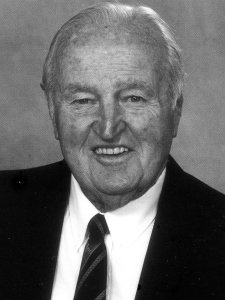
Leo Armstrong
Image Source: The Panthers: Men in Black

Murray Leo Armstrong

Director, Chairman Penrith Rugby League Club Ltd

Murray Leo Armstrong — Leo — was one of the most significant and well-respected figures in Panthers history. A distinguished World War II veteran, respected community leader and long-serving chairman, he helped guide Panthers through some of the most important and turbulent years in its development.

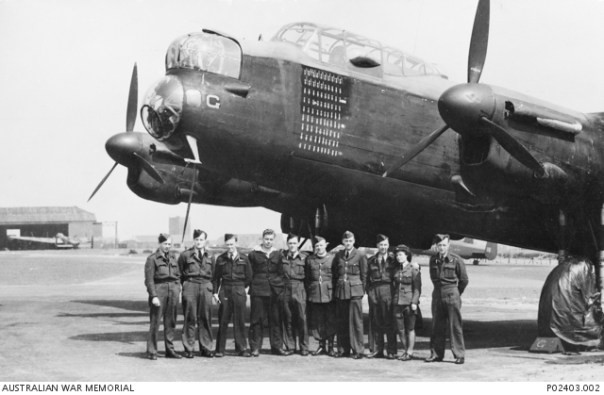
Leo Armstrong (2nd from left) and crew in front of Lancaster bomber G for George. On an “away” to Canberra, the 2003 Panthers squad visited the Australian War Memorial and were inspired by this photo and the story of Leo’s service. (Photo: Australian War Memorial)

Armstrong served on the Panthers board from 1980 and became chairman in 1984, following the unification of the licensed club and football club boards. He remained chairman until 2000, making him the longest-serving chairman in the club’s history.

His chairmanship spanned many of the defining events of the modern Panthers era, including the move to Mulgoa Road, the club’s first premiership in 1991, the Super League conflict, the transition to the NRL, and significant growth in both the football and licensed club operations.

Role in the Narrative

Leo Armstrong appears throughout the Panthers, Passion & Politics narrative as chairman during many of the events described in the Roger Cowan years.

His relationship with Roger Cowan was generally characterised by mutual respect and trust. Armstrong frequently found himself chairing the organisation through periods of intense debate, organisational change and external pressure. His calm demeanour and measured approach were important stabilising influences during some of the club’s most challenging periods.

He was also instrumental in supporting the unified governance model that ultimately transformed the management of Panthers.

Background

Born: 4 November 1922, Gayndah, Queensland
Died: 22 June 2015, North Parramatta, New South Wales

Military Service:
• Royal Australian Air Force, World War II
• Served with 460 Squadron RAAF
• Navigator, Bomb Aimer and Front Gunner
• Flew 32 operational missions over Europe
• Flew the final three missions aboard the famous Lancaster bomber G for George

Profession: Commonwealth Bank of Australia, retired (1984) as Manager of the Penrith Branch

Recognition by Panthers
• Life Membership, Penrith Panthers (1991)

Relevance to Events Described

Armstrong became chairman at a pivotal moment in Panthers history. The newly unified board had adopted a radically different management structure, the Mulgoa Road development was underway, and the football club was struggling both financially and competitively.

Throughout the following sixteen years, Armstrong chaired the organisation during a period of extraordinary transformation. Under his leadership, Panthers grew into one of Australia’s most successful licensed clubs while simultaneously establishing itself as a competitive force in first-grade rugby league.

His tenure was not without controversy. Board disputes, the Super League war, questions about governance and growing political tensions within the organisation all occurred during his chairmanship. Yet Armstrong’s personal dignity and steady leadership earned him widespread respect from many who worked with him.

For many involved with Panthers during this period, Leo Armstrong represented a style of leadership that was thoughtful, measured and deeply committed to both the club and the wider Penrith community.

Related Topics


Related Themes:

Board Decisions · Governance


To receive new Parts and occasional project updates by email, you may subscribe below.

Readers who hold recollections, documents, or material relevant to this history are welcome to contribute via the Commentary & Contributions page.

Project Updates

Receive updates when new parts are published.


Editorial Note

This profile is presented as contextual background.
Additional material may be introduced as the narrative progresses.


Charlie Gibson and the Culture Clash

This article forms part of the serialised republication of Panthers, Passion & Politics – The Roger Cowan Years.

Start · Reader’s Guide · All Parts


Although the new structure fell short of the model Cowan had long advocated, it was seen at the time as a significant step forward.

Both Cowan and the board were pleased with the appointment of Charlie Gibson. He was part of rugby league’s inner circle1, a close friend of Kevin Humphreys, and the man recommended by Mackie and the Super Six for the role of rugby league secretary at Penrith.

Gibson came with excellent credentials. He had been secretary of the South Sydney club for ten years and was there during the club’s winning streak of four premierships between 1967 and 1971. While the structure fell far short of the ultimate solution Cowan had been fighting to achieve for more than ten years, it was a huge step in the right direction. The Board and Cowan made an agreement that he would concentrate on the licensed club and take no further part in rugby league management. Cowan recalls;

We all thought – great! Charlie really knows his way around the rugby league world and that is what we need. We thought it could be the turning point in our rugby league fortunes.

I thought the board was making a mistake by having him report direct to the board, but I was willing to give it a go. I even agreed to have my contract changed to reflect that rugby league was no longer part of my responsibilities.

Charlie’s role was going to involve a lot of co-operation with the licensed club management in areas of accounting, ground maintenance, and in football-related marketing and promotions.

My vision for the club had always been a structure that united all the expertise available. For example, the club’s catering manager was far better qualified to manage rugby league functions than honorary committees or a rugby league manager. The club’s maintenance and cleaning managers could look after the ground. Financial management could come under the club’s finance manager.  Making rugby league successful would require a united effort and a high degree of co-operation.

Problems began to emerge quite early.. They were used to working as a team with overlapping needs, and they felt there was a lack of co-operation that was making their jobs difficult.

The fact is that we were not ready for such a radical departure from the way football was managed in those days.

Although no one realised it at the time, we were again seeing culture at work. This time it was a clash of cultures. Charlie was new to the organisation and we probably should have done more to talk through the tensions that were building. Culture can be a building force but it can also be destructive.

Keith Rhind says that Charlie Gibson was very much a part of the old rugby league ethos. Penrith was developing a culture that was unique, and Gibson often found it hard to adapt. It started out well enough, but eventually the cracks began to appear as the management culture developing at Penrith came into conflict with the rugby league culture that had helped Gibson achieve success at South Sydney.

Tension between the club and rugby league was growing. But that was only the tip of the iceberg. The Gibson appointment would also create a bitter division within the board and ultimately destroy a long-standing friendship between the chairman and Cowan. It would also light the slow-burning fuse that culminated in Detective Sergeant Mick Howe’s raid on the club a few years later.

When the election was held in 1980 for the first joint board, John Hewett became chairman. He had held that position on the licensed club board for the previous ten years, and he and Cowan had become good friends and built a strong working relationship.

Rhind says that Gibson also developed a close relationship with Hewett, taking him to events and functions to meet the high-profile people in his rugby league circles. Hewett was enjoying the attention. Another director from those days describes him as ‘basking in the reflected glory’.

When a Kangaroo tour was coming up, Hewett told others on the board that Gibson was going to use his influence to take him on the tour. It seems likely that Hewett was pushing for this favour and Gibson was doing his best to accommodate him. But there was disquiet among other members of the board, and Gibson himself also appeared unhappy about it.

Looking back, it was a relatively minor issue. Yet it became one of those moments where personality, disappointment and misunderstanding combined to produce consequences far beyond the original dispute.

Hewett believed that he was about to be invited to join league heavyweights on a Kangaroo Tour2, but that belief was against the designs of the heavyweights themselves. When it didn’t happen, Hewett was devastated and the conflict within the Board intensified. His disappointment, and the atmosphere of conflict on the board, caused him to resign as chairman in 1982. But his bitterness remained.

Deputy chairman Barry Hubbard, who was Hewett’s close friend, also resigned, leaving two vacancies on the board executive. Both men remained on the board. Keith Rhind, then deputy chairman, moved into the chairman’s role, which he held until the following AGM. At that meeting, Leo Armstrong was elected unopposed, and would become the club’s longest serving chairman.

Few could have known it at the time, but Armstrong would go on to become the longest-serving chairman in Panthers history and preside over some of the most significant years in the Club’s development.

Nevertheless the tensions that had been building were far from resolved — and the consequences were only just beginning to emerge.


To receive new Parts and occasional project updates by email, you may subscribe below.

Readers who hold recollections, documents, or material relevant to this history are welcome to contribute via the Commentary & Contributions page.

Project Updates

Receive updates when new parts are published.


  1. For more on Cowan’s experiences within the NSW Rugby League hierarchy, Removed Section in Beyond the Book – Rugby League’s Inner Circle. ↩︎
  2. A Kangaroo Tour was regarded as a high honour and a prestigious experience for rugby league administrators during this era. ↩︎

← Part 19 · All Parts · Part 21 →

Commentary and Contributions

Why One Board, One CEO?

Readers of Parts 19–21 may wonder why Roger Cowan spent more than sixteen years arguing for what appeared to be a relatively simple administrative reform. Why did the issue matter so much to him? Why did he keep returning to it despite repeated setbacks, opposition and criticism?

The answer lies in a question that had troubled Panthers almost from the beginning:

The issue was not new.

Readers familiar with the events of 1971 may recognise some familiar themes. The removal of football club secretary Merv Cartwright and treasurer Ron Partridge arose from concerns about the administration of rugby league affairs and accountability for financial decisions. Although the circumstances were different, the disputes that emerged again in the late 1970s centred on many of the same questions. Who should make decisions? Who should be accountable for those decisions? And what happened when agreements were not honoured?

From the time Penrith entered first grade rugby league in 1967, the football club and licensed club operated under separate governance structures. The arrangement was common in rugby league, but Roger increasingly came to believe it created problems that could never be fully resolved.

It would be easy to assume the conflict was simply about money. Certainly finances played a part. Rugby league required increasing investment, while the licensed club was trying to strengthen its financial position and pursue long-term development projects. Yet Roger’s frustration was not that football sought resources. In his view, the licensed club had repeatedly demonstrated a willingness to support rugby league and invest heavily in its future.

The real problem arose after decisions had been made.

Budgets would be negotiated. Agreements would be reached. Plans would be approved. Yet time and again, football expenditure exceeded agreed limits or new commitments were entered into without the knowledge or approval of those responsible for managing the Club’s overall finances.

From Roger’s perspective, this was not simply a financial problem. It made long-term planning almost impossible.

A licensed club board could approve a football budget, commit to major development projects and make decisions based upon expected cash flows. If those assumptions later proved incorrect because spending commitments had changed, the consequences extended well beyond rugby league. The entire organisation could be affected.

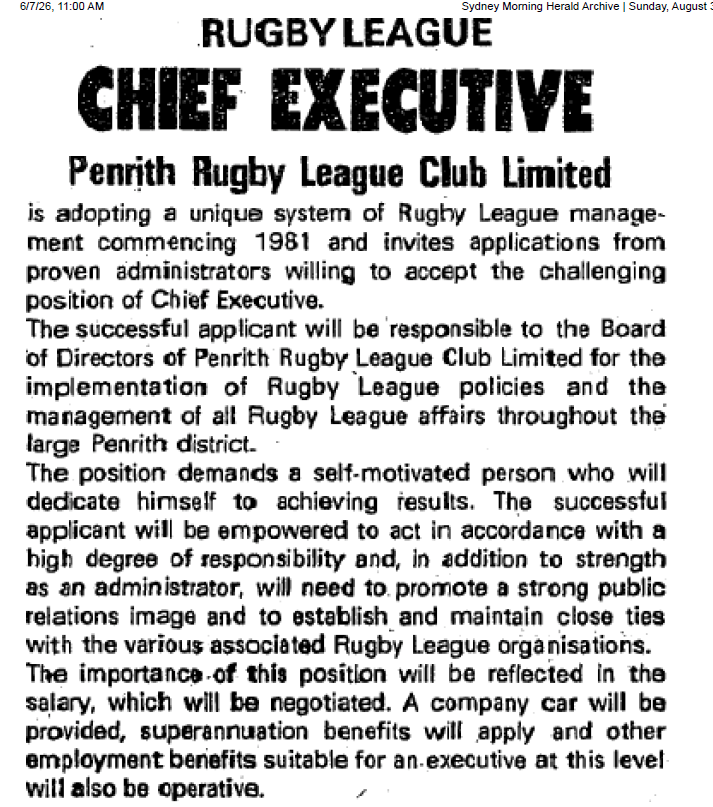
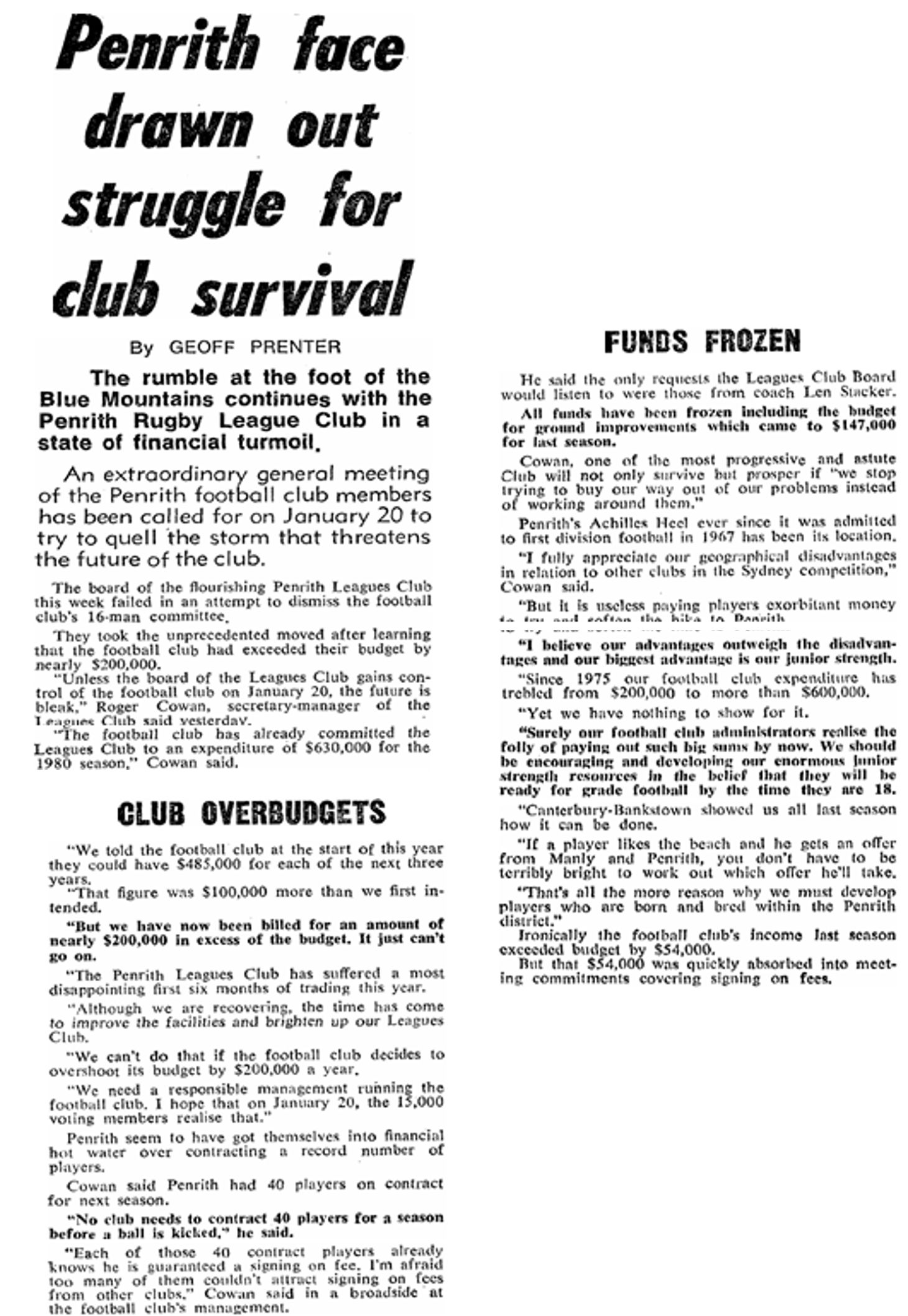
By the late 1970s, these tensions had become increasingly public. In December 1979, the Sydney Morning Herald reported on financial difficulties and disagreements between the football and licensed club administrations. Around the same time, Panthers was preparing for the enormous financial challenge of constructing its new Mulgoa Road complex.

SMH 1979 Dec 9 – click image for full article.

Reports to members in 1980 revealed the extent of the concern. Directors reported that the football club had exceeded an agreed annual budget of $485,000 by more than $100,000 during 1979, while additional commitments had already been entered into for the following season. To the licensed club board, the issue was not simply the amount involved. It was that decisions affecting the future of the entire organisation had been made outside the framework that had previously been agreed.

These events helped bring the governance debate to a head, but they do not fully explain Roger’s determination.

For him, the issue was ultimately one of organisational unity.

He believed Panthers would never achieve its potential while parts of the organisation operated according to different priorities, different assumptions and different lines of accountability. A football club and licensed club could share the same colours, the same members and the same ambitions, yet still find themselves working against each other.

His solution was straightforward.

One board would determine policy and direction for the entire organisation. Management would then be responsible for implementing those decisions. Everyone would work towards the same agreed objectives and everyone would be accountable to the same governing body.

Not everyone agreed.

Some viewed Roger’s campaign as an attempt to centralise power. The perception is understandable. After all, he was advocating a structure that would eventually place responsibility for football and licensed club operations under a single administration. His persistence over sixteen years inevitably raised questions about motive.

Yet there is another interpretation.

Roger was not arguing that football should receive less support. Nor was he arguing that rugby league was less important than the licensed club. Rather, he believed the entire organisation should operate according to a common plan and that all parts of Panthers should be accountable to that plan.

Many years later, Panthers would use concepts such as “twin citizenship” to describe the idea that people belonged not only to their immediate team but also to the wider organisation. While that language did not exist in the 1970s, the philosophy behind it helps explain Roger’s thinking. He wanted rugby league, club management, directors and staff to see themselves as contributors to a single enterprise rather than separate interests competing for influence.

The first major breakthrough came in 1980 when a single board was finally established. Yet even then, the model remained incomplete. Rugby league and the licensed club continued under separate chief executives. As described in Parts 20 and 21, the compromise produced its own difficulties and did not resolve the underlying tensions.

It was not until the end of 1983 that the structure Roger had advocated for so long was fully implemented. One board and one chief executive became responsible for the entire organisation.

Whether that decision alone explains the improvements that followed is impossible to know. Organisations are rarely transformed by a single reform. Nevertheless, the years that followed saw a stronger emphasis on cooperation, planning and shared ownership. The workshops that led to the Five by Five program, closer relationships throughout the rugby league district and a more integrated approach to football and club operations all emerged during this period.

Reasonable people may still disagree about whether Roger was right. They may also disagree about the extent to which later successes flowed from the governance reforms he championed.

What is difficult to dispute is that he regarded the issue as fundamental. For more than sixteen years he returned to the same argument, often in the face of resistance and disappointment.

Ironically, that persistence contributed to one of the enduring myths about Roger Cowan — that he was somehow anti-rugby league.

The evidence suggests a more complex reality.

His long campaign for “One Board, One CEO” was not driven by a desire to diminish rugby league, but by a belief that Panthers could only achieve lasting success when every part of the organisation was working towards the same goals and operating under the same commitments.

Whether one agrees with that belief or not, it became one of the defining ideas in the history of Panthers.


Source Material*

The following documents are extracts of the relevant sections of larger reports:


Related Topics


Related Themes

Financial Management · Governance · Board Decisions · Culture · Club Structure


* Resource material courtesy of The Ausburn Collection


To receive new Parts and occasional project updates by email, you may subscribe below.

Readers who hold recollections, documents, or material relevant to this history are welcome to contribute via the Commentary & Contributions page.

Project Updates

Receive updates when new parts are published.


A Solution — Of Sorts

This article forms part of the serialised republication of Panthers, Passion & Politics – The Roger Cowan Years.

Start · Reader’s Guide · All Parts


Despite the promise shown in 1974, the underlying problems did not go away. Ashurst and Stephenson had settled in — the team had shown promise by reaching the finals of the Amco Cup and the budgeting and financial controls were in place. Cowan recommended that it was time for him to hand over to ex-player, Ron Workman.1

The committee agreed and Cowan stepped aside to concentrate on the management of the licensed club.

The potential shown in 1974 was never realised. The first-grade team finished in the bottom four of the competition for most of the seventies.

Cowan’s growing frustration with a system that he considered wasteful, inefficient and noted only for a succession of failures fuelled his determination to convince both clubs of the advantages of a united effort.

If I analyse that history, I can see that the real cause of a lot of the internal problems through the seventies and early eighties was my unequivocal belief that Penrith would never achieve success as a rugby league competitor while it had separate administrations. I harped and nagged boards for ten years before I finally won the argument, and even then, the win was only because of the involvement of the NSWRL [New South Wales Rugby League] executive.

Later critics would portray Roger Cowan as a CEO surrounded by yes-men. The events of the 1970s suggest otherwise. They must have been either unaware of or had forgotten those years. It was an ongoing battle to achieve his ‘one board, one CEO’ ambition. He often thought he would never win. Neither side was willing to make the concessions necessary to bring the two together. Cowan laughs at the ‘yes-men’ tag.

For more than ten years, I did my very, very best – put my absolute best efforts into getting one board, one management. I kept going back, and going back, and it didn’t happen.  So, no – they definitely weren’t yes-men.

One time in the late seventies, I was getting so frustrated, I thought I’m really going to make the effort here. I prepared a 19-page booklet for the next board meeting. It had graphs, and charts – every piece of information I could pull together to try and convince them.  I was determined to make them see that “this is the only way this club is going to succeed”. I gave it to them a couple of weeks before the meeting to give them time to read it.

On the night of the board meeting, I made sure it was on the agenda. The item came up, and the deputy chairman, Murray Clarke, said: “I move that this document be received”. Somebody else said, “I second that”.

And that was it, there was no discussion, nothing – they just moved on to the next item! I blew my top, lost my temper completely.

It was really stupid putting a 19-page document before a board anyway – boards need concise documents. But I’d tried those for years and they hadn’t worked either.

It took me another couple of years, and a lot more frustrations to win that argument. And we haven’t looked back since. Many other clubs now operate the same way.

Cowan’s commitment to the cause was also used by his opponents to brand him as anti-rugby-league. This is one of the major Cowan myths, and it would be used against him many times by many people. It was also another factor that contributed to his appearance before Ian Temby in 2004. That one small trickle that began as a frustration with failure in rugby league in 1971 combined with some other small trickles along the way, became a raging torrent 33 years later.

Editor’s Note: Roger’s long campaign for “One Board, One CEO” was about far more than administrative structure. It reflected a deeply held belief about accountability, organisational unity and the future direction of Panthers. Readers seeking additional background may wish to read Why One Board, One CEO?

Barry Hubbard says that at one time, Cowan and the board executive even travelled down to the NSW rugby league office in Sydney to talk to Kevin Humphreys [then NSWRL president] to see if there was some way for the licensed club to take over the rugby league club. Hubbard was dead against the idea but still felt it should be explored. Humphreys told them in no uncertain terms that it was impossible. It was unconstitutional, and if they tried, they could be expelled from the game.

Local butcher and prominent cricketing identity, the late Trevor Wholohan OAM2 interpreted Cowan’s trip to rugby league headquarters very differently. His opinion, expressed with his characteristic passion and vehemence, was aligned with those branding Cowan as anti-rugby-league. He declared with his characteristic passion and vehemence, that Cowan’s meeting with Humphreys was “to get rid of rugby league”.

Cowan’s reaction to this was disbelief. He wonders how any rational person could come to such a conclusion.

Imagine meeting with Kevin Humphreys to talk to him about getting rid of rugby league. Any sane, logical person would know that you wouldn’t do that. Humphries would chew you up and spit you out.

Hubbard said Cowan had returned from the meeting with Humphreys undaunted.

Roger was never one to take no for an answer. He had tunnel vision. He went back to the club and resolved to have a meeting with the football committee to decide on holding a joint election for a board that would have responsibility for both clubs.

In discussion, the football committee had agreed, in principle, to hold the election But when the actual motion was put to a vote, a division was called, and people were asked to vote by moving to opposite sides of the room. It was narrowly defeated. A couple of the committeemen who had agreed to an election now crossed the floor and voted against it.

The internal squabbling at Penrith – and the poor performance of the team – was becoming an embarrassment to rugby league administrators. The executive of the NSWRL offered to help, bringing in Alec Mackie, a highly respected rugby league administrator, who was chairman of St George and a vice president of the NSWRL. A committee – dubbed the Super Six3 – was set up to find a way forward, with three representatives from each board. Roger Cowan was also a part of the committee. Mackie chaired the meetings, which eventually concluded that there should only be one board at Penrith. The two committees, for the second time, came to an agreement.4

When the joint election was held in 1980, the new board comprised all the directors of the licensed club. No-one from the football committee had been successful. It became the first board in rugby league history to handle the affairs of both a licensed club and a football club. However, it was only halfway towards the model that Cowan had been recommending.

I believed that a structure comprising one board employing two chief executives would be just as difficult as having two boards dealing with two chief executives.

In many ways it could even be worse. It missed the whole point of the recommendation.  

When the boards came together, that is what they did. Rugby league was controlled through a newly appointed chief executive, Charlie Gibson, while I retained responsibility for the licensed club.

A promising coaching strategy for the 1974 season was derailed by a committee modifying it for the wrong reasons. It was years before its time and it might have been successful had it been given a chance. Here we were in 1980 and I had a feeling it was happening again. The system I had been advocating was being half introduced and again the modifications were for all the wrong reasons. You can’t half bake a cake.

And that was exactly the position the Club found itself in.


To receive new Parts and occasional project updates by email, you may subscribe below.

Readers who hold recollections, documents, or material relevant to this history are welcome to contribute via the Commentary & Contributions page.

Project Updates

Receive updates when new parts are published.


  1. Ron Workman is Panthers player number 13, a member of the 1967 foundation team, he retired as a player in 1973 after playing 93 1st Grade matches. In 1975 he was appointed as the Secretary of the Football Club, a role he held until 1978.
    ↩︎
  2. Trevor Wholohan was a long-standing critic of Roger Cowan, with tensions between the two dating back to 1974 when Wholohan’s butchery supplied the Club. A dispute over an account led Wholohan to claim that Cowan had impugned his honesty. He later attended most sittings of the 2004 Temby Inquiry as an observer.
    ↩︎
  3. The committee was in fact: Kevin Humphreys (NSWRL), Alec Mackie (NSWRL), John Jennings (Penrith Distric Club), Tom Ellis (Penrith District Club), John Hewett (Penrith Leagues Club) Rocky Davis (Penrith Leagues Club) — that’s the “Super Six” — and Roger Cowan. Keith Rhind (Penrith Legues Club) was on the bench for this team.
    ↩︎
  4. To get to this point had been difficult — there were 14 on the football club board and 12 on the licensed club board. Many seats were in jeopardy. It was Barry Walsh who convinced the football club board that, for the sake of the organisation, sacrifices had to be made. Barry lost his seat but would regain it a few years later and go on to contribute to Panthers for close to four decades. See: Beyond the Book — Major Player: Barry Walsh. ↩︎

← Part 18 · All Parts · Part 20 →

Commentary and Contributions

Negotiating with Council — The Station St Road Closures

A removed section from the original Chapter 5: Building the Basics — Business Principles and Property. This examines the challenges faced in negotiating with Council over the Station Street site.

Roger reflected that certain individuals within Council held the view — and perhaps the expectation — that he would eventually be taken down a notch or two. To this day one aspect of this attitude irks Cowan, describing it as one of his worst memories.

While others involved in the negotiations may have viewed the issues differently, Roger believed the Club received little recognition for its contribution to the community. In his view, the charges and conditions imposed during the sale and development process reflected a lack of support for what Panthers was attempting to achieve.

I think the Club was treated very unfairly by Council. Before we could start building on Mulgoa Road, we had to sell the Station Street site. Council made it extraordinarily difficult. One of the conflicts related to two roads on the Station Street property. One of them was no more than a line on a map. It had never been a road. But the only way we were going to be able to sell that property was to negotiate with Council. The price Council sought was $850,000 — around a quarter of the total amount the Club expected to receive for the entire property.

I tried everything to get a better deal. I told them of a similar case where a club had been able to negotiate an agreement with its local council to close a road for the nominal sum of $1, as a sign of support for the club.

Our involvement in our community was far greater than that of the other club. For instance, we had previously agreed to a joint venture with Council to build a Police Citizen’s Boys Club in Penrith. It was the first boys club ever built without the need to raise funds from the public. We were sponsoring most sports in the area. On top of this the Club’s work to get Penrith to the elite level of rugby League had dramatically increased the city’s profile. I thought we had earned the right to support from Council, rather than obstruction. The city was benefiting on a number of levels from the work we had done, and it was giving nothing back. In fact it was profiteering from our planning.

I told them what we were planning to do would be a tremendous boost for Penrith. But all they saw were the problems, rather than the advantages.

The roads incident was not the only problem imposed on us by Council over that property sale. Another episode contributed to a very nasty police investigation a few years later.

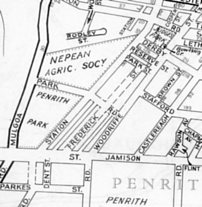
One of the key issues underlying these negotiations related to what are known as paper roads. Paper roads are sections of land set aside by councils for roads in the future. According to Pat Sheehy:

Council planners had discovered the paper road in earlier negotiations for the property. It meant that Panthers did not own the whole site, with the result that Council said “OK, if you want to buy that land back from us, this is what we’re going to charge. All this happened before I was on council, but as far as Panthers was concerned it was absolutely exorbitant.

Robinsons 1957 Street Directory showing Frederick St ( a “paper road”) between Station & Wooddriff Sts. The other street in the negotiation was Park St.

Cowan said the problems extended beyond the property sale and continued into the approval process for the new site:

Council imposed a per hectare sewerage fee on the property based on the total area of land we owned. We were planning to build the club on an area of about 8 hectares. Most of the land was flood-prone, so you couldn’t build on it anyway. But we were hit with this huge bill, based on 86 hectares.

We had to negotiate to defer the payment, but this also became an issue. Even though we eventually came to an agreement, there are still people on Council who believe that Panthers ripped off the Council over that sewerage fee. Under the circumstances, that’s quite laughable

These issues illustrate the complexity of the negotiations and the differing perspectives that would continue to shape relations between the Club and Council.


Related Topics


Related Themes

Governance · Growth · Board Decisions · Licensed Club · Conflict


To receive new Parts and occasional project updates by email, you may subscribe below.

Readers who hold recollections, documents, or material relevant to this history are welcome to contribute via the Commentary & Contributions page.

Project Updates

Receive updates when new parts are published.