A Solution Kept Quiet

This article forms part of the serialised republication of Panthers, Passion & Politics – The Roger Cowan Years.

Start · Reader’s Guide · All Parts


Cowan continues with further thoughts on the bad decision to place Clare as head coach:

It was a ridiculous decision. Jack had some strange ideas about the strategies of the game and started clashing with the captain, Mick Stephenson. Mick was a passionate competitor and was quick to argue with Jack if he thought the coach was talking nonsense. Jack said he would take him out the back of the grandstand and sort him out.

My response was something like: “Jack, if you think the answer is to fight our captain, I want you to know that you will be doing it over my dead body”.

It was one of the many signs that we had made a bad decision.

This episode reinforced Cowan’s belief that Rugby League decision-making should be seated in one body, looking after the interests of the entire club.

Tom Wilson gives an example of the way the football committee worked at the time.

Les Boyd was a brilliant newcomer at the time, only a very young kid. The coaching committee had invited him and his father to come to the club to talk to us. His father was a little short stocky bloke. Les wasn’t much bigger, but he was a very strong looking, solid boy. And he had already started to make a name for himself.

We’re all standing around talking, and Pat Russell — who was on the football committee —  is down at the end of the bar, holding court. He says to me, ‘Look Tom, look at the kid’s old man, the size of him. This kid will never grow up to be any decent sort of a footballer.

That’s what we were up against. Les Boyd did grow up, and he became an outstanding footballer — a mongrel, but a great footballer. It was only one man’s opinion, but that’s all it needed back then. It was like that all the time — how would the bloody schoolteachers know?

Appointing Jack Clare as head coach, the football committee cited Masters’ lack of first grade experience, saying he only had coached school football. In fact, his credentials were very similar to Jack Clare’s, but Masters had a far better CV.

So, the 1974 season began with Clare in the driving seat. Masters was to look after tactics, Harris coached the forwards, and Wilson the backs.

It soon became apparent that there was a problem, says Masters. The team lost its first four games and conceded a total of 107 points.

So on a wet Sunday at Warragamba, after a club family day up there, Roger gathered all four coaches in his car, and gave us an ultimatum. He said, “It’s obvious that this is not working, and I’m going to appoint Roy as head coach. You can accept it, or we go back to the board – who will no doubt go to the media, and wherever else it goes from there.

Cowan made it clear it was up to them — handle it quietly and confidentially or suffer the glare of media coverage and the uncertainty of how the committee would handle making a new decision.

For the remainder of the season, Harris became second grade coach, Wilson coached third grade and as far as the world knew, Clare was the head coach. None of us ever revealed to the press what the situation really was. We maintained that situation only to preserve Jack Clare’s dignity, but the reality was that I was first grade coach for that season.

The entire Penrith experience is one that Masters would prefer to forget. He felt very let down at the time.

My significant problem was that Roger … didn’t give me any support … I had to make my own arrangements … I just had to cop it sweet.

I thought that I had made a significant investment in a life change and ended up being dumped pretty much high and dry

In a recent exercise to select Penrith’s best team and coach of the past 40 years, Masters is named as the first-grade coach for 1974, but it’s taken 40 years to acknowledge it. Cowan told a meeting held in 2006 to discuss that 40-year team, that Panthers has treated Roy Masters abominably.

Masters speaks highly of Cowan,

I have a very great affection for Roger. But my admiration for him is based on what he’s done for the club since I left, not any problem that I had at the time with him.

See, you’ve got to be measured in this world – you just don’t define your personal history in terms of a couple of years you spent somewhere, and that forever influences your view of a person. You also make observations as you go down the track. And I can’t deny the fact that he, selflessly, with massive amounts of hard work, has built a vast empire.

Roger’s model introduced a revolutionary coaching plan It was a good model, but it was too far ahead of its time in terms of the politics that existed at the club in those times.

It didn’t matter what you tried to do with those people. If you came up with something new — like trying to develop match plans or produce videos — or had any kind of scientific training, you were completely alien. You belonged to a culture they didn’t like, and couldn’t accept. Yet look at the game now, it’s all scientific, all research and video analysis.

The politics during those days of two boards was treacherous … and it was very destructive and soul destroying. Merv Cartwright wasn’t on the committee at the time, but he was still a powerful force behind the scenes.

My experience at Penrith steeled me for the future.

In 1974, the year that Roy Masters came to Penrith, Mike Stephenson and Bill Ashurst also came — from England, to play with the team. Under the direction of Roy Masters, the team made the final of the new mid-week competition, the Amco Cup.  They finished in ninth position in the first-grade competition, and had come close to making the semi-finals.

Although the team had its best yet success under Masters, he opted to remove himself from the politics and coach the Under 23 side the following year.


To receive new Parts and occasional project updates by email, you may subscribe below.

Readers who hold recollections, documents, or material relevant to this history are welcome to contribute via the Commentary & Contributions page.

Project Updates

Receive updates when new parts are published.


Part 17 · All Parts · Part 19

Commentary and Contributions
Innovation Stumbles Over Prejudice

This article forms part of the serialised republication of Panthers, Passion & Politics – The Roger Cowan Years.

Start · Reader’s Guide · All Parts


From early in the 70s, Roger Cowan maintained an absolute commitment to the belief that rugby league would never succeed at Penrith while it was a separate entity. Cowan passionately believed that the secret of success was to integrate rugby league, uniting all the expertise within the management structure.

It took more than ten years to achieve that goal. Yet the struggle came with an unforeseen downside — the move to integrate had a negative impact on some relationships and reputations.

Cowan says there had been consistent failure under the two-committee system, and serious conflict.

I sometimes wonder what would have happened if I had taken the easy path and simply kept out of rugby league. I am not sure that it would have been possible to do that and also protect the interests of the licensed club. In so many ways, the two are interdependent. But if I had found a way to do it, there is no chance whatsoever that the police would have walked through that door in 1985.

I know some very successful CEOs of large clubs who have kept right out of Rugby League. I think they were smarter than me. If Rugby League had been managed openly, honestly and effectively in the first few years there would have been no need for me to ever get involved. But I was never about to lead a team working for the success of the Registered Club and have it all blown away by irresponsible management of football.

As the club moved into the seventies, the licensed club continued its growth. But on the football side of things, the club was struggling

The results told the story.

The team’s best performance throughout the seventies was equal seventh in the 12-team competition, in 1971. It was second-last twice and had collected its first wooden spoon in 1973.

Something had to be done to improve performance and Cowan formed a small strategic sub-committee to focus on new strategies. The group included Cowan, Tom Wilson – who would become the club’s director of coaching the following year, Dave Podmore, a local businessman and Frank Ley, a schoolteacher who was also heavily involved in school rugby league. Podmore, Wilson and Ley were on the football committee.

The group devised a whole new concept of coaching.

The plan was to appoint a panel of coaches. The head coach would lead a team of specialist coaches – one for backs, one for forwards, and one skilled in tactics and strategy. The panel would oversee all three grades of football, and each would train the players in their specialty.

This was a new concept for Australian sport and structurally very different. There were similar systems used at the time in American football. Balmain coach Jack Gibson1 had also spoken in support of such a coaching system, although he never actually used it. It is now in common use in all football codes.

The system was introduced in time for the 1974 season.

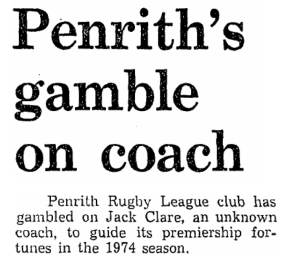
Roy Masters, who would become a prominent Sydney sports journalist2, was part of that 1974 coaching panel. Barry Harris – a former state representative – was to be the forwards coach, and Wilson, already established as a coach, would oversee the backs. The fourth member of the team was Jack Clare. Clare was popular in the world of rugby league and seen as a ‘nice bloke’. He had been chairman of selectors with the Balmain club but had no experience coaching at grade level. He had coached high school teams and had only ever played five first grade matches.

Cowan and the strategy team wanted Masters as head coach. He had coached a number of successful school teams, notably the Australian schoolboys’ team that returned unbeaten from a tour of England in 1973.

Tom Wilson remembers that some of the group travelled to Tamworth to meet with Masters, who was teaching high school there at the time.

We spoke to Roy for 40 minutes on the sideline of a training session. We watched the session, and Masters didn’t say a thing to the team the whole time. They went through 43 moves – and dropped the ball once. What an efficient team!

Roy had developed a completely different way of doing things. It was a real management concept. We convinced him to leave Tamworth and come to Penrith to head up the new coaching panel.

But it would not prove that easy! Wilson continues,

When they got back and started to work on the new strategy, the old brigade came out fighting, “What would some schoolteachers and a couple of businessmen know about football?” The committee was prepared to go along with the new coaching concept but personality clashes within the committee caused a poor decision that derailed the strategy. The decision was later corrected by Cowan in quite extraordinary circumstances, but the strategy did not recover.

Masters says there were problems from the start.

The pervading culture on the football committee at that time was anti-intellectual. If you were a schoolteacher, you were gone from the start. There was one particular person on the board who really had it in for me. He was very vocal and wielded a lot of power.

There was something like 16 men on that committee, and most of them were the same.

It was never going to work. Frank Ley – who was a teacher – signed me. Roger, the club secretary, had also been a teacher, and here was I, another one. They just would not accept me. And it was all down to the prejudices of this unbelievably insidious committee.

It was even worse than that, says Cowan.

Frank Ley was unpopular with the committee, and he was seen by the committee as the driving force behind the appointment of Roy Masters, so the vote to appoint Jack Clare as the head coach was really a vote against Frank Ley. Personal prejudices easily won the battle over logical argument.

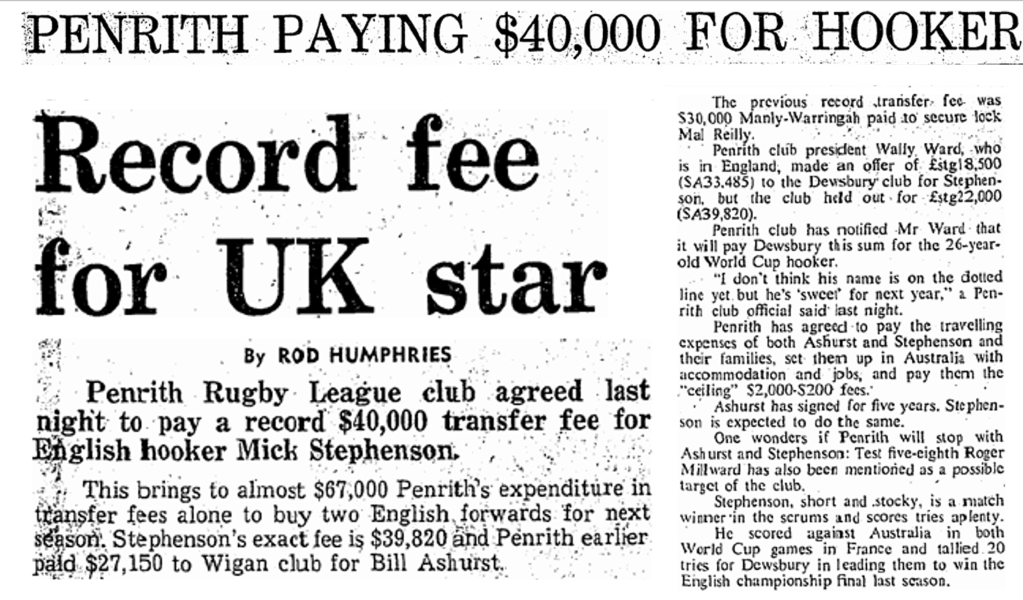
Headline SMH Herald 11 October 1973 – click image to read the article

To receive new Parts and occasional project updates by email, you may subscribe below.

Readers who hold recollections, documents, or material relevant to this history are welcome to contribute via the Commentary & Contributions page.

Project Updates

Receive updates when new parts are published.


  1. Jack Gibson did not coach Balmain. In 1973 he coached Newtown and in 1974, he was in his second stint as coach of Eastern Suburbs. ↩︎
  2. Roy Masters later became a prominent journalist and columnist with the Sydney Morning Herald and is now based in Melbourne. ↩︎

Part 16 · All Parts · Part 18

Commentary and Contributions
The Iconic Panthers Scoreboard

The Panthers scoreboard became one of the most distinctive features of Penrith Stadium — or any rugby league ground at the time. Its origins can be traced to the club’s early think-tank culture.

In the early days of Penrith Rugby League Club, Roger Cowan used think-tanks to encourage participation and generate ideas for the club’s development.

According to Kevin McGrath, the unique scoreboard installed at Penrith Park in 1979-80 had its origins in one of those sessions.

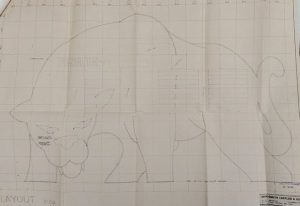
An idea for creating a Luna Park style feature for the club entry was eventually re-imagined as a football scoreboard. The concept was developed further by the architects Dick-Smith Leffler & Gill, who drafted the concept.

Finally, that original idea was brought to life at the southern end of Penrith Park as an innovative scoreboard.

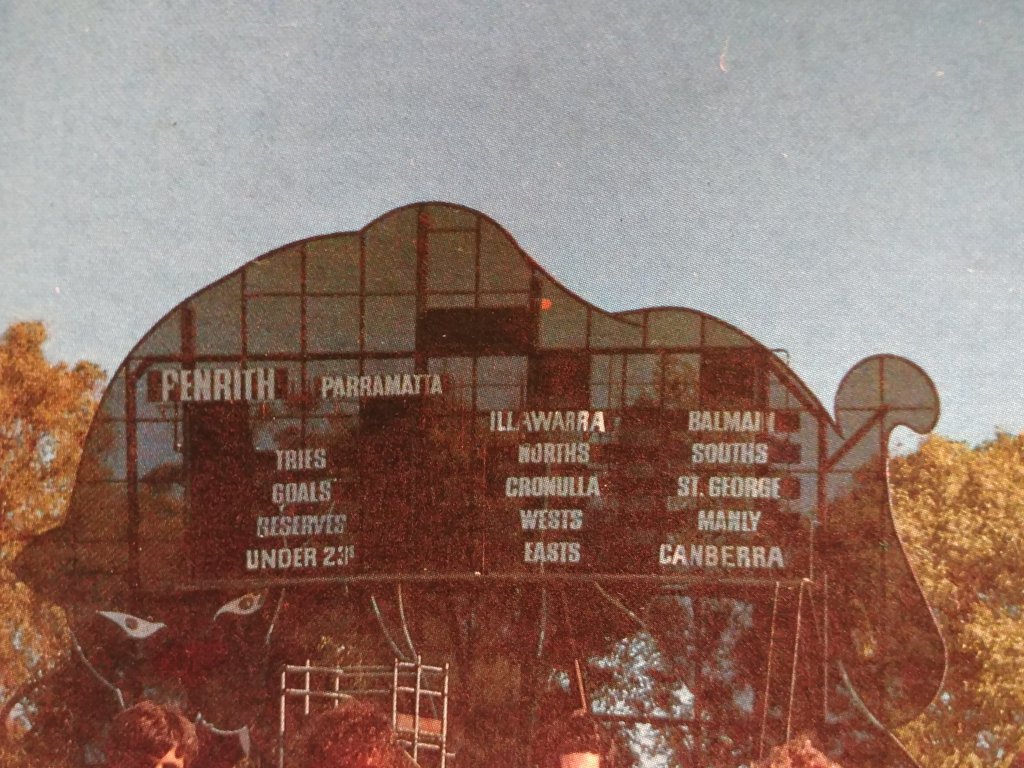
The scoreboard displayed the score of the Panthers game, as well as progress scores from other matches being played on the day. A score by the home team triggered a response from the structure — flashing eyes and a Panther’s roar marking the moment.

Over time, modifications were made as the structure aged and operational demands changed.

The iconic scoreboard had its operational flaws, as it aged there were many breakdowns and failures and eventually could not deliver what was required at a modern sporting stadium … but still it was loved by Panthers fans and visitors alike.

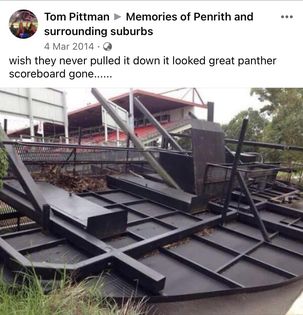
In 2013 it met a fate unbefitting of a trusted, if unreliable, friend:

This Facebook post is dated 4 March 2014, the photo (source unknown) was taken in 2013.

In 2013, the scoreboard was removed.

At the time, it was suggested that the structure had been carefully dismantled and placed into storage, with the possibility of future restoration. Other accounts indicated that it had instead been destroyed during the removal process.

Regardless of the circumstances, its disappearance marked the end of one of the most recognisable symbols of the Panthers experience.


Related Topics


Related Themes

Culture · Innovation


To receive new Parts and occasional project updates by email, you may subscribe below.

Readers who hold recollections, documents, or material relevant to this history are welcome to contribute via the Commentary & Contributions page.

Project Updates

Receive updates when new parts are published.

The Think Tank Culture

This article forms part of the serialised republication of Panthers, Passion & Politics – The Roger Cowan Years.

Start · Reader’s Guide · All Parts


Focus groups — later formalised as Strategic Planning Groups — became a part of everyday life at Panthers. Glenn Matthews says the involvement of staff remains essential when Panthers considers major changes or redevelopment

Back in the early 70s, with a full-time staff numbering only 30, it already worked the same way. Kevin McGrath who started at Penrith Leagues a little after Roger Cowan, describes how it was then.

We used to have what they called think-ins or think-tanks. They started out once or twice a year, but pretty soon they were every three months. They would get groups of employees – someone from the bars, poker machines, a cleaner, an office person, one of the catering staff, and one of the directors – and put us all in a room together for a day. We had to sit there and come up with ideas that we thought could benefit the club. The ideas could be as weird and wonderful as we liked. Roger used to tell us the more way out, the better.

We had to work as a group, write the ideas down, throw them around, and come up with a list of a final few. Then they would pass the lists on to another similar group, to be discussed and modified again.

That’s an interesting comment, but is it true?

McGrath once jokingly told Cowan he was the biggest plagiarist of all time, because many of those ideas helped make the place what it is today. ‘But he was able to take those ideas and make them become reality.’

For example, one of McGrath’s suggestions was to make the front doors of the club a big open panther mouth – a la Luna Park. This went through the process and ended up as the scoreboard at Penrith Stadium.1

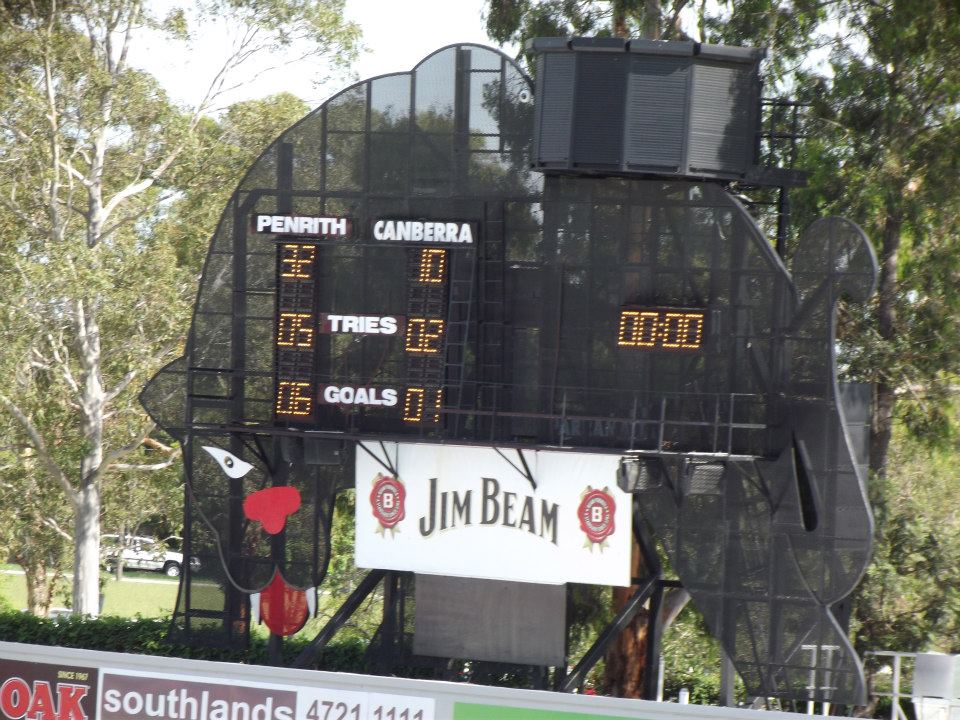
Penrith Stadium’s iconic “Panther” Scoreboard – this was a later modified version.

Keith Rhind says,

Roger was always working on ways to stay ahead of what other clubs were doing. I’m sure he used to stay awake at night thinking up new ideas. He once bet me that one of the groups could come up with more than 200 suggestions in a day. I didn’t believe it was possible, but I lost the bet.

Cowan used to take people out of their comfort zones, Rhind says,

The main purpose of the think-tanks was to give the staff confidence in themselves. When Roger first started, there were a lot of problems, and staff morale was very low. We had a lot of internal pilfering and other bad practices, and there was no real structure or systems. These groups got the staff involved, they began to work as a team, and feel they were a part of something when they came to work. And we were getting all these ideas as well.

Kevin McGrath says it made him feel good to be part of those groups. ‘I was only a cellarman, but in those think-ins, I was equal to any of those blokes.’

In the 70s, Random Breath Testing was introduced to NSW. There was great apprehension about the effects it would have on businesses selling alcohol.

At Panthers, however, the legislation had positive effects. The Club’s “think tank” culture enabled it to come up with strategies that would take it to another level of growth.

Two managers went to Victoria, where RBT had been introduced five years earlier. They researched its effects in Victoria and what hotels had done about it. On their returned a think tank involving a number of key staff. It lasted several hours, and about 150 suggestions were listed. Once the list was complete, the more crazy ones were eliminated. The remainder were grouped and analysed.

Because of this one piece of legislation, the seeds were sown for Panthers to broaden its marketing focus. Now it would include family activities, tourism, and greater emphasis on food. The session was probably one of the two most valuable think tanks ever held by the Club.

The other, in 1983, drove the transformation of rugby league in Penrith from its lowest point to an era of success.

What began as informal ‘think-ins’ had become one of the defining engines of Panthers’ growth.


To receive new Parts and occasional project updates by email, you may subscribe below.

Readers who hold recollections, documents, or material relevant to this history are welcome to contribute via the Commentary & Contributions page.

Project Updates

Receive updates when new parts are published.


  1. The scoreboard became an iconic and much-loved feature of Penrith Stadium. It was removed in the early 2010s. For further context, see: https://pantherspassionpolitics.com/2026/06/02/the-iconic-panthers-scoreboard/. ↩︎

Part 15 · All Parts · Part 17

Commentary and Contributions
Maintaining Momentum — Beyond the Clubhouse

This article forms part of the serialised republication of Panthers, Passion & Politics – The Roger Cowan Years.

Start · Reader’s Guide · All Parts


With Mulgoa Road established, the focus shifted to sustaining momentum and extending  Panthers’ presence beyond the club itself.

After the blaze of publicity that followed the 1984 opening of the Mulgoa Road premises, Cowan and the management team were looking for ways to keep up the momentum of the Panthers brand.

Around the same time as Mulgoa Road opened its doors, a new water-ski concept had been developed in a Perth suburb. A man-made lake had been created for water-skiing with a novel twist. There was no need for boats. Water skiers queued and were given instructions as they waited their turn. As they neared the top of the queue, they were handed a ski rope. The operator would pull a lever, the rope would become attached to the moving cable and the skier would take off for two or three circuits of the lake.

When the managers of the Perth enterprise heard of Panthers, they made contact.  They approached the Club to explore whether such a park might be feasible for Penrith. Representatives of the Club inspected the WA operation and carried out studies to determine whether it could be a worthwhile investment.

Here was a unique and interesting way to build the Panthers brand and generate publicity.

Further, there was a large area of land that had been earmarked for future use, but it was too low-lying for any development – it needed to be filled. Excavating two large lakes would provide the hundreds of thousands of cubic metres of fill for this low area. They would not be paying to dump the excavated fill, nor would they need to buy any to raise the land.

One important point was overlooked in assessing the financial feasibility of this venture – the climates of Perth and Penrith are similar, except that Perth gets most of its rainfall in winter, whereas Penrith is wettest in summer.

In 1987-88, its first year, the park – named Cable’s Ski Park -made a profit, generated enormous publicity and provided all the fill needed for the lower areas of property. It was a win all round.

In the second year, it started to rain in December and continued through most of January – the summer school holiday period, and the most important revenue generating part of the year. The following year the weather pattern was repeated.

It turned out that a dry December-January period was the difference between profit and loss for the entire year. When the novelty died away after a few years, so did the publicity, and the park struggled to break even. For a while it was a great attraction, helping to raise the city’s profile, along with Panthers. Eventually repeated losses could not be justified, and Cable’s was closed in 2002.1

The ski park decision has been criticised by some, but Cowan later reflected that factoring in the fill requirements for other parts of the property meant the real cost of building the park was quite low. He says:.

On the one hand, the fact that it had to be closed down says very clearly that it was a failure. There is another perspective. If we were able to go back and I was faced with the same situation, I would have no hesitation in making the same decision. The gains far exceeded the losses. The ski park did more to boost the Panthers name throughout Australia than anything else we did, apart from moving to Mulgoa Road.

Another ‘outside the square’ decision for Panthers was the purchase, in 1993, of Nepean Shores. It was an upmarket mobile home village located close to the Nepean River. It had more than 80 cabins, all fully occupied, and several function rooms. The developers had overspent on it and been forced to appoint an administrator, so it came on the market for much less than its cost.

Management inspected the site. They discovered that the current income was less than the holding costs of interest, rates and maintenance – but not much less.

The conference rooms were a strong attraction. They had been tastefully constructed and were practical and functional. The Club’s conference market was growing, and business was often limited by availability of rooms. Nepean Shores could open up new opportunities.

Cowan says Nepean Shores had been finished to a high standard, in fact it was probably overdone for the income it could generate. The infrastructure, although a bit run-down, could be revitalised at a relatively small cost. The purchase price was $3 million. To the Board and management, it seemed an excellent investment with the potential to be further developed for a good cash flow.

Nepean Shores enhanced the status of Panthers as a provider of a range of conference facilities. It became a venue of choice for Panthers’ management and Board conferences. It remained part of the Panthers portfolio for many years and proved to be one of the Club’s most successful commercial investments.

Roger Cowan believes that the physical side of building a business – the buildings, infrastructure, equipment and systems – make up only a very small part of the whole when compared with the other side – the people.

It’s the people who make it work, the relationships and networks, the supporters and the critics. The culture of a company develops automatically as the various influences take dominance for periods. The philosophies, values, beliefs, tall stories and historical landmarks combine to affect decision making and strategy in a dramatic way.

Strange to say, culture was an important concept at Panthers even before the word became a recognised part of the management language.

Behind each of these decisions was a consistent thread — the belief that while buildings and assets matter, it is people, relationships and culture that ultimately determine success – a theme that would continue to shape the Club in years ahead.


To receive new Parts and occasional project updates by email, you may subscribe below.

Readers who hold recollections, documents, or material relevant to this history are welcome to contribute via the Commentary & Contributions page.

Project Updates

Receive updates when new parts are published.


  1. Cables reopened in 2009 as Cables Wake Park and continues operate under a lease from Penrith Rugby League Club Ltd. ↩︎

Part 13 · All Parts · Part 15

Commentary and Contributions
Panther Stamps

In modern clubs, loyalty systems are everywhere.

Members accumulate points through gaming, dining and entertainment spending, redeeming them for meals, prizes, discounts or benefits through sophisticated computerised systems linked to membership cards and databases.

Security surrounding gaming operations was often basic, particularly in smaller or rapidly growing clubs where staffing and oversight systems struggled to keep pace with expansion.

Long before those systems became standard across the club industry, Panthers experimented with an early version of the same idea.

It was called Panther Stamps.

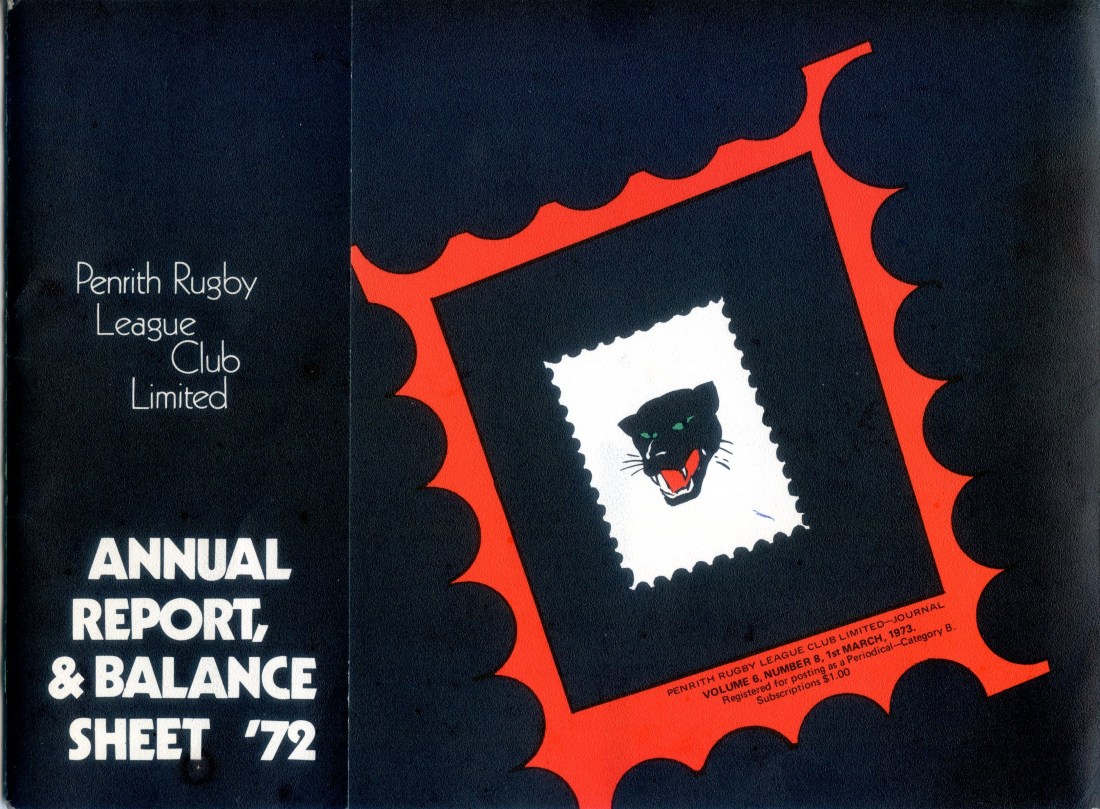
Introduced in 1972, the scheme rewarded patrons — with bonus stamps that could later be exchanged for prizes and trophies. While simple by modern standards, the concept reflected a surprisingly advanced understanding of customer loyalty, repeat visitation and member engagement

The Panthers Annual Report for 1972 described the program as:

“one of the most outstanding successes we have ever had.”

The scheme had officially commenced on 10 July 1972 after several months of delay caused by what the club described as “security and administrative problems involved.”

Even at this early stage, Panthers recognised that a rewards system required careful operational controls, stock management and accounting procedures.

Within less than six months:

  • and prizes worth approximately $22,000 at cost price had been distributed.
  • members had collected more than 150,000 stamps
  • over 90,000 had already been redeemed

The prizes ranged from trophies and sporting awards through to toys and household items. The report noted that demand became particularly intense in the weeks before Christmas, with thousands of dollars’ worth of toys redeemed by members.

Importantly, Panthers did not present the scheme simply as generosity or entertainment.

Club management acknowledged that while the program carried significant administrative costs — including staffing, storage, stationery and prize purchasing — they believed the increased engagement from members more than justified the expense.

In effect, Panthers had identified an idea that would later become central to the modern club and gaming industries: reward loyalty, encourage repeat visitation, and strengthen the relationship between the member and the venue.

The system also demonstrated the increasingly sophisticated operational mindset developing within Panthers during the early 1970s. By this period, the club was not merely expanding physically — it was experimenting with new forms of marketing, patron engagement and gaming promotion that were relatively advanced for the time.

Although Panther Stamps relied on physical booklets and manual administration rather than computers and swipe cards, the underlying principle was remarkably familiar to modern readers.

Today’s digital loyalty programs — with their points systems, rewards catalogues and member incentives — are built upon many of the same ideas.

While modest by modern standards, Panther Stamps reflected the growing importance of structured member engagement within the evolving licensed club industry of the period.

Panther Stamps were simply an early analogue version of that future.


Related Topics


Related Themes

Financial Management · Innovation


To receive new Parts and occasional project updates by email, you may subscribe below.

Readers who hold recollections, documents, or material relevant to this history are welcome to contribute via the Commentary & Contributions page.

Project Updates

Receive updates when new parts are published.

Wires, Magnets and Monitoring

During the 1960s and 1970s, poker machine operations were still relatively primitive by modern standards. Machines were largely mechanical, heavily cash-based and vulnerable to manipulation.

Across the NSW club industry, stories circulated of patrons using wires, magnets, lead discs being used as coins, and other improvised devices in attempts to interfere with machine mechanisms or influence payouts.

Security surrounding gaming operations was often basic, particularly in smaller or rapidly growing clubs where staffing and oversight systems struggled to keep pace with expansion.

At the same time, the sheer volume of coins moving through gaming rooms created operational difficulties of its own. Machines required constant clearing, counting and refilling. Cash handling was labour intensive and exposed clubs to risks ranging from simple human error to outright theft.

These problems were not unique to Panthers. They reflected broader challenges facing the club industry as poker machine revenue expanded rapidly during this period.

For administrators such as Roger Cowan, such vulnerabilities highlighted the need for tighter operational systems and greater technological oversight. At Panthers, this gradually led to innovations in surveillance, accounting controls, machine monitoring and broader administrative systems designed to improve both security and efficiency.

Part of Cowan’s reputation within the club industry stemmed from his willingness to embrace technology earlier than many contemporaries. What later became sophisticated electronic monitoring and integrated management systems began, in part, as practical responses to very immediate operational problems.

The issue was not simply dishonesty. It was scale.

As clubs grew larger and gaming operations expanded, informal methods that may once have worked in smaller suburban venues became increasingly inadequate. Stronger systems, better monitoring and more professional management structures became essential to running modern licensed clubs.

Seen in that light, the technological innovations discussed in Part 9 were not merely about efficiency or modernisation. They were also responses to a rapidly changing gaming environment in which security, accountability and operational control had become central concerns for the industry.


Related Topics


Related Themes

Financial Management · Innovation


To receive new Parts and occasional project updates by email, you may subscribe below.

Readers who hold recollections, documents, or material relevant to this history are welcome to contribute via the Commentary & Contributions page.

Project Updates

Receive updates when new parts are published.

Roger Cowan

This article forms part of the serialised republication of Panthers, Passion & Politics – The Roger Cowan Years.

Start · Reader’s Guide · All Parts


Note for readers:
This Part presents a narrative portrayal of Roger Cowan as part of the unfolding story. A structured biographical overview is available on the Roger Cowan profile page.

Roger Cowan was born in 1935. His father, Norm, was one of seven children who grew up on a farm in Victoria. Norm married Mary Jamieson from West Wyalong, who was also raised on a farm. Mary had two sisters and five brothers. Both parents had left school early and had experienced the ravages of the Great Depression.

Norm was a proud man. Cowan says his Dad often recounted the humiliation of the day that he lined up to apply for a job to dig trenches with pick and shovel, and had to show his hands to the people recruiting the workers. If they were calloused sufficiently, it proved he was used to hard work. That someone had treated his father with such indignity stayed with Cowan. Even as a young boy, he knew it was a disgraceful thing to do. Most of the important values of an adult are developed in the earliest years. He made up his mind he would never act like that.

One of the main influences on the young Cowan was the dedication of both parents to make sure he was given better educational opportunities than they had. They coached and encouraged him to read and learn beyond what was being taught at school. Both were intelligent people who had succeeded in their studies as far as they were allowed to go. Norman Cowan could have been a professional working out of an office and earning a good wage had he been given the opportunities.

The Jamieson boys were horse breakers. They had a reputation for liking a bit of a brawl now and then, even within the family if nothing better was available. In an indirect way that would also influence the values developing in Cowan.

His mother had very strong values and she passed these on to her children at every opportunity. On the one hand she had a revulsion for fighting and violence. She was close to her brothers and was distressed by their willingness to resolve things with their fists. On the other hand, she was against any show of weakness. No matter what challenges might arise, they had to be met with determination and strength.

Cowan remembers one example of his mother’s attitude towards developing a tough approach. The Cowan family – Mary, Norm, Roger and his sister Clare – were living in the village of Hampton near the Jenolan Caves. On a cold winter day, his mother asked him to ride his bike to the shop to pick up some butter. He was nine years old.

As he rounded the bend near the school, an icy wind blew him off his bike. Sleet mixed with wind seemed to cut into his bare face, legs and hands. He picked up the bike and battled his way to the shop, walking it when he was unable to control it against the wind. He arrived home cold, sore, and distressed. He was in tears when his mother met him at the door.

But Mary was not about to encourage that sort of weakness. She told him she was surprised he wasn’t tougher than that. Instead of sympathy, it was a scolding and a reminder that he would have to face worse adversity than that in his life, and he had better get used to it.

Mary was a nagging but enthusiastic teacher, and her impact was considerable. Cowan remembers the principles that mattered to her – never start a fight, but never back away from adversity. Never deliberately hurt another person unless in defence. Be strong no matter what. And learn everything you can.

Norm’s constant struggle with asthma was another one of the influences that shaped Roger Cowan’s life. Norm was a labourer and there were no sickness benefits back then. Hearing their Dad sitting in a chair all night struggling for breath was distressing for Roger and his sister.

When he was sick, the loss of wages became an unbeatable handicap. He fared better in some climates than others, and his condition sometimes worsened if the family stayed too long in one place.

The move from Bathurst was detrimental to his education, but there were other effects that were not so obvious at the time.

The school at Bathurst was of a high standard, and there was plenty of competition to push the brighter kids to extend themselves. Cowan and another boy had competed for top position in the class all through second grade and were still locked in friendly competition in third class. When he heard of the plan to move him to a one teacher school in the bush, Roger’s teacher expressed his concern that a bright future would be jeopardized. Mary and Norm were concerned but had no choice.

Roger was nine years old and was just beginning fourth class when his mother became aware that the teacher sometimes asked him to take younger children out on the school verandah and help them learn to read. His younger sister Clare remembers that it was Roger who taught her to read when she was at the Hampton school.

Mary complained to the teacher that she was sending Roger to school to be educated, and not to educate others. The teacher agreed, but said he was a boy that needed to be challenged. Teacher and mother decided that he would do fourth class and fifth class in the same year. The effect of that decision was that he entered high school just after his eleventh birthday and completed his final year of school at fifteen.

It made a big difference, he says. He feels that with that the extra year, he would have been more mature and would probably have handled it better. Despite being quite a lot younger than most of his final year classmates, he was elected vice captain of the school.

He also captained the school’s first grade rugby league team and finished dux.

Cowan has some good memories of Hampton. It enabled him and his father to develop a closer relationship, he says.

Norm was a hard worker when he was free of asthma and was a contract timber cutter at Jenolan State Pine Forest. He was also a strong advocate of having a go. At one time, the family traveled out to the forest where Norm was working. In those days, timber cutting was very much a physical activity. Chain saws were still a long way off. Trees were felled by axe, and sawn into lengths using a bow saw. A horse pulled the logs onto tracks and men lifted them onto the back of trucks for transport to the sawmill.

By the time he was ten, he was using the bow saw to prepare the trees that his father felled for the sawmill. Often they would camp in a hut near the forest. Most days, they would have the first tree falling by 7am and return to the hut in time to cook an evening meal and sharpen the tools.

The family was renting a house eight miles from the forest. Norm would load up his pushbike with his tools and carry enough provisions for a week in a hessian bag roped over his back. He would ride to the forest early Monday morning and return Friday night.

After a year or so, he was offered a 1927 Chevrolet that was sitting on blocks in a local farmer’s shed. The old car was affordable, and they bought it.

One day the boy sat in the car studiously watching his father drive. The Chev had a crash gearbox and a gear stick from the floor. He said to his father, ‘I reckon I could drive this car.’ They were on a bush track and Norm’s response was ‘OK. Let’s see you try’.

Sitting on a cushion so that he could see over the steering wheel, the eleven-year-old put the car into gear and released the clutch. It took off like a kangaroo, the gears crashed, and his father’s patient lessons started. In a few weeks he was driving regularly, collecting loads of wood in the bush, driving when he went to work with Norm and grabbing every opportunity to get behind the wheel.

A personal reflection around this moment — From a Child’s Eyesis available in the Beyond the Book section.

Those who know Roger Cowan would find it difficult to equate the confident, articulate man of later years with the extremely reticent and shy boy he once was. The move from Bathurst had allowed his natural shyness to become more pronounced. In the larger school, he would have been competing with many other pupils of his own age and taking part in development exercises under experienced teachers. Hampton had less than thirty pupils. Their ages spread from the five-year-olds in kindergarten to a few who were fourteen and studying high school by correspondence. In that situation he became even more introverted and shy. To this day he is uncomfortable in the spotlight. Being the centre of attention embarrasses him.

At the age of ten, he was encouraged by his teacher to enter a competition conducted by the NSW Police. On the day of the award presentation the schoolroom filled with all the parents and the pupils of the school. A number of police sitting at the front seemed to have ribbons and medals all over them. The head policeman gave a speech of congratulations and made the award. The teacher asked the young Roger to stand and respond. He stood. He was right in the spotlight now. The whole world seemed to be looking at him expectantly. He froze solid. Not one word would come out of his mouth.

The next time would be much worse. At the end-of-year farewell at high school Roger, as vice-captain of the school, was on the program to make a speech. The room was full of fourth and fifth year students and teachers. As he stood, again, he froze. Not a word. He still shudders when he remembers the embarrassment of that moment.

When he started high school, Roger’s parents moved to a small house near the forest. It was unlined and erected from pine cut at the local sawmill. Water came from a creek about fifty metres from the house. They carried it in large kerosene tins converted into buckets. Young Roger would bang the tins together in case there were snakes in the creek bed. He didn’t know at the time was that the snakes would have been aware only of the vibrations of his footsteps and not the banging of the tins.

In that first year of high school, he boarded in Lithgow during the week. On Sunday afternoon, he would either hitchhike to Lithgow or catch one of the buses that took tourists to the Jenolan Caves. Most weekends and holidays he worked with his father. If it wasn’t timber cutting, it was share farming in potatoes or peas.

It was not an ideal situation for education. At the end of the first year, Mary decided it would be better if she moved to Lithgow. The family had no money and there were no houses available for rent anyway. They moved into a room in a house where they shared the kitchen and bathroom. Some weekends they returned to Hampton for share farming or timber cutting, other times they all lived in the one room in Lithgow.

Towards the end of third year at high school, Cowan’s family had the chance to rent a housing commission home on the outskirts of Lithgow. It had two bedrooms and was very small, but it was a palace compared to sharing other people’s homes. Clare had the second bedroom. At the back of the house was a small alcove just large enough to squeeze in a single bed. It was under the roof but otherwise exposed to the elements, and at Lithgow that meant snow, sleet and rain if the wind was blowing the wrong way. But Cowan remembers it as ‘the best little snuggle hole in the world’. It had privacy, fresh air and plenty of warm blankets to burrow under if the conditions got too harsh.

There was never any spare money but there was never any whinging about it either, as far as the kids knew. Only once was there a very big disappointment. During his second year at high school, Roger spent many weekends helping his father clear about ten acres so that they could plant a crop of potatoes. The owner of the land would get a share of the crop and would also end up with an improved paddock.

All the clearing was done with axe, saw, fire and a draught horse. It was a slow job, taking several weeks. After that there was the monotonous task of walking around behind a tractor for ten hours a day, dropping a seed potato at every step and throwing blood and bone into the furrow turned over by the plough pulled by the tractor. The two of them, father and son, could keep the tractor moving continuously.

The harvest was magnificent. Bags and bags of potatoes were sent to market and it looked like their luck had turned at last. Mary started to see a chance to get a larger home – maybe they could even buy one. All they needed was another good crop the following year. Some of the money was reinvested into seed, fertilizer, and a contractor with a tractor. Again, they watched the field covered with rows and rows of healthy green plants. When the small potato nodules started to appear, Norm expectantly dug in beside some of the plants to see how they were developing. Another good crop was on the way.

One day it all ccollapsed. The crop became infected with blight and not one potato got to the market. That was the last hurrah for share farming. Norm moved into Lithgow where he could work in the mine and be with his family seven days a week.

Cowan says that many of his attributes were handed down from father. The ability to work long days without complaining, driven only by the need to get a job done, was one. He worked through most school holidays. He can only remember going on a family holiday once. When he was 14 they rented a holiday cottage at The Entrance for two weeks.

At the end of fourth year, just a few days after his fifteenth birthday1, he applied to the local brickworks for a job. The money was good. He convinced the manager he was 18. The first job was in the loft shoveling sand into a pipe that fed a brick-making machine directly below. The pipe could not be allowed to run out of sand. It was boring repetitious work and quite physical. A lot of men quit after one day. Roger Cowan was promoted after a while to wheeling bricks – even harder work, but more money. He stayed until school started again and he went into fifth year.

He only remembers hearing one argument between his parents. It was a clash of ideas about what would be best for his future. He was eleven years old and had worked with his father every day of the school holidays. Mary was accusing Norm of turning the boy into a labourer who would rather be doing physical work than study. Norm responded that it would do him good and help him appreciate what hard work was like. It was another defining moment, an incentive to study even harder.

After school, Bathurst Teachers College was ‘a life of luxury’. The government allowance for student teachers was certainly adequate for his needs. He could not understand why some of his friends needed to draw from their parents on top of the allowance.

Students spent time each year at local schools practicing their teaching skills and learning to put theory into practice. Standing in front of a class, under the observation of an experienced teacher and thus becoming the centre of attention, was an ordeal at first. Such challenges just had to be overcome.

By the time Cowan started at Panthers, few people would have realised that there was still a problem. He joined a local Toastmasters Club, and that experience would make the problem even more difficult for outsiders to see. But the preference to avoid the spotlight remained with him throughout his life.

Childhood experiences, and the things that our parents do, and instill in us, shape the people that we become. That seems relevant to many events described in this book.

In the Cowan home, financial matters were never discussed. Such things were between the parents and kept private. There was never any feeling in the Cowan kids that they were deprived in any way, although they were aware that their friends had homes and other material things that they didn’t. Those things were never discussed. If they needed something they would ask. If it was unaffordable at the time the answer would be no and that was the end of it.

The person who took on the management of Penrith Rugby League Club in 1965 had a belief that if something had to be done you just got on and did it. Planting potatoes for 10 hours when others were enjoying their weekends just had to be done, and it felt good to achieve completion. Working 12-hour days every day for more than a year to get Panthers on track was just another thing that had to be done, and that felt good too.

Cowan suspects that one aspect of his mother’s values has had a negative twist. She taught him that the first step in every dispute was to try to talk your way out of it. The last resort is to take a fighting stance. Once forced into that, you do your utmost.

This teaching has created several difficult moments in his life. He describes it as reaching a threshold in a conflict. When he reaches the point where he believes that all further talk is useless, there is a sudden change of posture. Caution goes out the window and from that point, obstinacy takes over from logic or self-preservation.

An injury when he was eighteen meant Cowan missed the first few weeks of training in his compulsory National Service training. At his first parade, his rifle slipped to the ground and he picked it up. The drill corporal told him to kiss it. Cowan thought he was joking and laughed. The corporal insisted and Cowan again tried to pass it off as a joke. A second corporal came around and stood behind him. Now both of them were demanding that the order be obeyed.

To Cowan it was a silly request and worse still, it was making him the centre of attention in an environment where he knew nobody. He had tried to reason his way out of it but now the curtain came down. It felt like a red blanket suddenly dropped around him. The time for reason and logic had passed. Now there was only anger and the grim determination to fight no matter what the cost. He told them angrily that they had better understand that there was no way he was going to kiss that rifle. He added that he did not care what they thought they could do about it or how many of them tried to force him. He says he ended up washing a lot of dishes, and he never got back onto good terms with those corporals.

When he stormed out of a Panthers Board meeting one night, the feeling was the same. Pent up anger had built to breaking point during unsuccessful efforts to talk through issues logically. It could well have been one of his most costly and damaging explosions but, he says, whenever that red blanket drops, caution is the victim.

The man who would later take over the management of Panthers possessed characteristics that would help him succeed — and others that would, in time, bring him into conflict.

One side of his personality was a workaholic who was not bound by conventional thinking and who welcomed ‘getting out of the square’. He believed that everybody is equal given equal opportunity, and that all should be treated with respect and dignity; also that the feelings and welfare of people are important elements of every decision.

On the other side was a tendency to delay, sometimes for too long, decisions that would hurt others. Then there was the ‘red blanket’ waiting far beneath the surface and making its risky appearance at inopportune times. Crucially, there was the desire for privacy in his personal and financial affairs, a strong degree of introversion, and a determination to push for what he believed was the right thing to do, even if it meant trying to convince others again and again and again.

Some of these tendencies would make life very difficult in time.

His perspective that everyone is potentially equal — depending on circumstances and opportunity rather than birthright – made Cowan extremely protective of confidentiality of salaries, especially his own. Being paid so much more than others who were helping him achieve success for the club seemed unfair, and he preferred that the difference was not part of public information. Adding weight to those feelings was his own experience growing up in circumstances some might describe as poverty. It is a description he strongly denies.

There is no way I grew up in poverty. We had no money, no house and an old car most of the time, but I had a fantastic family. We helped each other. My sister and I never went without the necessities although we probably did not appreciate the sacrifices made by our parents to provide them. I was a strong and healthy kid and very willing to work at any task to earn money in the holidays and on weekends. I had lots of friends who could not care how much money we had or what sort of car we drove. I grew up in riches, not poverty.

In January 1954, Cowan married Phyllis Snape. Phyllis was a teacher who also attended Bathurst Teachers College. Cowan’s first appointment in 1954 was to Blacktown Boys Primary. They built a small house in Cambridge Park in 1958 and moved to the Penrith area.

In 1962, Cowan commenced teaching at Nepean High School.2


A personal reflection connected to this chapter — From a Child’s Eyesis available in the Beyond the Book section.


To receive new Parts and occasional project updates by email, you may subscribe below.

Readers who hold recollections, documents, or material relevant to this history are welcome to contribute via the Commentary & Contributions page.

Project Updates

Receive updates when new parts are published.


  1. Roger Cowan’s birthday is 9 November. He spent most of his fourth year at high school aged fourteen but turned fifteen late in the school year. He completed his Leaving Certificate examinations the following year while still fifteen.
    ↩︎
  2. Nepean High School did not formally open until 1963, initially operating from classrooms at Penrith High School. Its permanent campus at Emu Plains opened in 1964, at which point Cowan resumed classroom teaching. Between 1958 and 1964, he had been engaged in a series of small business ventures, including a fruit shop in High Street, Penrith, and an ice-cream run servicing the Richmond area.
    ↩︎

Part 4 · All Parts · Part 6

Commentary and Contributions