Wires, Magnets and Monitoring

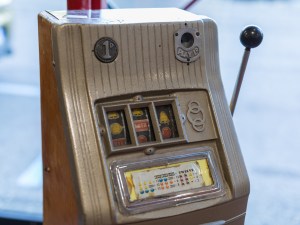
During the 1960s and 1970s, poker machine operations were still relatively primitive by modern standards. Machines were largely mechanical, heavily cash-based and vulnerable to manipulation.

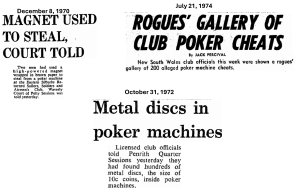
Across the NSW club industry, stories circulated of patrons using wires, magnets, lead discs being used as coins, and other improvised devices in attempts to interfere with machine mechanisms or influence payouts.

Security surrounding gaming operations was often basic, particularly in smaller or rapidly growing clubs where staffing and oversight systems struggled to keep pace with expansion.

At the same time, the sheer volume of coins moving through gaming rooms created operational difficulties of its own. Machines required constant clearing, counting and refilling. Cash handling was labour intensive and exposed clubs to risks ranging from simple human error to outright theft.

These problems were not unique to Panthers. They reflected broader challenges facing the club industry as poker machine revenue expanded rapidly during this period.

For administrators such as Roger Cowan, such vulnerabilities highlighted the need for tighter operational systems and greater technological oversight. At Panthers, this gradually led to innovations in surveillance, accounting controls, machine monitoring and broader administrative systems designed to improve both security and efficiency.

Part of Cowan’s reputation within the club industry stemmed from his willingness to embrace technology earlier than many contemporaries. What later became sophisticated electronic monitoring and integrated management systems began, in part, as practical responses to very immediate operational problems.

The issue was not simply dishonesty. It was scale.

As clubs grew larger and gaming operations expanded, informal methods that may once have worked in smaller suburban venues became increasingly inadequate. Stronger systems, better monitoring and more professional management structures became essential to running modern licensed clubs.

Seen in that light, the technological innovations discussed in Part 9 were not merely about efficiency or modernisation. They were also responses to a rapidly changing gaming environment in which security, accountability and operational control had become central concerns for the industry.


Related Topics


Related Themes

Financial Management · Innovation


To receive new Parts and occasional project updates by email, you may subscribe below.

Readers who hold recollections, documents, or material relevant to this history are welcome to contribute via the Commentary & Contributions page.

Project Updates

Receive updates when new parts are published.

Removing the Football Club Secretary and Treasurer

The removal of Merv Cartwright (Secretary) and Ron Partridge (Treasurer) from their respective roles with the Penrith District Rugby League Football Club occurred against the backdrop of a broader and more complex set of issues than is immediately apparent in the main narrative.

While Cartwright became the central public focus of the dispute, the Board’s concerns also extended to the financial administration of the football club more broadly, including the role of Treasurer Ron Partridge.

Contemporaneous Board papers and meeting records from the period indicate a growing concern among Directors regarding both the financial management of the Club’s football operations and the processes by which financial commitments were being made.

At the centre of these concerns was the relationship between the Licensed Club — which generated the revenue — and the District Rugby League Club, which was responsible for football operations. While this arrangement had supported the Club’s early growth, it also created a structural tension: financial responsibility and operational control were not always aligned.

By the late 1960s, the Board had become increasingly uneasy that commitments were being entered into without sufficient oversight, and in some cases without formal authority. This was not framed as a single incident, but as a pattern that had developed over time.

Internal analysis presented to the Board suggested that the Club’s financial position was more fragile than it appeared. Liabilities associated with player payments, bonuses and sign-on fees were, in the Board’s view, not being fully or consistently reflected in financial reporting. When assessed against normal operating income, there was concern that the Club could not meet its existing commitments without significant restraint.

These concerns were reinforced by a pattern of escalating expenditure. Board discussions from the period refer to sharp increases in allocations to football operations, alongside uncertainty as to how those figures had been determined. Directors questioned both the reliability of the budgeting process and the basis upon which commitments had been made.

In response, the Board moved to assert clearer control over financial decision-making. Proposals and subsequent resolutions emphasised that:

  • no contracts or financial commitments were to be entered into without explicit Board approval;
  • committees operating within the football structure were to act within clearly defined limits;
  • and all funds were to be subject to centralised oversight and reporting.

These measures were not presented as routine administrative adjustments, but as necessary steps to address what was seen as a deteriorating financial and governance position.

At the time the NSW Rugby Football League (NSWRFL) was responsible for the debts of all District Clubs — and should Penrith Rugby League Club Ltd (Licensed Club) stop funding the Penrith District Rugby League Football Club (District Club), the Board was confident it would not prevent the District Club from operating. It could, however, trigger intervention by the NSWRFL as administrators of the Penrith District Club.

Within this context, the recommendation to cease funding unless Secretary Merv Cartwright and Treasurer Ron Partridge resigned can be understood not as an isolated or sudden decision, but as the culmination of these concerns. This was not an easy decision for the Board, a fact reflected in the final paragraph of the Board Resolution.


Resource Material*

The following documents can be seen as PDFs:


Related Material


Related Themes

Conflict · Governance · Financial Management


* Resource material courtesy of The Ausburn Collection


To receive new Parts and occasional project updates by email, you may subscribe below.

Readers who hold recollections, documents, or material relevant to this history are welcome to contribute via the Commentary & Contributions page.

Project Updates

Receive updates when new parts are published.

The Panthers Magazine Arrangement

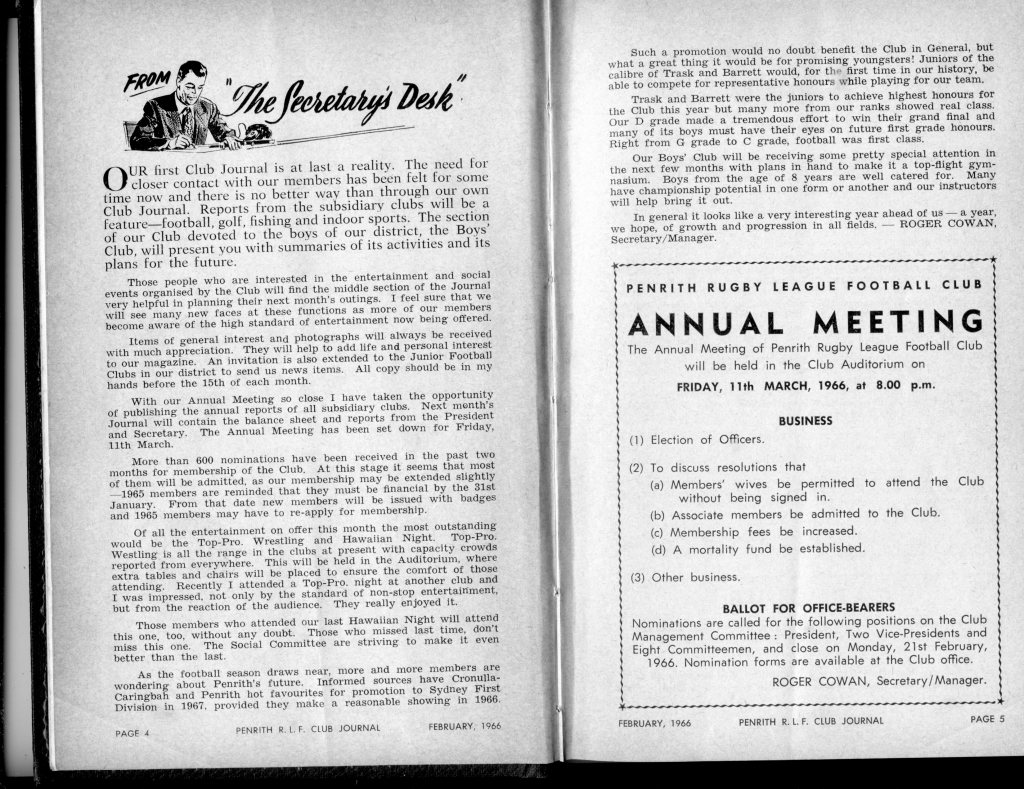
In February 1966, the Penrith Rugby League Football Club published the first edition of its official members’ journal.

The publication, issued monthly, was introduced at a critical point in the club’s development — as it sought admission to the New South Wales Rugby League First Division.

A central feature of the journal was a column titled From the Secretary’s Desk, written by Roger Cowan in his role as Secretary-Manager. In the opening issue, Cowan outlined club activities, membership growth and upcoming events, and referred to the club’s ambition of securing promotion to First Division.

The magazine was largely written and produced by Cowan and served as a means of communicating with members during the club’s First Division campaign.

In June 1968, Phyro Holdings Pty Ltd was registered, with Roger and Phyllis Cowan as directors. The name itself was derived from their first names — Phy from Phyllis and Ro from Roger.

In the years that followed, responsibility for publishing the club’s magazine — The Panthers Magazine — was transferred to Phyro Holdings under an arrangement approved by the club committee. The structure included conditions relating to profit limits, auditing of accounts and the remuneration deetails of Cowan’s role.

The arrangement formalised the transfer of publication responsibilities from the club to Phyro Holdings, under agreed financial and audit conditions.

The magazine arrangement — and the broader financial relationship between the club and Phyro Holdings — was later subject to scrutiny. Questions raised in subsequent decades focused on governance, transparency and the management of related-party transactions.

The Panthers Magazine became much more than a publication for PRLC members – it was a powerful community voice and was distributed to over 200,000 households in the Penrith Junior Rugby League District – Katoomba to Blacktown.

Those issues are examined in more detail in later sections of this project.


Related Topics


Related Themes

Financial Management · Strategic Planning


To receive new Parts and occasional project updates by email, you may subscribe below.

Readers who hold recollections, documents, or material relevant to this history are welcome to contribute via the Commentary & Contributions page.

Project Updates

Receive updates when new parts are published.


The Bungool Picnic and Unpaid Players

This article forms part of the serialised republication of Panthers, Passion & Politics – The Roger Cowan Years.

Start · Reader’s Guide · All Parts


Penrith in the 60s was, in many ways, still a country town. Some of the trains were still steam hauled, and holidaymakers would pass through on their way to the Blue Mountains – or stop off and catch the Bales’ bus out to one of the many guesthouses at Wallacia, some ten miles out of town.

Through 1963-64, Roger Cowan continued teaching while acting as honorary treasurer of the football committee. What started out as an amicable relationship with Merv Cartwright gradually deteriorated into frequent clashes.

The registered club’s main function in those days was to finance rugby league.

In 1964, the registered club committee had agreed to a football budget of £10,000 and player contracts were agreed within that budget. Payday for the players was planned for the traditional end of season picnic on the banks of the Hawkesbury River — Bungool1.

When Cowan went to the club administration to organise the cheques for the players, he was informed that they didn’t have the money. He had no warning of the problem. Merv Cartwright who sat on the registered club committee and was also secretary of the football club, would known much earlier that the Club was in financial trouble — yet the football club had been allowed to proceed on its merry way without any warning.2

Before this Cowan had never thought about getting into club politics. It was this failure — the inability to meet its obligations to the players — that first motivated him to stand for election onto the committee of the licensed club – ‘to understand how £10,000 could be promised and not paid’.

He was elected, and soon after asked to take on the role of treasurer. It quickly became apparent that the club had virtually no systems of control. Dishonesty was widespread, enabled by the absence of basic procedures.

I started to look into why the club wasn’t making any money. We were losing money hand over fist. The bank was threatening to take action. One of the first things I did was to install control systems for poker machines.  This included a monthly analysis of each of the 26 machines to ensure they were operating within carded percentages.

I also put as much time as I could into getting some systems operating. There was no system for stock control, no cash systems, there was nothing. I began with cash systems. We started to count the money, and balance it against the cash register tapes, and so on. Basic stuff, but it had never been done.

 Cash control was a simple system before then. When trading finished for a shift, the cash would be taken to the vault and tipped into a large container with all the cash from other cash registers. Nobody checked the cash register tapes to see if there was a balance. Each morning the money in the container would be counted and banked.

Rumour has it that one employee boasted that he never bothered taking less than a twenty pound note when he wanted some cash. He bought a new car in less than 12 months working as a bar steward.  After getting a system started, I came in one Sunday morning and discovered a £1,700 discrepancy between the cash register tapes and the money we had. That was a lot of money in those days for such a small club.’

At a special meeting, the board decided that the Secretary-Manager Rocky Davis wasn’t managing things properly, and asked for his resignation. There was no suggestion of dishonesty, only mismanagement.

The Club immediately advertised for a replacement. But the small size and low profile of the Club meant that the quality of candidates was not very high. After three months of advertising, they had still found nobody suitable. In the meantime, Cowan continued holding things together in his spare time – evenings and weekends – and continued to improve the systems.

I was doing the job anyway, as well as teaching. I was convinced in my own mind that I could put systems in place to make the place work. So I just said to the committee one night, “I’m prepared to resign from teaching. I’ll take the job for a trial period if you want to give it to me. And I’ll give you a guarantee that if I’m not making a profit within three months, I’ll resign and you can keep looking”. I agreed to commence on a very low salary.

That was October 1965. The Board agreed, and Cowan remained in the position continuously for almost 40 years.

There is a logical question here, of course. Here is a young man – 29 years old, married, four young kids. He’s a schoolteacher, which is a reasonably secure job for life. He suddenly decides to turn his whole life upside down. There is no contract, no security of tenure – just ‘give me three months to make a success of it. If not, I’ll go’.

Phyllis Cowan says it was the challenge.

He loved school teaching, he was an excellent teacher, but he didn’t like the system. I don’t think he wanted to be doing that for the rest of his life. Many people advised him against it at the time. But he always could have gone back to teaching, she said –- it was easier back then.

It was the challenge that attracted him, and kept him there, she said. He was being successful, the club was making money, it was growing, and he was introducing all these new measures. She spoke of a couple of nights in the early days when he took a blanket and pillow and sat on a roof where he could watch for the people that he knew were stealing stores from the club.

Under Cowan’s stewardship, the club began to more stable financially. The systems he implemented, some while acting as treasurer and others when he took the management role, had already begun to have an impact on the profitability of the business.

Within a year, the club had moved out of the red. For the first time, it had the financial stability needed to think beyond survival.


To receive new Parts and occasional project updates by email, you may subscribe below.

Readers who hold recollections, documents, or material relevant to this history are welcome to contribute via the Commentary & Contributions page.

Project Updates

Receive updates when new parts are published.


  1. Bungool’s location was at Cattai on the Hawkesbury River where Riverside Oaks Golf Resort is today. ↩︎
  2. This failure became evident at the end-of-season Bungool picnic, when players could not be paid in full.
    See Beyond the Book: The Bungool Picnic. ↩︎

Part 5 · All Parts · Part 7

Commentary and Contributions

From Tin Shed to Taj Mahal — Scale and Contrast in 1963

In 1963, Penrith and St George Rugby League Clubs each opened new premises. The contrast between them — in scale, cost, and ambition — highlights the gap between an emerging club and one already established as a powerhouse of the game.

To describe Penrith Rugby League Club as a minnow compared to St George Rugby League Club in the early 1960s is no exaggeration.

In 1963, the St George Dragons had already secured seven consecutive premierships, a run that would extend to eleven.

In 1963, both clubs opened new premises.

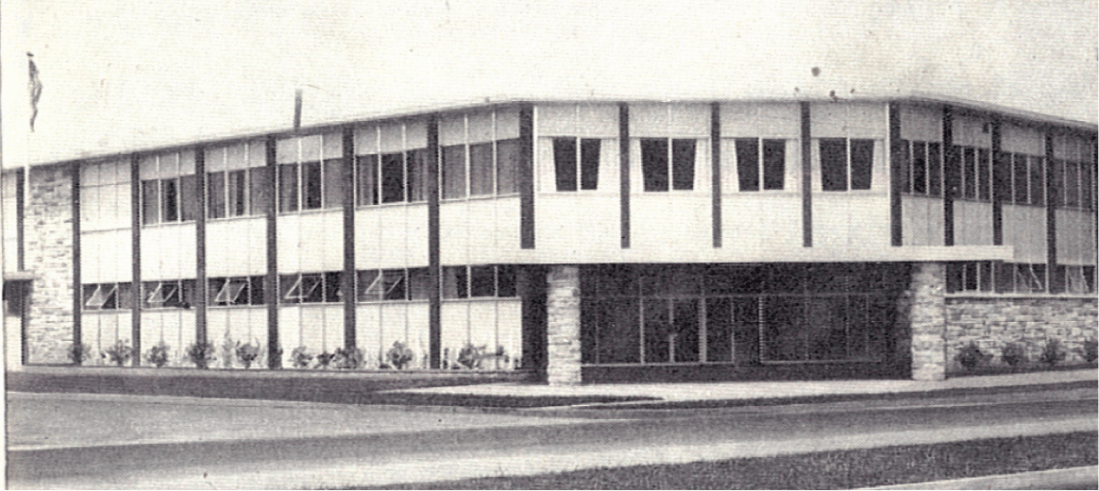
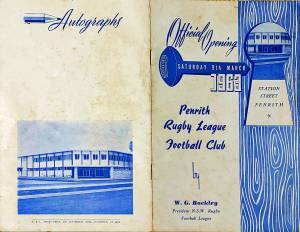
In March, Penrith Leagues Club opened a new building adjacent to the old Boys Club, at a cost of approximately £150,000.

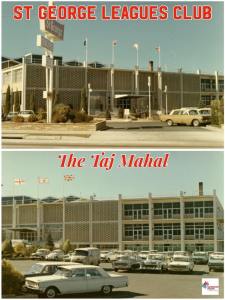
In July, St George Leagues Club opened its new premises at Kogarah, with construction costs approaching £1,000,000.

William “Bill” Buckley (1906–1973), Chairman of the Australian Rugby League, officially opened both clubs. During a tour of the new St George premises, struck by its scale and extensive use of marble, he is said to have remarked: “This reminds me very much of the Taj Mahal.”

The nickname endured.

St George Leagues Club — Photo: Joan Hatton

Both developments marked a move beyond earlier, more modest beginnings — the kinds of facilities often remembered, and sometimes simplified, as the “tin shed” era.

For St George, that transition had already occurred.

For Penrith, it was only just beginning.

The scale of the St George club did more than impress. It set a benchmark — one that emerging clubs like Penrith could not yet match, but would, over time, seek to close.

From the Narrative

This contrast sits alongside the developments described in Part 4 — From Small Beginnings, where Penrith’s early structures begin to take shape against a backdrop of more established clubs.

A Little Extra

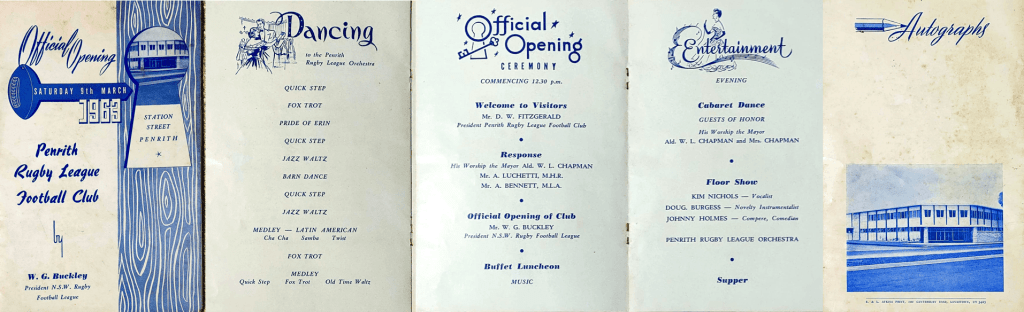
Here is the complete 1963 Opening Program for Penrith Rugby League Club — it was a big day, starting with lunch, then evening and supper — and lots of dancing! And plaudits to the Penrith Rugby League Orchestra who must have exhausted by night’s end.


Related Material


Related Themes

Financial Management · Growth


To receive new Parts and occasional project updates by email, you may subscribe below.

Readers who hold recollections, documents, or material relevant to this history are welcome to contribute via the Commentary & Contributions page.

Project Updates

Receive updates when new parts are published.

The Impact of a Turnover Tax

A turnover tax on gambling is a tax imposed on the total amount of money wagered or “turned over” in a gambling activity, rather than on the profits generated by the gambling operators.

For example, imagine you take $100 to the races, and you place a $100 on the first race, it wins and you now have $350. You continue to bet $50 on each of the 7 remaining races. So, if you add up the amount you bet it comes to $450 – your first bet of $100 plus 7 bets of $50.

A turnover tax on this activity means the tax is calculated on the total value of the the bets placed, $450. Yet, the amount spent by the punter was only $100.

This example shows the very best result for the betting provider would be for the punter to finish the day broke – and the provider would have a revenue of $100. But they would be paying tax on $450.

Of course, it would be possible for the provider to lose hundreds of dollars to this punter, yet still pay tax on the $450 turned over.

Industry opponents of turnover taxation argued that the structure materially reduced operators’ capacity to improve return-to-player rates.

The mathematics of a turnover tax make it extremely restrictive – and, in fact, for some gambling games (like blackjack) even a small turnover tax would mean the game would not be viable.

For example, poker machines in NSW have a minimum return to player rate of 87%.

At a theoretical level this means a couple of things:

  • Firstly, it means the theoretical revenue for the operator is 13% – that is the operator can expect to retain $13 in every $100 staked on their games.
  • Secondly, it means the theoretical turnover for the player is 3.42 times their orginal stake. So, starting $100 and playing until depleted will generate a theoretical turnover of $342.

In the case of a starting stake of $100, theoretically the operator will retain $13. If a 3% turnover tax is applied their obligation to the tax office will be 3% of $342, which is $10.25.

Now, imagine an operator wants to offer a better deal to their patrons with a 90% return to player. So $100 stake produces a theoretical $10 revenue for the operator. The turnover is $388 and a 3% turnover tax will produce a tax obligation of $11.74 – so the tax office will take all the operator’s revenue plus more.

Critics maintained that turnover taxation limited pricing flexibility and distorted game viability.


To receive new Parts and occasional project updates by email, you may subscribe below.

Readers who hold recollections, documents, or material relevant to this history are welcome to contribute via the Commentary & Contributions page.

Project Updates

Receive updates when new parts are published.

Introduction — An Industry Insight

This article forms part of the serialised republication of Panthers, Passion & Politics – The Roger Cowan Years.

Start · Reader’s Guide · All Parts


Because of Cowan’s deep involvement in the licensed club industry, the history of Panthers cannot be separated from the broader history of the NSW club movement..

Phil Bennett1 was an officer with the Liquor Administration Board2 for many years. He remembers some of the interesting episodes. He had first encountered Cowan in the early 1980s. When Treasury was pushing to use turnover as the basis for taxing poker machine revenue, it was Bennett’s job to sell the concept to the clubs. Until then, only gross revenue had been taxed. Bennett said:

The idea was to tax the money being spent by the gamblers — a turnover tax3 — taking it off the top. Roger had a great moral difficulty with this, and he was very vocal.

I wrote a whole lot of papers and reports, and had to present them to the industry. By then I was in the policy section of the Chief Secretary’s department. We used the analogy of liquor . . . Clubs were paying a tax on the purchase of their liquor — which is like a turnover tax. And I also brought out other examples. So, we were trotting out all these arguments, and Roger would come back to me and say ‘that’s completely ridiculous, and a false analogy’. And proceed to explain in detail why it was, and shoot all my arguments down in flames. There was one day I distinctly remember. I had put together this paper and sent it to him, and then we met to discuss it. We were sitting opposite each other in his office, talking about the issues.

Roger presented a different analogy. ‘Look, this is different to a liquor tax. If you go and buy a beer, you pay tax on it at that point. But then you go into the toilet, and you piss it up against the wall, and it goes down the drain and it’s all over. With gaming machines, if you put on a turnover tax, you’re taxing me when I spend it now, and then I get my money back when I get a payout. But then, if I bet it again you’ll make me pay another lot of tax, and when I win again you’ll tax it again, and again, and again.’

He was right, but we were saying that’s the way all gambling is taxed. At the races, the punter is taxed out of the turnover tax. But it was very funny. He sat there, looked across at me and said, ‘well, the person who wrote this paper obviously has no understanding of the club industry.’ He knew very well that I wrote it.

Cowan does not remember being so tactless:

When Phil asked me to discuss turnover tax I was appalled, and my body language was probably negative. I was convinced that one day we would have higher denomination machines and a turnover tax would restrict the return that we could offer the customers. The turnover tax they were proposing was only 3% and that sounded small enough to get acceptance from the industry. But I was concerned it would stifle the growth and eventually it would be unfair to players. I believed that higher denominations would eventually be part of the gaming market — and that should mean offering higher returns to the player. I knew for example that there were machines in the casinos in Las Vegas paying the player 99% — not many to be sure, but it would be impossible to do that under a turnover tax.

A turnover tax would force clubs to have machines set to the lowest possible return to players, and yet, it would be highway robbery to introduce high denomination machines at less than say, 94% return to players.

So, what I was trying to convey to Phil was that they were not looking at the future potential of the industry.

I was so concerned that I called a special meeting of several of the larger clubs and made a presentation to them of the dangers of a turnover tax. It was a long battle and finally the government saw the point and withdrew the proposal. Even though I was probably seen as the leader of the push to have it withdrawn, I never felt any sense of resentment from the government or the department officers . . .

If it had been a Carr/Egan government, I might have been facing a Royal Commission inquiry much sooner.

Bennett says:

You always knew that Roger would speak out if he believed that something was wrong. And he did his research, so he always knew what he was talking about.

Researching this book, I heard many words used to describe Roger Cowan, both positive and negative.

In recent years some have sought to attach another label to Cowan — dishonest.

Barrister Terrence Lynch4 says that from the start, he never believed that the inquiry would find any type of dishonesty in Cowan’s behavior.

I really was very relaxed about the inquiry. If a man is a crook, you don’t get staff five and six years in retirement still volunteering their time to assist him.

Dishonesty was just not consistent with any part of my exposure to what that place was like. My impression of Panthers is of a very internally open organisation. There never seemed to be the sense that if you disagree with Roger, there was going to be any discomfort or risk in doing that. You can’t operate dishonestly in such an open environment. And then, that flowed down through the organisation. I got the impression that he expected those people to be equally open with their own teams.

The events of 2004 have left permanent scars on Roger Cowan. There is no doubt that he sees Panthers as his life’s work, something that he could take pride in on his retirement. In his mind, the Inquiry, and the attendant headlines and publicity, altered that. That Inquiry, and the circumstances surrounding the events leading up to it, is a story that certainly needs telling.

The real story here is the growth of Panthers from a near-bankrupt suburban club into a significant force within the NSW club movement — and how that success eventually drew it into complex and contested political terrain.


To receive new Parts and occasional project updates by email, you may subscribe below.

Readers who hold recollections, documents, or material relevant to this history are welcome to contribute via the Commentary & Contributions page.

Project Updates

Receive updates when new parts are published.


  1. Phil Bennett worked in gaming-related departments within the NSW public service, including Treasury, the Liquor Administration Board, Casino Control and as Senior Policy Adviser in the Chief Secretary’s Department. In 1989 he established Phil Bennett Consulting, advising organisations in the gaming and liquor industries.
    ↩︎
  2. The Liquor Administration Board (LAB) has since undergone structural and naming changes. Its current successor body is the Independent Liquor & Gaming Authority (ILGA) of NSW.
    ↩︎
  3. A turnover tax is calculated on the total amount wagered rather than net loss. For example, if $10 is gambled and returns $100, and $40 of those winnings is wagered again, the tax applies to the total $50 wagered. For a fuller explanation, see The Impact of A Turnover Tax in Beyond the Book.
    ↩︎
  4. Terrence Lynch was a member of the legal team engaged to represent Panthers during the Inquiry. Senior Counsel for the Panthers legal team was Bernie Coles KC.
    ↩︎

Part 2 · All Parts · Part 4

Commentary and Contributions