Maintaining Momentum — Beyond the Clubhouse

This article forms part of the serialised republication of Panthers, Passion & Politics – The Roger Cowan Years.

Start · Reader’s Guide · All Parts


With Mulgoa Road established, the focus shifted to sustaining momentum and extending  Panthers’ presence beyond the club itself.

After the blaze of publicity that followed the 1984 opening of the Mulgoa Road premises, Cowan and the management team were looking for ways to keep up the momentum of the Panthers brand.

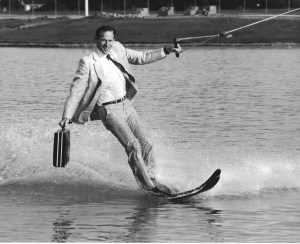
Around the same time as Mulgoa Road opened its doors, a new water-ski concept had been developed in a Perth suburb. A man-made lake had been created for water-skiing with a novel twist. There was no need for boats. Water skiers queued and were given instructions as they waited their turn. As they neared the top of the queue, they were handed a ski rope. The operator would pull a lever, the rope would become attached to the moving cable and the skier would take off for two or three circuits of the lake.

When the managers of the Perth enterprise heard of Panthers, they made contact.  They approached the Club to explore whether such a park might be feasible for Penrith. Representatives of the Club inspected the WA operation and carried out studies to determine whether it could be a worthwhile investment.

Here was a unique and interesting way to build the Panthers brand and generate publicity.

Further, there was a large area of land that had been earmarked for future use, but it was too low-lying for any development – it needed to be filled. Excavating two large lakes would provide the hundreds of thousands of cubic metres of fill for this low area. They would not be paying to dump the excavated fill, nor would they need to buy any to raise the land.

One important point was overlooked in assessing the financial feasibility of this venture – the climates of Perth and Penrith are similar, except that Perth gets most of its rainfall in winter, whereas Penrith is wettest in summer.

In 1987-88, its first year, the park – named Cable’s Ski Park -made a profit, generated enormous publicity and provided all the fill needed for the lower areas of property. It was a win all round.

In the second year, it started to rain in December and continued through most of January – the summer school holiday period, and the most important revenue generating part of the year. The following year the weather pattern was repeated.

It turned out that a dry December-January period was the difference between profit and loss for the entire year. When the novelty died away after a few years, so did the publicity, and the park struggled to break even. For a while it was a great attraction, helping to raise the city’s profile, along with Panthers. Eventually repeated losses could not be justified, and Cable’s was closed in 2002.1

The ski park decision has been criticised by some, but Cowan later reflected that factoring in the fill requirements for other parts of the property meant the real cost of building the park was quite low. He says:.

On the one hand, the fact that it had to be closed down says very clearly that it was a failure. There is another perspective. If we were able to go back and I was faced with the same situation, I would have no hesitation in making the same decision. The gains far exceeded the losses. The ski park did more to boost the Panthers name throughout Australia than anything else we did, apart from moving to Mulgoa Road.
Another ‘outside the square’ decision for Panthers was the purchase, in 1993, of Nepean Shores. It was an upmarket mobile home village located close to the Nepean River. It had more than 80 cabins, all fully occupied, and several function rooms. The developers had overspent on it and been forced to appoint an administrator, so it came on the market for much less than its cost.

Management inspected the site. They discovered that the current income was less than the holding costs of interest, rates and maintenance – but not much less.

The conference rooms were a strong attraction. They had been tastefully constructed and were practical and functional. The Club’s conference market was growing, and business was often limited by availability of rooms. Nepean Shores could open up new opportunities.

Cowan says Nepean Shores had been finished to a high standard, in fact it was probably overdone for the income it could generate. The infrastructure, although a bit run-down, could be revitalised at a relatively small cost. The purchase price was $3 million. To the Board and management, it seemed an excellent investment with the potential to be further developed for a good cash flow.

Nepean Shores enhanced the status of Panthers as a provider of a range of conference facilities. It became a venue of choice for Panthers’ management and Board conferences. It remained part of the Panthers portfolio for many years and proved to be one of the Club’s most successful commercial investments.

Roger Cowan believes that the physical side of building a business – the buildings, infrastructure, equipment and systems – make up only a very small part of the whole when compared with the other side – the people.

It’s the people who make it work, the relationships and networks, the supporters and the critics. The culture of a company develops automatically as the various influences take dominance for periods. The philosophies, values, beliefs, tall stories and historical landmarks combine to affect decision making and strategy in a dramatic way.

Strange to say, culture was an important concept at Panthers even before the word became a recognised part of the management language.

Behind each of these decisions was a consistent thread — the belief that while buildings and assets matter, it is people, relationships and culture that ultimately determine success – a theme that would continue to shape the Club in years ahead.


To receive new Parts and occasional project updates by email, you may subscribe below.

Readers who hold recollections, documents, or material relevant to this history are welcome to contribute via the Commentary & Contributions page.

Project Updates

Receive updates when new parts are published.


  1. Cables reopened in 2009 as Cables Wake Park and continues operate under a lease from Penrith Rugby League Club Ltd. ↩︎
← Part 13 · All Parts · Part 15 →

Commentary and Contributions

Building the Future, A Block at a Time

This article forms part of the serialised republication of Panthers, Passion & Politics – The Roger Cowan Years.

Start · Reader’s Guide · All Parts


Long before Mulgoa Road, the Club had already begun to adopt a deliberate approach to property.

From the time that Cowan took on the job, the Club’s philosophy was to invest in property that could support future development – even if it meant increasing debt.

In 1965 the Penrith Rugby League Club was boxed in on all sides. The main parking area for its customers was the Council Swimming Pool on the opposite side of Station Street, or on the streets nearby. The old clubhouse had been built in 1955 and provided facilities for a Boy’s Club. In 1963, a new clubhouse was completed next door, and the old building was dedicated to Boys Club Facilities.

By 1970, the Club needed a major extension, and the Boys Club building had to be demolished. It was replaced by the Police Youth Club, further North on Station Street, in a project funded, uniquely at the time, jointly by the Club and Penrith City Council.

From the time the Club had overcome its financial problems and secured a position in the first division rugby league competition, Cowan and the committee looked for solutions to a parking problem that could only become worse as business grew. The Club quietly began to buy the houses surrounding the site. When the strategy became known, two of the closest residents decided to dig their heels in and hold out for some absolutely extraordinary prices.

As the Club’s fortunes improved, management increasingly found itself paying premium prices for properties it wished to acquire. One five-acre property on the opposite side of Reserve Street would make an ideal car parking area. This and an adjacent property were on the market, but the owners were adamant they would not sell to the Club.

By this time Cowan had established the private family company, Phyro Holdings Pty Ltd.1 When that company made a lower — but still very reasonable — offer to the owners they happily accepted. After settlement, the properties were transferred to the Club at the same cost. Gradually, the Club acquired all the properties around it and on both sides of Reserve Street. Some houses along Station Street were also purchased and rented out until the land would be needed.2

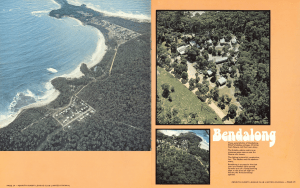
In the late 60s, the Club had also purchased some holiday cabins at Bendalong, south of Nowra, for $25,000. The club sponsored an active fishing club at that time, and it was a popular venue for members looking for a subsidised holiday. A ballot was held each year to see who the lucky tenants over the Christmas holidays would be. That property was sold in the 1990s for $900,000.

Mulgoa Road was added to the property portfolio in 1971.

Even with the properties it had purchased, the Club was still boxed in and very limited in its potential for growth. Parking would always be a nightmare on this site and the use of the swimming pool carpark by the Club’s customers was causing conflict. It was in the middle of a residential area and noise complaints were building momentum. Long-term planning for this site would be difficult.

However, if all the properties were consolidated, it would be an ideal site for a shopping centre, and around 1978 there was interest from a developer. A price of $3.25 million was negotiated subject to council approval of a shopping centre and the consolidation of all the properties including some roads.3 That caused difficulties, lengthy delays, unforeseen charges and a lot of bitterness but it was finally achieved. At that time, the book value of the properties was less than $1 million and it was a good profit for the club.

But it all hinged on Council approval of a shopping centre. Cowan says the first response was an almost blunt: “no chance”.

More work, feasibilities, and growth forecasts eventually led to agreement for a major retailer — but no specialty shops.

However, shopping centres depend on specialty shops. Further negotiations led to a revised proposal, but the permitted mix remained too limited to be viable, and time was passing.

In the meantime, the developer was spending more money on buying neighbouring properties and updating plans and information for Council.Finally, the development application was approved, and the Club was paid. Within a few days the developer sold the site to another developer for $7 million. The other properties purchased by the developer would allow for a shopping centre quite a bit better than the one we had approved. Nearly four years had elapsed from the time the deal had been agreed. A relatively small annual appreciation would have added well over a million to the value of the Club’s portion. Long delays cost money. And we did not have the experience of developers who could see other ways of doing things for a better result.

The first developer certainly made a nice profit and, eventually, so did Panthers. However, the sequence of events gave rise to one of the enduring myths surrounding Cowan and later became one of the matters that prompted a police investigation.4

This willingness to think beyond conventional boundaries would continue to shape decisions — not just in land, but in how the Panthers brand evolved.


To receive new Parts and occasional project updates by email, you may subscribe below.

Readers who hold recollections, documents, or material relevant to this history are welcome to contribute via the Commentary & Contributions page.

Project Updates

Receive updates when new parts are published.


  1. Phyro Holdings Pty Ltd becomes very important in this narrative. Phyro is derived from the names Phyllis and Roger.
    ↩︎
  2. One of these houses was 138 Station St, where the Cowan family lived from 1968-1972.
    ↩︎
  3. See Beyond the Book — Negotiation with Council — The Station St Road Closures.
    ↩︎
  4. The allegations arising frm these transactions are examined in Parts 22-25. ↩︎

← Part 12 · All Parts · Part 14 →

Commentary and Contributions

Negotiating with Council — The Station St Road Closures

A removed section from the original Chapter 5: Building the Basics — Business Principles and Property. This examines the challenges faced in negotiating with Council over the Station Street site.

Roger reflected that certain individuals within Council held the view — and perhaps the expectation — that he would eventually be taken down a notch or two. To this day one aspect of this attitude irks Cowan, describing it as one of his worst memories.

While others involved in the negotiations may have viewed the issues differently, Roger believed the Club received little recognition for its contribution to the community. In his view, the charges and conditions imposed during the sale and development process reflected a lack of support for what Panthers was attempting to achieve.

I think the Club was treated very unfairly by Council. Before we could start building on Mulgoa Road, we had to sell the Station Street site. Council made it extraordinarily difficult. One of the conflicts related to two roads on the Station Street property. One of them was no more than a line on a map. It had never been a road. But the only way we were going to be able to sell that property was to negotiate with Council. The price Council sought was $850,000 — around a quarter of the total amount the Club expected to receive for the entire property.

I tried everything to get a better deal. I told them of a similar case where a club had been able to negotiate an agreement with its local council to close a road for the nominal sum of $1, as a sign of support for the club.

Our involvement in our community was far greater than that of the other club. For instance, we had previously agreed to a joint venture with Council to build a Police Citizen’s Boys Club in Penrith. It was the first boys club ever built without the need to raise funds from the public. We were sponsoring most sports in the area. On top of this the Club’s work to get Penrith to the elite level of rugby League had dramatically increased the city’s profile. I thought we had earned the right to support from Council, rather than obstruction. The city was benefiting on a number of levels from the work we had done, and it was giving nothing back. In fact it was profiteering from our planning.

I told them what we were planning to do would be a tremendous boost for Penrith. But all they saw were the problems, rather than the advantages.

The roads incident was not the only problem imposed on us by Council over that property sale. Another episode contributed to a very nasty police investigation a few years later.

One of the key issues underlying these negotiations related to what are known as paper roads. Paper roads are sections of land set aside by councils for roads in the future. According to Pat Sheehy:

Council planners had discovered the paper road in earlier negotiations for the property. It meant that Panthers did not own the whole site, with the result that Council said “OK, if you want to buy that land back from us, this is what we’re going to charge. All this happened before I was on council, but as far as Panthers was concerned it was absolutely exorbitant.

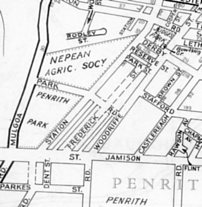
Robinsons 1957 Street Directory showing Frederick St ( a “paper road”) between Station & Wooddriff Sts. The other street in the negotiation was Park St.

Cowan said the problems extended beyond the property sale and continued into the approval process for the new site:

Council imposed a per hectare sewerage fee on the property based on the total area of land we owned. We were planning to build the club on an area of about 8 hectares. Most of the land was flood-prone, so you couldn’t build on it anyway. But we were hit with this huge bill, based on 86 hectares.

We had to negotiate to defer the payment, but this also became an issue. Even though we eventually came to an agreement, there are still people on Council who believe that Panthers ripped off the Council over that sewerage fee. Under the circumstances, that’s quite laughable

These issues illustrate the complexity of the negotiations and the differing perspectives that would continue to shape relations between the Club and Council.


Related Topics


Related Themes

Governance · Growth · Board Decisions · Licensed Club · Conflict


To receive new Parts and occasional project updates by email, you may subscribe below.

Readers who hold recollections, documents, or material relevant to this history are welcome to contribute via the Commentary & Contributions page.

Project Updates

Receive updates when new parts are published.

The Cow Paddock Purchase

This article forms part of the serialised republication of Panthers, Passion & Politics – The Roger Cowan Years.

Start · Reader’s Guide · All Parts


There was one more monumental event for the Penrith Leagues Club in the seventies.

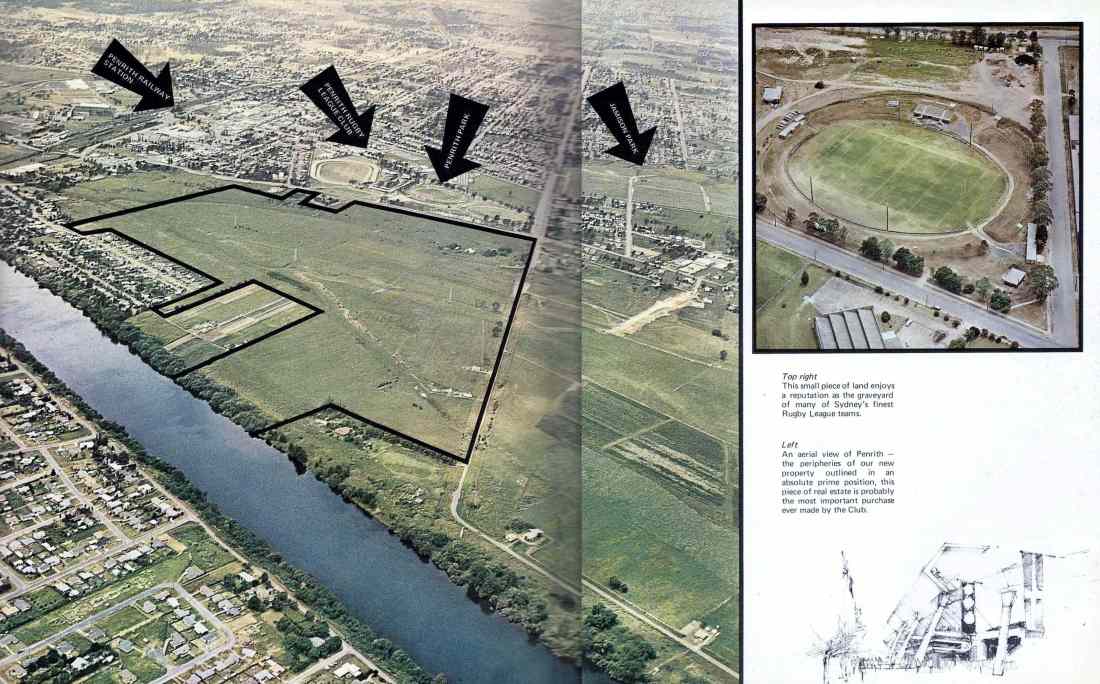
In 1971, the club became aware of a property on Mulgoa Road that was for sale for around $2 million.  It was nearly 100 hectares, with large sections of swampy dairy farmland. Parts of it extended all the way to the Nepean River.

In Cowan’s eyes, Mulgoa Road was destined to be a major link in the future. The part of the property fronting Mulgoa Road, about 10 hectares, had already been zoned for residential development. Because of the residential zoning, he saw the purchase as a low-risk strategy, although it would be a massive investment for such a small club. The land would provide enormous development options for both the registered club and the football club. He became a passionate advocate of acquiring the property.

When he first floated the idea of buying the Mulgoa Road property, most people thought he was crazy. The price on the property was $2.25 million, not an amount that could be shrugged off easily. It had to be financed and the Club’s bankers refused. Undaunted, Cowan negotiated to transfer financial dealings to another bank where the management could see that the Club was going places and was worthy of support.

The criticism came from many quarters. One local newspaper ran the headline, “Roger’s Pipe Dream”.

‘People called it Frog Hollow’, says Don Ellks, one of the senior managers at the time. He says people were either laughing or sceptical. ‘It was very difficult to convince the Board, but Roger persisted and eventually won out. It showed enormous vision when he was being ridiculed from every quarter.’

Don Feltis, later a director at Panthers, was at the time a member of the police force in Penrith. He remembers a police inspector friend telling him the purchase was the worst decision the Club ever made. ‘It’s too far out of town. No-one is going to go that far to go to a club.’

Anyone who has ever visited Panthers’ Penrith club, exiting the M4 and travelling along Mulgoa Road, will know that the club is the focal point of a thriving commercial centre outside the city’s CBD.

But in 1971, once it left Penrith’s main street, Mulgoa Road was little more than a country road. It paralleled the Nepean River, heading out in the direction of Warragamba Dam. Along the way it passed through Wallacia, with its impressive Tudor-style hotel, seen by some at the time as an alternative to Medlow Bath’s Hydro Majestic for honeymoons and romantic trysts.

Former director Tom Wilson agreed that many people thought Roger was mad when he proposed the purchase.

But they thought he was mad about a lot of things. At one time we went and had a look at Australiana Village, out along the Hawkesbury near Windsor, when it came up for sale. We looked at buying other land in Penrith too, but at the time we thought it might be overextending. But Roger could see how that whole area was going to go ahead.

Phyllis Cowan remembers that Jamison Park — now one of Penrith’s major parklands with playing fields and recreational areas — was also considered by Cowan as a possibility to expand the club. It was covered in thick scrub and even further out of town.1

There was a lot of discussion about the land purchase, Max Connors recalls.

Many people in town were against it and some on the Board were not sure. But Roger was very persuasive, he saw it as a great opportunity.

Barry Hubbard said the criticism came from locals, club members and from Council. People were saying,

Why on Earth would they want to buy that swamp? You’ll never be able to build anything on it.

The view from corner of Mulgoa & Jamison Rds looking west. (Unknown source.)

After about four months of deliberations, the Board finally agreed to the purchase.

Hubbard’s first visit to the property did not go well. He had seen the property from the road, but once the decision was made, he and another director, Murray Clarke, decided they wanted a closer look.

We were in Murray’s four-wheel drive. We drove in about 100 metres, and the car was up to its axles in mud. “You’d better get out and have a look”, Murray said. I stepped down, and I was up to my knees. We eventually got the car out, and I went back to the club to clean myself up before I went home.

The boardroom had its own bathroom, so Hubbard decided to wash his trousers in the basin. It was the classic scenario of ‘one of these days, you’re going to get caught …’ . When sprung by the chairman, in his boxers, doing his laundry in the washbasin, he explained that he had just inspected the club’s new site.

Phyllis Cowan says she could never have imagined in 1971 what the Club would become. She could see the drive her husband had, though.

I think that Roger knew, right from the start. And I think if he was still there, he’d still have the same dreams and visions. He was always very conscious of what it was doing for Penrith, that it was putting the area on the map. His sense of community was very strong. Even in the early days he often talked about Penrith becoming a major centre in the state, and how the Club could help.

Pat Sheehy has been on Penrith Council since 19872, he says:

Panthers has been an asset to the city of Penrith for the very simple reason that people found out where we were. So, we benefited as a community by that exposure – and that advertising didn’t cost us anything.

The relationship between Panthers and Council has at times been symbiotic, and at others almost parasitic, says Sheehy.

What stage it was at depended on where you were standing. Often Panthers thought that we were the greatest mongrels on Earth, and just as often council thought the same about Panthers.

But the two have worked together on many community projects and are always ready to forget their differences in times of local crisis, such as bushfires and floods.

Council was particularly opposed to the development of a club on Mulgoa Road. One of the reasons given was the land’s proximity to the Jamison Hospital and the noise that a new club might generate. But the current club was quite close to the town, in what was essentially a residential area. Ellks says the neighbours were already starting to complain about the noise, and there were some problems with young people hanging around in the street. The Club was growing, so the complaints could only increase.

Although he wasn’t on council at the time of the purchase, Sheehy was living and working in Penrith, and has heard much of the history from council colleagues.

Roger had the vision for that land long before anyone else ever saw it. All the pundits around town were saying, “What do they want to move there for? It’s on the edge of bloody town, no-one’s going to go there”.

He was able to cut through a lot of the wowserism that was current in council in those days. I would think that most councillors were middle-aged men in grey suits, who were not really into the whole club scene.

 And he had no background in clubs – it was quite brave. What he was seeing was enormous potential, where most of us were still seeing the country town where we’d grown up. He had this whole concept of what Panthers could become, which I don’t believe was shared by many people. He certainly had to convince the board – and he didn’t get a lot of support from the people on council at the time.

Yes, he was definitely seen as an upstart. Especially wanting to set up this huge expanse of club-land. They thought he was biting off more than he can chew, driving too far, too quickly. To some extent, I think the belief – and hope – in council was that this bloke will end up being put in his place.

That thinking was to continue, at least in some quarters, over the entire Cowan years at Panthers. One particular aspect irked Cowan for the rest of his life — how Council managed the disposal of two roads on the Station Street property. For further background see Beyond the Book — Negotiating with Council: The Station Street Road Closures.

With the purchase of the Mulgoa Road property going ahead, Roger Cowan faced the prospect of raising the money to develop the site. Cowan came up with some unusual ideas about how to do it, says Tom Wilson.

Anyone who knows Penrith knows that there’s vast deposits of sand and gravel under the land all along the river, right through to Castlereagh. The quarries on the northern side of the city have been operating for many years. One of Roger’s early concepts to finance the development was to mine some of the blue metal under the new site. The idea was to sub-contract the work out to BMG, who would take it over the river to Emu Plains and process it.

The concept did not get very far. There was no way it would ever be approved, given the position and the need for thousands of noisy trucks plying back and forth on the edge of town, holding up traffic on the narrow bridge across the river. But he said it was typical of Cowan’s style, to look beyond what’s in front of your face and see what could be.


To receive new Parts and occasional project updates by email, you may subscribe below.

Readers who hold recollections, documents, or material relevant to this history are welcome to contribute via the Commentary & Contributions page.

Project Updates

Receive updates when new parts are published.


  1. Jamison Park already included playing fields, the scrub referred to here was at the southern end of the Park.
    ↩︎
  2. Pat Sheehy retired from Penrith City Council in 2008. He passed away in 2025. ↩︎

← Part 11 · All Parts · Part 13 →

Commentary and Contributions

Entertainment, Experience & Prestige

This article forms part of the serialised republication of Panthers, Passion & Politics – The Roger Cowan Years.

Start · Reader’s Guide · All Parts


With a broader audience now emerging, attention turned to what would bring people in — and keep them coming back.

Another early innovation was an in-house band, fully employed by the club. Rhind believes it was one of the first in the industry — and unheard of for such a small club. At the time, the Board was resisting putting poker machines in the upstairs auditorium area.

Roger persisted, finally convincing them to trial half a dozen machines upstairs for four hours on a Saturday night — between 6 and 10pm. He and a couple of the assistant managers would carry them upstairs and bring them back down again later.

The trial was successful; the figures increased, and the machines went upstairs permanently. 

Rhind says he and Cowan were both in their thirties but most of the Board at the time were older men who sometimes found it a bit more difficult to cope with all the change being promoted by management.

However, they all shared a quality that would help overcome obstacles. They had a strong sense of ownership of the club they had helped build, and they wanted it to be secure for the future.

There were no hidden agendas and no ambitions of personal gain. It was about loyalty to a common cause. It was their club, and they would do whatever was necessary to protect it.

In the early 1970s the club began to put on prawn nights, other special nights, Sunday afternoon concerts and talent quests. Max Connors recalls,

Mum and Dad would come in for whatever was on, and they would always put a few bucks in the pokies. Roger was doing surveys all the time. He told the board that we had to start to give a little back to people to encourage them to come to the club, even though we might lose a little money on the prawn nights.

Bringing in the couples meant that women were starting to come to the club. It was changing the whole social scene. Back then, there were not many places that women could go, especially if they were on their own. They could come in either with a partner, or a girlfriend, and enjoy a regular night out.

The final shift away from the club’s traditional male bastion came with the launch of what became known as the “purple passion pit”, one of the new extensions to the club. Kevin McGrath remembers,

The room was quite stunning, with beautiful décor, purple furniture and fittings and large fish-tanks along one wall. It had poker machines, comfortable lounges and a full bar and it very quickly became the most popular area in the club.

Also, to attract the mixed market, the club began to focus on entertainment. This was an extraordinary time for the Penrith Leagues Club, says Bryn Miller, who was part of the club’s entertainment team in the seventies.

The first auditorium only held 580 people, so by today’s standards, it was not a big room. Don Ellks was the entertainment manager at the time, and he and Cowan formed an association with an agent, John Hansen. The Board approved their recommendation that the club set up its own entertainment agency as a joint venture with Hansen.

Through the new company, Prestige Attractions1, the club set out to bring in major overseas acts — performers who were appearing at leading Sydney nightclubs such as Chequers2, as well as venues like St George Leagues and Souths Juniors — artists such as Roy Orbison, Rolf Harris, Jerry Lee Lewis, the Hollies, and the Mamas and the Papas.

But we would get them on Tuesday nights — traditionally a dead night in the entertainment industry. Most artists didn’t get bookings for Tuesdays, so we could get them at a good rate. We would put on prawn nights, and beef and burgundy nights, and still charge reasonable prices. These shows were every second Tuesday, and the response was phenomenal. People came from all over Sydney.

We needed to find a way to get more people in, and at the time, there was a fountain in the middle of the auditorium. We ripped that out, and the room was able to hold 800.

We started to advertise in Sydney newspapers, which was our first real exposure out of Penrith. Here we were, this little hick country town, and we were really getting known out there.

Miller adds,

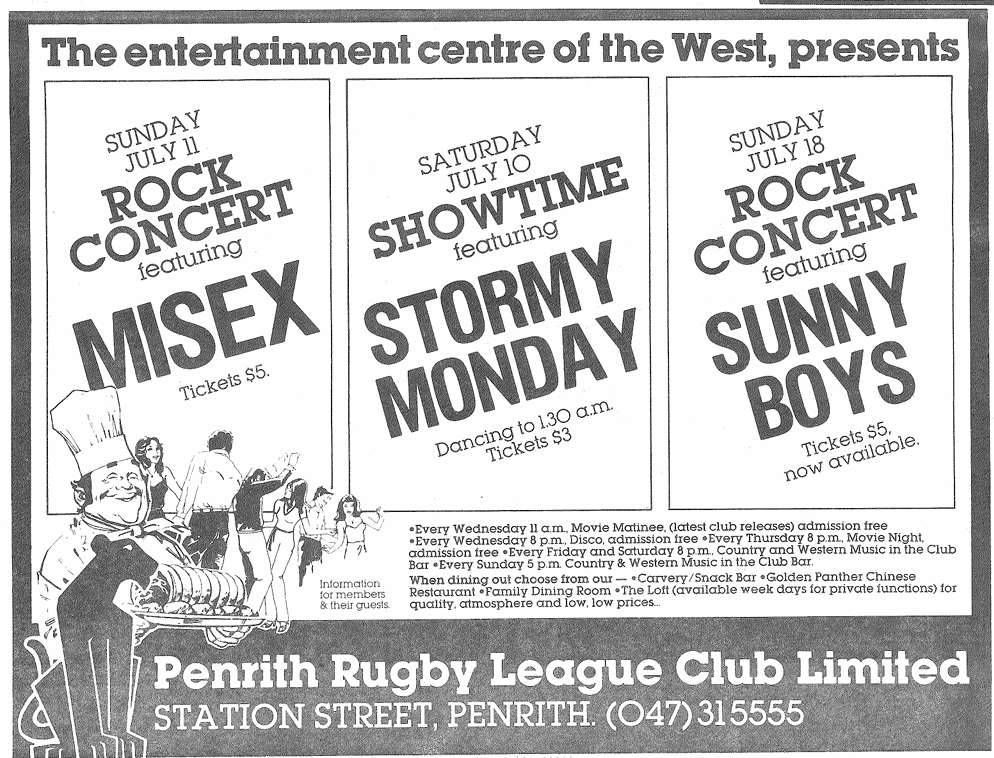
Sundays were another big night. It was Australian rock night, with bands such as Skyhooks, Sherbert, the Little River Band and INXS appearing in the auditorium.

But the building of success inside the club was creating pressures that could not be resolved within its existing footprint.

1982 Advertisement for the week’s rock entertainment.

To receive new Parts and occasional project updates by email, you may subscribe below.

Readers who hold recollections, documents, or material relevant to this history are welcome to contribute via the Commentary & Contributions page.

Project Updates

Receive updates when new parts are published.


  1. Prestige Attractions was a joint entertainment venture involving Penrith Leagues Club and entertainment promoter John Hansen during the 1970s.
    ↩︎
  2. Chequers was one of Sydney’s best-known nightclub venues during the 1960s and 1970s, regularly hosting major Australian and international entertainers ↩︎

← Part 10 · All Parts · Part 12 →

Commentary and Contributions

Feeney Electronics – Ahead of its Time

The following material draws upon club publications from the early and mid-1970s, later interviews and recollections from former Panthers staff and executives.

By the mid-1970s, Penrith Rugby League Club was doing something few licensed clubs in Australia would even have contemplated — experimenting with computerised gaming and security systems.

The project emerged from a practical problem. As poker machine revenue increased across the club industry, so too did concerns about theft, scams, inefficient cash handling and poor operational oversight. Panthers had already experienced some of these issues directly. Roger Cowan believed tighter systems and better information could reduce losses and improve efficiency.

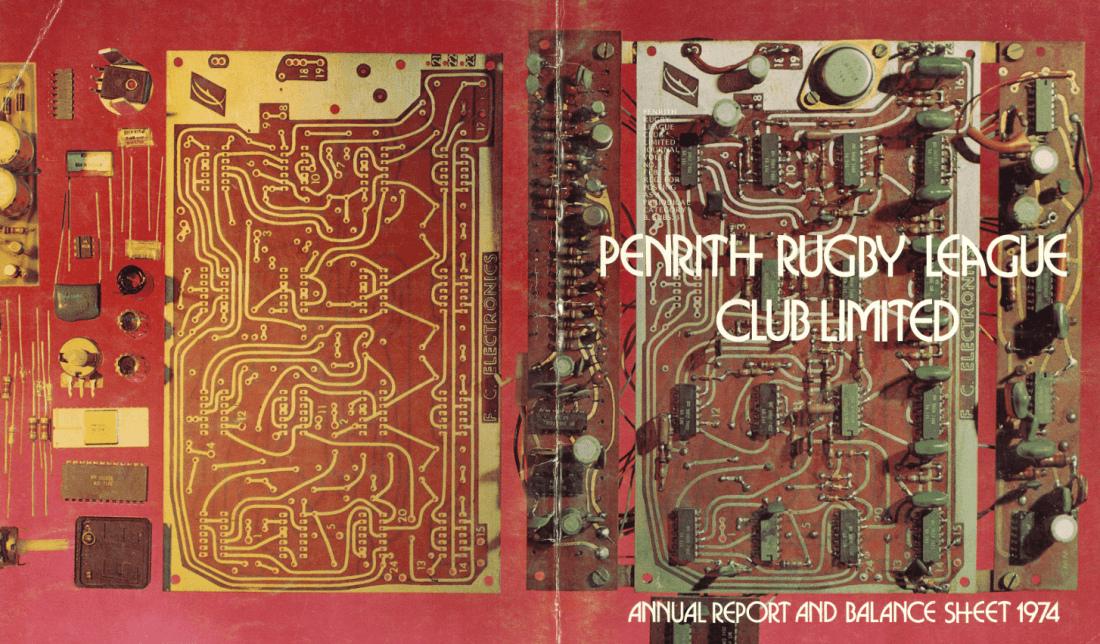
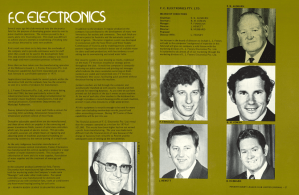
What followed was an ambitious venture into electronics and computer technology through a company known as F.C. Electronics Pty Ltd.

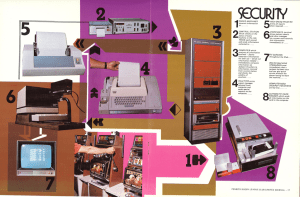
Contemporary club material described F.C. Electronics as producing “probably the world’s most sophisticated poker machine security system”. While that language reflected the promotional enthusiasm of the period, there is little doubt the system was unusually advanced for an Australian club environment of the 1970s.

The system attempted to electronically monitor poker machine activity from a central control point.

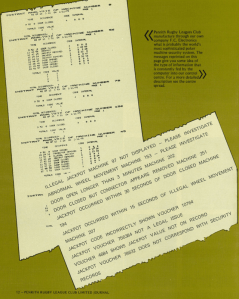
According to material published by the club, poker machine events were coded and transmitted to television monitors around the club, allowing supervisors to immediately identify jackpots and machine activity. The system also attempted to monitor irregularities including abnormal wheel movement, door openings and jackpot inconsistencies.

The operation relied on technology that, at the time, would have appeared extraordinary to most club employees and patrons. The club’s own promotional material featured computer consoles, printers, monitoring screens and electronic reporting systems — all at a time when many organisations still relied entirely on manual record keeping.

Former Panthers executive Bryn Miller later recalled that the system was “so far ahead of its time” that most clubs did not even possess a computer when Panthers was experimenting with electronic monitoring and reporting.

The project extended beyond poker machine security. F.C. Electronics also produced industrial control equipment and commercial products including lighting dimmers and environmental control systems. Club publications noted that the company’s capabilities had expanded sufficiently for it to seek work beyond the club industry itself.

Yet the venture also carried substantial cost and risk.

Club material acknowledged that F.C. Electronics operated at a financial loss during part of this period, while Roger Cowan later conceded that Panthers may have persisted with the project longer than it should have. Had the technology evolved commercially the way he hoped, the rewards may have been significant. Instead, the project became one of several ambitious experiments that pushed the club into areas rarely explored by licensed clubs of the era.

Even so, many who observed the system believed its core ideas eventually became standard throughout the gaming industry. Automated monitoring, centralised reporting, electronic jackpot recording and machine data analysis are now routine parts of modern club gaming operations.

In that sense, the Feeney Electronics project reflected something larger about the Panthers administration during the Cowan years. The club was rarely content simply to follow established practice. Whether the experiments succeeded or failed, there was often a willingness to try ideas that others considered unrealistic, premature or unnecessarily ambitious.

Feeney Electronics was one of the clearest examples of that philosophy in action.


Related Topics


Related Themes

Financial Management · Innovation


Image Credits: All images in this post — including the feature image — are from Panthers Annual Reports. These were kindly provided by The Ausburn Collection.


To receive new Parts and occasional project updates by email, you may subscribe below.

Readers who hold recollections, documents, or material relevant to this history are welcome to contribute via the Commentary & Contributions page.

Project Updates

Receive updates when new parts are published.


Panther Stamps

In modern clubs, loyalty systems are everywhere.

Members accumulate points through gaming, dining and entertainment spending, redeeming them for meals, prizes, discounts or benefits through sophisticated computerised systems linked to membership cards and databases.

Security surrounding gaming operations was often basic, particularly in smaller or rapidly growing clubs where staffing and oversight systems struggled to keep pace with expansion.

Long before those systems became standard across the club industry, Panthers experimented with an early version of the same idea.

It was called Panther Stamps.

Introduced in 1972, the scheme rewarded patrons — with bonus stamps that could later be exchanged for prizes and trophies. While simple by modern standards, the concept reflected a surprisingly advanced understanding of customer loyalty, repeat visitation and member engagement

The Panthers Annual Report for 1972 described the program as:

“one of the most outstanding successes we have ever had.”

The scheme had officially commenced on 10 July 1972 after several months of delay caused by what the club described as “security and administrative problems involved.”

Even at this early stage, Panthers recognised that a rewards system required careful operational controls, stock management and accounting procedures.

Within less than six months:

  • and prizes worth approximately $22,000 at cost price had been distributed.
  • members had collected more than 150,000 stamps
  • over 90,000 had already been redeemed

The prizes ranged from trophies and sporting awards through to toys and household items. The report noted that demand became particularly intense in the weeks before Christmas, with thousands of dollars’ worth of toys redeemed by members.

Importantly, Panthers did not present the scheme simply as generosity or entertainment.

Club management acknowledged that while the program carried significant administrative costs — including staffing, storage, stationery and prize purchasing — they believed the increased engagement from members more than justified the expense.

In effect, Panthers had identified an idea that would later become central to the modern club and gaming industries: reward loyalty, encourage repeat visitation, and strengthen the relationship between the member and the venue.

The system also demonstrated the increasingly sophisticated operational mindset developing within Panthers during the early 1970s. By this period, the club was not merely expanding physically — it was experimenting with new forms of marketing, patron engagement and gaming promotion that were relatively advanced for the time.

Although Panther Stamps relied on physical booklets and manual administration rather than computers and swipe cards, the underlying principle was remarkably familiar to modern readers.

Today’s digital loyalty programs — with their points systems, rewards catalogues and member incentives — are built upon many of the same ideas.

While modest by modern standards, Panther Stamps reflected the growing importance of structured member engagement within the evolving licensed club industry of the period.

Panther Stamps were simply an early analogue version of that future.


Related Topics


Related Themes

Financial Management · Innovation


To receive new Parts and occasional project updates by email, you may subscribe below.

Readers who hold recollections, documents, or material relevant to this history are welcome to contribute via the Commentary & Contributions page.

Project Updates

Receive updates when new parts are published.

The Walls Come Down

This article forms part of the serialised republication of Panthers, Passion & Politics – The Roger Cowan Years.

Start · Reader’s Guide · All Parts


Clubland in the fifties and sixties was overwhelmingly a male domain — more a bastion than a business.

When Roger Cowan arrived, the ‘Long Bar’ extended the length of the building, and it was for men only. There was also the Sports Lounge, with its dartboards and pool tables. It too was restricted to men.

As in most clubs and hotels in those days there was The Ladies Lounge.  This small room was the only place in the entire club where women — or couples — could go.  It had poker machines and couches but didn’t have its own bar. The women were served by stewards from the other bars. In those very early days of the women’s liberation movement, the room had acquired the unflattering nickname, the ‘sow pen’.

Women were only admitted to the club as associate members. Full membership was restricted to men. Keith Rhind, who was a young director at the time, recalls:

One of Roger’s early pushes against the Board was to allow women into the bar, but there was a lot of resistance. One of the directors at the time was Lou Brown. Lou was real old school, a man’s man, and he used to growl, “Women! They’re like white ants. Once you let ‘em in, you’ll never get rid of ‘em”.

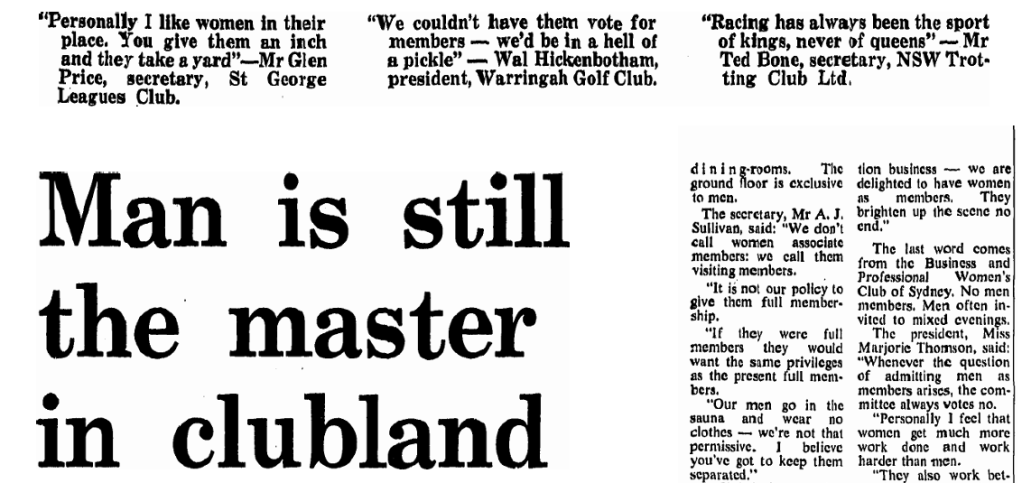
Contemporary attitudes within the licensed club industry could still be remarkably conservative. A 1971 Sydney Morning Herald article captured some of the prevailing assumptions of the era:

Read the full article: PDF

Bryn Miller also remembers that time.

Cowan had analysed the figures — the men’s bar took up 80 per cent of the space but only brought in 20 per cent of the revenue.

By 9 o’clock at night, there might be only three people in the men’s bar and the ladies area would be full to overflowing to the point that some couples would just leave and go to the RSL.

This was especially so on Saturday night — traditionally the time for couples to have a night out – or on big trading nights like New Year’s Eve.

The revenue figures were common knowledge, but the men were very possessive of their space, and this certainly carried through to most of the directors.

Roger used to wander around every night, often quite late, keeping an eye on things. One late Thursday night after the trots at the local showground, he and a duty manager were watching a couple of men. One had big pockets inside his coat, the other was keeping watch while he cleaned out the drawers. They caught them and went to their car which was full of calico bags filled with ten and twenty cent pieces.

Kevin McGrath recalls how this played out in practice,

When a football game was on, it was stand aside or be swept up in the rush.

On game days they would pull the shutters down in the men’s bar so that the drinkers would go over the road to the game. After the game was finished, they would pour dozens and dozens of half schooners and have them lined up. There would be a mad rush from the football ground as hundreds of thirsty fans descended on the bar.The schooners were filled and the shutters went up. If you only wanted a middy — or perish the thought, a scotch — you just had to wait.

Cowan later said the changes were not a conscious move to overcome discrimination, but simply, a commercial reality.

We were trying to make ourselves more popular. We had to be all the time working out what was needed and then responding. The demand at the time was for much bigger accommodation for mixed company. We were squeezing them into one tiny corner of the club, where they were uncomfortable. There was no space, people were pushing and shoving each other, and often there would be fights in there.

I always thought that to run a club, or any business, you have to give the people what they want. At that time, it was being run for the convenience of a fairly small group of men who wanted to protect it for themselves.

The real shift came one New Year’s Eve — Cowan had convinced the Board to do a one-off and allow women into the Long Bar.

The Board finally relented, at first creating a small, partitioned area of the bar where women could go. “Roger persisted, and they were eventually persuaded to have a proper mixed bar, and the sales increased dramatically”, says Rhind.

“It took women a while to really want to go in there,” Miller says, “because that whole male bastion thing was all so entrenched. But the barriers were starting to come down.”

As those barriers began to shift, the club was changing not just who it welcomed, but what it offered — and how people experienced it.


To receive new Parts and occasional project updates by email, you may subscribe below.

Readers who hold recollections, documents, or material relevant to this history are welcome to contribute via the Commentary & Contributions page.

Project Updates

Receive updates when new parts are published.


← Part 9 · All Parts · Part 11 →

Commentary and Contributions

Wires, Magnets and Monitoring

During the 1960s and 1970s, poker machine operations were still relatively primitive by modern standards. Machines were largely mechanical, heavily cash-based and vulnerable to manipulation.

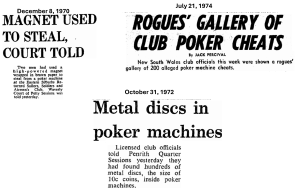
Across the NSW club industry, stories circulated of patrons using wires, magnets, lead discs being used as coins, and other improvised devices in attempts to interfere with machine mechanisms or influence payouts.

Security surrounding gaming operations was often basic, particularly in smaller or rapidly growing clubs where staffing and oversight systems struggled to keep pace with expansion.

At the same time, the sheer volume of coins moving through gaming rooms created operational difficulties of its own. Machines required constant clearing, counting and refilling. Cash handling was labour intensive and exposed clubs to risks ranging from simple human error to outright theft.

These problems were not unique to Panthers. They reflected broader challenges facing the club industry as poker machine revenue expanded rapidly during this period.

For administrators such as Roger Cowan, such vulnerabilities highlighted the need for tighter operational systems and greater technological oversight. At Panthers, this gradually led to innovations in surveillance, accounting controls, machine monitoring and broader administrative systems designed to improve both security and efficiency.

Part of Cowan’s reputation within the club industry stemmed from his willingness to embrace technology earlier than many contemporaries. What later became sophisticated electronic monitoring and integrated management systems began, in part, as practical responses to very immediate operational problems.

The issue was not simply dishonesty. It was scale.

As clubs grew larger and gaming operations expanded, informal methods that may once have worked in smaller suburban venues became increasingly inadequate. Stronger systems, better monitoring and more professional management structures became essential to running modern licensed clubs.

Seen in that light, the technological innovations discussed in Part 9 were not merely about efficiency or modernisation. They were also responses to a rapidly changing gaming environment in which security, accountability and operational control had become central concerns for the industry.


Related Topics


Related Themes

Financial Management · Innovation


To receive new Parts and occasional project updates by email, you may subscribe below.

Readers who hold recollections, documents, or material relevant to this history are welcome to contribute via the Commentary & Contributions page.

Project Updates

Receive updates when new parts are published.

Eliminating Scams with Innovation and Systems

This article forms part of the serialised republication of Panthers, Passion & Politics – The Roger Cowan Years.

Start · Reader’s Guide · All Parts


With control of both clubs established, attention turned to strengthening the systems that underpinned the operation.

Taking responsibility for both clubs gave Cowan far greater control over the finances. As the club began to show consistent profits, attention turned to planning improvements.  

A significant part of the club’s early success in 1966 involved attacking the internal and external scams that were rife in the club industry at the time, particularly around gaming machines.1

Kevin McGrath, who worked in the club’s poker machine area during the 1970s, late recalled an early scam highlighting the brazenness of the scams operating within clubs at the time:

There was one syndicate that had worked out how to set up a jackpot on the Inca machines. They were laughing at us and getting a lot of jackpots. We knew it was not possible to get that many jackpots, but nobody knew how they were doing it.

By watching them, we worked out that you could see into the machine at the side, and, using a thin piece of steel, line up the bolts. So, we cut strips of cardboard and stuck them to the machines so that you couldn’t see inside.

The group walked in while we were doing it and they were very angry. One guy marched straight up to me and said, “What are you doing with my machine – you can’t do that!”

Max Connors remembers how serious these people were about what they were doing.

Some would get an imprint from the lock of the machine and make their own key.

Roger used to wander around every night, often quite late, keeping an eye on things. One late Thursday night after the trots at the local showground, he and a duty manager were watching a couple of men. One had big pockets inside his coat, the other was keeping watch while he cleaned out the drawers. They caught them and went to their car which was full of calico bags filled with ten and twenty cent pieces.

On another occasion, club management worked with the Liquor Administration Board2 on investigations of a scam by a group of the Club’s poker machine attendants who were later charged by police.

Over the next few years, Cowan introduced measures in the poker machine area to try to eliminate theft, and to streamline the process, both for staff and players. One of these was a conveyor belt. The coins would drop onto the belt and move along to a central bin, saving attendants from having to clear out individual machines and carry heavy coins.

Bryn Miller, later CEO of Merrylands RSL club, also worked in the Penrith club’s poker machine area at the time. He says the conveyor system predated the widespread use of nylon bearings, so everything had to be greased. Often the coins would come out covered in black grease. But he says it was a novel way of handling money, and it made it so much easier for the staff.

Miller recalls that Cowan was always open to new ideas and would do everything he could to put them into practice. He believed the club was probably the first to introduce computers into the club industry.  A particular system called Feeney Electronics3, introduced in the early 70s, met with mixed reaction from staff and directors.

This was an absolutely brilliant system so far ahead of its time. The poker machines had small electrodes on their reels, and when they lined up for a jackpot, it recorded in a computer system. This transmitted the details onto television monitors around the club. The supervisors on the floor could see the machine number, and the jackpot details. We would go straight there, check it and pay it.

It was state of the art stuff, unbelievable for the time — most clubs didn’t even have a computer. Colour television was only just around.

To put this into perspective, Penrith Council installed its first in-house computers in 1977. It was a system that used dumb terminals. Council got its first PCs in 1984, when the typing pool was replaced by a few word processors on secretaries’ desks.

Phil Bennett was an inspector with the Liquor Administration Board in the Feeney years. He agreed that the system was 15 years ahead of its time. He said it was innovative and visionary, but it came too early to get any useful information from the Liquor Administration Board’s point of view.

Although the system did not evolve the way it was envisioned, it delivered valuable information that supported other areas of the business.

Cowan later conceded that he may have convinced the Board to persist with Feeney longer than he should have. Had it succeeded, it would have been a major breakthrough. There was nothing like it anywhere in the world at the time4, and the commercial potential was significant. Ultimately it cost the club around $1 million.

Barry Hubbard said many on the board saw it as throwing good money after bad.

Bryn Miller saw it differently

It was one of the very important innovations. It took ten or fifteen years for the industry to even start working on it again. And at least twenty years for the systems to actually come out and be operating properly. It would be impossible to estimate the value of the savings we made because of the system.

Cowan also introduced a further innovation to Panthers members.Members were able to collect Panther Stamps; the club had a large gift room, and stamps could be used to purchase items. This was, of course, the forerunner of the incentive schemes operated by many clubs.5 But it was very likely the first.

Being different and leading the way was part of the Cowan psyche. Another Penrith first in poker machines was an increase to the jackpots. The standard jackpots paid on 5, 10 and 20 cent machines were 5, 10 and 20 dollars. The club increased this to 6, 12 and 24 dollars. By today’s standards, that extra $4 may not seem much, but with the average wage around that time about $60, it was a real bonus for the players.

But improving systems was only part of the challenge. The broader question was who the club was being built for — and that would require a different kind of change.


To receive new Parts and occasional project updates by email, you may subscribe below.

Readers who hold recollections, documents, or material relevant to this history are welcome to contribute via the Commentary & Contributions page.

Project Updates

Receive updates when new parts are published.


  1. The mechanical operations of poker machines in those days made them an easy target. See Beyond the Book: Wires, Magnets and Monitoring ↩︎
  2. The Liquor Administration Board (LAB) was the NSW regulatory authority responsible for the oversight of licensed clubs and gaming operations. It later became the Department of Gaming and Racing, and now is the Liquor & Gaming NSW.
    ↩︎
  3. Feeney Electronics developed an early electronic poker machine monitoring system that attempted to centralise jackpot and machine data – a concept well ahead of industry practice. See Beyond the Book: Feeney Electronics — Ahead of its Time
    ↩︎
  4. Electronic monitoring systems were emerging internationally during this period, several interviewees believed the Penrith system was unusually advanced.
    ↩︎
  5. Trading stamp reward systems were common in Australian retailing during the 1960s and 1970s. Penrith Rugby League Club adapted the concept into a club-based loyalty and reward program. See Beyond the Book: Panther Stamps. ↩︎

← Part 8 · All Parts · Part 10 →

Commentary and Contributions