
Why One Board, One CEO?

Readers of Parts 19–21 may wonder why Roger Cowan spent more than sixteen years arguing for what appeared to be a relatively simple administrative reform. Why did the issue matter so much to him? Why did he keep returning to it despite repeated setbacks, opposition and criticism?

The answer lies in a question that had troubled Panthers almost from the beginning:

The issue was not new.

Readers familiar with the events of 1971 may recognise some familiar themes. The removal of football club secretary Merv Cartwright and treasurer Ron Partridge arose from concerns about the administration of rugby league affairs and accountability for financial decisions. Although the circumstances were different, the disputes that emerged again in the late 1970s centred on many of the same questions. Who should make decisions? Who should be accountable for those decisions? And what happened when agreements were not honoured?

From the time Penrith entered first grade rugby league in 1967, the football club and licensed club operated under separate governance structures. The arrangement was common in rugby league, but Roger increasingly came to believe it created problems that could never be fully resolved.

It would be easy to assume the conflict was simply about money. Certainly finances played a part. Rugby league required increasing investment, while the licensed club was trying to strengthen its financial position and pursue long-term development projects. Yet Roger’s frustration was not that football sought resources. In his view, the licensed club had repeatedly demonstrated a willingness to support rugby league and invest heavily in its future.

The real problem arose after decisions had been made.

Budgets would be negotiated. Agreements would be reached. Plans would be approved. Yet time and again, football expenditure exceeded agreed limits or new commitments were entered into without the knowledge or approval of those responsible for managing the Club’s overall finances.

From Roger’s perspective, this was not simply a financial problem. It made long-term planning almost impossible.

A licensed club board could approve a football budget, commit to major development projects and make decisions based upon expected cash flows. If those assumptions later proved incorrect because spending commitments had changed, the consequences extended well beyond rugby league. The entire organisation could be affected.

By the late 1970s, these tensions had become increasingly public. In December 1979, the Sydney Morning Herald reported on financial difficulties and disagreements between the football and licensed club administrations. Around the same time, Panthers was preparing for the enormous financial challenge of constructing its new Mulgoa Road complex.
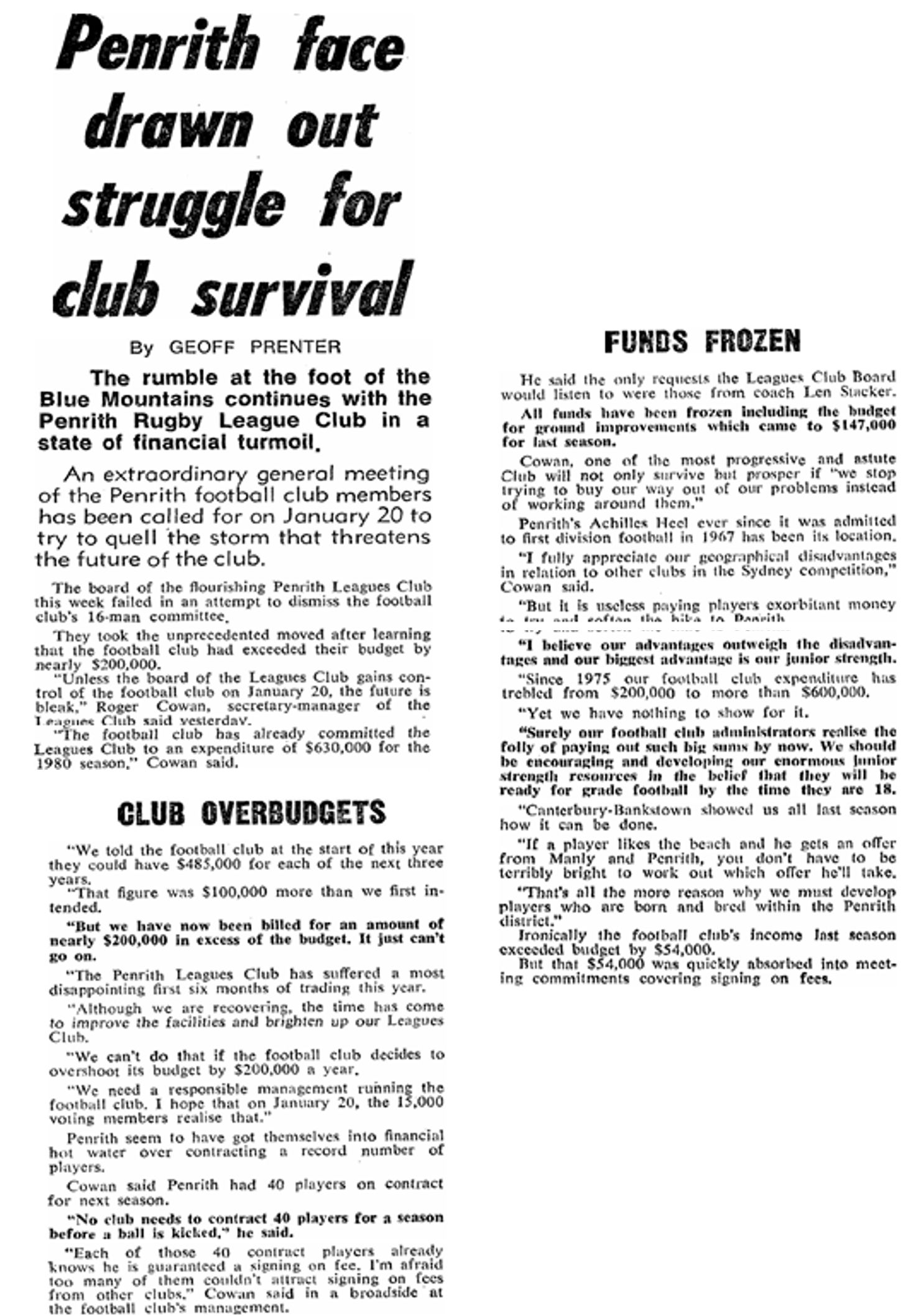
SMH 1979 Dec 9 – click image for full article.

Reports to members in 1980 revealed the extent of the concern. Directors reported that the football club had exceeded an agreed annual budget of $485,000 by more than $100,000 during 1979, while additional commitments had already been entered into for the following season. To the licensed club board, the issue was not simply the amount involved. It was that decisions affecting the future of the entire organisation had been made outside the framework that had previously been agreed.

These events helped bring the governance debate to a head, but they do not fully explain Roger’s determination.

For him, the issue was ultimately one of organisational unity.

He believed Panthers would never achieve its potential while parts of the organisation operated according to different priorities, different assumptions and different lines of accountability. A football club and licensed club could share the same colours, the same members and the same ambitions, yet still find themselves working against each other.

His solution was straightforward.

One board would determine policy and direction for the entire organisation. Management would then be responsible for implementing those decisions. Everyone would work towards the same agreed objectives and everyone would be accountable to the same governing body.

Not everyone agreed.

Some viewed Roger’s campaign as an attempt to centralise power. The perception is understandable. After all, he was advocating a structure that would eventually place responsibility for football and licensed club operations under a single administration. His persistence over sixteen years inevitably raised questions about motive.

Yet there is another interpretation.

Roger was not arguing that football should receive less support. Nor was he arguing that rugby league was less important than the licensed club. Rather, he believed the entire organisation should operate according to a common plan and that all parts of Panthers should be accountable to that plan.

Many years later, Panthers would use concepts such as “twin citizenship” to describe the idea that people belonged not only to their immediate team but also to the wider organisation. While that language did not exist in the 1970s, the philosophy behind it helps explain Roger’s thinking. He wanted rugby league, club management, directors and staff to see themselves as contributors to a single enterprise rather than separate interests competing for influence.

The first major breakthrough came in 1980 when a single board was finally established. Yet even then, the model remained incomplete. Rugby league and the licensed club continued under separate chief executives. As described in Parts 20 and 21, the compromise produced its own difficulties and did not resolve the underlying tensions.

It was not until the end of 1983 that the structure Roger had advocated for so long was fully implemented. One board and one chief executive became responsible for the entire organisation.

Whether that decision alone explains the improvements that followed is impossible to know. Organisations are rarely transformed by a single reform. Nevertheless, the years that followed saw a stronger emphasis on cooperation, planning and shared ownership. The workshops that led to the Five by Five program, closer relationships throughout the rugby league district and a more integrated approach to football and club operations all emerged during this period.

Reasonable people may still disagree about whether Roger was right. They may also disagree about the extent to which later successes flowed from the governance reforms he championed.

What is difficult to dispute is that he regarded the issue as fundamental. For more than sixteen years he returned to the same argument, often in the face of resistance and disappointment.

Ironically, that persistence contributed to one of the enduring myths about Roger Cowan — that he was somehow anti-rugby league.

The evidence suggests a more complex reality.

His long campaign for “One Board, One CEO” was not driven by a desire to diminish rugby league, but by a belief that Panthers could only achieve lasting success when every part of the organisation was working towards the same goals and operating under the same commitments.

Whether one agrees with that belief or not, it became one of the defining ideas in the history of Panthers.


Source Material*

The following documents are extracts of the relevant sections of larger reports:


Related Topics


Related Themes

Financial Management · Governance · Board Decisions · Culture · Club Structure


* Resource material courtesy of The Ausburn Collection


To receive new Parts and occasional project updates by email, you may subscribe below.

Readers who hold recollections, documents, or material relevant to this history are welcome to contribute via the Commentary & Contributions page.

Project Updates

Receive updates when new parts are published.

A Solution — Of Sorts

This article forms part of the serialised republication of Panthers, Passion & Politics – The Roger Cowan Years.

Start · Reader’s Guide · All Parts


Despite the promise shown in 1974, the underlying problems did not go away. Ashurst and Stephenson had settled in — the team had shown promise by reaching the finals of the Amco Cup and the budgeting and financial controls were in place. Cowan recommended that it was time for him to hand over to ex-player, Ron Workman.1

The committee agreed and Cowan stepped aside to concentrate on the management of the licensed club.

The potential shown in 1974 was never realised. The first-grade team finished in the bottom four of the competition for most of the seventies.

Cowan’s growing frustration with a system that he considered wasteful, inefficient and noted only for a succession of failures fuelled his determination to convince both clubs of the advantages of a united effort.

If I analyse that history, I can see that the real cause of a lot of the internal problems through the seventies and early eighties was my unequivocal belief that Penrith would never achieve success as a rugby league competitor while it had separate administrations. I harped and nagged boards for ten years before I finally won the argument, and even then, the win was only because of the involvement of the NSWRL [New South Wales Rugby League] executive.

Later critics would portray Roger Cowan as a CEO surrounded by yes-men. The events of the 1970s suggest otherwise. They must have been either unaware of or had forgotten those years. It was an ongoing battle to achieve his ‘one board, one CEO’ ambition. He often thought he would never win. Neither side was willing to make the concessions necessary to bring the two together. Cowan laughs at the ‘yes-men’ tag.

For more than ten years, I did my very, very best – put my absolute best efforts into getting one board, one management. I kept going back, and going back, and it didn’t happen.  So, no – they definitely weren’t yes-men.

One time in the late seventies, I was getting so frustrated, I thought I’m really going to make the effort here. I prepared a 19-page booklet for the next board meeting. It had graphs, and charts – every piece of information I could pull together to try and convince them.  I was determined to make them see that “this is the only way this club is going to succeed”. I gave it to them a couple of weeks before the meeting to give them time to read it.

On the night of the board meeting, I made sure it was on the agenda. The item came up, and the deputy chairman, Murray Clarke, said: “I move that this document be received”. Somebody else said, “I second that”.

And that was it, there was no discussion, nothing – they just moved on to the next item! I blew my top, lost my temper completely.

It was really stupid putting a 19-page document before a board anyway – boards need concise documents. But I’d tried those for years and they hadn’t worked either.

It took me another couple of years, and a lot more frustrations to win that argument. And we haven’t looked back since. Many other clubs now operate the same way.

Cowan’s commitment to the cause was also used by his opponents to brand him as anti-rugby-league. This is one of the major Cowan myths, and it would be used against him many times by many people. It was also another factor that contributed to his appearance before Ian Temby in 2004. That one small trickle that began as a frustration with failure in rugby league in 1971 combined with some other small trickles along the way, became a raging torrent 33 years later.

Editor’s Note: Roger’s long campaign for “One Board, One CEO” was about far more than administrative structure. It reflected a deeply held belief about accountability, organisational unity and the future direction of Panthers. Readers seeking additional background may wish to read Why One Board, One CEO?

Barry Hubbard says that at one time, Cowan and the board executive even travelled down to the NSW rugby league office in Sydney to talk to Kevin Humphreys [then NSWRL president] to see if there was some way for the licensed club to take over the rugby league club. Hubbard was dead against the idea but still felt it should be explored. Humphreys told them in no uncertain terms that it was impossible. It was unconstitutional, and if they tried, they could be expelled from the game.

Local butcher and prominent cricketing identity, the late Trevor Wholohan OAM2 interpreted Cowan’s trip to rugby league headquarters very differently. His opinion, expressed with his characteristic passion and vehemence, was aligned with those branding Cowan as anti-rugby-league. He declared with his characteristic passion and vehemence, that Cowan’s meeting with Humphreys was “to get rid of rugby league”.

Cowan’s reaction to this was disbelief. He wonders how any rational person could come to such a conclusion.

Imagine meeting with Kevin Humphreys to talk to him about getting rid of rugby league. Any sane, logical person would know that you wouldn’t do that. Humphries would chew you up and spit you out.

Hubbard said Cowan had returned from the meeting with Humphreys undaunted.

Roger was never one to take no for an answer. He had tunnel vision. He went back to the club and resolved to have a meeting with the football committee to decide on holding a joint election for a board that would have responsibility for both clubs.

In discussion, the football committee had agreed, in principle, to hold the election But when the actual motion was put to a vote, a division was called, and people were asked to vote by moving to opposite sides of the room. It was narrowly defeated. A couple of the committeemen who had agreed to an election now crossed the floor and voted against it.

The internal squabbling at Penrith – and the poor performance of the team – was becoming an embarrassment to rugby league administrators. The executive of the NSWRL offered to help, bringing in Alec Mackie, a highly respected rugby league administrator, who was chairman of St George and a vice president of the NSWRL. A committee – dubbed the Super Six3 – was set up to find a way forward, with three representatives from each board. Roger Cowan was also a part of the committee. Mackie chaired the meetings, which eventually concluded that there should only be one board at Penrith. The two committees, for the second time, came to an agreement.4

When the joint election was held in 1980, the new board comprised all the directors of the licensed club. No-one from the football committee had been successful. It became the first board in rugby league history to handle the affairs of both a licensed club and a football club. However, it was only halfway towards the model that Cowan had been recommending.

I believed that a structure comprising one board employing two chief executives would be just as difficult as having two boards dealing with two chief executives.

In many ways it could even be worse. It missed the whole point of the recommendation.  

When the boards came together, that is what they did. Rugby league was controlled through a newly appointed chief executive, Charlie Gibson, while I retained responsibility for the licensed club.

A promising coaching strategy for the 1974 season was derailed by a committee modifying it for the wrong reasons. It was years before its time and it might have been successful had it been given a chance. Here we were in 1980 and I had a feeling it was happening again. The system I had been advocating was being half introduced and again the modifications were for all the wrong reasons. You can’t half bake a cake.

And that was exactly the position the Club found itself in.


To receive new Parts and occasional project updates by email, you may subscribe below.

Readers who hold recollections, documents, or material relevant to this history are welcome to contribute via the Commentary & Contributions page.

Project Updates

Receive updates when new parts are published.

  1. Ron Workman is Panthers player number 13, a member of the 1967 foundation team, he retired as a player in 1973 after playing 93 1st Grade matches. In 1975 he was appointed as the Secretary of the Football Club, a role he held until 1978.
    ↩︎
  2. Trevor Wholohan was a long-standing critic of Roger Cowan, with tensions between the two dating back to 1974 when Wholohan’s butchery supplied the Club. A dispute over an account led Wholohan to claim that Cowan had impugned his honesty. He later attended most sittings of the 2004 Temby Inquiry as an observer.
    ↩︎
  3. The committee was in fact: Kevin Humphreys (NSWRL), Alec Mackie (NSWRL), John Jennings (Penrith Distric Club), Tom Ellis (Penrith District Club), John Hewett (Penrith Leagues Club) Rocky Davis (Penrith Leagues Club) — that’s the “Super Six” — and Roger Cowan. Keith Rhind (Penrith Legues Club) was on the bench for this team.
    ↩︎
  4. To get to this point had been difficult — there were 14 on the football club board and 12 on the licensed club board. Many seats were in jeopardy. It was Barry Walsh who convinced the football club board that, for the sake of the organisation, sacrifices had to be made. Barry lost his seat but would regain it a few years later and go on to contribute to Panthers for close to four decades. See: Beyond the Book — Major Player: Barry Walsh. ↩︎

← Part 18 · All Parts · Part 20 →

Commentary and Contributions

Looking Abroad — Bringing Stephenson and Ashurst to Penrith

In the winter of 1973, Penrith found itself searching for answers.

The club had entered the first-grade competition only six years earlier and was struggling badly. Results were poor, confidence was low and the future looked uncertain. The low point came when Manly-Warringah inflicted a humiliating 70–7 defeat on the Panthers. The result became part of club folklore and reinforced the belief that dramatic action was needed.

Penrith’s response was bold. Rather than look only within Australia, the club turned its attention to England.

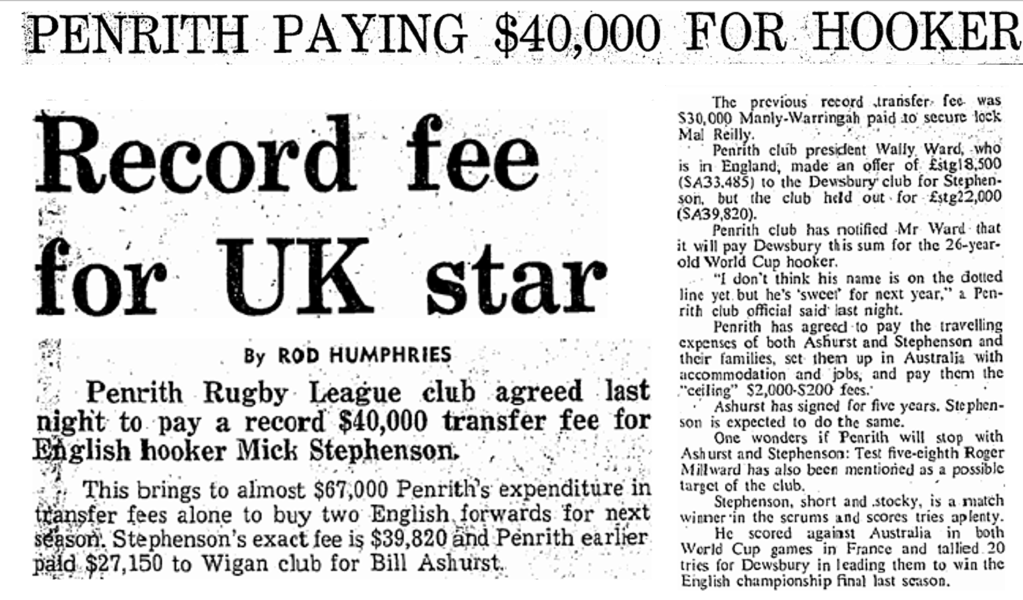
Club president Wally Ward and director Bruce Welladsen travelled to England with a clear objective: find experienced players who could strengthen the team and help establish a culture of professionalism. Their first target was Bill Ashurst, one of Britain’s leading second-row forwards. Negotiations were successful and Penrith secured his signature for what was reported at the time as a record rugby league transfer fee. Contemporary reports noted that Penrith had committed more than $27,000 to secure Ashurst’s services.

But Penrith wanted more than a forward. They also wanted leadership.

While in England, Ward and Welladsen turned their attention to Mike Stephenson, captain of the English champions, Dewsbury. Stephenson later recalled receiving an unexpected approach while working on a building site in Yorkshire. A workmate shouted up a ladder asking whether he was Mike Stephenson. When he answered yes, he was told that visitors from Australia wanted to speak with him.

The meeting that followed would change the course of Stephenson’s career.

Ward and Welladsen outlined their vision for Penrith and offered Stephenson a long-term contract. At first he was uncertain. Penrith sat at the bottom of the premiership table and had just suffered one of the heaviest defeats in its history. Yet the honesty of the approach impressed him. Rather than paint an unrealistic picture, the Penrith representatives openly explained the club’s position and their plans for the future.

Stephenson later said that this honesty was one of the decisive factors in his decision. The club was struggling, but it had ambition. Just as importantly, it had a strong junior base and a growing district. He believed there was an opportunity to help build something meaningful rather than simply join an established powerhouse.

Penrith eventually secured Stephenson’s release after complex negotiations with Dewsbury. The reported transfer fee of almost $40,000 established a new benchmark and attracted national attention. The press described the signing as a record-breaking deal and evidence of Penrith’s determination to improve its fortunes.

The arrival of Ashurst and Stephenson generated enormous excitement. Two of Britain’s finest players were heading to Penrith. Expectations rose accordingly.

The results, however, were mixed. Despite the quality and commitment of both men, rugby league success remained elusive. Penrith finished with the wooden spoon in 1973 and continued to struggle for consistency. Yet the significance of the signings went beyond wins and losses. They demonstrated that Penrith was prepared to think differently, act boldly and invest in its future.

Those qualities would become recurring themes throughout the Roger Cowan years.


Related Topics


Related Themes

Football Club · Innovation


To receive new Parts and occasional project updates by email, you may subscribe below.

Readers who hold recollections, documents, or material relevant to this history are welcome to contribute via the Commentary & Contributions page.

Project Updates

Receive updates when new parts are published.
A Solution Kept Quiet

This article forms part of the serialised republication of Panthers, Passion & Politics – The Roger Cowan Years.

Start · Reader’s Guide · All Parts


Cowan continues with further thoughts on the bad decision to place Clare as head coach:

It was a ridiculous decision. Jack had some strange ideas about the strategies of the game and started clashing with the captain, Mick Stephenson. Mick was a passionate competitor and was quick to argue with Jack if he thought the coach was talking nonsense. Jack said he would take him out the back of the grandstand and sort him out.

My response was something like: “Jack, if you think the answer is to fight our captain, I want you to know that you will be doing it over my dead body”.

It was one of the many signs that we had made a bad decision.

This episode reinforced Cowan’s belief that Rugby League decision-making should be seated in one body, looking after the interests of the entire club.

Tom Wilson gives an example of the way the football committee worked at the time.

Les Boyd was a brilliant newcomer at the time, only a very young kid. The coaching committee had invited him and his father to come to the club to talk to us. His father was a little short stocky bloke. Les wasn’t much bigger, but he was a very strong looking, solid boy. And he had already started to make a name for himself.

We’re all standing around talking, and Pat Russell — who was on the football committee —  is down at the end of the bar, holding court. He says to me, ‘Look Tom, look at the kid’s old man, the size of him. This kid will never grow up to be any decent sort of a footballer.

That’s what we were up against. Les Boyd did grow up, and he became an outstanding footballer — a mongrel, but a great footballer. It was only one man’s opinion, but that’s all it needed back then. It was like that all the time — how would the bloody schoolteachers know?

Appointing Jack Clare as head coach, the football committee cited Masters’ lack of first grade experience, saying he only had coached school football. In fact, his credentials were very similar to Jack Clare’s, but Masters had a far better CV.

So, the 1974 season began with Clare in the driving seat. Masters was to look after tactics, Harris coached the forwards, and Wilson the backs.

It soon became apparent that there was a problem, says Masters. The team lost its first four games and conceded a total of 107 points.

So on a wet Sunday at Warragamba, after a club family day up there, Roger gathered all four coaches in his car, and gave us an ultimatum. He said, “It’s obvious that this is not working, and I’m going to appoint Roy as head coach. You can accept it, or we go back to the board – who will no doubt go to the media, and wherever else it goes from there.

Cowan made it clear it was up to them — handle it quietly and confidentially or suffer the glare of media coverage and the uncertainty of how the committee would handle making a new decision.

For the remainder of the season, Harris became second grade coach, Wilson coached third grade and as far as the world knew, Clare was the head coach. None of us ever revealed to the press what the situation really was. We maintained that situation only to preserve Jack Clare’s dignity, but the reality was that I was first grade coach for that season.

The entire Penrith experience is one that Masters would prefer to forget. He felt very let down at the time.

My significant problem was that Roger … didn’t give me any support … I had to make my own arrangements … I just had to cop it sweet.

I thought that I had made a significant investment in a life change and ended up being dumped pretty much high and dry

In a recent exercise to select Penrith’s best team and coach of the past 40 years, Masters is named as the first-grade coach for 1974, but it’s taken 40 years to acknowledge it. Cowan told a meeting held in 2006 to discuss that 40-year team, that Panthers has treated Roy Masters abominably.

Masters speaks highly of Cowan,

I have a very great affection for Roger. But my admiration for him is based on what he’s done for the club since I left, not any problem that I had at the time with him.

See, you’ve got to be measured in this world – you just don’t define your personal history in terms of a couple of years you spent somewhere, and that forever influences your view of a person. You also make observations as you go down the track. And I can’t deny the fact that he, selflessly, with massive amounts of hard work, has built a vast empire.

Roger’s model introduced a revolutionary coaching plan It was a good model, but it was too far ahead of its time in terms of the politics that existed at the club in those times.

It didn’t matter what you tried to do with those people. If you came up with something new — like trying to develop match plans or produce videos — or had any kind of scientific training, you were completely alien. You belonged to a culture they didn’t like, and couldn’t accept. Yet look at the game now, it’s all scientific, all research and video analysis.

The politics during those days of two boards was treacherous … and it was very destructive and soul destroying. Merv Cartwright wasn’t on the committee at the time, but he was still a powerful force behind the scenes.

My experience at Penrith steeled me for the future.

In 1974, the year that Roy Masters came to Penrith, Mike Stephenson and Bill Ashurst also came — from England, to play with the team. Under the direction of Roy Masters, the team made the final of the new mid-week competition, the Amco Cup.  They finished in ninth position in the first-grade competition, and had come close to making the semi-finals.

Although the team had its best yet success under Masters, he opted to remove himself from the politics and coach the Under 23 side the following year.


To receive new Parts and occasional project updates by email, you may subscribe below.

Readers who hold recollections, documents, or material relevant to this history are welcome to contribute via the Commentary & Contributions page.

Project Updates

Receive updates when new parts are published.


← Part 17 · All Parts · Part 19 →

Commentary and Contributions

Innovation Stumbles Over Prejudice

This article forms part of the serialised republication of Panthers, Passion & Politics – The Roger Cowan Years.

Start · Reader’s Guide · All Parts


From early in the 70s, Roger Cowan maintained an absolute commitment to the belief that rugby league would never succeed at Penrith while it was a separate entity. Cowan passionately believed that the secret of success was to integrate rugby league, uniting all the expertise within the management structure.

It took more than ten years to achieve that goal. Yet the struggle came with an unforeseen downside — the move to integrate had a negative impact on some relationships and reputations.

Cowan says there had been consistent failure under the two-committee system, and serious conflict.

I sometimes wonder what would have happened if I had taken the easy path and simply kept out of rugby league. I am not sure that it would have been possible to do that and also protect the interests of the licensed club. In so many ways, the two are interdependent. But if I had found a way to do it, there is no chance whatsoever that the police would have walked through that door in 1985.

I know some very successful CEOs of large clubs who have kept right out of Rugby League. I think they were smarter than me. If Rugby League had been managed openly, honestly and effectively in the first few years there would have been no need for me to ever get involved. But I was never about to lead a team working for the success of the Registered Club and have it all blown away by irresponsible management of football.

As the club moved into the seventies, the licensed club continued its growth. But on the football side of things, the club was struggling

The results told the story.

The team’s best performance throughout the seventies was equal seventh in the 12-team competition, in 1971. It was second-last twice and had collected its first wooden spoon in 1973.

Something had to be done to improve performance and Cowan formed a small strategic sub-committee to focus on new strategies. The group included Cowan, Tom Wilson – who would become the club’s director of coaching the following year, Dave Podmore, a local businessman and Frank Ley, a schoolteacher who was also heavily involved in school rugby league. Podmore, Wilson and Ley were on the football committee.

The group devised a whole new concept of coaching.

The plan was to appoint a panel of coaches. The head coach would lead a team of specialist coaches – one for backs, one for forwards, and one skilled in tactics and strategy. The panel would oversee all three grades of football, and each would train the players in their specialty.

This was a new concept for Australian sport and structurally very different. There were similar systems used at the time in American football. Balmain coach Jack Gibson1 had also spoken in support of such a coaching system, although he never actually used it. It is now in common use in all football codes.

The system was introduced in time for the 1974 season.

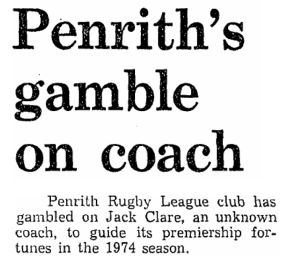
Roy Masters, who would become a prominent Sydney sports journalist2, was part of that 1974 coaching panel. Barry Harris – a former state representative – was to be the forwards coach, and Wilson, already established as a coach, would oversee the backs. The fourth member of the team was Jack Clare. Clare was popular in the world of rugby league and seen as a ‘nice bloke’. He had been chairman of selectors with the Balmain club but had no experience coaching at grade level. He had coached high school teams and had only ever played five first grade matches.

Cowan and the strategy team wanted Masters as head coach. He had coached a number of successful school teams, notably the Australian schoolboys’ team that returned unbeaten from a tour of England in 1973.

Tom Wilson remembers that some of the group travelled to Tamworth to meet with Masters, who was teaching high school there at the time.

We spoke to Roy for 40 minutes on the sideline of a training session. We watched the session, and Masters didn’t say a thing to the team the whole time. They went through 43 moves – and dropped the ball once. What an efficient team!

Roy had developed a completely different way of doing things. It was a real management concept. We convinced him to leave Tamworth and come to Penrith to head up the new coaching panel.

But it would not prove that easy! Wilson continues,

When they got back and started to work on the new strategy, the old brigade came out fighting, “What would some schoolteachers and a couple of businessmen know about football?” The committee was prepared to go along with the new coaching concept but personality clashes within the committee caused a poor decision that derailed the strategy. The decision was later corrected by Cowan in quite extraordinary circumstances, but the strategy did not recover.

Masters says there were problems from the start.

The pervading culture on the football committee at that time was anti-intellectual. If you were a schoolteacher, you were gone from the start. There was one particular person on the board who really had it in for me. He was very vocal and wielded a lot of power.

There was something like 16 men on that committee, and most of them were the same.

It was never going to work. Frank Ley – who was a teacher – signed me. Roger, the club secretary, had also been a teacher, and here was I, another one. They just would not accept me. And it was all down to the prejudices of this unbelievably insidious committee.

It was even worse than that, says Cowan.

Frank Ley was unpopular with the committee, and he was seen by the committee as the driving force behind the appointment of Roy Masters, so the vote to appoint Jack Clare as the head coach was really a vote against Frank Ley. Personal prejudices easily won the battle over logical argument.

Headline SMH Herald 11 October 1973 – click image to read the article

To receive new Parts and occasional project updates by email, you may subscribe below.

Readers who hold recollections, documents, or material relevant to this history are welcome to contribute via the Commentary & Contributions page.

Project Updates

Receive updates when new parts are published.

  1. Jack Gibson did not coach Balmain. In 1973 he coached Newtown and in 1974, he was in his second stint as coach of Eastern Suburbs. ↩︎
  2. Roy Masters later became a prominent journalist and columnist with the Sydney Morning Herald and is now based in Melbourne. ↩︎

← Part 16 · All Parts · Part 18 →

Commentary and Contributions

The Iconic Panthers Scoreboard

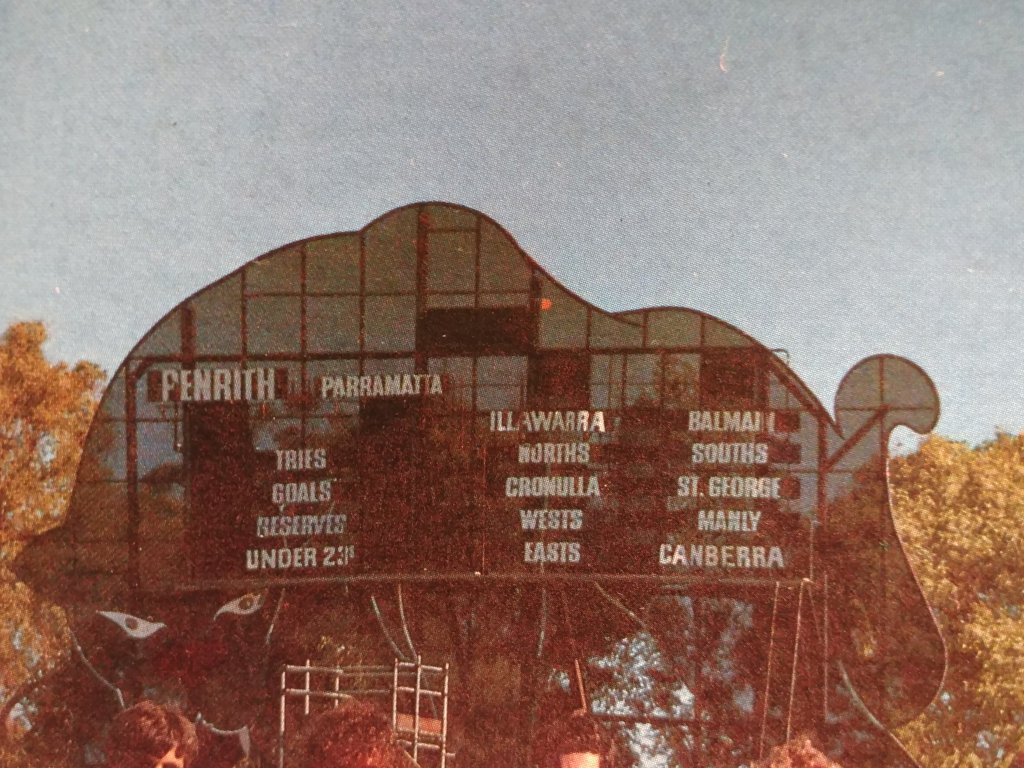
The Panthers scoreboard became one of the most distinctive features of Penrith Stadium — or any rugby league ground at the time. Its origins can be traced to the club’s early think-tank culture.

In the early days of Penrith Rugby League Club, Roger Cowan used think-tanks to encourage participation and generate ideas for the club’s development.

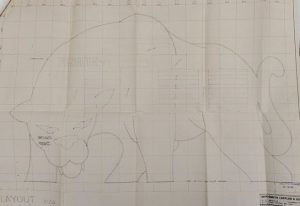
According to Kevin McGrath, the unique scoreboard installed at Penrith Park in 1979-80 had its origins in one of those sessions.

An idea for creating a Luna Park style feature for the club entry was eventually re-imagined as a football scoreboard. The concept was developed further by the architects Dick-Smith Leffler & Gill, who drafted the concept.

Finally, that original idea was brought to life at the southern end of Penrith Park as an innovative scoreboard.

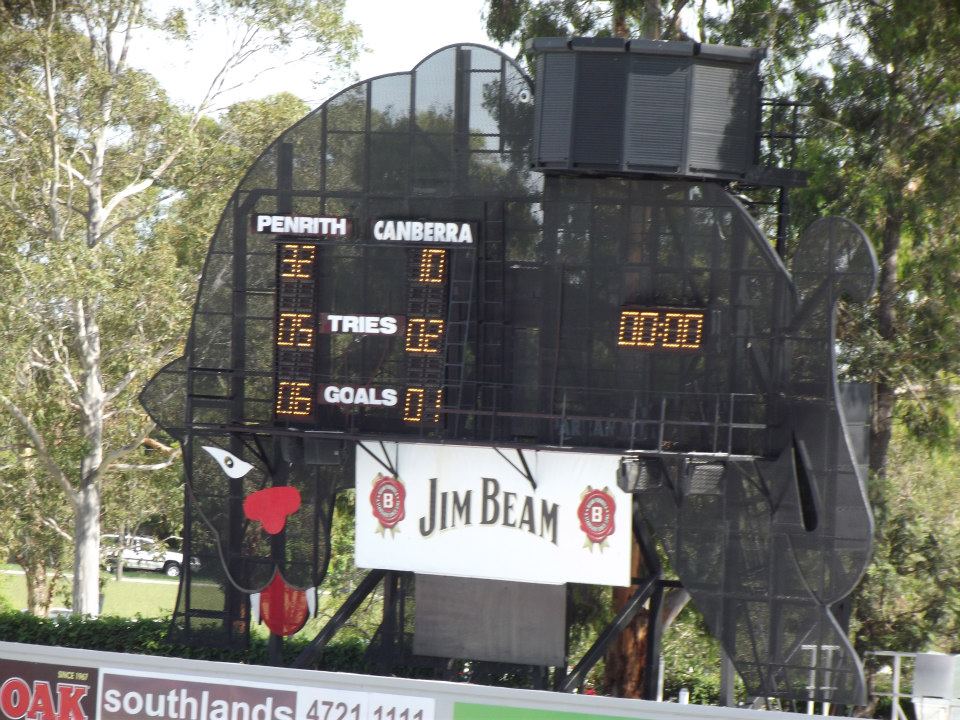
The scoreboard displayed the score of the Panthers game, as well as progress scores from other matches being played on the day. A score by the home team triggered a response from the structure — flashing eyes and a Panther’s roar marking the moment.

Over time, modifications were made as the structure aged and operational demands changed.

The iconic scoreboard had its operational flaws, as it aged there were many breakdowns and failures and eventually could not deliver what was required at a modern sporting stadium … but still it was loved by Panthers fans and visitors alike.

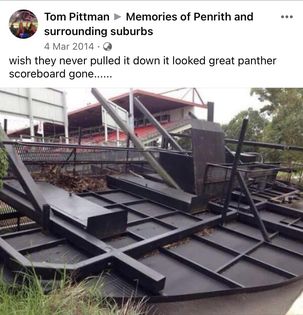
In 2013 it met a fate unbefitting of a trusted, if unreliable, friend:

This Facebook post is dated 4 March 2014, the photo (source unknown) was taken in 2013.

In 2013, the scoreboard was removed.

At the time, it was suggested that the structure had been carefully dismantled and placed into storage, with the possibility of future restoration. Other accounts indicated that it had instead been destroyed during the removal process.

Regardless of the circumstances, its disappearance marked the end of one of the most recognisable symbols of the Panthers experience.


Related Topics


Related Themes

Culture · Innovation


To receive new Parts and occasional project updates by email, you may subscribe below.

Readers who hold recollections, documents, or material relevant to this history are welcome to contribute via the Commentary & Contributions page.

Project Updates

Receive updates when new parts are published.
The Think Tank Culture

This article forms part of the serialised republication of Panthers, Passion & Politics – The Roger Cowan Years.

Start · Reader’s Guide · All Parts


Focus groups — later formalised as Strategic Planning Groups — became a part of everyday life at Panthers. Glenn Matthews says the involvement of staff remains essential when Panthers considers major changes or redevelopment

Back in the early 70s, with a full-time staff numbering only 30, it already worked the same way. Kevin McGrath who started at Penrith Leagues a little after Roger Cowan, describes how it was then.

We used to have what they called think-ins or think-tanks. They started out once or twice a year, but pretty soon they were every three months. They would get groups of employees – someone from the bars, poker machines, a cleaner, an office person, one of the catering staff, and one of the directors – and put us all in a room together for a day. We had to sit there and come up with ideas that we thought could benefit the club. The ideas could be as weird and wonderful as we liked. Roger used to tell us the more way out, the better.

We had to work as a group, write the ideas down, throw them around, and come up with a list of a final few. Then they would pass the lists on to another similar group, to be discussed and modified again.

That’s an interesting comment, but is it true?

McGrath once jokingly told Cowan he was the biggest plagiarist of all time, because many of those ideas helped make the place what it is today. ‘But he was able to take those ideas and make them become reality.’

For example, one of McGrath’s suggestions was to make the front doors of the club a big open panther mouth – a la Luna Park. This went through the process and ended up as the scoreboard at Penrith Stadium.1

Penrith Stadium’s iconic “Panther” Scoreboard – this was a later modified version.

Keith Rhind says,

Roger was always working on ways to stay ahead of what other clubs were doing. I’m sure he used to stay awake at night thinking up new ideas. He once bet me that one of the groups could come up with more than 200 suggestions in a day. I didn’t believe it was possible, but I lost the bet.

Cowan used to take people out of their comfort zones, Rhind says,

The main purpose of the think-tanks was to give the staff confidence in themselves. When Roger first started, there were a lot of problems, and staff morale was very low. We had a lot of internal pilfering and other bad practices, and there was no real structure or systems. These groups got the staff involved, they began to work as a team, and feel they were a part of something when they came to work. And we were getting all these ideas as well.

Kevin McGrath says it made him feel good to be part of those groups. ‘I was only a cellarman, but in those think-ins, I was equal to any of those blokes.’

In the 70s, Random Breath Testing was introduced to NSW. There was great apprehension about the effects it would have on businesses selling alcohol.

At Panthers, however, the legislation had positive effects. The Club’s “think tank” culture enabled it to come up with strategies that would take it to another level of growth.

Two managers went to Victoria, where RBT had been introduced five years earlier. They researched its effects in Victoria and what hotels had done about it. On their returned a think tank involving a number of key staff. It lasted several hours, and about 150 suggestions were listed. Once the list was complete, the more crazy ones were eliminated. The remainder were grouped and analysed.

Because of this one piece of legislation, the seeds were sown for Panthers to broaden its marketing focus. Now it would include family activities, tourism, and greater emphasis on food. The session was probably one of the two most valuable think tanks ever held by the Club.

The other, in 1983, drove the transformation of rugby league in Penrith from its lowest point to an era of success.

What began as informal ‘think-ins’ had become one of the defining engines of Panthers’ growth.


To receive new Parts and occasional project updates by email, you may subscribe below.

Readers who hold recollections, documents, or material relevant to this history are welcome to contribute via the Commentary & Contributions page.

Project Updates

Receive updates when new parts are published.

  1. The scoreboard became an iconic and much-loved feature of Penrith Stadium. It was removed in the early 2010s. For further context, see: https://pantherspassionpolitics.com/2026/06/02/the-iconic-panthers-scoreboard/. ↩︎

← Part 15 · All Parts · Part 17 →

Commentary and Contributions

Culture — An Early Instance at Panthers

A removed section from the original Chapter 6: Building a Culture — by Accident and Design. This is Roger Cowan’s descirption of the culture of the licensed club in te early days.

The following reflection from Roger Cowan describes how elements of that culture were already taking shape in the early years — often without formal structure.

The importance of managing the culture arose out of the efforts to find better ways of managing Panthers after its rapid growth from 1984 on, and our difficulties coping with it.

Before that, whatever was happening in the culture was happening quite naturally with no thought of planning it. No matter who takes the position of CEO, the culture of the organisation will reflect many of that person’s values, behaviours and beliefs.

The one thing I believed in most strongly was that getting results required hard work and long hours. I think I probably went a little bit overboard, and the family paid the price. But I led the way and before long I had a management team prepared to give a lot of time to chasing the club’s goals.

Don Ellks, Leo Trevena and Bob Donaghy were the key drivers of the business in the early days, and they were prepared to put in whatever time was necessary to make sure they got things done. Leo left after a few years, but Don and Bob were linchpins for many years.

An interesting story shows how recruitment plays a part in building culture in a team. It concerns the promotion of Don Ellks. He came to Panthers as a casual barman, and it was not long before his qualities started to shine through. He was promoted to a supervisory position.

At that time Bob Donaghy and Leo Trevena were the club’s two assistant managers. We needed another assistant to help cover the long hours of operation and Don was suggested. But I was not sure whether he was the sort of person who could handle the hours. I did not want anyone on the management team who would crumble if asked to work long hours, sometimes for a seven-day week. We were a small club and there were a lot of demands.

I asked Bob and Leo to give Don a really tough roster for a couple of months to see how he would handle it. He came through with flying colours and was promoted to assistant manager – where he continued to shine for more than 25 years.

This is a good example of how a culture builds. By that time there were four of us leading the way and you might imagine that the expectations and beliefs of staff was that you would not get far in Panthers if you were not prepared to give a bit extra in time and effort. In those years none of us had ever heard of culture in a business sense but we were building one anyway.

There was another thing I learned in those early days. Most people are more comfortable when they know there are good controls in place. There was a lot of dishonesty in the culture before I arrived – people believing the game was to get what you could without getting caught.

As the controls started to take effect, employees would sometimes very privately give me the tip where something was still going wrong. The culture was changing. The honest people were starting to dominate. They knew that what was happening was wrong and wanted to do something about it, wanted to stop others from getting what they could.

Most people were willing to work together to make the club successful. All they needed was someone to show the way.

Later accounts from those who worked within the Club at the time reinforce this description of the early culture — particularly the expectation that staff would contribute beyond defined roles, and that leadership was demonstrated through action rather than hierarchy.


Related Topics


Related Themes

Culture


To receive new Parts and occasional project updates by email, you may subscribe below.

Readers who hold recollections, documents, or material relevant to this history are welcome to contribute via the Commentary & Contributions page.

Project Updates

Receive updates when new parts are published.

The Thomas Paynter Story

A removed section from the original Chapter 6: Building a Culture — by Accident and Design.

At the time of publication (2006), around 25 CEOs of clubs in NSW had spent their ‘formative’ career years at Panthers.

Thomas Paynter is one of those managers.

Now the CEO of Port Macquarie Panthers1, he started at Penrith in 1987, working in the bars, picking up glasses. As he began to work his way up, he was given a couple of opportunities early in the piece, which he says he ‘stuffed up’.

I was lucky enough to be given another chance, and I think that’s why I am here today.

Bathurst was the first of the Panthers amalgamations to be finalised. Paynter was sent there as caretaker for three months, but ended up staying a couple of years, before taking on the job at Port Panthers.

It was a huge learning curve for me. The culture of Penrith was really open. People did their job and knew what was expected of them. Coming into an organisation where there were no systems or procedures in place was very difficult. Everything at Bathurst had been quite dictatorial. People would come up and say, “Well, what should we do?”, and I would answer: “Well, what do YOU think you should do?”  I persevered, and a lot of those people picked up and ran with it.

Coming from the culture of Panthers — with its teams, and systems, that sense of natural ownership — and then walking into the other clubs was like stepping back in time.

Bathurst was a bit of a baptism of fire, especially once I knew I was staying. I had never dealt with a board before, never dealt with the community, or even outside suppliers.

But Roger puts very big shoes on people, so you wear them. The fact that Panthers, and Roger – believe that you can do it — you believe you can too.

Janette Hyde2 is the marketing manager of Port Macquarie Panthers. She is one of the original Port staff and has worked at the club for more than 20 years. Panthers amalgamated with the club in 2002. In a classic example of the way that a culture filters through an organisation, Hyde speaks about the management style of her boss, Thomas Paynter. Her words are almost an echo of the words he used to describe the Cowan management philosophy.

Thomas gets the best out of all of us, because he gives us autonomy, he allows us to grow and use our own initiative. He believes we can do it. Underneath the business thing, which is a very big part of it all, there’s also a strong sense of caring about people.

Thomas Paynter’s journey from bar staff at Penrith to CEO of Port Macquarie Panthers illustrates how the club’s culture of trust, responsibility and opportunity translated into leadership beyond the organisation.


Related Topics


Related Themes

Culture


To receive new Parts and occasional project updates by email, you may subscribe below.

Readers who hold recollections, documents, or material relevant to this history are welcome to contribute via the Commentary & Contributions page.

Project Updates

Receive updates when new parts are published.


  1. Thomas left the Panthers organisation in November 2008. He spent a further four years in the club industry before moving into the insurance sector, where he has continued in specialist and leadership roles.
    ↩︎
  2. Janette Hyde retired from Panthers in 2011. She has continued to contribute to the Port Macquarie region through leadership roles in Business Port Macquarie and the Greater Port Macquarie Tourism Association, and was named 2019 Citizen of the Year. ↩︎

Culture — Pivotal to this Story … and the Club

This article forms part of the serialised republication of Panthers, Passion & Politics – The Roger Cowan Years.

Start · Reader’s Guide · All Parts


Evidence given by some of the Footy Five at the Temby Inquiry – and carried through in newspaper stories at the time – suggested that Roger Cowan had a dictatorship mentality. Some Cowan critics interviewed for this book echo that view.

‘Cowan always had yes-men on the boards’, they said. ‘He was used to getting his own way and resented anyone who questioned his proposals or ideas’.

That’s an interesting comment, but is it true?

It was April 1984 when the Club finally moved to its new home. It walked out the doors of Station Street as the Penrith Leagues Club, and into Mulgoa Road as Panthers. It had taken almost thirteen years to create the physical part of the vision, but other foundations of the Panthers world were being laid all the time.

As soon as a new CEO takes over, a transition begins from the old culture to a new one. A lot of the culture of an organisation develops naturally from the interactions between people. Some of it is driven as a part of the strategic planning. Culture is the unique combination of stories, beliefs, myths and experiences within an organisation that influence how people treat each other and how they expect to be treated.

Every organisation has a culture.

By the late 80s the culture of Panthers became a management project as they searched for better ways to manage the dramatic growth that had occurred.

The words “corporate culture” came to many people’s notice in New South Wales at the time of the Police Royal Commission in 1994. Justice James Wood found that the NSW police culture had been carried through from the senior level to new recruits in an ever-spinning wheel over many years. Because of this, it had been almost impossible to wipe it out, though many had tried.

The Panthers story proves that the theory also works on the other side of that equation. Once the basic elements of a strong, positive culture exist, it too spreads through all levels of the organisation – from the board through management to new employees. The culture at Panthers was resilient and protected by everyone — it has also spread into the broader world of club-land with those who left Panthers.

Bryn Miller is now the CEO of Merrylands RSL Club in Sydney’s west. He worked at the Penrith club through the seventies and eighties, moving up through the structure. His responsibilities included poker machine promotions, entertainment, duty management and managing the new water ski park.

After 14 years in the job, he believed he was ready for another opportunity, but still looks back fondly on his experience at Panthers.

At Panthers we had a very strong team culture. In this ongoing environment of team bonding, you start to believe that there’s nothing outside Panthers. Other people who have moved on have said the same. For a long time afterwards, when you’re talking about Panthers, you still say ‘we’.

 There was none of that feeling at other clubs where I worked. You went to work and you collected your pay. If you tried to be creative or do things differently, there was always somebody white-anting you, including the bosses above you. There was none of the structure or discipline that was normal practice at Panthers.

And it wasn’t that Roger went around ranting and raving. He trod quietly. I found some of the situations in those other clubs absolutely abhorrent. But it also taught me a lot.

People who come through Panthers are usually greeted with open arms when they apply for positions with other employers. The discipline that Miller spoke of, the ability to work as part of a team, the creativity, and the leadership skills make them an asset to any organisation.

Panthers’ amalgamations have been an extension of the whole process. Steve Van Zwieten is the General Manager of the Penrith site.1 He said amalgamations have allowed the company to retain many good people they may well have lost.

When top management positions are limited, and people have that drive and ambition, they will move on. Amalgamations allowed us to hang on to those people. We can move them out into our smaller clubs, where they can continue their growth – realise their potential.

‘It worked the other way too. When we went into those new clubs, we found a lot of good people out there, but often they had had no leadership. As we started to work with them and educate them to our systems and culture, we found many that began to flourish. We had stars rising from all over the place.

‘Growing people is certainly one of our strengths’, says Glenn Matthews. ‘You’ve only got to look at the number of club general managers out there that came through this organisation.’

Around 25 CEOs of clubs in NSW spent their ‘formative’ career years at Panthers. One example is Thomas Paynter, who progressed from bar staff at Penrith to CEO of Port Macquarie Panthers. His story is explored in a companion Beyond the Book article.

That culture had its roots in the early days, when employees were encouraged to believe in the importance of their own contribution to success. Some of the earliest examples can be seen in a removed section from the original manuscript, Culture — An Early Instance at Panthers.

Cowan says there was a strong spirit of helping each other, with less emphasis on seniority or status.

Kevin McGrath tells the story of the first big Sunday night show in the auditorium.

‘It was Col Joye, and the staff was just not prepared for the numbers. People came from everywhere. There were no tickets, it was first come, first served, and total chaos. We sent down for more staff, but it was still not enough, so we called Roger. He raced down and said, “OK, what do you want me to do?” We put him behind the bar working the till. We were his boss that night.’

McGrath says he’s worked in a lot of places, and the boss always says to you, ‘My door is always open’. But when it comes to the crunch, he said, it seldom is.

Roger’s door was always open. I had eight kids, and all you got back then was your wages and endowment. I was always getting into financial trouble. Every time I needed bailing out till payday – or help to pay a bill – Roger would help me out.

Glenn Matthews joined the organisation in 1984, and he confirms that the ‘open door’ really always was an open door. And he says as group GM, he continues that policy. ‘Although it’s not really policy’, he says. ’It’s more than that – it’s a culture, a philosophy that seems to have always been there.’

Matthews says not everybody is going to be successful working for Cowan.

If you’re the sort of person who can give yourself your own pats on the back, you’re fine. But if you expected that Roger was going to pat you on the back, well, that just wasn’t going to happen. He supported and encouraged you and showed his faith in you by letting you go off on tangents, and try new things, so you knew you were OK. But that doesn’t work for everybody.

I thrived in that environment anyway; I always knew if I was doing a good job. If I gave something to Roger that he thought needed more work, or wasn’t quite right, he would give it back to me. He was always constructive, never really critical. And I took on board what he said for the next time.

Bryn Miller agrees that there were few actual ‘pats on the back’ from Cowan, but he says they weren’t really needed.

When we started bringing in the big acts, and it was all going so well, he would present the latest figures at a meeting and make the comparisons. We didn’t need him to come out and say, “good job, guys” because we knew. I now have quite a big staff of my own, and I know that some people do need that kind of reinforcement in their work, but it was never really Roger’s style.

Recognition, at Panthers, was often implicit — built into results, trust, and responsibility.


To receive new Parts and occasional project updates by email, you may subscribe below.

Readers who hold recollections, documents, or material relevant to this history are welcome to contribute via the Commentary & Contributions page.

Project Updates

Receive updates when new parts are published.


  1. Steven van Zwieten left Panthers in September 2007. ↩︎

← Part 14 · All Parts · Part 16 →

Commentary and Contributions