Removing the Football Club Secretary and Treasurer

The removal of Merv Cartwright (Secretary) and Ron Partridge (Treasurer) from their respective roles with the Penrith District Rugby League Football Club occurred against the backdrop of a broader and more complex set of issues than is immediately apparent in the main narrative.

While Cartwright became the central public focus of the dispute, the Board’s concerns also extended to the financial administration of the football club more broadly, including the role of Treasurer Ron Partridge.

Contemporaneous Board papers and meeting records from the period indicate a growing concern among Directors regarding both the financial management of the Club’s football operations and the processes by which financial commitments were being made.

At the centre of these concerns was the relationship between the Licensed Club — which generated the revenue — and the District Rugby League Club, which was responsible for football operations. While this arrangement had supported the Club’s early growth, it also created a structural tension: financial responsibility and operational control were not always aligned.

By the late 1960s, the Board had become increasingly uneasy that commitments were being entered into without sufficient oversight, and in some cases without formal authority. This was not framed as a single incident, but as a pattern that had developed over time.

Internal analysis presented to the Board suggested that the Club’s financial position was more fragile than it appeared. Liabilities associated with player payments, bonuses and sign-on fees were, in the Board’s view, not being fully or consistently reflected in financial reporting. When assessed against normal operating income, there was concern that the Club could not meet its existing commitments without significant restraint.

These concerns were reinforced by a pattern of escalating expenditure. Board discussions from the period refer to sharp increases in allocations to football operations, alongside uncertainty as to how those figures had been determined. Directors questioned both the reliability of the budgeting process and the basis upon which commitments had been made.

In response, the Board moved to assert clearer control over financial decision-making. Proposals and subsequent resolutions emphasised that:

  • no contracts or financial commitments were to be entered into without explicit Board approval;
  • committees operating within the football structure were to act within clearly defined limits;
  • and all funds were to be subject to centralised oversight and reporting.

These measures were not presented as routine administrative adjustments, but as necessary steps to address what was seen as a deteriorating financial and governance position.

At the time the NSW Rugby Football League (NSWRFL) was responsible for the debts of all District Clubs — and should Penrith Rugby League Club Ltd (Licensed Club) stop funding the Penrith District Rugby League Football Club (District Club), the Board was confident it would not prevent the District Club from operating. It could, however, trigger intervention by the NSWRFL as administrators of the Penrith District Club.

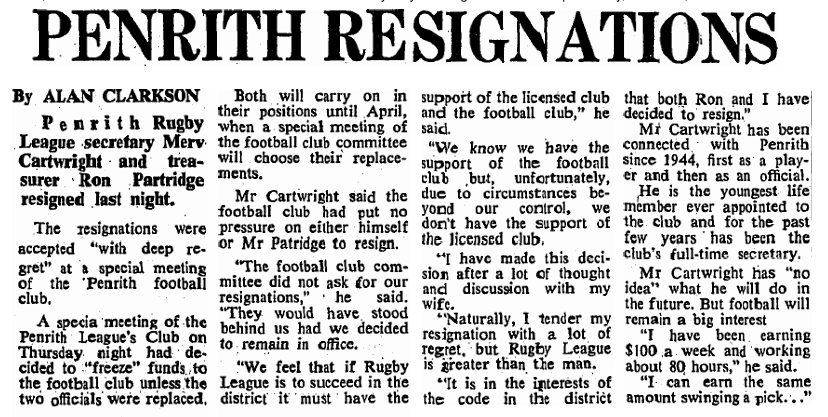
Within this context, the recommendation to cease funding unless Secretary Merv Cartwright and Treasurer Ron Partridge resigned can be understood not as an isolated or sudden decision, but as the culmination of these concerns. This was not an easy decision for the Board, a fact reflected in the final paragraph of the Board Resolution.


Resource Material*

The following documents can be seen as PDFs:


Related Material


Related Themes

Conflict · Governance · Financial Management


* Resource material courtesy of The Ausburn Collection


To receive new Parts and occasional project updates by email, you may subscribe below.

Readers who hold recollections, documents, or material relevant to this history are welcome to contribute via the Commentary & Contributions page.

Project Updates

Receive updates when new parts are published.
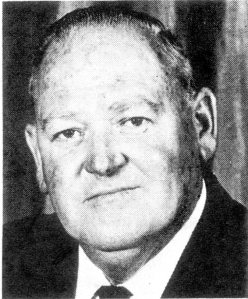
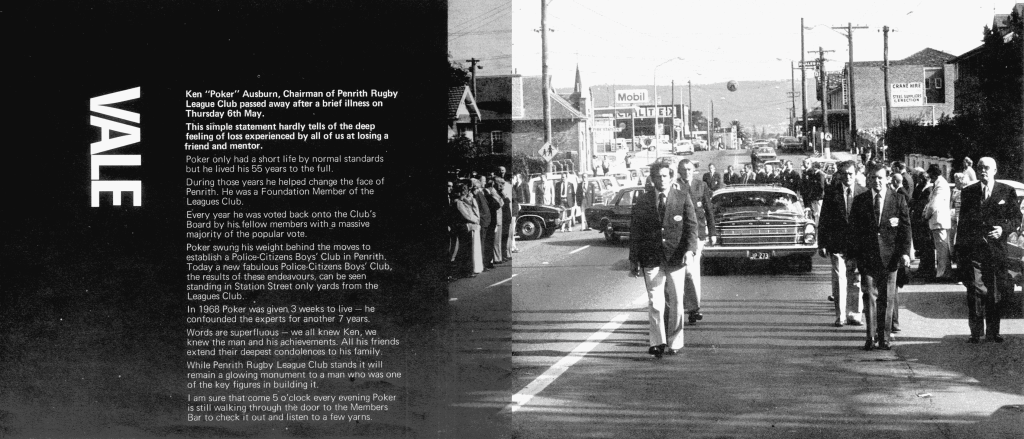
Major Player: Ken “Poker” Ausburn

Ken “Poker” Ausburn

Ernest Kenneth “Poker” Ausburn

Foundation Member, Chairman and Long-time Penrith Clubman

Ken “Poker” Ausburn was one of the foundational figures of Penrith Rugby League Club and among the generation of local volunteers who helped transform Panthers from a small district football organisation into a major community institution.

A lifelong Penrith resident, Ausburn served the club across many years as a committee member, director and eventually chairman. Remembered for his humour, warmth and strong community spirit, he became one of the best-known personalities associated with Panthers’ formative decades.

Though he died in 1976 before the club’s later expansion into the entertainment giant it would become, Ausburn remained widely respected within Panthers history as one of the men who helped establish the culture and identity of the early club.

Role in the Narrative

Ken Ausburn appears within the early development period of the Panthers, Passion and Politics narrative — the years in which Panthers evolved from modest local beginnings into an increasingly ambitious football and licensed club organisation.

He represents the generation of volunteers and local administrators who laid the foundations upon which later Panthers success would be built.

Ausburn is closely connected to Panthers’ long campaign for admission to the NSW Rugby League first grade competition, and to the club culture that developed during the 1950s, 1960s and early 1970s. His involvement reflects an era when Panthers depended heavily upon local personalities willing to contribute time, energy and leadership to both football and licensed club activities.

His life and reputation also provide insight into the strong community identity that surrounded Panthers during its formative decades.

Background

Born: 9 February, 1921, Penrith
Died: 6 May, 1976, Penrith

Profession: Boilermaker; long-time employee at the St Marys Munitions Factory

Panthers Roles:
• Foundation member
• Director
• Chairman
• Hon. Secretary Penrith Rugby League Golf Club

Community Involvement:
• Supporter of local sporting and youth activities
• Associate with support for Police Boys Club initiatives.
• Long-time Penrith community volunteer

Recognition by Panthers:
• Life Membership, Penrith Panthers (1964)
• Poker Ausburn Award – for most improved Panthers player (now discontinued).

In 2017 Penrith City Council named Ausburn Reserve — between Nepean St and Annett St, Emu Plains — to honour the contributions to the Penrith region from the Austbun family and specifically “Poker” and his brother, Bob.

Known As: “Poker” — a nickname reportedly derived from the poker face he adopted while telling stories, joking with friends or “spinning a yarn”.

Relevance to Events Described

Ausburn belonged to the generation that guided Panthers through its difficult formative years.

He witnessed — and helped contribute to — the club’s evolution from football played at very basic local facilities to the construction of larger licensed club premises and ultimately the development ambitions that would reshape Panthers in later decades.

Bruce Turner’s Footprints on the Banks of the Nepean reproduces the cover of Ausburn’s copy of the proposal supporting Penrith’s elevation to first grade competition in 1967. Although the full submission itself does not appear to have survived publicly, the surviving cover reflects the determination among local administrators to secure top-level rugby league representation for the growing Penrith district.

Contemporaries consistently remembered Ausburn not simply as an administrator, but as a personality. Family members and friends recalled his humour, generosity and capacity to engage people socially. Those qualities appear repeatedly in recollections of early Panthers culture.

His life was also marked by resilience. Following a serious motor vehicle accident, Ausburn endured long-term injuries and health complications, yet continued working and remained active in club affairs.

When he died unexpectedly in 1976 at the age of 55, Panthers tributes described him as one of the “small band of men who pushed the club onto its feet in the very beginning.”

Legacy

Ken “Poker” Ausburn is remembered as one of the local figures who helped give early Panthers its personality and community identity.

He represented an era when the club relied heavily upon volunteers, local businessmen, tradesmen and sporting enthusiasts whose commitment extended well beyond formal administrative duties.

Although later Panthers history would become associated with major commercial development, political influence and large-scale expansion, figures like Ausburn reflected the grassroots community culture from which the organisation originally emerged.

His reputation for humour, sincerity and loyalty ensured that his contribution remained warmly remembered long after his death.


Related Material


Related Themes

First Division Admission · Licensed Club · Football Club


Editorial Note

This profile is presented as contextual background.
Additional material may be introduced as the narrative progresses.


To receive new Parts and occasional project updates by email, you may subscribe below.

Readers who hold recollections, documents, or material relevant to this history are welcome to contribute via the Commentary & Contributions page.

Project Updates

Receive updates when new parts are published.
Divided Control: The Club and Football

This article forms part of the serialised republication of Panthers, Passion & Politics – The Roger Cowan Years.

Start · Reader’s Guide · All Parts


The licensed club was going from strength to strength despite ongoing problems between its board and the football committee. This conflict was to plague Cowan for fourteen years. He would tell every board member in those years,

This club is never going to be truly successful until we bring it all together – the club and the football. We have to be totally united.

There had always been two bodies. Merv Cartwright was the first secretary of the football club, while Cowan managed the registered club.1

Prior to the commencement of the 1967 season, the board of the licensed club had been asked to approve a budget of £40,000 to cover all rugby league-related expenses for the year. At the end of the season, Cartwright informed the committee that he would need £90,000.

The blow-out of more than 100 per cent was a huge impost on a club that was still struggling to establish itself. At that time it was easily the smallest registered club supporting a first grade team. Cowan was furious. So much hard work had been put into making the club profitable and Cartwright appeared to have little regard for budgets and financial controls. He seemed to have the view that there was a bottomless pit of money. Cowan says there were absolutely no controls over the football spending, with money continually wasted on unnecessary things.

When he took the job on the three-month trial, Cowan was confident that if he worked hard for a few months he would be on top of it all and then could take it easy. He was halfway through a university course as an external student of Armidale University. His plan was to get everything sorted out, and once that was done, “I’ll have plenty of time to study and take some time off”.

It did not quite work out that way. At the beginning of 1967, after 16 months of working 7 days a week, Cowan took his first day off since taking on the job. The Cowan family enjoyed a four-day break, driving to Broken Hill and returning via Mildura. The university course was never touched again.

Football expenditure in 1968 again exceeded the budget, and a couple of other problems had arisen with Cartwright during the year.

By 1969, the registered club Board had had enough. The events surrounding the removal of secretary and treasurer —Merv Cartwright and Ron Partrdige — are examined further in Beyond the Book: Removing the Football Club Secretary and Treasurer.

Eventually they called an extraordinary meeting of members. Realising the controversial nature of the event, they invited the mayor, Bill Chapman, to be chairman for the day. The Board’s recommendation was for the licensed club to cease rugby league funding unless Merv Cartwright resigned.2

Directors involved with the club during that period later described Cartwright in mixed but revealing terms.

Merv was an excellent PR man. He had the ability to influence and manipulate people. He did do a lot to build rugby league in the area and was very involved in the campaign for Penrith to join first division.

But he had lots of problems managing the money. Merv was always overspending, and Roger was trying to build a reliable business. That’s where a lot of the friction started.

The issues underlying that recommendation were more complex than this account suggests, particularly in relation to the Club’s financial position and governance arrangements at the time.

Around 1,000 of the club’s 6,000 members attended, with 80 per cent supporting the recommendation.

Cartwright did resign and moves were made to heal the rift between the two boards.

Sydney Morning Herald — Saturday, 20th March 1971

The District Club committee approached Cowan and asked him to take over as Secretary of the football club, a move that surprised him, given the history. The committee members said that they hoped such a move might help build a more co-operative relationship between the two clubs. 

Cowan decided to give it a try. The move gave him responsibility for both entities but after less than a year, the frustrations of managing both sides of the organisation while reporting to separate Boards with competing interests proved unworkable. So, Cowan began advocating his policy to unite them under one board and one CEO.

On two separate occasions after his removal as secretary, Cartwright ran foul of the board of the licensed club and had his membership suspended. The board was adamant that he would never be allowed back into the club. This issue remained unresolved for many years, and intensified, particularly when his sons started to show outstanding rugby league skills and were selected to play for the Panthers.

The board received regular written appeals to lift his suspension.

Long-time director Barry Hubbard (1973-85)3 told of the meetings in the years after Cartwright left:

Every AGM, Tom O’Connor, who was on the board at that time, would stand up and ask for the reinstatement of Merv Cartwright’s membership. This would get a very cool reception from the chairman, Ken [Poker] Ausburn, and the ensuing debates were the fieriest I experienced in my whole time on the board. Ausburn and O’Connor would scream at each other across the room, and O’Connor would invariably end the argument with the words, “It is not British justice that Merv Cartwright, who has done so much for rugby league in this area, is barred from this club”.

Hubbard says the resolution was always beaten, and Ausburn would rule that the matter was resolved and was not to be raised again for the rest of the year. Apart from O’Connor the entire board was against the reinstatement of Cartwright’s membership.

At times, the disputes became highly confrontational, even farcical. In a heated discussion at one of those AGMs, the deputy chairman, Murray Clarke, who was the most vocal critic of Cartwright, was told never to venture into St Marys. If he did, said the speaker, he would never get out alive. It was Clarke who had previously cited Cartwright to appear before the Board after allegedly abusing him and threatening him in public. 

The removal of Cartwright was to have ramifications for Cowan far into the future. The two had repeatedly clashed. Cartwright and his supporters blamed Cowan, not the board, for the loss of his membership. It was a festering antagonism that wouldn’t go away. In fact, it was one of the many small pieces in an intricate maze of events that would place Roger Cowan before Ian Temby in June 2004.


To receive new Parts and occasional project updates by email, you may subscribe below.

Readers who hold recollections, documents, or material relevant to this history are welcome to contribute via the Commentary & Contributions page.

Project Updates

Receive updates when new parts are published.

  1. At this time, both football and licensed club operated under the single entity of Penrith District Rugby League Football Club (PDRLFC). Separate committees had oversight of the football and licensed club operations. Penrith Rugby League Club Ltd was established in June 1967 to take responsibility for the registered club. ↩︎
  2. Related Board papers from 1968 and 1969 illustrate the growing conflict between the licensed club board and football administration. These papers are included in full in Beyond the Book: Removing the Football Club Secretary and Treasurer. ↩︎
  3. Barry passed away in 2021, aged 90. ↩︎

← Part 7 · All Parts · Part 9 →

Commentary and Contributions

The Panthers Magazine Arrangement

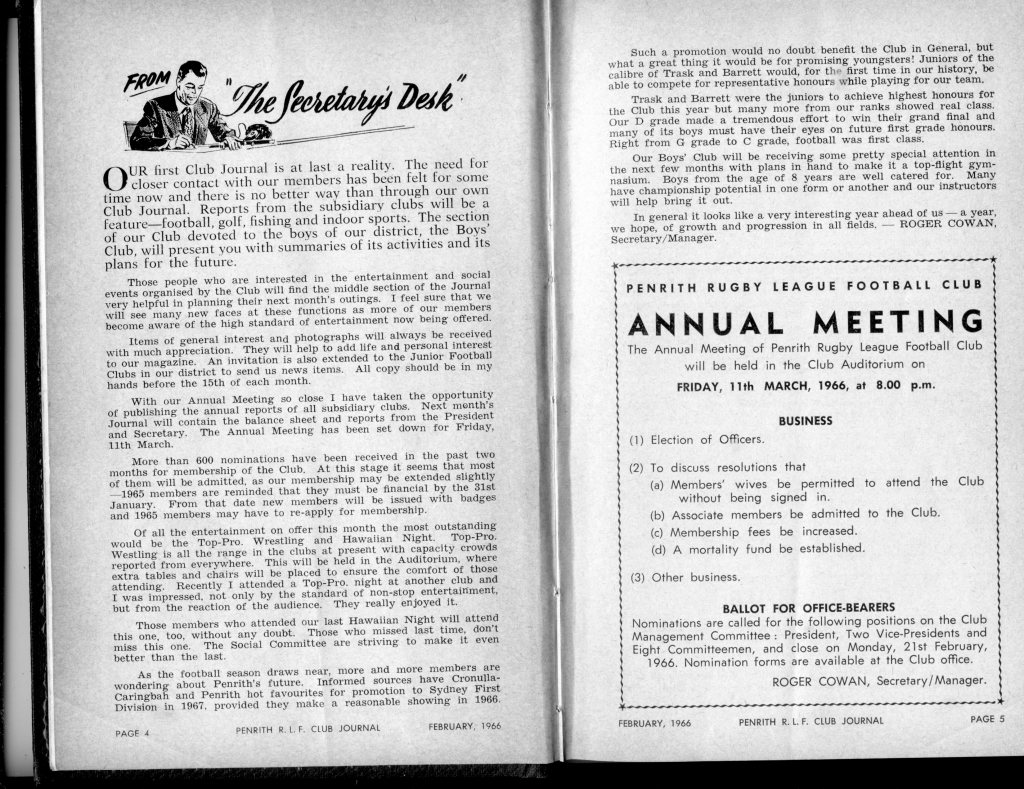
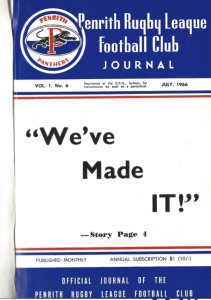
In February 1966, the Penrith Rugby League Football Club published the first edition of its official members’ journal.

The publication, issued monthly, was introduced at a critical point in the club’s development — as it sought admission to the New South Wales Rugby League First Division.

A central feature of the journal was a column titled From the Secretary’s Desk, written by Roger Cowan in his role as Secretary-Manager. In the opening issue, Cowan outlined club activities, membership growth and upcoming events, and referred to the club’s ambition of securing promotion to First Division.

The magazine was largely written and produced by Cowan and served as a means of communicating with members during the club’s First Division campaign.

In June 1968, Phyro Holdings Pty Ltd was registered, with Roger and Phyllis Cowan as directors. The name itself was derived from their first names — Phy from Phyllis and Ro from Roger.

In the years that followed, responsibility for publishing the club’s magazine — The Panthers Magazine — was transferred to Phyro Holdings under an arrangement approved by the club committee. The structure included conditions relating to profit limits, auditing of accounts and the remuneration deetails of Cowan’s role.

The arrangement formalised the transfer of publication responsibilities from the club to Phyro Holdings, under agreed financial and audit conditions.

The magazine arrangement — and the broader financial relationship between the club and Phyro Holdings — was later subject to scrutiny. Questions raised in subsequent decades focused on governance, transparency and the management of related-party transactions.

The Panthers Magazine became much more than a publication for PRLC members – it was a powerful community voice and was distributed to over 200,000 households in the Penrith Junior Rugby League District – Katoomba to Blacktown.

Those issues are examined in more detail in later sections of this project.


Related Topics


Related Themes

Financial Management · Strategic Planning


To receive new Parts and occasional project updates by email, you may subscribe below.

Readers who hold recollections, documents, or material relevant to this history are welcome to contribute via the Commentary & Contributions page.

Project Updates

Receive updates when new parts are published.

“We’ve Made It!” — The Decision to Admit Penrith to First Division

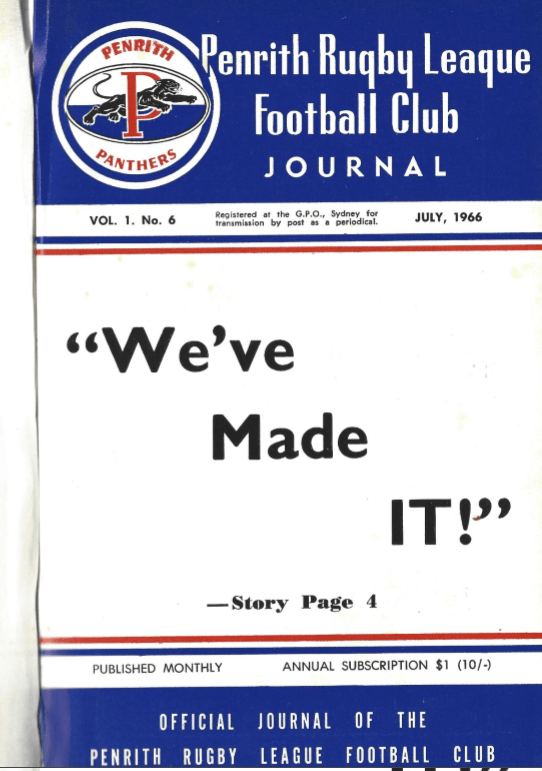
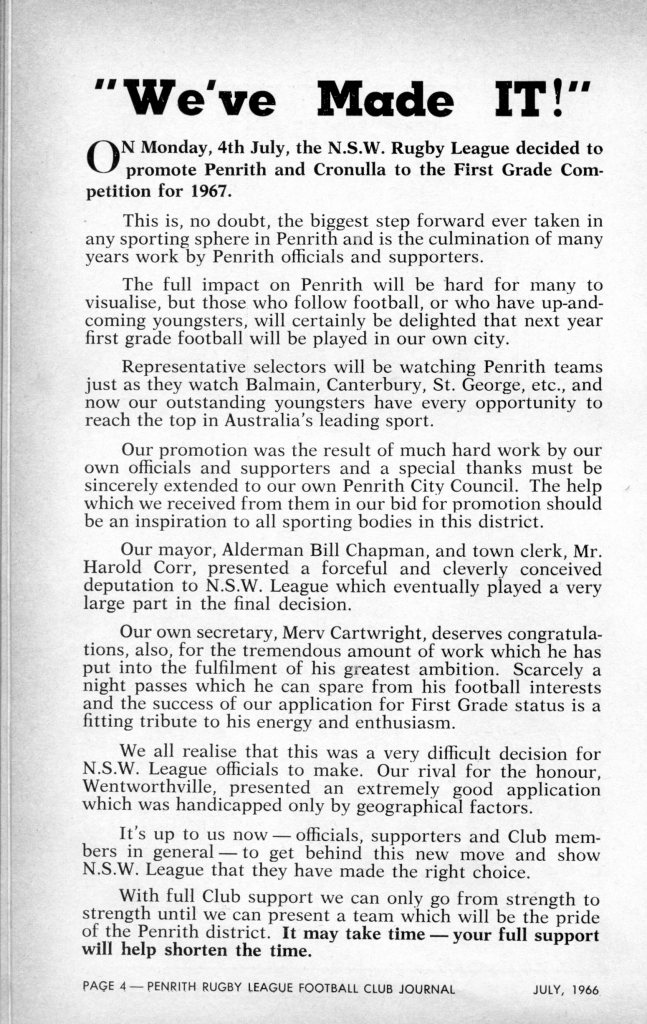
On Monday, 4 July 1966, the New South Wales Rugby League confirmed that Penrith and Cronulla would be admitted to the First Grade competition for the 1967 season.

Within the club, the decision was received as a defining moment. The July 1966 edition of the Penrith Rugby League Football Club Journal captured the announcement simply and emphatically on its cover: “We’ve Made It!”

Inside, the accompanying article described the promotion as “the biggest step forward ever taken in any sporting sphere in Penrith” and emphasised that it was the culmination of many years of work by club officials and supporters. It also acknowledged the contribution of civic leaders, including mayor Bill Chapman and town clerk Harold Corr, whose efforts were said to have played a significant role in the final decision.

The sense of achievement within the club is also reflected in later recollections. Coach Leo Trevena described the moment in more understated terms, recalling that when he heard the news, his reaction was immediate and practical: “The bell’s ringing; now the fight’s on.”

Different Reactions

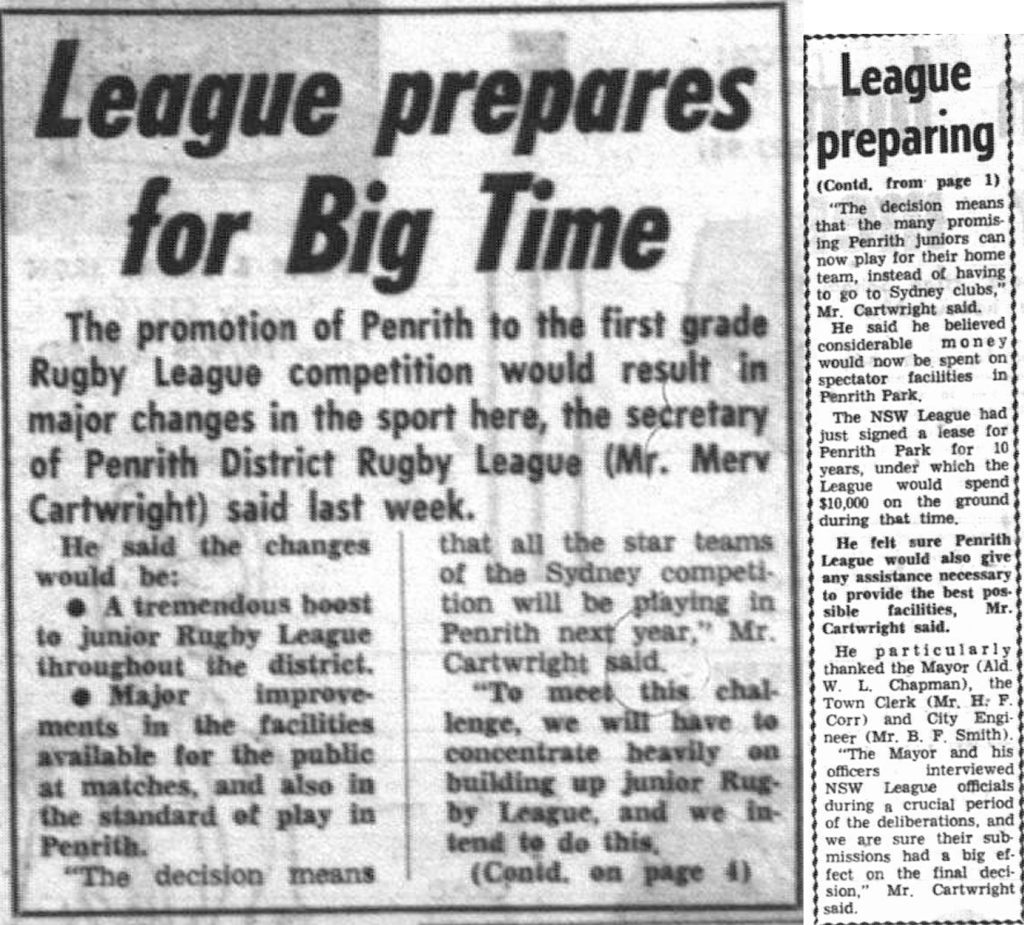
Beyond the club, the reaction was more measured. Contemporary coverage in the Penrith Press focused on the implications of the decision — including improvements to facilities, increased junior opportunities and the challenge of competing at a higher level — rather than celebration.

The contrast between the club’s own presentation of the moment and the more restrained tone of the local press is notable.

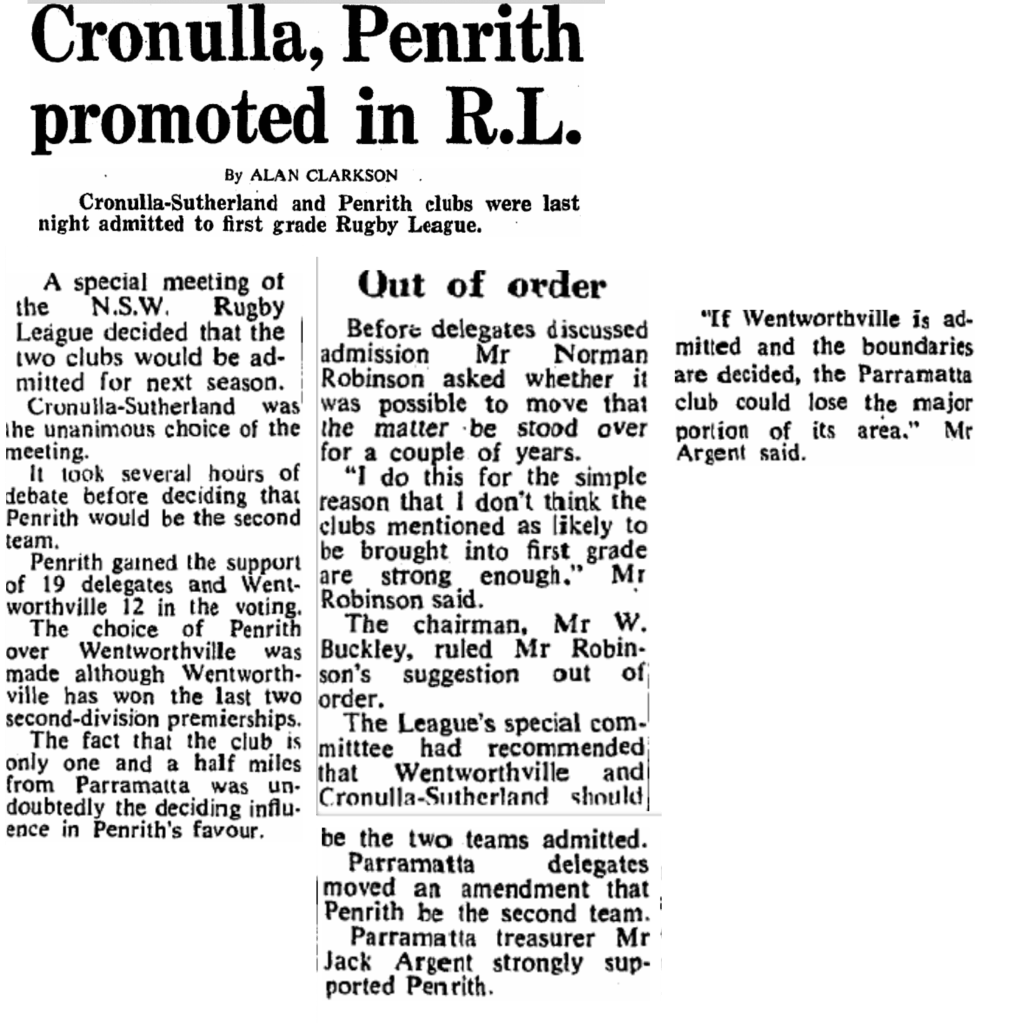
The Sydney Morning Herald also highlighted how narrow the decision had been, including Wentworthville’s unsuccessful attempt to have the matter deferred following the announcement.

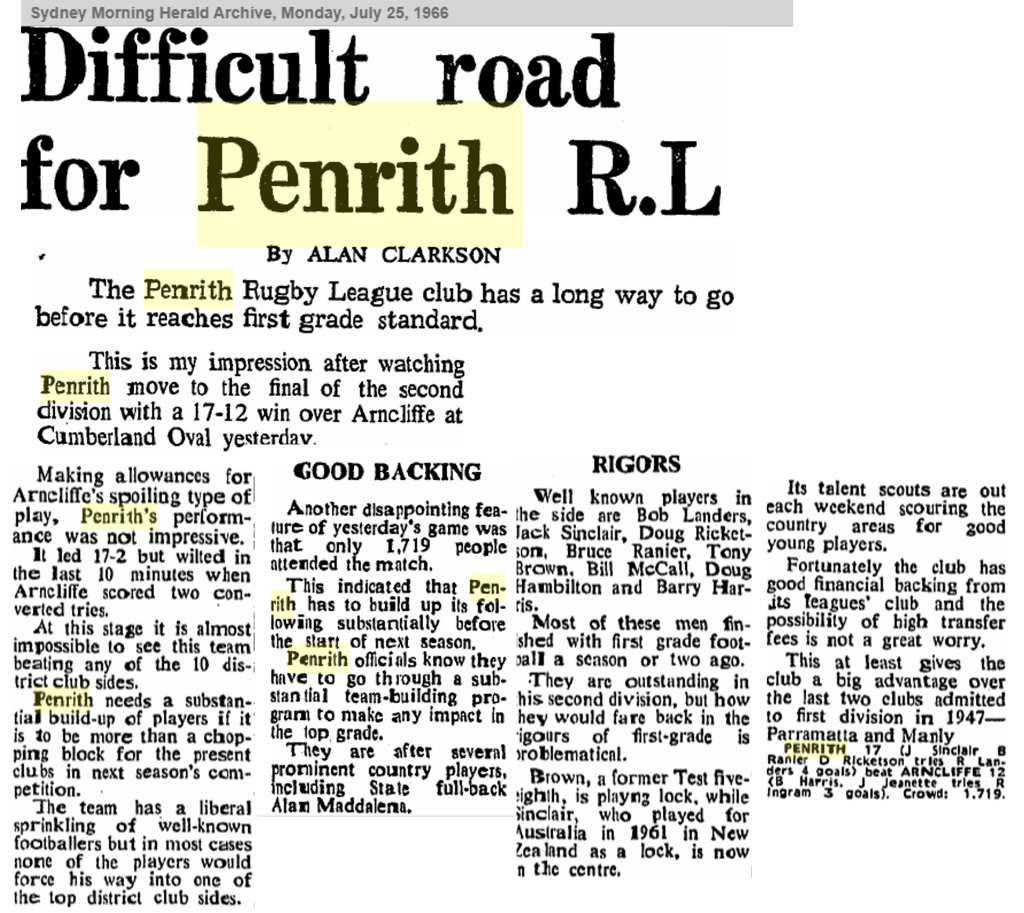
Three weeks later, Sydney Morning Herald journalist Alan Clarkson published a more cautious assessment of Penrith’s prospects, while acknowledging the club’s improving financial position and the support provided by the leagues club.

For Penrith, however, the significance was clear. Entry into First Division marked the transition from ambition to reality — and the beginning of a new phase in the club’s development.


Related Topics


Related Themes

Football Club · Milestones · First Division Admission


To receive new Parts and occasional project updates by email, you may subscribe below.

Readers who hold recollections, documents, or material relevant to this history are welcome to contribute via the Commentary & Contributions page.

Project Updates

Receive updates when new parts are published.
The Bid For First Division

This article forms part of the serialised republication of Panthers, Passion & Politics – The Roger Cowan Years.

Start · Reader’s Guide · All Parts


The financial stability that had recently been established allowed Penrith to pursue something that had previously been out of reach — entry into the NSW Rugby League First Division.  

Not long after Cowan took over as CEO1, the Penrith club had started making a push for one of two new spots that were being created in the First Division of the NSW Rugby League. It appeared that one of those holes had pretty much been filled by Cronulla. And while the credentials of the Penrith team were strong enough to give it a chance, the financial woes of the licensed club had to be overcome. Penrith needed to prove it had the resources to support a first division club. It also had to have sufficient player strength to be competitive.

The main rival for the position was Wentworthville. It was one of the most successful registered clubs in the state, had been the leading club in the Second Division competition for a number of years and was favoured to win the 1966 competition. It was a David and Goliath match up!

Early in 1966, Cowan advised the football committee that the club could confidently forecast a profit. The licensed club committee agreed it would support the bid for a place in the First Division competition. With a bit of extra money, the committee was able to pick up a number of established first grade players.

All stops were pulled out to build local support for the bid.

One of the more deliberate moves was the establishment of a monthly club magazine for members, largely written and produced by Cowan. Its aim was to push the First Division claim and stir up local support.2

Cowan also began to foster ties with Penrith mayor Bill Chapman and the town clerk, Harold Corr, both of whom would play key roles in Penrith’s promotion to first division.

The football committee led by Secretary Merv Cartwright, had worked strongly throughout the campaign.3

Another factor in Penrith’s favour was that Jack Argent, the Parramatta delegate to the New South Wales Rugby League, didn’t want Wentworthville in there, and he was very influential in those days. Roger Cowan s

Halfway through 1966, Penrith was able to prove to the NSW rugby league that it was profitable. Many factors contributed to the success of the bid, but we would never have got into First Division if the club had remained in the financial state it was. It was a narrow decision and we made it by the skin of our teeth. Six months earlier we would have had no chance of showing we could finance it.

Looking back, it seems logical that Penrith would be a better choice than Wentworthville, situated so close to Parramatta and competing for supporters. It was different back then though.  Souths, Easts and Balmain were good examples of successful clubs competing in the same areas. The NSWRL showed great foresight in considering the geographical qualifications and Jack Argent made sure they did.

Penrith supporters today can reflect that it was a very close call. Just a couple of votes and Penrith would have remained in Second Division.

The entry of the Penrith Panthers into first grade was a time of great celebration in the young city of Penrith. The team would have mixed fortunes over the next 24 years. They first made the semi-finals in 1985 and won their first premiership in 1991.


To receive new Parts and occasional project updates by email, you may subscribe below.

Readers who hold recollections, documents, or material relevant to this history are welcome to contribute via the Commentary & Contributions page.

Project Updates

Receive updates when new parts are published.

  1. Cowan’s formal title was Secretary-Manager, the standard senior administrative role used by rugby league clubs at the time.
    ↩︎
  2. The monthjly Club Journal is the precursor to The Panthers Magazine – which later becomes central to a number of governance issues. See Beyond the Book — The Panthers Magazine
    ↩︎
  3. The campaign involved the efforts of many people, including club officials, local supporters and civic leaders such as Penrith mayor Bill Chapman and town clerk Harold Corr. Chapman and Corr were instrumental to the process. ↩︎

← Part 6 · All Parts · Part 8 →

Commentary and Contributions

The Bungool Picnic

This is Cowan’s description of what happened when the players were given the news that their pay would be “short”. This was taken directly from the manuscript.

We decided to go ahead with the picnic and pay the players half their contracts in the hope that we would be able to pay more later. When I turned up at the picnic, I found I was the only person from the football committee there. Everyone else, including Cartwright and the club’s president, had suddenly found they were unable to attend. It was up to me to explain to the players.

Most were OK with it, until it came to a player called Billy Tonkin. He was a terrific football player – big, tough, strong – and I’m sitting down. Billy’s next in line, and I say, “Bill, I can only give you half your money.”

Billy growls, “Yeah, Cowan, bullshit! You write my cheque out.”

I say, “Bill, I can only give you half.”

“Write the cheque for the full amount”, says Bill in a very menacing tone, leaning across the table.

The next bloke in the queue is Cec Reddy, who used to play hooker for us. Cec was only slightly built but he was a real pug. He used to box in the ring. Some people used to joke that he should sell advertising on the soles of his shoes.

Cec walks up to Bill and says, “Look, he said he can’t pay you, so leave him alone”. These two proceeded to have a big argument across the picnic area, but in the end, Bill did accept his half pay.

Max’s Notes

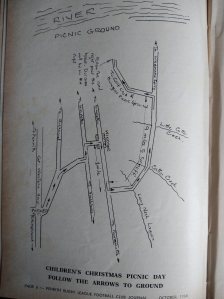
The drive to Bungool at Cattai — and back — felt long. The Club’s monthly journal even published directions for members to follow, a reminder of how different travel was at the time.

When I first read Roger’s account, I assumed it referred to the 1964 or 1965 season — certainly before Penrith entered the major competition in 1967. I can remember, even as a child, him returning home frustrated by events at the football club. This felt like one of those occasions, although there were many.

However, the reference to Billy Tonkin complicates that assumption.

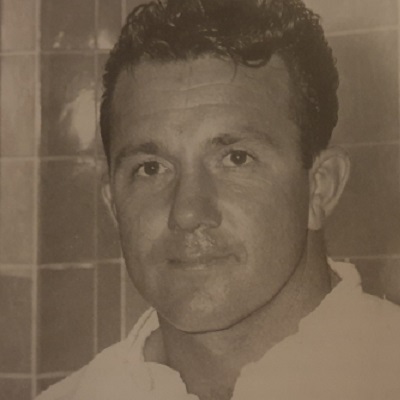
Bill Tonkin (pictured right) was signed to Penrith in 1967. He is Player #11 and played in our opening game against Canterbury-Bankstown. Bill played 18 1st grade games in his two seasons (1967-8), scored 2 tries and kicked a goal for a total of 8 points. He was a lock forward who’d previously played for Balmain, Wests, and Souths.

If the player in Roger’s account was indeed Tonkin, the incident must have occurred in either 1967 or 1968 — suggesting it took place after Penrith’s admission to the competition. Alternatively, and almost certainly, the identity of the player has been misremembered.

Either way, the underlying issue remains clear.

The club had committed to player payments it could not meet. Those responsible for managing the football budget failed to address the situation in advance, and were not present when the consequences had to be explained.

Roger, a rookie then, was left to do so alone.


Related Topics


Related Themes

Growth · Licensed Club


To receive new Parts and occasional project updates by email, you may subscribe below.

Readers who hold recollections, documents, or material relevant to this history are welcome to contribute via the Commentary & Contributions page.

Project Updates

Receive updates when new parts are published.
The Bungool Picnic and Unpaid Players

This article forms part of the serialised republication of Panthers, Passion & Politics – The Roger Cowan Years.

Start · Reader’s Guide · All Parts


Penrith in the 60s was, in many ways, still a country town. Some of the trains were still steam hauled, and holidaymakers would pass through on their way to the Blue Mountains – or stop off and catch the Bales’ bus out to one of the many guesthouses at Wallacia, some ten miles out of town.

Through 1963-64, Roger Cowan continued teaching while acting as honorary treasurer of the football committee. What started out as an amicable relationship with Merv Cartwright gradually deteriorated into frequent clashes.

The registered club’s main function in those days was to finance rugby league.

In 1964, the registered club committee had agreed to a football budget of £10,000 and player contracts were agreed within that budget. Payday for the players was planned for the traditional end of season picnic on the banks of the Hawkesbury River — Bungool1.

When Cowan went to the club administration to organise the cheques for the players, he was informed that they didn’t have the money. He had no warning of the problem. Merv Cartwright who sat on the registered club committee and was also secretary of the football club, would known much earlier that the Club was in financial trouble — yet the football club had been allowed to proceed on its merry way without any warning.2

Before this Cowan had never thought about getting into club politics. It was this failure — the inability to meet its obligations to the players — that first motivated him to stand for election onto the committee of the licensed club – ‘to understand how £10,000 could be promised and not paid’.

He was elected, and soon after asked to take on the role of treasurer. It quickly became apparent that the club had virtually no systems of control. Dishonesty was widespread, enabled by the absence of basic procedures.

I started to look into why the club wasn’t making any money. We were losing money hand over fist. The bank was threatening to take action. One of the first things I did was to install control systems for poker machines.  This included a monthly analysis of each of the 26 machines to ensure they were operating within carded percentages.

I also put as much time as I could into getting some systems operating. There was no system for stock control, no cash systems, there was nothing. I began with cash systems. We started to count the money, and balance it against the cash register tapes, and so on. Basic stuff, but it had never been done.

 Cash control was a simple system before then. When trading finished for a shift, the cash would be taken to the vault and tipped into a large container with all the cash from other cash registers. Nobody checked the cash register tapes to see if there was a balance. Each morning the money in the container would be counted and banked.

Rumour has it that one employee boasted that he never bothered taking less than a twenty pound note when he wanted some cash. He bought a new car in less than 12 months working as a bar steward.  After getting a system started, I came in one Sunday morning and discovered a £1,700 discrepancy between the cash register tapes and the money we had. That was a lot of money in those days for such a small club.’

At a special meeting, the board decided that the Secretary-Manager Rocky Davis wasn’t managing things properly, and asked for his resignation. There was no suggestion of dishonesty, only mismanagement.

The Club immediately advertised for a replacement. But the small size and low profile of the Club meant that the quality of candidates was not very high. After three months of advertising, they had still found nobody suitable. In the meantime, Cowan continued holding things together in his spare time – evenings and weekends – and continued to improve the systems.

I was doing the job anyway, as well as teaching. I was convinced in my own mind that I could put systems in place to make the place work. So I just said to the committee one night, “I’m prepared to resign from teaching. I’ll take the job for a trial period if you want to give it to me. And I’ll give you a guarantee that if I’m not making a profit within three months, I’ll resign and you can keep looking”. I agreed to commence on a very low salary.

That was October 1965. The Board agreed, and Cowan remained in the position continuously for almost 40 years.

There is a logical question here, of course. Here is a young man – 29 years old, married, four young kids. He’s a schoolteacher, which is a reasonably secure job for life. He suddenly decides to turn his whole life upside down. There is no contract, no security of tenure – just ‘give me three months to make a success of it. If not, I’ll go’.

Phyllis Cowan says it was the challenge.

He loved school teaching, he was an excellent teacher, but he didn’t like the system. I don’t think he wanted to be doing that for the rest of his life. Many people advised him against it at the time. But he always could have gone back to teaching, she said –- it was easier back then.

It was the challenge that attracted him, and kept him there, she said. He was being successful, the club was making money, it was growing, and he was introducing all these new measures. She spoke of a couple of nights in the early days when he took a blanket and pillow and sat on a roof where he could watch for the people that he knew were stealing stores from the club.

Under Cowan’s stewardship, the club began to more stable financially. The systems he implemented, some while acting as treasurer and others when he took the management role, had already begun to have an impact on the profitability of the business.

Within a year, the club had moved out of the red. For the first time, it had the financial stability needed to think beyond survival.


To receive new Parts and occasional project updates by email, you may subscribe below.

Readers who hold recollections, documents, or material relevant to this history are welcome to contribute via the Commentary & Contributions page.

Project Updates

Receive updates when new parts are published.

  1. Bungool’s location was at Cattai on the Hawkesbury River where Riverside Oaks Golf Resort is today. ↩︎
  2. This failure became evident at the end-of-season Bungool picnic, when players could not be paid in full.
    See Beyond the Book: The Bungool Picnic. ↩︎

← Part 5 · All Parts · Part 7 →

Commentary and Contributions

From Tin Shed to Taj Mahal — Scale and Contrast in 1963

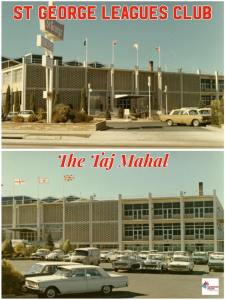
In 1963, Penrith and St George Rugby League Clubs each opened new premises. The contrast between them — in scale, cost, and ambition — highlights the gap between an emerging club and one already established as a powerhouse of the game.

To describe Penrith Rugby League Club as a minnow compared to St George Rugby League Club in the early 1960s is no exaggeration.

In 1963, the St George Dragons had already secured seven consecutive premierships, a run that would extend to eleven.

In 1963, both clubs opened new premises.

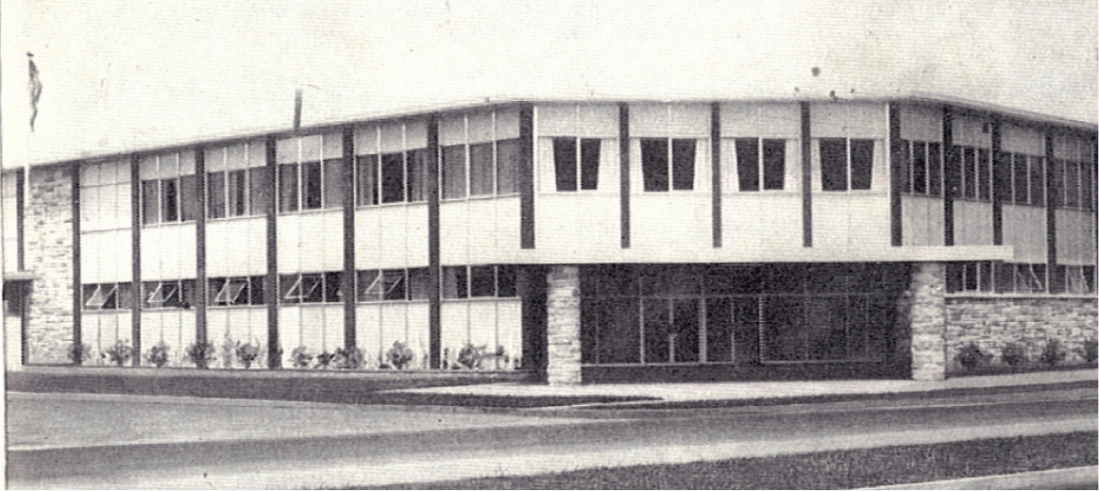
In March, Penrith Leagues Club opened a new building adjacent to the old Boys Club, at a cost of approximately £150,000.

In July, St George Leagues Club opened its new premises at Kogarah, with construction costs approaching £1,000,000.

William “Bill” Buckley (1906–1973), Chairman of the Australian Rugby League, officially opened both clubs. During a tour of the new St George premises, struck by its scale and extensive use of marble, he is said to have remarked: “This reminds me very much of the Taj Mahal.”

The nickname endured.

St George Leagues Club — Photo: Joan Hatton

Both developments marked a move beyond earlier, more modest beginnings — the kinds of facilities often remembered, and sometimes simplified, as the “tin shed” era.

For St George, that transition had already occurred.

For Penrith, it was only just beginning.

The scale of the St George club did more than impress. It set a benchmark — one that emerging clubs like Penrith could not yet match, but would, over time, seek to close.

From the Narrative

This contrast sits alongside the developments described in Part 4 — From Small Beginnings, where Penrith’s early structures begin to take shape against a backdrop of more established clubs.

A Little Extra

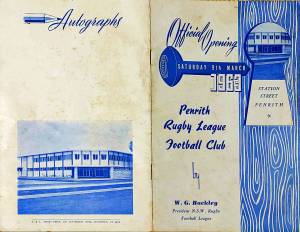
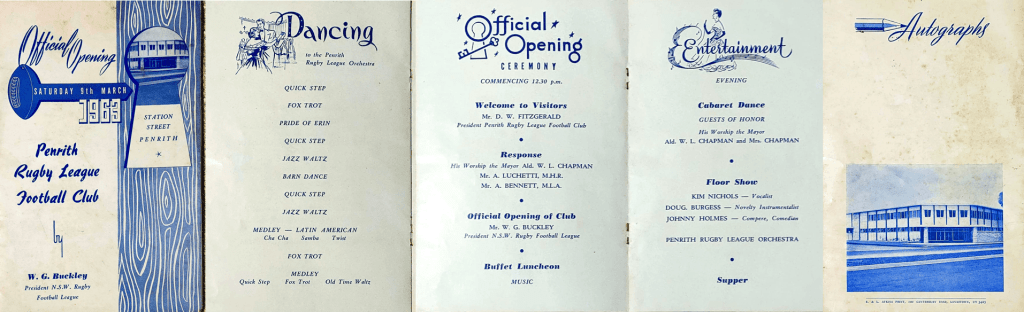
Here is the complete 1963 Opening Program for Penrith Rugby League Club — it was a big day, starting with lunch, then evening and supper — and lots of dancing! And plaudits to the Penrith Rugby League Orchestra who must have exhausted by night’s end.


Related Material


Related Themes

Financial Management · Growth


To receive new Parts and occasional project updates by email, you may subscribe below.

Readers who hold recollections, documents, or material relevant to this history are welcome to contribute via the Commentary & Contributions page.

Project Updates

Receive updates when new parts are published.
The Tin Shed — Myth and Memory

In telling the history of Penrith Rugby League Club, one phrase appears again and again — the “tin shed.”

It is often used to describe the club’s early years: humble, under-resourced, and far removed from the scale of the modern Panthers organisation.

Like many origin stories, the reality is both more specific — and more revealing.

What Was the “Tin Shed”?

As former director Max Connors recalled, the so-called “tin shed” was not a clubhouse in the way the term is now understood. It was, in fact, a kiosk at the showground where the team played.

The tin shed that people talk about was actually a kiosk on the showground where they used to play. It was run by the ladies, and the players used to get three free tickets each, and the supporters could buy three tickets for two shillings.

The structure doubled as a dressing area for players, reflecting the limited facilities available at the time.

Penrith’s “Tin Shed” Mark II

Many would label this building as the “tin shed” of Penrith’s history.

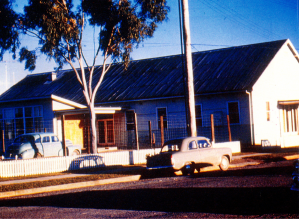
Panthers first clubhouse in Station St, Penrith

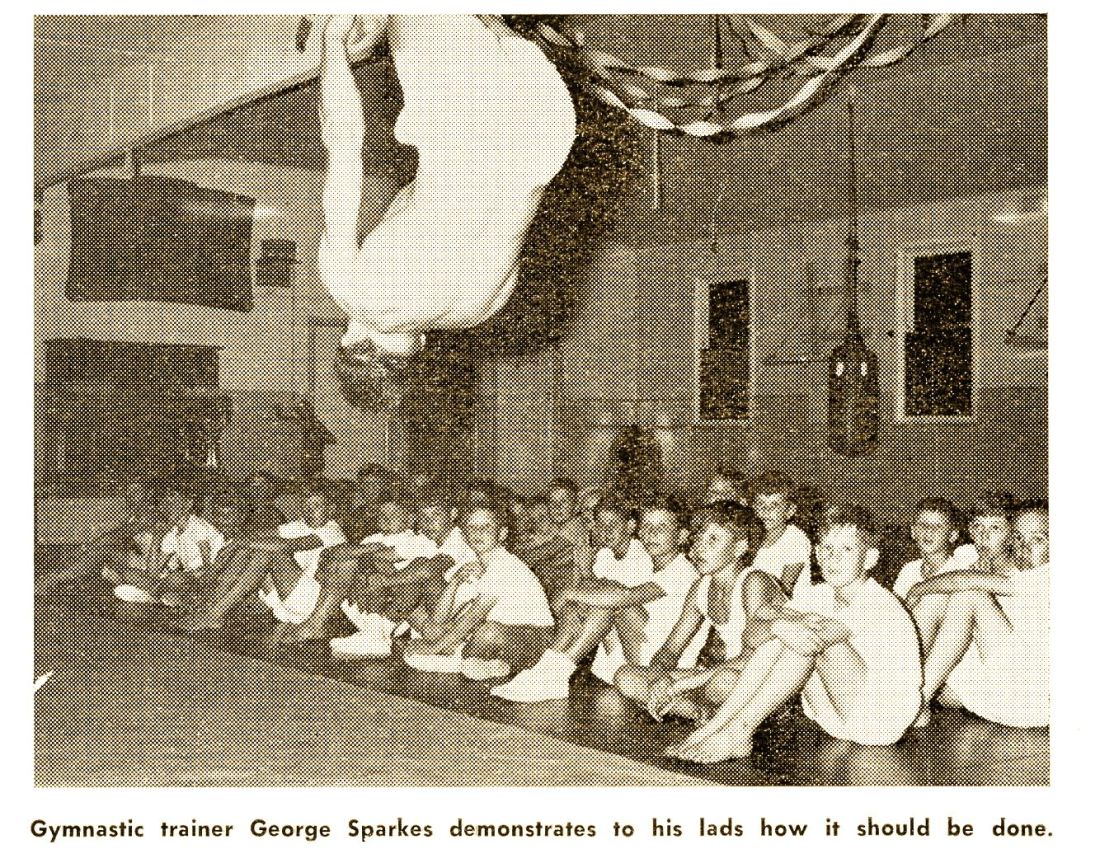
It would be a fair label, for this too is a far cry from the building that, in 1963, opened along side it. But this second “tin shed” was already multi-functional, and efficiently so. Dining room, function room, gymnastics (see feature image), boxing, calisthentics, jiu-jitsu, weights and of course, the club staples of bar and poker machines.

A Familiar Story

The idea of a club beginning in a “tin shed” is not unique to Penrith.

Across New South Wales, the history of registered clubs abounds with stories of “tin shed” origins — always small, improvised buildings, often constructed from basic materials and supported by volunteer labour.

Whether literally accurate or not, the phrase has become a kind of shorthand for humble beginnings and community effort.

In that sense, the “tin shed” is as much a cultural expression as a physical description.

How Myths Take Shape

Over time, the image of the “tin shed” has taken on a broader symbolic meaning — shorthand for:

  • hardship
  • simplicity
  • and the idea of a club built from nothing

This kind of simplification is very common in tales of sporting and community history. The details are simplified, merged, or reshaped into something more easily remembered and retold.

The result is not necessarily inaccurate — but it is selective.

The Penrith Version

At Penrith, the story is slightly more nuanced.

While the original “tin shed” referred to the showground kiosk described by Connors, later early facilities — including the original Station Street club building — were also modest in scale and construction.

In practical terms, they fit very well with the image the phrase now conveys.

The mythology, in that sense, is not entirely misplaced — but it is an interpretation crossing several realities.

Why it Matters

Understanding the reality behind the “tin shed” does not diminish the achievement of those early years.

If anything, it clarifies it.

The club did not begin in abstraction or myth, but in a very real, very practical setting — a showground, a kiosk, and a community effort sustained by volunteers, financiers — lenders and donors — players, and supporters.

That distinction matters, because it grounds the story of Penrith not just in adversity, but in structure, place, and people.

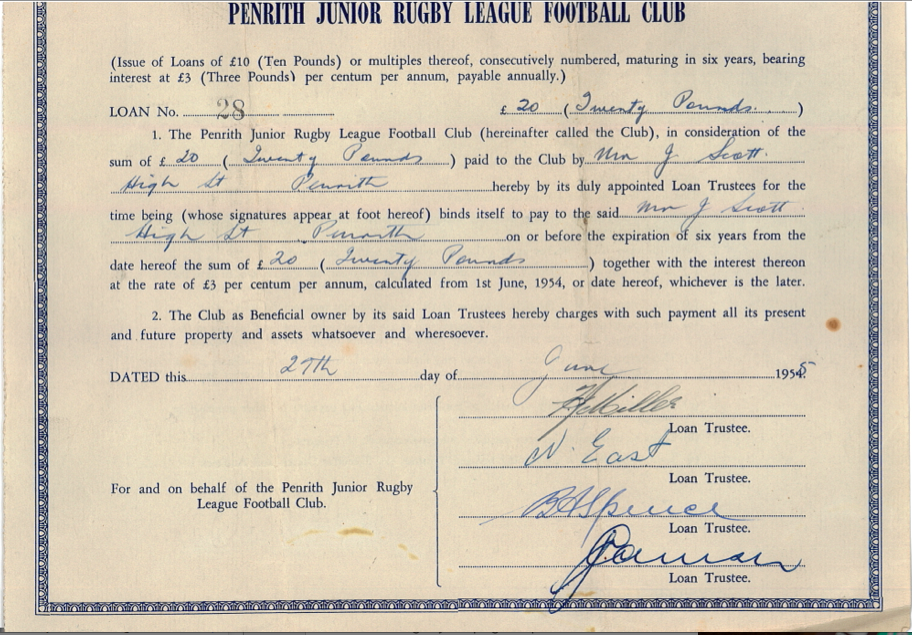
One of the people who helped Penrith Rugby League Club move beyond tin shed was Mr John Scott who provided the Penrith Junior Rugby League with a loan of £20 in 1955. The Scott family have supported the Club from its very beginnings, have seen many changes, great growth, challenges and remain firmly part of the Panthers family today.

In the Narrative

The reference to the “tin shed” appears in Part 4 — From Small Beginnings, where it helps frame the scale of the club’s early operations, and the distance between those beginnings and what would follow.


Related Materials


Related Themes

Culture


To receive new Parts and occasional project updates by email, you may subscribe below.

Readers who hold recollections, documents, or material relevant to this history are welcome to contribute via the Commentary & Contributions page.

Project Updates

Receive updates when new parts are published.