The Iconic Panthers Scoreboard

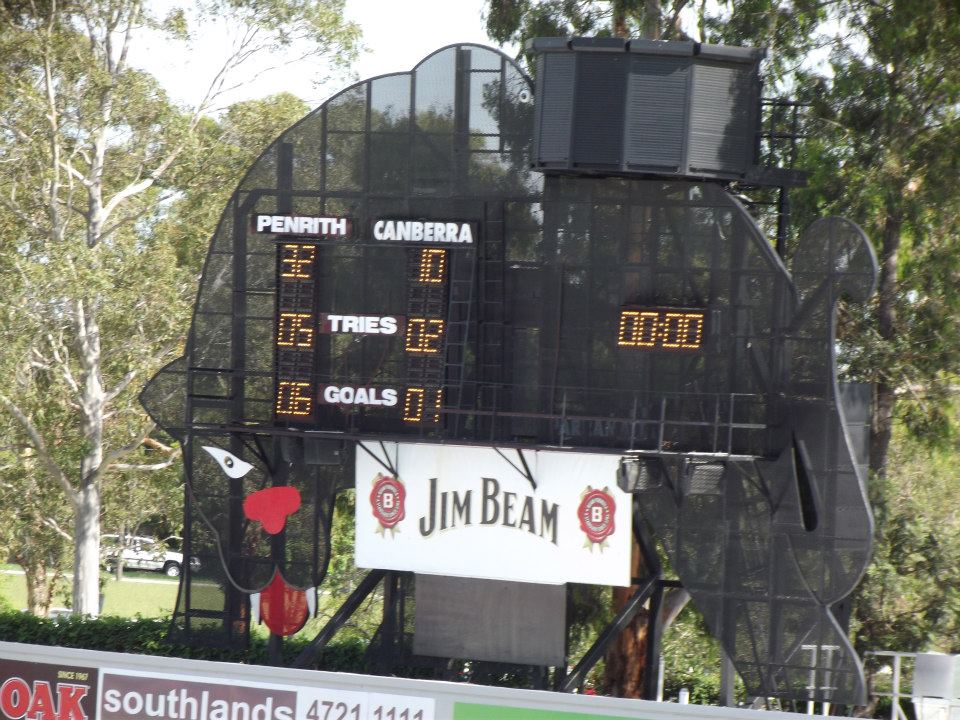
The Panthers scoreboard became one of the most distinctive features of Penrith Stadium — or any rugby league ground at the time. Its origins can be traced to the club’s early think-tank culture.

In the early days of Penrith Rugby League Club, Roger Cowan used think-tanks to encourage participation and generate ideas for the club’s development.

According to Kevin McGrath, the unique scoreboard installed at Penrith Park in 1979-80 had its origins in one of those sessions.

An idea for creating a Luna Park style feature for the club entry was eventually re-imagined as a football scoreboard. The concept was developed further by the architects Dick-Smith Leffler & Gill, who drafted the concept.
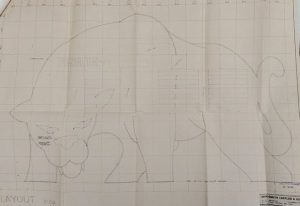
Finally, that original idea was brought to life at the southern end of Penrith Park as an innovative scoreboard.

The scoreboard displayed the score of the Panthers game, as well as progress scores from other matches being played on the day. A score by the home team triggered a response from the structure — flashing eyes and a Panther’s roar marking the moment.

Over time, modifications were made as the structure aged and operational demands changed.
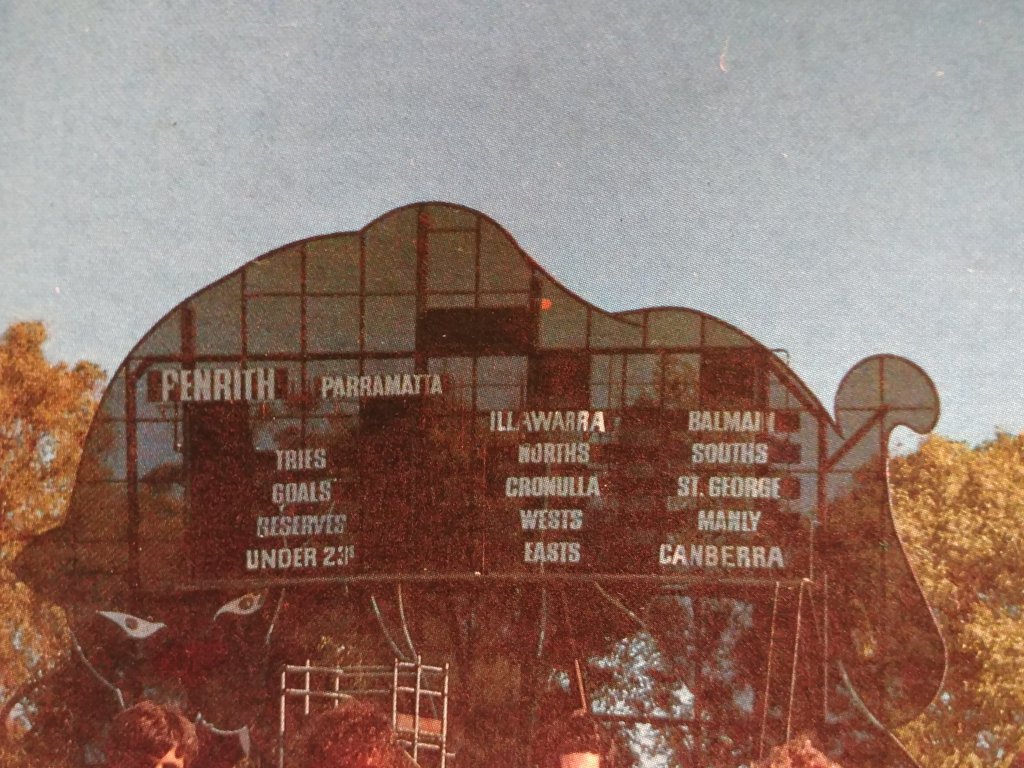
The iconic scoreboard had its operational flaws, as it aged there were many breakdowns and failures and eventually could not deliver what was required at a modern sporting stadium … but still it was loved by Panthers fans and visitors alike.

In 2013 it met a fate unbefitting of a trusted, if unreliable, friend:
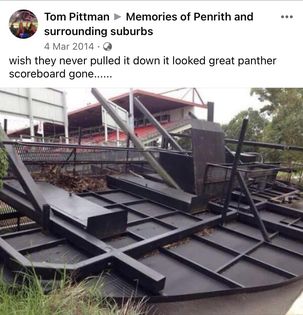
This Facebook post is dated 4 March 2014, the photo (source unknown) was taken in 2013.

In 2013, the scoreboard was removed.

At the time, it was suggested that the structure had been carefully dismantled and placed into storage, with the possibility of future restoration. Other accounts indicated that it had instead been destroyed during the removal process.

Regardless of the circumstances, its disappearance marked the end of one of the most recognisable symbols of the Panthers experience.


Related Topics


Related Themes

Culture · Innovation


To receive new Parts and occasional project updates by email, you may subscribe below.

Readers who hold recollections, documents, or material relevant to this history are welcome to contribute via the Commentary & Contributions page.

Project Updates

Receive updates when new parts are published.
Panther Stamps

In modern clubs, loyalty systems are everywhere.

Members accumulate points through gaming, dining and entertainment spending, redeeming them for meals, prizes, discounts or benefits through sophisticated computerised systems linked to membership cards and databases.

Security surrounding gaming operations was often basic, particularly in smaller or rapidly growing clubs where staffing and oversight systems struggled to keep pace with expansion.

Long before those systems became standard across the club industry, Panthers experimented with an early version of the same idea.

It was called Panther Stamps.

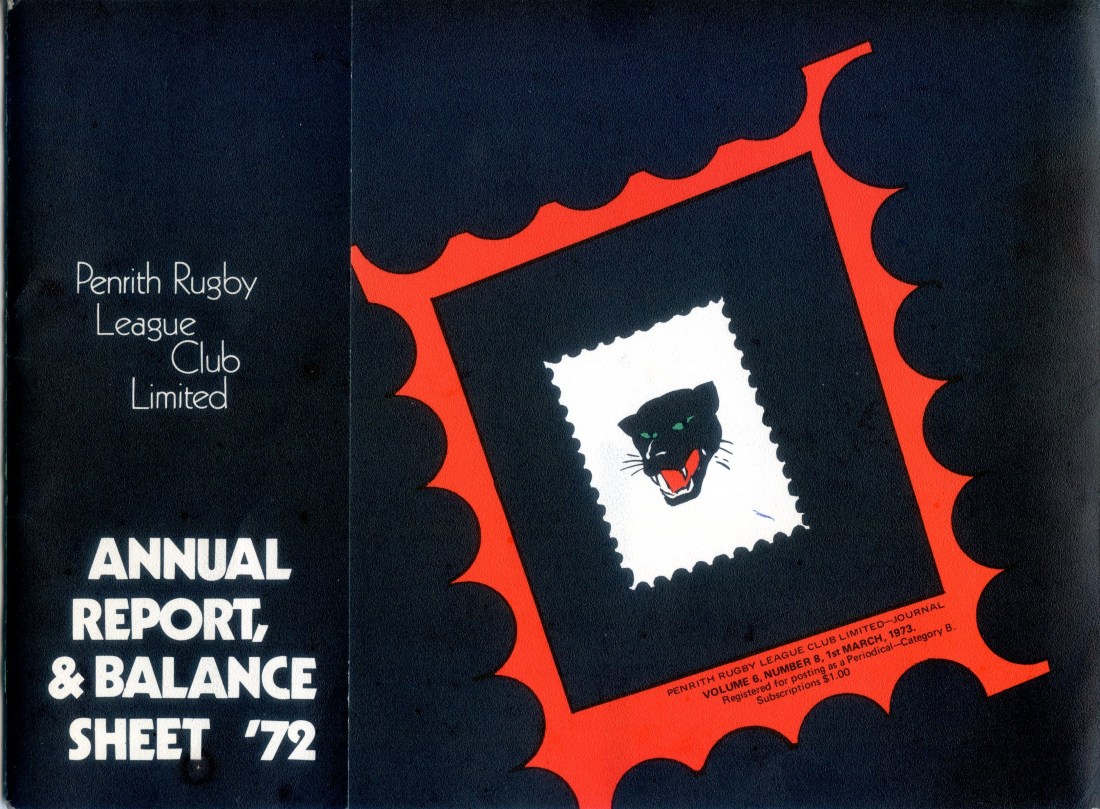
Introduced in 1972, the scheme rewarded patrons — with bonus stamps that could later be exchanged for prizes and trophies. While simple by modern standards, the concept reflected a surprisingly advanced understanding of customer loyalty, repeat visitation and member engagement

The Panthers Annual Report for 1972 described the program as:

“one of the most outstanding successes we have ever had.”

The scheme had officially commenced on 10 July 1972 after several months of delay caused by what the club described as “security and administrative problems involved.”

Even at this early stage, Panthers recognised that a rewards system required careful operational controls, stock management and accounting procedures.

Within less than six months:

  • and prizes worth approximately $22,000 at cost price had been distributed.
  • members had collected more than 150,000 stamps
  • over 90,000 had already been redeemed

The prizes ranged from trophies and sporting awards through to toys and household items. The report noted that demand became particularly intense in the weeks before Christmas, with thousands of dollars’ worth of toys redeemed by members.

Importantly, Panthers did not present the scheme simply as generosity or entertainment.

Club management acknowledged that while the program carried significant administrative costs — including staffing, storage, stationery and prize purchasing — they believed the increased engagement from members more than justified the expense.

In effect, Panthers had identified an idea that would later become central to the modern club and gaming industries: reward loyalty, encourage repeat visitation, and strengthen the relationship between the member and the venue.

The system also demonstrated the increasingly sophisticated operational mindset developing within Panthers during the early 1970s. By this period, the club was not merely expanding physically — it was experimenting with new forms of marketing, patron engagement and gaming promotion that were relatively advanced for the time.

Although Panther Stamps relied on physical booklets and manual administration rather than computers and swipe cards, the underlying principle was remarkably familiar to modern readers.

Today’s digital loyalty programs — with their points systems, rewards catalogues and member incentives — are built upon many of the same ideas.

While modest by modern standards, Panther Stamps reflected the growing importance of structured member engagement within the evolving licensed club industry of the period.

Panther Stamps were simply an early analogue version of that future.


Related Topics


Related Themes

Financial Management · Innovation


To receive new Parts and occasional project updates by email, you may subscribe below.

Readers who hold recollections, documents, or material relevant to this history are welcome to contribute via the Commentary & Contributions page.

Project Updates

Receive updates when new parts are published.
Wires, Magnets and Monitoring

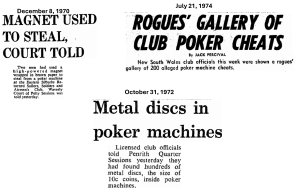
During the 1960s and 1970s, poker machine operations were still relatively primitive by modern standards. Machines were largely mechanical, heavily cash-based and vulnerable to manipulation.

Across the NSW club industry, stories circulated of patrons using wires, magnets, lead discs being used as coins, and other improvised devices in attempts to interfere with machine mechanisms or influence payouts.

Security surrounding gaming operations was often basic, particularly in smaller or rapidly growing clubs where staffing and oversight systems struggled to keep pace with expansion.

At the same time, the sheer volume of coins moving through gaming rooms created operational difficulties of its own. Machines required constant clearing, counting and refilling. Cash handling was labour intensive and exposed clubs to risks ranging from simple human error to outright theft.

These problems were not unique to Panthers. They reflected broader challenges facing the club industry as poker machine revenue expanded rapidly during this period.

For administrators such as Roger Cowan, such vulnerabilities highlighted the need for tighter operational systems and greater technological oversight. At Panthers, this gradually led to innovations in surveillance, accounting controls, machine monitoring and broader administrative systems designed to improve both security and efficiency.

Part of Cowan’s reputation within the club industry stemmed from his willingness to embrace technology earlier than many contemporaries. What later became sophisticated electronic monitoring and integrated management systems began, in part, as practical responses to very immediate operational problems.

The issue was not simply dishonesty. It was scale.

As clubs grew larger and gaming operations expanded, informal methods that may once have worked in smaller suburban venues became increasingly inadequate. Stronger systems, better monitoring and more professional management structures became essential to running modern licensed clubs.

Seen in that light, the technological innovations discussed in Part 9 were not merely about efficiency or modernisation. They were also responses to a rapidly changing gaming environment in which security, accountability and operational control had become central concerns for the industry.


Related Topics


Related Themes

Financial Management · Innovation


To receive new Parts and occasional project updates by email, you may subscribe below.

Readers who hold recollections, documents, or material relevant to this history are welcome to contribute via the Commentary & Contributions page.

Project Updates

Receive updates when new parts are published.
Removing the Football Club Secretary and Treasurer

The removal of Merv Cartwright (Secretary) and Ron Partridge (Treasurer) from their respective roles with the Penrith District Rugby League Football Club occurred against the backdrop of a broader and more complex set of issues than is immediately apparent in the main narrative.

While Cartwright became the central public focus of the dispute, the Board’s concerns also extended to the financial administration of the football club more broadly, including the role of Treasurer Ron Partridge.

Contemporaneous Board papers and meeting records from the period indicate a growing concern among Directors regarding both the financial management of the Club’s football operations and the processes by which financial commitments were being made.

At the centre of these concerns was the relationship between the Licensed Club — which generated the revenue — and the District Rugby League Club, which was responsible for football operations. While this arrangement had supported the Club’s early growth, it also created a structural tension: financial responsibility and operational control were not always aligned.

By the late 1960s, the Board had become increasingly uneasy that commitments were being entered into without sufficient oversight, and in some cases without formal authority. This was not framed as a single incident, but as a pattern that had developed over time.

Internal analysis presented to the Board suggested that the Club’s financial position was more fragile than it appeared. Liabilities associated with player payments, bonuses and sign-on fees were, in the Board’s view, not being fully or consistently reflected in financial reporting. When assessed against normal operating income, there was concern that the Club could not meet its existing commitments without significant restraint.

These concerns were reinforced by a pattern of escalating expenditure. Board discussions from the period refer to sharp increases in allocations to football operations, alongside uncertainty as to how those figures had been determined. Directors questioned both the reliability of the budgeting process and the basis upon which commitments had been made.

In response, the Board moved to assert clearer control over financial decision-making. Proposals and subsequent resolutions emphasised that:

  • no contracts or financial commitments were to be entered into without explicit Board approval;
  • committees operating within the football structure were to act within clearly defined limits;
  • and all funds were to be subject to centralised oversight and reporting.

These measures were not presented as routine administrative adjustments, but as necessary steps to address what was seen as a deteriorating financial and governance position.

At the time the NSW Rugby Football League (NSWRFL) was responsible for the debts of all District Clubs — and should Penrith Rugby League Club Ltd (Licensed Club) stop funding the Penrith District Rugby League Football Club (District Club), the Board was confident it would not prevent the District Club from operating. It could, however, trigger intervention by the NSWRFL as administrators of the Penrith District Club.

Within this context, the recommendation to cease funding unless Secretary Merv Cartwright and Treasurer Ron Partridge resigned can be understood not as an isolated or sudden decision, but as the culmination of these concerns. This was not an easy decision for the Board, a fact reflected in the final paragraph of the Board Resolution.


Resource Material*

The following documents can be seen as PDFs:


Related Material


Related Themes

Conflict · Governance · Financial Management


* Resource material courtesy of The Ausburn Collection


To receive new Parts and occasional project updates by email, you may subscribe below.

Readers who hold recollections, documents, or material relevant to this history are welcome to contribute via the Commentary & Contributions page.

Project Updates

Receive updates when new parts are published.
“We’ve Made It!” — The Decision to Admit Penrith to First Division

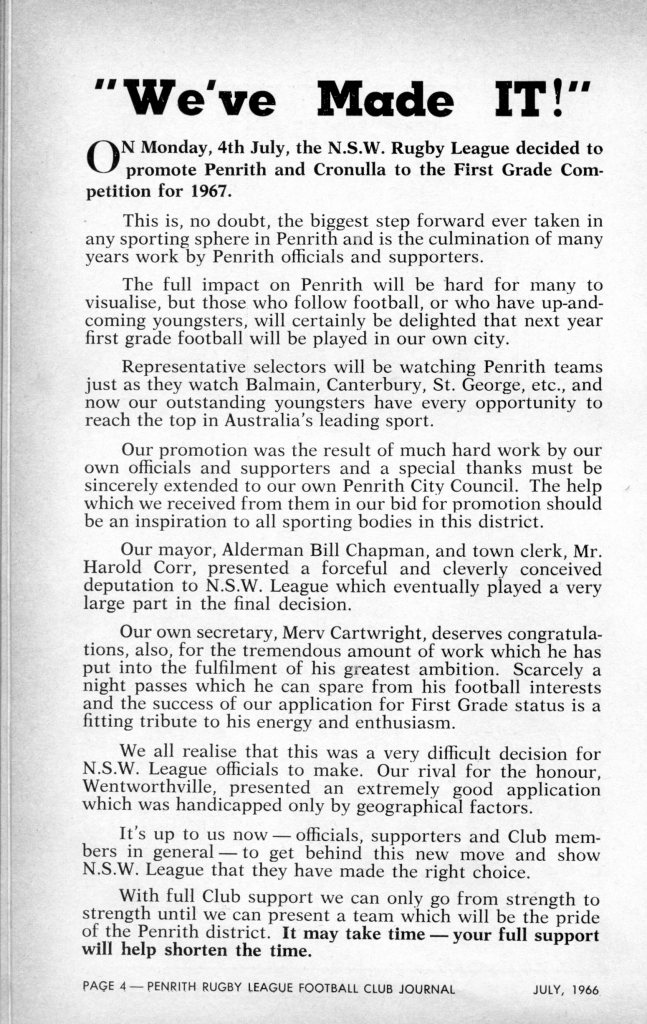
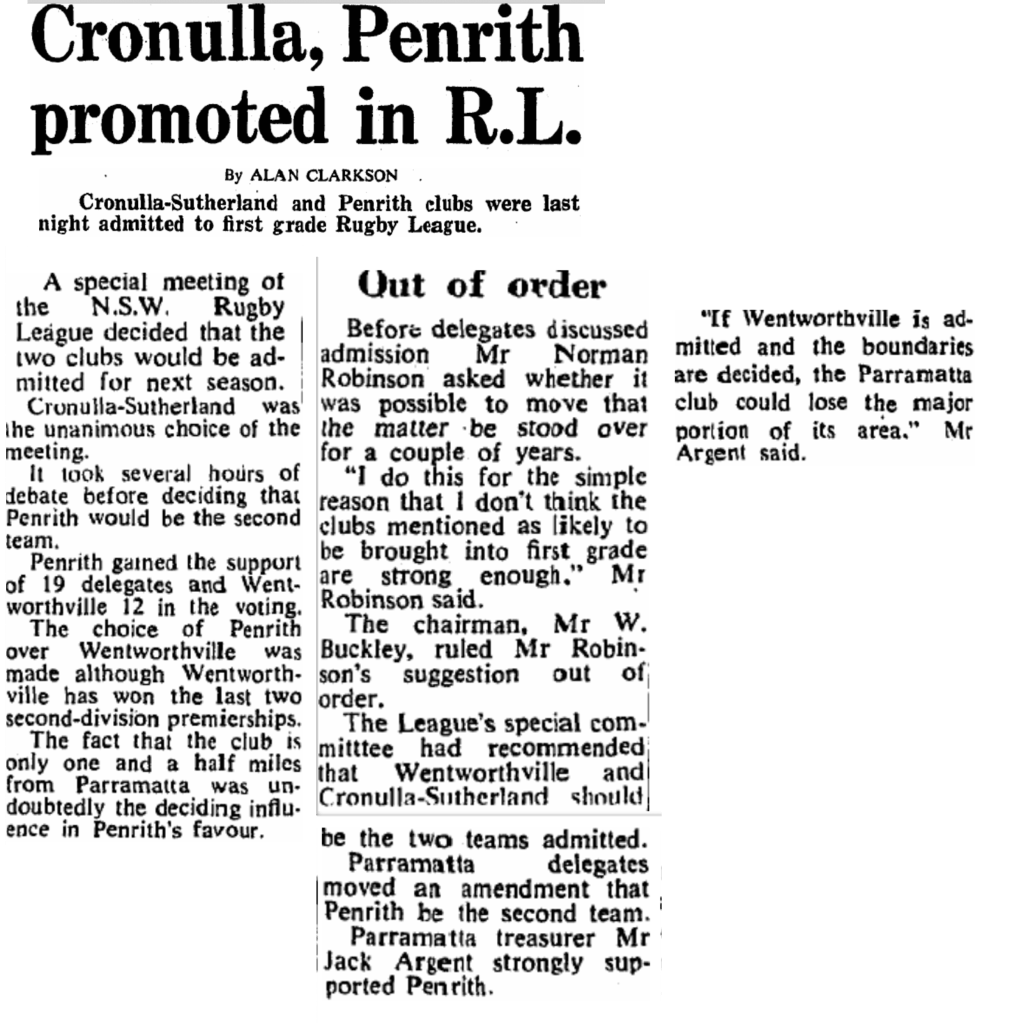
On Monday, 4 July 1966, the New South Wales Rugby League confirmed that Penrith and Cronulla would be admitted to the First Grade competition for the 1967 season.

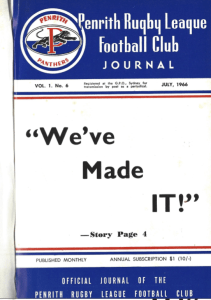
Within the club, the decision was received as a defining moment. The July 1966 edition of the Penrith Rugby League Football Club Journal captured the announcement simply and emphatically on its cover: “We’ve Made It!”

Inside, the accompanying article described the promotion as “the biggest step forward ever taken in any sporting sphere in Penrith” and emphasised that it was the culmination of many years of work by club officials and supporters. It also acknowledged the contribution of civic leaders, including mayor Bill Chapman and town clerk Harold Corr, whose efforts were said to have played a significant role in the final decision.

The sense of achievement within the club is also reflected in later recollections. Coach Leo Trevena described the moment in more understated terms, recalling that when he heard the news, his reaction was immediate and practical: “The bell’s ringing; now the fight’s on.”

Different Reactions

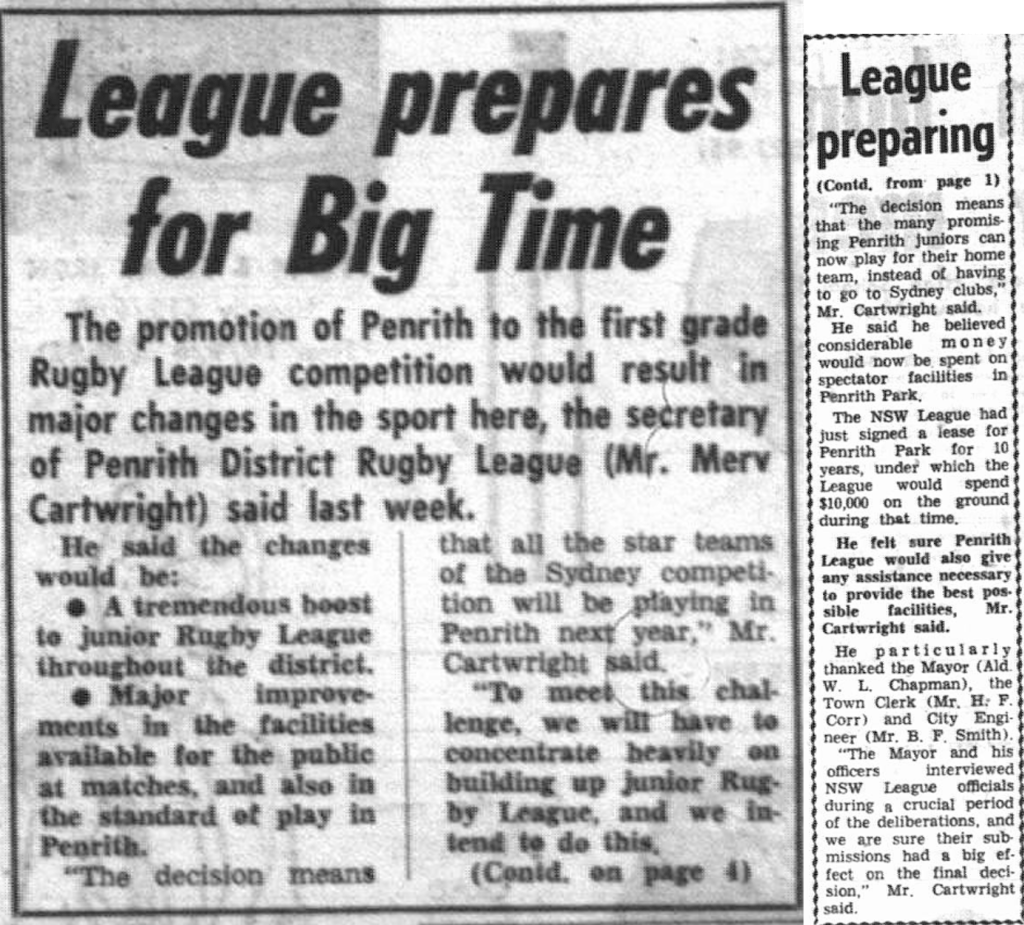
Beyond the club, the reaction was more measured. Contemporary coverage in the Penrith Press focused on the implications of the decision — including improvements to facilities, increased junior opportunities and the challenge of competing at a higher level — rather than celebration.

The contrast between the club’s own presentation of the moment and the more restrained tone of the local press is notable.

The Sydney Morning Herald also highlighted how narrow the decision had been, including Wentworthville’s unsuccessful attempt to have the matter deferred following the announcement.

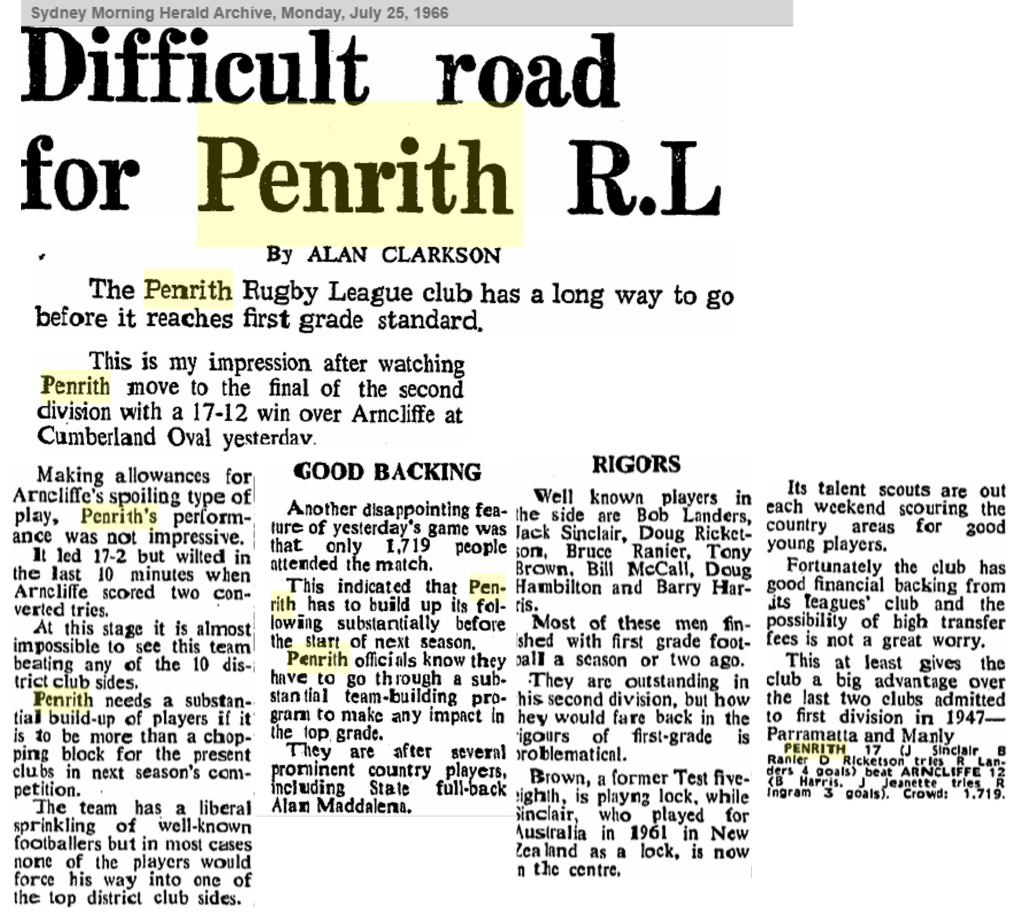
Three weeks later, Sydney Morning Herald journalist Alan Clarkson published a more cautious assessment of Penrith’s prospects, while acknowledging the club’s improving financial position and the support provided by the leagues club.

For Penrith, however, the significance was clear. Entry into First Division marked the transition from ambition to reality — and the beginning of a new phase in the club’s development.


Related Topics


Related Themes

Football Club · Milestones · First Division Admission


To receive new Parts and occasional project updates by email, you may subscribe below.

Readers who hold recollections, documents, or material relevant to this history are welcome to contribute via the Commentary & Contributions page.

Project Updates

Receive updates when new parts are published.
The Tin Shed — Myth and Memory

In telling the history of Penrith Rugby League Club, one phrase appears again and again — the “tin shed.”

It is often used to describe the club’s early years: humble, under-resourced, and far removed from the scale of the modern Panthers organisation.

Like many origin stories, the reality is both more specific — and more revealing.

What Was the “Tin Shed”?

As former director Max Connors recalled, the so-called “tin shed” was not a clubhouse in the way the term is now understood. It was, in fact, a kiosk at the showground where the team played.

The tin shed that people talk about was actually a kiosk on the showground where they used to play. It was run by the ladies, and the players used to get three free tickets each, and the supporters could buy three tickets for two shillings.

The structure doubled as a dressing area for players, reflecting the limited facilities available at the time.

Penrith’s “Tin Shed” Mark II

Many would label this building as the “tin shed” of Penrith’s history.

Panthers first clubhouse in Station St, Penrith

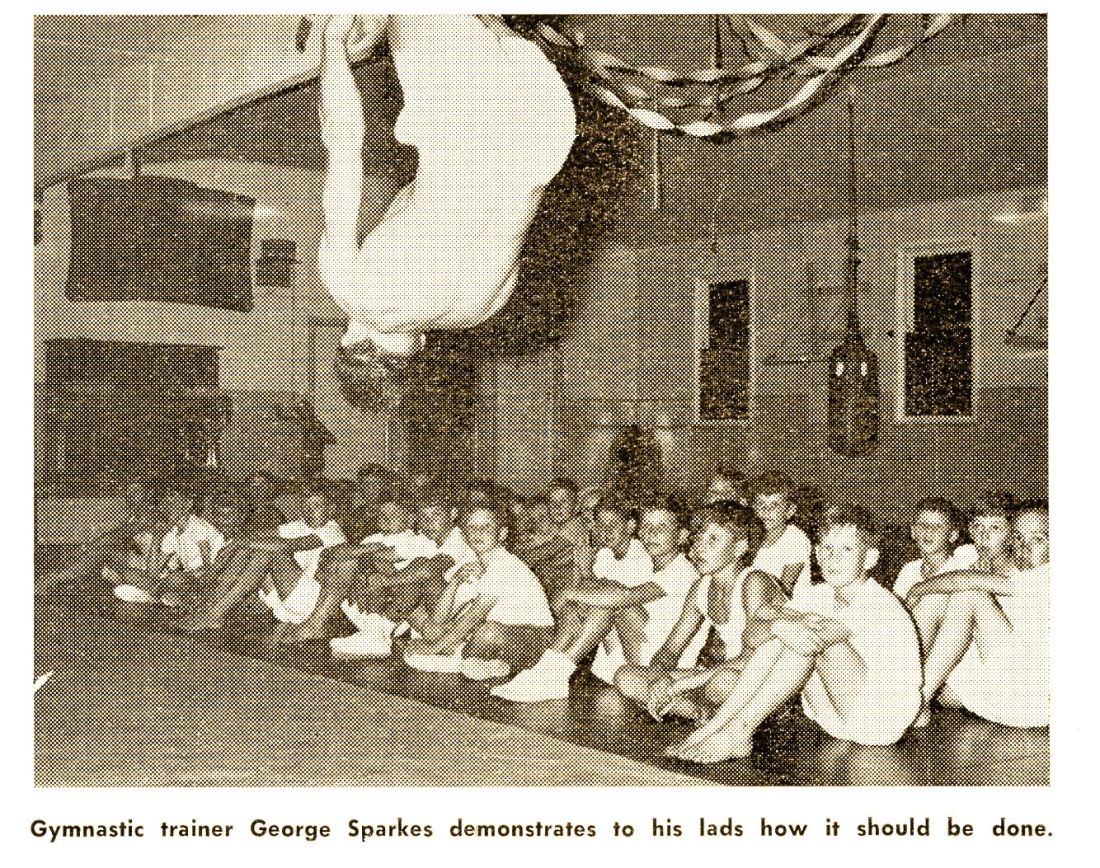
It would be a fair label, for this too is a far cry from the building that, in 1963, opened along side it. But this second “tin shed” was already multi-functional, and efficiently so. Dining room, function room, gymnastics (see feature image), boxing, calisthentics, jiu-jitsu, weights and of course, the club staples of bar and poker machines.

A Familiar Story

The idea of a club beginning in a “tin shed” is not unique to Penrith.

Across New South Wales, the history of registered clubs abounds with stories of “tin shed” origins — always small, improvised buildings, often constructed from basic materials and supported by volunteer labour.

Whether literally accurate or not, the phrase has become a kind of shorthand for humble beginnings and community effort.

In that sense, the “tin shed” is as much a cultural expression as a physical description.

How Myths Take Shape

Over time, the image of the “tin shed” has taken on a broader symbolic meaning — shorthand for:

  • hardship
  • simplicity
  • and the idea of a club built from nothing

This kind of simplification is very common in tales of sporting and community history. The details are simplified, merged, or reshaped into something more easily remembered and retold.

The result is not necessarily inaccurate — but it is selective.

The Penrith Version

At Penrith, the story is slightly more nuanced.

While the original “tin shed” referred to the showground kiosk described by Connors, later early facilities — including the original Station Street club building — were also modest in scale and construction.

In practical terms, they fit very well with the image the phrase now conveys.

The mythology, in that sense, is not entirely misplaced — but it is an interpretation crossing several realities.

Why it Matters

Understanding the reality behind the “tin shed” does not diminish the achievement of those early years.

If anything, it clarifies it.

The club did not begin in abstraction or myth, but in a very real, very practical setting — a showground, a kiosk, and a community effort sustained by volunteers, financiers — lenders and donors — players, and supporters.

That distinction matters, because it grounds the story of Penrith not just in adversity, but in structure, place, and people.

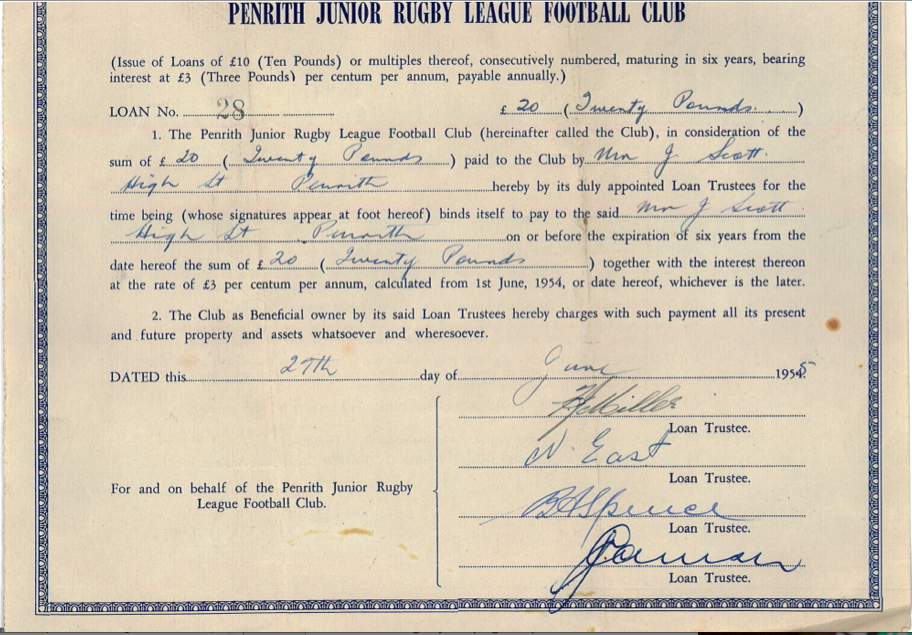
One of the people who helped Penrith Rugby League Club move beyond tin shed was Mr John Scott who provided the Penrith Junior Rugby League with a loan of £20 in 1955. The Scott family have supported the Club from its very beginnings, have seen many changes, great growth, challenges and remain firmly part of the Panthers family today.

In the Narrative

The reference to the “tin shed” appears in Part 4 — From Small Beginnings, where it helps frame the scale of the club’s early operations, and the distance between those beginnings and what would follow.


Related Materials


Related Themes

Culture


To receive new Parts and occasional project updates by email, you may subscribe below.

Readers who hold recollections, documents, or material relevant to this history are welcome to contribute via the Commentary & Contributions page.

Project Updates

Receive updates when new parts are published.
The Western Weekender

The Western Weekender is a free weekly newspaper serving the Penrith region of New South Wales. Established in 1991, as a “good news” publication, it has become a consistent local media presence, covering community news, sport, politics, and issues relevant to Western Sydney.

Distributed widely across the Penrith local government area, the Weekender positions itself as a community-focused publication, with an emphasis on local identity and accessibility. Over time, it has built a strong readership base and a recognised voice within the region.

Editorially, the Weekender has played an ongoing role in reporting on developments at Penrith Rugby League Club and within the broader Penrith community. Its coverage has ranged from routine reporting to more involved commentary during periods of controversy or significant change.

The publication has not been without interruption. It ceased operations briefly in 2008 before being revived in 2009 under new ownership, after which it re-established its presence in the local media landscape.

As with any local media outlet, the Weekender reflects both the priorities of its editorial leadership and the interests of its readership. This can influence not only what is reported, but how events are framed and understood within the community.

Throughout this series, references to the Western Weekender should be understood in that context — as a prominent local publication whose reporting formed part of the public narrative surrounding the events described.


Related Topics


To receive new Parts and occasional project updates by email, you may subscribe below.

Readers who hold recollections, documents, or material relevant to this history are welcome to contribute via the Commentary & Contributions page.

Project Updates

Receive updates when new parts are published.
The Footy Five

The term “Footy Five” was coined by Ron Mulock to describe a group of five directors who, during this period, generally adopted a shared position on a range of issues affecting the Panthers organisation.

Despite the name, the distinction between this group and the remaining directors was not based on differing levels of commitment to rugby league. Directors on both sides of the Board were deeply committed to the future of football in Penrith. Indeed, several of the directors outside the Footy Five had devoted decades to building both the football club and the broader Panthers organisation.

The differences between the two groups became most apparent during the Super League era, the merger debate and the wider governance issues confronting Panthers during the late 1990s. These included questions surrounding the club’s strategic direction, its response to the changing rugby league landscape and the future structure of the Panthers organisation.

The four remaining directors—Leo Armstrong, Barry Walsh, Terry Heidtmann and Keith Rhind—were never collectively identified by a comparable title. Ron Mulock occasionally referred to them as “Roger’s Four Kinsmen”, a phrase drawn from the well-known Australian musical group The Four Kinsmen. The expression implied that these directors simply supported Roger Cowan’s position, but it never achieved the widespread usage of the term Footy Five.

Both expressions formed part of the language surrounding one of the most divisive periods in Panthers’ history. While Footy Five became the enduring shorthand used by directors, members, the media and later historical accounts, neither label should be interpreted as a literal description of the directors’ respective commitment to rugby league or of the complexity of the issues under debate.

As the Footy Five is referenced throughout the narrative, it is useful to identify the individuals within the group:

  • Geoff James: Private Enquiry Agent.
  • John Bateman OAM: Solicitor. Mayor of Penrith (1998-2000)
  • Greg Evans: Owner of the Western Weekender, a local newspaper also prominent in the narrative.
  • Craig Terry: Financial controller at Liquorland.
  • Denis Coffey: Owner of successful engineering company. Former Panthers player.

Although the Footy Five were frequently identified as a group, each member brought different professional experience and motivations to the Board. Their backgrounds included law, engineering, finance, investigation and newspaper publishing. While they often acted together on major issues, the narrative suggests that their reasons for doing so were not necessarily identical.

Each member of the Footy Five played a distinct role in the events described in Panthers, Passion & Politics. Individual profiles provide further background on their professional careers, their involvement with Panthers and their contribution to the governance conflicts that followed.

Each member of the Footy Five played a distinct role in the events described in Panthers, Passion & Politics. Individual profiles provide further background on their professional careers, their involvement with Panthers and their contribution to the governance conflicts that followed.


Related Topics


Related Themes

Conflict · Governance · Board Decisions


To receive new Parts and occasional project updates by email, you may subscribe below.

Readers who hold recollections, documents, or material relevant to this history are welcome to contribute via the Commentary & Contributions page.

Project Updates

Receive updates when new parts are published.
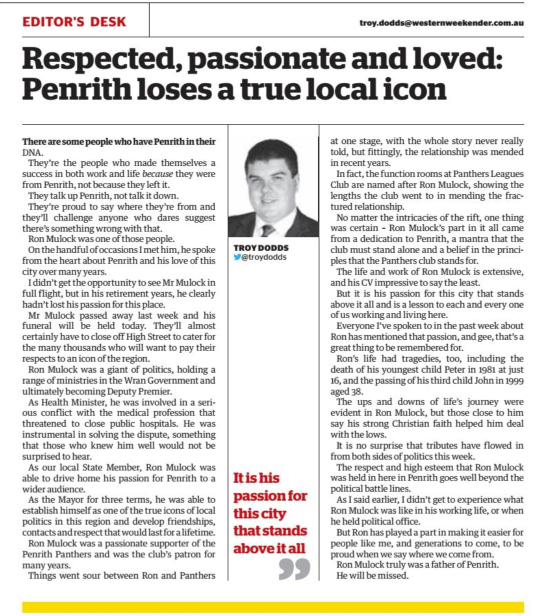
Ron Mulock – Public Tribute (Western Weekender, 2014)

The following article was published in The Western Weekender following the passing of Ron Mulock in 2014.

It provides a contemporary reflection on Mulock’s standing within the Penrith community.

Western Weekender article titled “Respected, passionate and loved: Penrith loses a true local icon” featuring Ron Mulock (2014)
The Western Weekender, 12 September 2014

Related Topics


To receive new Parts and occasional project updates by email, you may subscribe below.

Readers who hold recollections, documents, or material relevant to this history are welcome to contribute via the Commentary & Contributions page.

Project Updates

Receive updates when new parts are published.