In the early nineties, when the Club had restructured and flattened its management structure, some employees had difficulty coping with the changes. Cowan engaged a change management consultant, Robert McLellan, to work within the club, and help the staff through the process. He conducted regular training sessions with managers and staff covering all aspects of change management.1 The experience provided a contrast with the problems that later developed between Board and management. Lynch says there did not seem to be the same recognition that this had become a major organisational problem requiring intervention.
Cowan says that there were attempts made to find a solution.
Kilmister was one attempt, but we know how that blew up. And after almost every board meeting, I would get together with managers and try to come up with ideas for improving things. We changed the board reporting system a few times to see if it would help. But there was no trust of motives, and you can’t negotiate with people if they have secret agendas. You just don’t know what has to be negotiated.
Sometimes we would have a board and management joint planning session spread over a few days, and we would live and work together in a convivial environment, and it all seemed positive. But afterwards it would be on again as usual.
Cowan was not alone in his concerns about the Board. One of the managers who was close to the action, Tony Lackey,2 recalls the change in atmosphere in the boardroom and the frustration it was causing. From Lackey’s perspective Craig Terry was an instigator of much of the disharmony and he says it seemed that Evans and Terry had quite opposite requirements of management reports.
After most board meetings the managers who attended would get together to discuss what was happening. We could not understand the dysfunction that was creeping in.
By that time there was a confusing attitude towards management reports. The management team believed it should share as much information as was practical with the Board.
Suddenly the attitude seemed to change. Every report became the subject of intense discussion and questioning. Board meetings were going way past midnight with most of the time being spent on petty detail that had nothing to do with policy.
Roger raised this issue with the Board and was told that anything in the report had to be discussed. Somebody suggested that a lot of the information was unnecessary. The managers complied by limiting the information to only support agenda items.
Later there was criticism that the Board was not getting enough information. It was fast becoming impossible to know what they wanted.
We could see the frustration building in Roger. Several times he would get home very late, so angry he could not sleep, and be back in his office at 5 am writing a hard-hitting letter to the Board about the lack of rational decision making and the disregard for longer term thinking.
He would ask for our opinions about his letters and most of the time we talked him out of sending them. We were all conscious of the need to keep trying for a more harmonious solution and when he had cooled down, he agreed.
The attempts to address the problem had begun even before the Kilmister workshop described in Part 52. In 1999, Cowan recommended the holding of a seminar involving the full Board and all the senior managers. It was his hope that this would help to achieve unity between board and management.
His recommendation included a list of desirable outcomes of such a seminar. Two of the items on his list were to have agreement about the roles of Board and management; and to compile a list of all weaknesses within the organisation. He believed that these might shake out the issues causing conflict and get all the problems out on the table.
The proposed seminar would have provided an opportunity for directors and managers to identify concerns about their respective roles, management accountability and other sources of tension within the organisation.
Later, in another attempt to achieve unity of purpose and more productive decision making, Cowan recommended a workshop, to be facilitated by an external consultant specialising in Corporate Governance and Board/Management relationships.3
A short summary of his written recommendation to the board again hinted at his frustrations. It included:
The board has to establish policies, delegate responsibility to a CEO who is trusted, and ensure accountability by monitoring results.
Board meetings should be for the purpose of reviewing policies, reviewing outcomes, considering reports on achievement of outcomes, and evaluating the CEO’s performance against the achievement of outcomes.
Cowan hoped this would finally bring into the open whatever was causing the dysfunction in the boardroom. Those interviewed about the period describe an atmosphere increasingly marked by suspicion, animosity, conflict and a lack of teamwork, trust and co-operation.
None of those attempts produced a lasting resolution. Eventually, as the relationship between Board and management deteriorated still further, Cowan proposed the most drastic solution available: he would step aside and give the Board a completely fresh start.
To receive new Parts and occasional project updates by email, you may subscribe below.
Readers who hold recollections, documents, or material relevant to this history are welcome to contribute via the Commentary & Contributions page.
Project Updates
Receive updates when new parts are published.
A key focus of McLellan’s work was establishing better communication between individuals and teams, including an understanding of concepts such as “twin citizenship” — the responsibility people have both to their own team and to the wider organisation. ↩︎
Tony Lackey was a long-serving senior manager who, for a period, attended Board meetings to take the minutes. His presence gave him direct exposure to the changing atmosphere in the boardroom. ↩︎
The Kilmister process produced a substantial body of governance work. Temby records that on 6 June 2000 the Board accepted 21 of 24 policies arising from it. The three policies deferred for further consideration concerned monitoring the CEO’s performance, financial performance benchmarks and assessment of the CEO’s contract against the position, industry benchmarks and comparable companies. ↩︎
For two years Cowan had been agonising about how to improve the decision-making process. His recommendation to the Board in 2000 to employ an external consultant was intended to improve those relationships. Instead, the workshop would expose an issue that took the conflict to a new level.
In 1996, Cowan had negotiated a new contract with the Board Executive, which would take him to his planned retirement date of 2006. The same confidentiality over his remuneration arrangements that he had insisted on since 1965 was written into the contract. In 2000, that confidentiality would become another catalyst for conflict.
We help you clearly define your board’s role and distinguish board from executive accountabilities.
Cowan contacted the company, and board and management agreed to hold an evening workshop, in May 2000, facilitated by John Kilmister. Cowan held high hopes that an independent consultant might help board and management work together more productively and harmoniously.
Kilmister made a number of recommendations that were designed to improve board/management relationships.
In the course of the workshop, somebody asked the consultant if he thought it was appropriate for senior management remuneration packages to be disclosed only to the executive of the board and the club’s auditors. The consultant’s opinion was that it would be preferable for the full board to have that information, but he added that there was nothing illegal about that sort of confidentiality.
Despite Bateman’s later evidence that he had been curious about Cowan’s remuneration since joining the Board, the issue had not previously been raised with Cowan in the boardroom.
In his first day of evidence at the inquiry, John Bateman told Ian Temby that he had been curious about the remuneration of the CEO from the time he first became a director, in December 1995. He cited his experience as a Penrith councillor as the reason for his interest. What is notable is that, despite that longstanding interest, he had apparently not previously raised the issue in the Panthers boardroom.
At the next board meeting1, John Bateman asked Roger Cowan a seemingly simple question. The answer was straightforward. Its significance would not become fully apparent until some four years later.The question?
Does any manager employed by Panthers hold an interest in any company doing business with Panthers?
Although John Bateman maintains that he never asked such a question, Cowan says he has a vivid recollection. It seemed rather confrontational and was quite unexpected, which is why it stands out in his memory. He recalls the question very well because of his reaction to it.
My immediate thought was that he was asking a question when he knew the answer. I sensed that he was trying to lay a silly trap, thinking that I would try to fudge an answer. To me, this was crazy because there was no secret about Phyro Holdings. Everybody in the office knew about it, all the managers knew about it, and then there were all the external companies where we booked our advertising, etc – all through Phyro. I had no reason to think anyone would not know about it.2
I didn’t know that in the week leading up to the meeting, someone in Bateman’s office had carried out ASIC searches on Phyro Holdings. But I still believed he was up to something, and, given my immediate suspicions, can anybody imagine that I would have failed to answer the question?
I replied that the only one that I was aware of was Phyro Holdings.
The discussion became more and more heated as some directors demanded that the confidentiality clause in the contract be ignored in favour of full disclosure to the Board. But confidentiality was a condition of his contract, Cowan told them, and that same confidentiality covered all senior managers. It was quite legal, he told the meeting, and everything was subject to audit at any time by the board executive and the club auditors.
He also told them that his experiences over the previous two years made it clear that once the full board learned the details of his contract, Ron Mulock would have them by the next morning. And the whole of Penrith would be reading it by the end of the week in the Western Weekender. From Cowan’s perspective, his experiences over the previous two years demonstrated that confidentiality could no longer be relied upon once information reached the full Board.
The friction in the meeting increased. Some directors were insisting that the confidentiality provisions be waived, and Cowan was telling them an agreement was binding and they had no right to change it. After a final outburst, Cowan walked out, declaring he would not work for such dishonorable people.
In hindsight, Cowan says the words he used at the time were only slightly less stupid than his decision to walk out:
The day this board finds out the details of my remuneration I will leave the club
But in that moment, he says, he had decided enough was enough. How could he have respect for a Board dominated by directors demanding that a long standing contract be broken? He told Ian Temby that in doing what he did, he knew he was resigning.
When I nearly got back home, I thought this is a stupid thing I am doing, I’ve let a lot of people down, I am acting selfishly. I drove back and went into the room, and nobody said anything. When I walked back in, I fully expected them to say, “No way, you resigned.”3
Terrence Lynch is a barrister who has acted for Panthers on several occasions4. He says that Cowan’s rigid stance on the whole confidentiality issue was out of character.
It always surprised me that Roger wasn’t prepared to open up his salary and remuneration arrangements to the full board, particularly when it became such a contentious issue.
I was also surprised that he let it continue. Given my understanding of how he had run the place, I am amazed that he allowed it to become an issue. Why didn’t he just step aside and shut it down? I went to many meetings with various groups at the club, and my impression was that it was a very open and relaxed place, and there was no factionalism or camps. I never ever sensed any party lines there at any time.
This was the environment he’d created, so it’s even more surprising that he dug in. It is the one time that I have ever seen him let ego get in the way, though maybe ego’s not the right word. But he was definitely acting more undisciplined than you would ever expect. It was a concentration on self rather than seeing the big picture – which he had always done for nearly forty years – and what he is known for.
Viewed dispassionately, the dispute was not simply about whether Cowan’s remuneration was excessive. Cowan maintained that his package was commensurate with the responsibilities of running a business approaching $300 million in annual turnover.
The argument had become one about disclosure, confidentiality and trust.
So, why didn’t somebody ever move to hose it down?
To receive new Parts and occasional project updates by email, you may subscribe below.
Readers who hold recollections, documents, or material relevant to this history are welcome to contribute via the Commentary & Contributions page.
Project Updates
Receive updates when new parts are published.
This refers to the next Board meeting after the May 2000 session with John Kilmister. ↩︎
Temby’s later findings drew a distinction between knowledge that Phyro Holdings existed and was the Cowan family company, and knowledge of the extent of its financial dealings with Panthers. Evidence before the Inquiry indicated that some directors knew of Phyro but said they did not know the extent or nature of the transactions passing through it. ↩︎
Temby later summarised the outcome starkly: “In the result nothing was achieved.” The existing arrangement remained: Cowan’s remuneration was known to him and the Board Executive, as was Phyro’s involvement. ↩︎
Lynch, a prominent Sydney barrister, was junior counsel representating Panthers during the Temby Inquiry. It should be noted that in that role he was not representing Cowan, he was representing the Panthers Board and ex-members of the Board including the group that had been labelled “The Footy Five”. ↩︎
Membership of a NSW registered club is more than a commercial relationship between a business and its customers. Members constitute the club and, depending upon their class of membership, have important governance rights.
Those rights include voting on constitutional changes and electing the directors who govern the organisation.
Before amalgamating with other clubs, Panthers membership was very simple. Members paid $20 annually, pensioners paid $10 for membership.1 Penrith had approximately 60,000 ordinary members. All members were eligible to participate in the governance of Panthers through voting in Board election, voting on constitutional matters and attendance at general meetings.
Amalgamations brought with it a challenge around the pricing of membership — the membership fees for all the amalgamating clubs was less than half the fee charge at the Penrith club.
To accommodate the price differential, a new category of membership was created — Social Membership. This allowed members from amalgamating clubs to retain their membership at a low rate. Taking Social Membership meant forgoing their rights to participate in the governance of the wider Panthers group.
As the number of amalgamations grew, so did the number of members — 120,000 members in total.
The membership offer was still relatively simple — Ordinary Membership $20; Social Membership $2.
However, Panthers was running the risk of breaching the Registered Clubs Act, which required a majority of the club’s members to be entitled to vote in Board elections and on changes to the constitution.
With Social Memberships proving popular at regional clubs and also with members who held membership in both Penrith and one or more of the other clubs in the group, there was a high potential for Social Members to become the majority.
This was still not regarded as a difficult problem.
A simple price reduction in Ordinary Membership would be the solution.
The recommendation of a lower-fee ($8 +GST) ordinary membership was being urged by every one of the fourteen club venues, the Panthers marketing team and all the management team.
This should have been a relatively straightforward commercial decision.
It turned out not to be so simple.
This recommendation was delivered to the Board who repeatedly rejected it and responded with requests for more information, more research — even asking for an analysis of the price elasticity of membership.
Recommendations to the Board set out the reasoning behind them. Although a potential 60 per cent reduction in membership revenue was an obvious concern, management believed there were strong commercial arguments supporting the change.
After months of rejection, it became clear that the recommendation was going nowhere. It also raised the possibility that the real obstacle was no longer the price of membership at all.
Roger Cowan took an extraordinary step as a final resort.
He went into a Board meeting with a three-page media release already prepared, ready to publicly accuse five directors of putting their own positions ahead of the interests of Panthers members.
As described in Part 51 of The Series, the release was never distributed. The Board eventually agreed to the lower fee.
But the document survives — and it helps explain why something as apparently simple as the price of membership had become so difficult.
The document reveals that what began as a relatively simple commercial and marketing issue had become entangled in arguments about voting rights and the future control of Panthers.
The three-page media release was headed.
“Directors put themselves ahead of members” — Cowan
It was dated 27 July 2002 and had been prepared for public distribution if the Board again rejected management’s recommendation.
According to the release, the Board had rejected the $8.80 proposal at its meeting the previous Tuesday.
Cowan said the reason was that the cheaper membership would be available to members across the Panthers Group and would give those members the right to vote at a meeting scheduled for 15 September to consider a constitutional change.
That constitutional change was itself significant.
At the time, Penrith members were guaranteed at least five positions on the nine-member Panthers Board. The proposed change would create a 14-member Group Board, with nine positions elected by Penrith members.
Cowan alleged that some directors wanted to prevent members from the other Panthers clubs from voting or attending the September meeting.
He also said some members of the Board had argued that increasing the number of voting members at the amalgamated clubs could result in Penrith losing control of the Group.
Cowan’s response was blunt. Penrith already had guaranteed majority representation on the existing nine-member Board and, under the proposed structure, Penrith members would elect nine of fourteen directors. If that was insufficient to protect Penrith’s position, he argued, he did not know what would be.
He also claimed that treating long-term members of Port Macquarie Panthers and ClubNova as Social rather than Ordinary Members would deny some 25,000 people the voting rights they had been promised.
These were Cowan’s allegations in a media release prepared during an increasingly bitter Board dispute. They do not, by themselves, establish the motives of the directors he was criticising.
While the Board agree to the new $8 membership — $8.80 including GST — being offered from August 2002. It was still far from simple because this membership price was introduced as an extra option rather than simply changing the price of ordinary membership.
Panthers now had a membership with 3 tiers with prices including GST:
Ordinary Membership: $22
The New Membership: $8.80
Social Membership: $2.20 (Note: this is also referred to as Remote Site Membership – it not available to those whose home club was Penrith)
Ordinary members paying $22 could vote for the Group Board and, subject to constitutional requirements, stand for election to it.
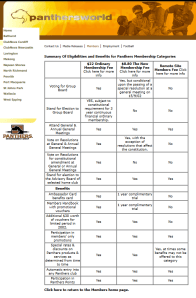
Members paying the new $8.80 fee could attend general and annual general meetings and vote on most resolutions. Their right to vote for the Group Board was initially shown as conditional upon the passage of a special resolution at the general meeting scheduled for 15 September 2002. They could not stand for election to the Group Board
Social members paying $2.20 could attend general and annual general meetings, but could not vote for or stand for election to the Group Board.
All three categories could stand for election to the Advisory Board of their selected home club.
The membership structure was therefore attempting to accommodate different kinds of members within an organisation that had changed enormously in only a few years.
When this was placed into communications for members it confused more than clarified. The following table is an extract the Panthers website circa Sptember 2002:
Click to enlarge
The September Change
The next step came on 15 September 2002, when a special general meeting approved changes to the Group Board structure.
The existing nine-member Board would increase to fourteen directors. Nine positions would be elected by Penrith members, while five would be guaranteed to nominees from other clubs within the Panthers Group.
A Panthers website announcement published the following day also confirmed that all members except Social Members would have the right to vote.
Media Release — 16 Sep 2002. Click to enlarge
What had begun as an argument about the price of membership had therefore become part of a much wider restructuring of membership rights and representation within the growing Panthers Group.
More Than a Price Cut
The dispute described in Part 51 began with what management regarded as a straightforward commercial problem. Penrith’s membership was expensive compared with other clubs, while amalgamation was creating a rapidly growing number of cheaper Social Members.
But solving one problem created another.
Membership price became connected to voting eligibility; voting eligibility became connected to Board representation; and Board representation became caught up in the increasingly bitter argument about who would control the expanding Panthers Group.
The $8.80 membership was therefore more than a price cut. It was part of the much larger challenge of adapting the governance of Panthers to an organisation that had grown far beyond Penrith.
That was why something apparently so simple became so difficult.
To receive new Parts and occasional project updates by email, you may subscribe below.
Readers who hold recollections, documents, or material relevant to this history are welcome to contribute via the Commentary & Contributions page.
Project Updates
Receive updates when new parts are published.
There was also the innovative Permanent Membership which in this era was $475. With this membership – an ordinary membership carrying full voting rights – there was no annual renewal and the fee was refundable in full if the member resigned, or payable to their estate on their death. Many who held this “perpetual” membership mistakenly referred to themselves as “life” members. Life Membership is an honour awarded to those who have served the club with distinction. ↩︎
2000 and 2001 should have been years of high optimism for Panthers. The Club had emerged from the tumultuous 1998-99 years without its rugby league team being eliminated from the competition or being forced to merge with Parramatta.
The new NRL competition was underway, and the club was about to complete its first two amalgamations.
But the situation in the boardroom was still tense.
In 1996, Cowan had negotiated a new contract with the Board Executive, which would take him to his planned retirement date of 2006. The same confidentiality over his remuneration arrangements that he had insisted on since 1965 was written into the contract. In 2000, that confidentiality would become another catalyst for conflict.
It would ultimately become one of the major criticisms levelled at Cowan, and a significant issue at the Temby Inquiry. But it was only one element in a Board-management relationship that was becoming increasingly dysfunctional.
During the amalgamation program, there were many important decisions to be made, and a lot of business to be dealt with at Board meetings.
On many occasions decisions were held over to the next meeting, and then another, and another, over what were just petty points. When it takes 12 months to make a relatively straightforward decision that is of ‘real time’ importance to the business, there was evidence of dysfunction. It took that long for the Board to agree on a policy governing amalgamations with other clubs.
I can’t remember any important decision that we needed to make in that period that we didn’t make eventually. But time – and more importantly – opportunities, can be lost.
A push by management to decrease membership fees was an example.
In 2001, Panthers membership was set at $22 a year, but many of the club’s competitors were advertising their fees at around $5.50. There was great concern in the management team that membership numbers at the Penrith site were decreasing.1
There was also confusion over trying to implement a system that would allow the members of amalgamating clubs to continue to pay the lower fees they were paying before amalgamating, but without breaching the 50% regulation.2
Having one lower membership fee right across the group was felt to be a good solution. It could also be used to push a more aggressive membership drive. It took well over a year – and some drastic measures – for the Board to agree to a reduction in fees.
Beyond the Book: The membership issue was considerably more complicated than the fee reduction alone suggests. Amalgamation had created questions about membership categories, voting rights and representation within the expanding Panthers Group. Read: Why Cutting the Membership Fee Wasn’t So Simple.
We eventually did get the fee down to $8.80, but it was a very complicated process.
In the meantime, our market was diminishing, and everyone knows that lost market share is not easy to recover. Once it was done, I think we increased the membership at Penrith by about 15,000. There were obvious benefits to our business, and the reasons they came up with for the delays were just not logical.
At one stage one of the Five came out and said that management wanted to lower the fees to get more members so we could get rid of those directors.
The membership fee deadlock was broken using tactics that would never have been considered in the open environment of the old Panthers. It demonstrated how confrontational life in the boardroom had become by July 2002. In the week leading up to a home game, Cowan asked Rob Weaver, the club’s media manager, to prepare a press release. A Board meeting was scheduled for the morning before the game3.
The release was very strongly worded, and it spelt out the situation in detail. In part, it read:
“Five out of the nine directors have shown that they care more about their seats on the Board than they do about our members and the focus of our organisation. It brings a new meaning to the phrase ‘bums on seats’, Mr Cowan said. “I will not stand by and watch them destroy what previous boards and managers have built, which is why I am going public to let members know what is going on.”
Cowan took the document to the meeting, held it up and told the Board part of what it said. He told them that Rob Weaver was already at the football ground. He had 30 copies of the release in his briefcase, and it would be handed out to every journalist at the game unless they agreed to the new fee. They demanded that Cowan show them the release, but he refused.
Rob Weaver recalls that day:
I was sitting in the media box in the western grandstand with a briefcase full of press releases, watching the board box on the other side of the ground through binoculars. As soon as I saw Roger arrive, I was to call him for instructions.
But he called and said they had agreed to reduce the fees.
To receive new Parts and occasional project updates by email, you may subscribe below.
Readers who hold recollections, documents, or material relevant to this history are welcome to contribute via the Commentary & Contributions page.
Project Updates
Receive updates when new parts are published.
There was also concern about members in regional areas being resistant to any increases. This was expressed strongly at regular meetings of venue General Managers. ↩︎
Section 30(9)(a) of the Registered Clubs Act required a “majority” of the clubs full members must be eligible to vote for the Board. Social Members were legally classed as a subclass of Ordinary Members and therefor were included as “full members”. In 2006 the ratio was reduced to 25% provided this was approved by a majority of full members. ↩︎
The game was Penrith v Melbourne which Penrith won 36-16. ↩︎
Greg Evans was a prominent Penrith businessman, newspaper proprietor, local councillor and Panthers director who became one of the central figures in the Board conflicts of the late 1990s and early 2000s.
Already well known within the Penrith community when he joined the Panthers Board in 1997, Evans became increasingly involved in disagreements over the future of the football club, the respective roles of the Board and management, and the exercise of authority within Panthers. On these and other issues, he increasingly found himself in opposition to Roger Cowan and eventually became one of the five directors who were known as the “Footy Five”.
His significance to the story, however, extends beyond that label. Evans’ business and civic standing, his ownership of The Western Weekender, and his strongly held views about the respective authority of the Board and management gave him an unusually influential position during one of the most divisive periods in Panthers history.
Role in the Narrative
Greg Evans enters the narrative during a period of considerable change on the Panthers Board.
Greg Evans joined the Panthers Board in 1997 after having previously stood unsuccessfully for election. His arrival was part of a period of unusual turnover on the Panthers Board, during which Craig Terry and Denis Coffey also joined.
Evans, Terry and Coffey subsequently became aligned with existing directors Geoff James and John Bateman. Ian Temby later described the emerging group as being determined to make management accountable. From Roger’s perspective, they increasingly represented an opposition to management.
Evans was instrumental in developing division.
He features prominently in the debate surrounding Panthers’ survival as a stand-alone NRL club in 1999, in the later disputes over the respective authority of the Board and management, the cancelled 2002 election and in the events that ultimately developed into the Board wars.
He was subsequently identified as one of the “Footy Five”, alongside John Bateman, Craig Terry, Geoff James and Denis Coffey.
Background
Evans had established a substantial business and community profile well before joining the Panthers Board.
Beginning his career as an analyst programmer, he moved into business management and became involved in computer distribution. After purchasing and operating a computer company, he took over the distribution business of a failed multinational supplier at the invitation of Apple Computer Inc. A later account of his career records that within two years the business had become Apple Australia’s largest distributor.
In 1991 he founded The Western Weekender.
Evans believed Penrith was often unfairly portrayed by the metropolitan media and saw an opportunity to establish a newspaper presenting the district from a local perspective. Under his ownership the Weekender developed into a significant independent local newspaper. Evans remained its owner and Chairman until 2008.
His media interests later extended to other publications and, briefly, local radio through Kick FM. He also owned the Sydney Spirit basketball team.
Evans was also active in civic and economic affairs. He served for nine years as a Penrith City Councillor, chaired the Penrith Economic Development Board for many years and served on a number of other local and regional bodies, including the University of Western Sydney and Western Sydney Institute of TAFE. He was also appointed to the Greater Western Sydney Economic Development Board.
By the time he joined Panthers, therefore, Evans was already a substantial figure within the Penrith community, with business, political, economic development and media experience.
Leadership and Culture
Matthews has consistently acknowledged Roger Cowan as the greatest influence on his development as a leader.
Working alongside Cowan during Panthers’ formative years exposed him to a management philosophy built upon trust, accountability and personal responsibility. Matthews has often recalled the lessons he learnt about treating people with respect, empowering staff to make decisions and responding to mistakes with honesty rather than blame.
One incident early in his career, when he admitted to a significant financial forecasting error, became a defining leadership lesson. Rather than reacting with anger, Cowan focused on solving the problem—an approach Matthews later identified as fundamental in shaping his own leadership style.
Those experiences would later influence Matthews’ own approach to leadership as he assumed increasingly senior responsibilities within the organisation.
Relevance to Events Described
One of Evans’ most important appearances in Panthers, Passion & Politics comes during the debate over Panthers’ future in the rapidly contracting NRL competition.
On 31 July 1999, the Board considered whether to sign a non-binding letter indicating that Panthers was prepared to investigate a possible joint venture with Parramatta. The proposal was intended to preserve an alternative while Panthers continued its efforts to survive as a stand-alone club.
Evans strongly opposed signing it.
He later explained his reasoning:
I really believed that signing that letter was signing to merge with Parramatta.
Despite the document being expressly non-binding, Evans believed that once Panthers entered the process the pressures being applied by the NRL would make amalgamation inevitable.
His position provides an important insight into the disagreement.
All of the directors wanted Panthers to survive as a stand-alone club. The division was over whether prudent planning required investigating alternatives in case that objective could not be achieved.
Evans genuinely appears to have believed that investigating the Parramatta option was itself an unacceptable risk. Others, including Roger, believed refusing even to investigate alternatives could place Panthers’ survival at greater risk.
The disagreement between Evans and Cowan, however, extended well beyond the merger question.
A deeper difference concerned the relationship between the Board and management and where operational authority should reside.
That difference became particularly evident during the crisis surrounding coach Royce Simmons in 2001. When Roger proposed returning responsibility for appointing and dismissing the football coach to management, Evans was vehemently opposed. The Board ultimately authorised Roger to deal with the matter, Simmons was dismissed and Evans resigned from the Board. He subsequently returned.
Evans later described the broader disagreement as an attempt by the group of five directors to get Roger to:
… come under the direction of the board, and to work within the parameters that they set.
Roger saw the governance issue differently. He believed the Board had an essential oversight role but that management needed sufficient authority to manage the organisation and remain accountable for the results.
The distinction was fundamental.
Both sides could argue for accountability and good governance while holding substantially different views about how those principles should operate in practice.
By 2002 Evans was firmly associated with the group that became known publicly as the “Footy Five”. The label would become an important feature of the Board election and subsequently of the way the conflict was remembered.
As explored elsewhere in this project, however, the name simplified a considerably more complicated history. The five directors did not begin as a formal group bearing that name, nor were they necessarily united on every issue. John Bateman later maintained that any real unison among the five developed much later, particularly during the licensed club amalgamation disputes of 2002.
The Publisher and the Director
Evans occupied another position that distinguished him from the other protagonists in the Board conflict: he was simultaneously a Panthers director and proprietor of one of Penrith’s most influential local newspapers.
The Western Weekender reported extensively on Panthers during a period when internal Board disputes were increasingly becoming public.
Roger became deeply concerned about confidential Board information finding its way into the media and believed the Weekender sometimes appeared to know of internal developments before management.
Evans’ dual roles inevitably complicated perceptions surrounding both the Board conflict and its public reporting.
The available material establishes Evans’ ownership of the newspaper and his role in setting its policy direction. It does not, by itself, establish the extent to which he personally influenced individual stories concerning Panthers.1
Nevertheless, the combination was unusual. Evans was simultaneously participating in an increasingly bitter governance dispute inside one of Penrith’s most important institutions while owning an influential newspaper reporting those events to the wider community.
Legacy
Greg Evans died in July 2025.
The tributes published following his death reflected a life and career extending well beyond the Panthers Board wars. He was remembered as a businessman, newspaper founder, councillor, community contributor and a significant figure in the civic and commercial life of Penrith.
The Western Weekender, which he founded in 1991, remains perhaps his most visible contribution to the district.
The tributes also demonstrated how strongly one interpretation of the Panthers conflict had become embedded in local memory.
Evans was remembered as one of the Footy Five who had prevented Panthers from being amalgamated with Parramatta. One obituary described him as a key figure in ensuring Panthers remained a stand-alone NRL club, while another tribute credited him with helping block a concerted drive for merger.
The events described in Panthers, Passion & Politics reveal a more complicated picture.
There was no Board proposal in July 1999 to amalgamate Panthers with Parramatta. There was a proposal to investigate an alternative while continuing the fight to remain independent. Evans sincerely believed taking that step would ultimately lead to merger. Others believed keeping the alternative available was prudent protection against the possibility that Panthers might otherwise be excluded from the NRL.
That distinction does not diminish Evans’ commitment to the football club. Rather, it helps explain the strength of his position.
Nor does the merger debate alone define his importance to this story.
Greg Evans was an independently successful businessman, publisher and civic figure who became a significant participant in the divisions that developed within the Panthers Board. His approach to the future of the football club, the respective roles of the Board and management, and the exercise of authority within Panthers increasingly brought him into conflict with Roger Cowan.
His role is therefore important not simply because he became one of the Footy Five, but because understanding Evans helps explain the very different perspectives from which the Panthers Board Wars developed.
To receive new Parts and occasional project updates by email, you may subscribe below.
Readers who hold recollections, documents, or material relevant to this history are welcome to contribute via the Commentary & Contributions page.
Project Updates
Receive updates when new parts are published.
Editorial Note
This profile is presented as contextual background. Additional material may be introduced as the narrative progresses.
The fact that the managing editor of the Western Weekender remians unamed throughout Panthers, Passion & Politics, demonstrates Jennie Bentley’s view of who was driving editorial policy on the Panthers issues during the Panthers conflict and throughout the Temby Inquiry. ↩︎
John Bateman, a Penrith solicitor, joined the board in 1995. He had previously stood unsuccessfully for the Board and his patience was rewarded when a vacancy occurred between elections. He was a local councillor. The Board considered he would be a valuable addition to the expertise available on the Board.
Around three years later, another seat became available on the Board, and Greg Evans was also invited to join. He owns a local newspaper, the Western Weekender. He had also served on council. He had stood for the Board two years in a row and had been unsuccessful. He confided in Barry Walsh, then a member of the Board Executive, that he could not afford to fail a third time. Walsh advised him that there was a vacancy coming up and that the Board would probably invite him to fill that.
So, a solicitor and a local businessman had been invited to fill vacancies on the Board – both experienced in local government – should have strengthened the board. Both were also sponsors of the rugby league team, and so were well known to the club management.
Four of the directors who became the Footy Five were actually invited to join, rather than securing their seats through a members’ vote. Craig Terry and Dennis Coffey joined In the latter part of 1998 and early 1998. Terry’s credentials were in accountancy and it was thought he would be a suitable replacement for the retiring Leigh Mawhood, also an accountant. Terry, too, had also stood unsuccessfully for the Board a couple of times.
The 90s saw Merv Cartwright back on the board after a hiatus of many years. Some of Cartwright’s history with the club is already documented, including the cancellation of his membership. When his sons began playing for the Panthers, he wrote letters to the Board asking that his membership be reinstated. He gave a written undertaking that he had no interest in becoming a director, and would not take any part in club politics.
The Board relented, and Cartwright was a member again. Soon after readmission he stood for the Board on a platform that criticised Cowan. When he eventually decided to stand down, he pushed for his son-in-law, Dennis Coffey, as his replacement.
Coffey is an ex-rugby league player for Penrith, and founder of Coffey Engineering, a successful Penrith-based industrial engineering company. He was a popular choice with all board members to fill the vacancy. Cartwright’s son John, one of the players in the 1991 premiership winning team, had married Dennis Coffey’s daughter.
Geoff James had been a director for several years as part of what had been a reasonably cohesive and productive board. James had a friendly relationship with chairman Leo Armstrong. They had been next door neighbours for many years and used to look after each other’s homes if one was away.
When Craig Terry arrived, he and James quickly established a good rapport. Cowan and the other managers came to believe an alliance was forming between them and Bateman, Coffey, and Evans. From that time, the dynamic on the board totally changed.
The situation in the boardroom began to deteriorate to become what has been described as ‘horrific’.
There is a lot of evidence of Cowan’s efforts – through Board management seminars, recommendations to Board meetings, and the employment of consultants to get the Board to clarify what it wanted from him and the management team.
Greg Evans says that members of the alliance of five were trying to get Cowan to ‘come under the direction of the board, and to work within the parameters that they set’.
He denies there was a hidden agenda, but says,
He’d been the boss for so many years, and things were going OK. Boards got used to going along with him. He always felt that his way was the right way; he just wanted to get things done. Any questioning by the board was just a nuisance, so he used to get impatient.
But Evans does not identify any of the ‘parameters’ that the Board wished to impose. The real problem was that the main protagonists in this drama saw their role – and the others’ – very differently.
It was a clash in values that caused me to walk out of a meeting in June 2000. I was angry that people saw nothing wrong with breaking a contract when it suited them.
I could not understand how they could even consider reneging on the amalgamation deal with Newcastle. It took more than a year to get the Board to make a decision about amalgamations. It is true that I used to get impatient. How can it take 12 months to make a simple decision about amalgamating with another small club? I could see great advantages for Panthers and I wanted to get started.
While we were talking around in circles we failed to take advantage of an opportunity to amalgamate with Kingswood Bowling Club and Eastern Suburbs snapped it up. Panthers’ management could see some big potential for that club but it was almost impossible to get the Board to look at proposals rationally and objectively.
Management and Board both have an important job to do. If I do a bad job, then the Board has to step in, but there has to be a line between Board and management, and that applies in any business.
I always insisted from the moment I started on that three month trial in 1965 that I would be totally in charge of all staff matters, all the hiring, firing, and all the discipline. It would be my responsibility. The Board was not to interfere in any of it. And they agreed with that.
It ultimately evolved into a strong part of the Panthers culture. As long as staff matters were my responsibility, I was able to oversee the day-to-day running of the place. I do know of some other clubs where board members interview and employ staff. They are even able to fire them.
In that kind of environment, the sailors are not taking their orders from the captain of the ship. They’re being told what to do by the owners of the shipping line.
Roger Cowan says the culture of an organisation is what sets it apart, and to be effective, it must be strong at all levels – from the chairman, all the way through to casual employees.
People have to know where they stand and feel good about the contribution they are making. He and most of the other managers were disappointed that the strong culture that had been built over many years was being eroded.
The problems in Panthers’ boardroom were exacerbated by the rugby league merger issue. Rumour had abounded about Cowan’s alleged plan to merge with Parramatta. Claims in Ray Hadley’s radio show that it was a ‘done deal’ added to the tension. Alliances that were initially tenuous now became solid.
The time was now right, says Cowan, and the group – Bateman, Coffey, Evans and Terry – made their move to unseat the chairman, Leo Armstrong.
Leo had been chairman for 14 years and was generally acknowledged as a fine figurehead for Panthers. He was respected and admired by the other directors and by management and staff. He was popular with the members and the general public, who recognised him from public appearances, and as the person who often presented cheques to community organisations on behalf of the club.
Leo often became quite angry with Bateman in Board meetings. But removing Leo was a problem for the Bateman camp. He had the support of four directors, and with his own vote could hold his position. They would need to shift the balance.
When Geoff James accepted the dangled carrot of the deputy chairman’s job, the die was cast.
Somehow the group managed to convince Geoff James to move against the chairman. Once Armstrong was removed from the chair, James moved into the position of Junior Deputy Chairman.1
Becoming a deputy chairman would automatically elevate him to the Board Executive. More importantly, even though many executive matters were supposed to be confidential, his appointment could open new doors for the alliance, and thus give it an added measure of power.
James would later admit faxing confidential executive material to John Bateman –an action questioned by Ian Temby in the Inquiry.
Once they knew that the alliance was solid, Bateman made his move. He first approached Keith Rhind, a deputy chairman at the time, telling him the Leo Armstrong was to be removed as chairman, and asking Rhind to take over the chair. Rhind refused the offer.
Bateman then went to deputy chairman Barry Walsh, making the same offer. Armstrong was going whatever happened, Bateman said. If Walsh also refused the chairman’s job, Bateman would take it himself.
Walsh, like Rhind, was a loyal Armstrong supporter. It was a terrible decision to have to make. Walsh opted for the lesser of the two evils and agreed to stand.
Preferring to avoid the ignominy of being voted out, Armstrong stood down. Cowan says he was bitterly disappointed to learn that his trusted neighbour had turned against him.
Cowan has some theories as to the motives of the group in putting Walsh in the chair instead of Bateman, who would be the logical choice.
They may have wanted to avoid the impression of a coup if both Armstrong and Walsh were deposed in one hit. Both were well known in the community, and popular with members, supporters, staff and management.
Also, there was the friendship between Barry and Bateman. Barry was godfather to one of Bateman’s children. Maybe Bateman hoped that that friendship would give his faction another supporter. I suspected it was just an interim measure.
Walsh stepped into the chair, but in many ways, he lacked the power of the position. In a very telling comment in the 41X inquiry, he told Department of Gaming & Racing (DGR) counsel Vickie Hartstein, ‘I never had control of the Board’.
The five had the numbers, and they used them.
Panthers’ group CEO Glenn Matthews described the board meetings as dysfunctional.
It often seemed that some of the Footy Five were being deliberately obstructive. They’d ask you for the same information again and again. Meetings usually went on till after midnight. I used to cop personal abuse all the time. Many times, I was called names, frequently a liar, in Board meetings. Often, we had the most trivial things to be approved by the Board, and they questioned every single item. Yet I can remember one night when they voted to spend over $100,000 on a player in some deal. There was no rhyme or reason. It was a nightmare.’
One night Craig Terry’s usual barrage of illogical, petty comments and accusations got the better of me. I became totally frustrated and in anger I hurled the papers I was holding in his direction. Later I was with John Wilson as we waited for the meeting to finish. I was regretful about losing my cool and I said to John, “I’m in for trouble when the boss gets out of the meeting. He is not going to like what I just did.”
One night Craig Terry’s usual barrage of illogical, petty comments and accusations got the better of me. I became totally frustrated and in anger I hurled the papers I was holding in his direction. Later I was with John Wilson as we waited for the meeting to finish. I was regretful about losing my cool and I said to John, “I’m in for trouble when the boss gets out of the meeting. He is not going to like what I just did.”
The meeting broke up and Roger came over to us. He said,
“Glenn, next time you throw something at Craig Terry make sure it is heavier than paper and make sure you aim better.”
We all laughed, and I was off the hook.
To receive new Parts and occasional project updates by email, you may subscribe below.
Readers who hold recollections, documents, or material relevant to this history are welcome to contribute via the Commentary & Contributions page.
Project Updates
Receive updates when new parts are published.
The Temby Inquiry records that in 1999 Leo Armstrong was replaced as Chairman by Barry Walsh and Geoff James became a member of the Board Executive. Temby noted that, according to Roger Cowan, these changes had been engineered by the group Cowan saw as opposed to him and had caused Armstrong “bitter disappointment”. See Ian Temby QC, Penrith Rugby League Club Inquiry: The Report, Chapter 2, “A Power Struggle”, p. 8. ↩︎
The club industry in NSW occupies a unique position — strongly regulated by the state government, but still very much a part of its individual communities. Most clubs are heavily involved in sport and recreational groups in their areas, and provide donations, facilities, and other benefits. Many also support local charities and organisations. By 2003, the total cash donations from NSW clubs amounted to around $102 million. The main recipients were health and social services programs, education (cash, scholarships, library support), emergency services and disaster relief, and of course local sport, at both professional and non-professional levels.
The situation of club directors is also unique. The shareholders who elect boards of major corporations have a ‘hip pocket’ interest in who is overseeing the running of the company. The directors are usually there because they bring some skill or expertise that qualifies them to do a good job.
In most club elections, a 1% turnout of members would be classed as good. This changes only slightly where there is a major issue being played out, as at Panthers in 2002. Even then, the 3000 people who voted still only represented a small percentage of the club’s 130,000 members at the time.1
People pay to become shareholders in a company, whereas people become members of a club to enjoy the facilities it offers and the geographical convenience. Few of them have any interest in the politics unless they become aware of major problems that are likely to impact on the amenities they enjoy.2
Craig Fantom3 is now the CEO of a well-known Irish pub on the western outskirts of Sydney. Before moving into hotels a couple of years ago, he had spent 25 years in the club industry, 20 of them dealing with boards. It was the three years he spent as CEO of the Rooty Hill RSL Club that became the catalyst for a change in his career direction.
‘Club directors have the same fiduciary duties as any other director, and often have control of a multi million dollar organisation’, says Fantom, who believes that one of the industry’s major weaknesses is the quality of the directors it attracts.
Roger Cowan says he was aware of the difficulties at Rooty Hill, but his experience at Panthers has been quite different and he doesn’t share Fantom’s view on club directors. Cowan says that some of the directors that have caused the most problems for Panthers over the years appeared to be the best qualified.
Look at the group that set themselves up as the Footy Five.4There was a solicitor, an accountant, two successful businessmen and a private investigator. They should have been the best directors we ever had but the reader of this tale might have some doubts about that.
There are a lot of directors in the club industry who are volunteering their time because of a genuine interest in their club. If they lack formal qualifications they make up for it with common sense, loyalty to the cause and the willingness to listen to expert opinions when they are needed.
One [Panthers] director who stands out in my memory was Lou Brown, a truck driver and a rough diamond if you ever saw one. Another was Poker Ausburn. He was a boilermaker and was chairman of the club for several of our most successful years. I could name a lot more very good directors and they all had one thing in common – a genuine unselfish desire to see the Club succeed. An uneducated director with a genuine sense of ownership and sound common sense will be an infinitely better director than a Rhodes scholar whose heart isn’t in it.
To the allegation that he worked with boards of ‘yes-men’, Cowan says,
It really is quite ridiculous to think that directors would volunteer their time to represent the members who elected them and then turn up to meetings to be told what to do. Human nature does not work like that.
Keith Rhind remembers one amusing example of the myth.
Before Vern Mychael was elected to the board, he would be at every general meeting asking the most probing questions. He made it well known that if he ever got onto the Board, he “was going to put Cowan in his place”. He was elected and became one of Cowan’s strongest supporters and friends.
Rhind recalls that years later Mychael related how different was the reality of the board from the myth.
Nobody in their wildest dreams could imagine Vern as a yes-man. He was a very strong character.
Rhind also points out that nobody could say Barry Walsh was a yes-man, and yet on most issues, he supported Cowan to the hilt.
The fact is that they shared the same vision for Panthers and they agreed on most things. They were both passionate about succeeding. Barry’s greatest passion is rugby league, but he knows the future of rugby league depends on the success of the club in every other way. When they did disagree, they were able to discuss it rationally and with respect for each other. The “yes-men” theory is really quite ludicrous when you think about it.
Another claim was that Cowan could choose who he wanted on the board. Boards are elected – as October 2002 proved. All the campaigning and the tickets made no difference. The members decide who they want.
It was the vagaries of directors that had seen Cowan in court facing charges in 1986.5 It had also taken him ten years to convince a board to implement a change to the way the rugby league club was administered.6
To receive new Parts and occasional project updates by email, you may subscribe below.
Readers who hold recollections, documents, or material relevant to this history are welcome to contribute via the Commentary & Contributions page.
Project Updates
Receive updates when new parts are published.
A total of 3273 ballot papers were retruned in the March 2002 election. 110 of these were informal. See: Temby Report page 39. ↩︎
Rugby League Clubs may be slightly different. If the team is performing badly, members appear to take great interest. The 1971 Extraordinary General meeting that saw Merv Cartwright and Ron Partridge resign had an attendance of 1000, when there was only 6000 members. See: Part 8 — Divided Control: The Club and Football↩︎
Craig Fantom held this role at the time of publication. ↩︎
A removed section from the original Chapter 13: Amalgamations Not Takeovers.It tells the remarkable story of the contest over the future of Port Macquarie RSL Club — a dispute involving competing amalgamation proposals, an intense local campaign, political intervention and even a bomb hoax. It has been removed from the main narrative because the level of detail interrupts the broader account of Panthers’ amalgamation strategy, but the episode provides important context for both the Port Macquarie amalgamation and the political reaction to Panthers’ expansion.
The Port Macquarie Panthers story reads like the script for a Bruce Willis movie. It had secret meetings and bomb threats, vandalism, office bugging, threatening phone calls, 19 faceless men, and, of course, who let the dog out?
But the most important element of all was people power.
In mid-2000, the Board and management of the Port Macquarie RSL agreed to approach Panthers about an amalgamation. The club was in trouble and had been for many years.
The original RSL club was born in 1947 in a corrugated Nissen hut, in the centre of what was then a small beachside town. The local sub-branch owned the site and leased it to the licensed club.
After a failed attempt to buy the property from the sub-branch in 1986, the club bought the land in Bay Street where its new premises would be built. It was a short distance from the centre of town, in what was to become a prime waterfront location.
The club moved into its new premises in August 1993, but due to the recession and a blow-out in the building costs, it started with a $22 million debt. Within a few months, it became clear that the new location had not attracted local members in the numbers anticipated. The locals were staying away in droves.
By early 1994, management knew they were in trouble. The club went into voluntary administration in May of that year and continued to operate that way until Panthers came on the scene.
An agreement was struck very quickly between Panthers and the club’s chief executive, Greg Willcocks, and board chairman Graham Linn. Board and management of both clubs negotiated a memorandum of understanding. Roger Cowan and Glenn Matthews attended a meeting of around 800 members on 26 November 2000. Linn told members that the amalgamation offered members ‘a brighter and more certain option for the future’.
Roger Cowan also spoke, assuring members that the Panthers model would preserve the club’s local identity, retain local management and that staff would have all their benefits honoured.
He told the meeting that Panthers had been able to negotiate with the bank to bring the club’s debt of $44 million dollars down to around $8.8 million. The members voted almost unanimously to proceed with the amalgamation.
Cowan explains,
The club had been in trouble for a long time, and the debt was growing. A lot of the accumulated debt was unpaid interest. The bank had not been able to bring about any improvements in the club’s trading position and wanted to write it off their books. At that point, they knew that there was no chance that they would ever collect the total debt, so it was just a matter of how far they would come down. We worked out a figure that we thought was manageable and negotiated from that angle.
For Panthers, the next phase began. An application to the licensing court was approved, and it appeared that everything was on track for a smooth transition.
Around the middle of 2001, Cowan received word that the club was looking at an alternative proposition. In the next couple of months, details of the new offer were revealed. A group of 19 local businessmen had put a proposition to the club.
Freely admitting that they were taking advantage of the new, lower debt that had been negotiated by Panthers, they said they had raised $2 million and had finance for the remainder. Their plan was to pay out the debt and take over the ownership of the prime Bay Street site. The club would retain ownership of its bowling club at Hibbard.
The relationship between Panthers and Graham Linn, and to a lesser extent with Willcocks, began to come apart. Unwilling to become embroiled in a local conflict, Panthers decided to back off. To them it seemed that the Port Macquarie club was committing itself to a deal that was almost suicidal, but they could also see there was no point in persisting where they were not wanted.
The nineteen investors were looking at a windfall. They would be buying a prime property for less than $9 million and renting it back to the club. After ten years, or if the club defaulted, they would have the right to sell or redevelop it. Property values in Port Macquarie were increasing, particularly on such a prime waterfront site, adjacent to the only major shopping centre in town. By 2004, the value of Port Panthers site was already close to 25 million. It had increased even more when development opportunities were explored in 2006.
It was a wonderful deal for the investors, but for the club it was a different prospect.
At the end of the ten years it would need to find a new site, in a suitable position, reasonably close to town, in a property market that was going through the roof. If profits were consistently high over the ten years, it may have accumulated the funds to buy the club back or to secure another site and rebuild. If it didn’t, its only alternative would be to relocate to the Hibbard club a few kilometres out of town and build a new club there. It would take an extremely optimistic view to believe that the club could accumulate, in ten years of trading, sufficient capital to start again in a reasonable way. Taking into account its trading history, and that the investors could do nothing to help in that regard, it was more than optimistic.
The biggest complaint from the locals was the fact that these 19 men, throughout the entire process, refused to reveal their identities. The secrecy, the future security of the club, and the enormous profit potential soon had members thinking and talking.
The ‘19 faceless men’ saga became the biggest story in town. Nine months earlier, there had been an overwhelming vote to go with Panthers, but now there were many who now saying that ‘local ownership’ was a better option than letting the big out-of-town super-club come in to take over the world. Today the club is probably much more a locally-owned club than it would have been had it taken the offer to sell the premises.
The club’s chairman and others were now enthusiastically backing the alternative bid. One of the points they would continue to push during the campaign was that the non-Panthers bid would see the club become ‘debt free’. What they failed to mention, however, was that it would also be free of its greatest asset. Instead of paying interest on its loans, it would be paying rent.
One group of members was particularly concerned about the disappearance of Panthers from the negotiating table. These ten ‘concerned club members’ formed their own little consortium. One of them, Col Munro, made a personal phone call to Roger Cowan. He asked, ‘you’re not dumping us, are you?’
I explained to Col that Panthers was not interested in pushing in where it was not wanted. This was a local issue and the members had to sort it out for themselves. He told me that we had been given the wrong impression. A large majority of members still wanted the Panthers amalgamation and the perception in town was that Panthers was letting them down. I finally agreed to meet his group to see if we should become involved again.
The following morning, a breakfast meeting was held in a Port Macquarie coffee shop. It was attended by Roger Cowan, Barry Walsh, and the ten concerned members. Munro was later elected to Port Macquarie Panthers’ advisory board. Another member of the group was David Meidling, also on the advisory board. David also was elected to Panthers’ group board.
Panthers agreed it would honour its original commitment provided there was sufficient support by the members.
The group mounted a campaign, bombarding the local Port News newspaper with letters to the editor. They also got out amongst the townspeople, talking, rallying members and getting signatures on petitions. This tactic would continue over the next three months, and in the end, was the thing that tipped the balance.
A meeting of members was scheduled for 11 October. Both sides would put their case. A local businessman would speak for the 19. It was here that the high farce began. Greg Wilcocks introduced the parties, and Roger Cowan addressed the large crowd for about 30 minutes. A speaker from the other side had just begun to speak when word came through that there was a bomb in the club.
‘Nobody moved for a while, the reaction was quite hostile,’ says Meidling. ‘There were boos and catcalls and the situation became quite ugly. Nobody at the meeting believed there was a bomb, and most refused to leave.’
The police were called and the meeting broke up, but the high farce continued.
Both sides accused each other of staging the hoax, but it did not stop there. Even the Sydney media got involved. In typical tabloid style, a Daily Telegraph story told of ransacked offices, glue in the locks of someone’s car and house, and anonymous phone threats being made to people on both sides. In a particularly bizarre turn, the story said that a gate had been deliberately opened, ‘allowing the general manager’s beagle to wander off’.
Col Munro shrugs that allegation off. ‘That dog had roamed the North Shore all its life’, says Munro. ‘It didn’t know what a fence was.’
‘We also got accused of bugging the boardroom’, says Munro, ‘though I don’t know how we got past security to do it. We used to meet in a little coffee shop near my place.’
Secret meetings became a way of life, for both sides.
Port News editor Janine Graham says the paranoia in people made the bomb threat seem real. ‘That was what pushed it into wierdsville’, she says.
The bomb did turn out to be a hoax, but it was totally unrelated to amalgamations, faceless men, or either club. A local woman had a little too much to drink and made the call. She received a fine and a suspended sentence.
The meeting galvanised the town. It split down the middle, with a massive media campaign. Full page ads ran in the Port News, and the Holiday Coast Pictorial. The latter publication began full-scale attacks on Panthers and the pro-amalgamation group of members. An ad run by a local businessman called the Panthers’ interest a ‘hostile takeover’. The ad stated that Panthers had never clarified the deal and warned that jobs would be in jeopardy.
He had either not been informed that a detailed memorandum of understanding had been signed by both parties, or he chose to ignore it.
The Hastings Council also got into the act, vocally supporting the local bid. One councillor dismissed concerns about the 19 men. ‘It’s not an issue knowing who is in the consortium,’ he said.
Another full-page ad featured local businesspeople and two local politicians, Rob Oakeshott and John Tingle. Tingle called the consortium ‘white knights’ and said their anonymity should not be seen as anything sinister, and spoke of Panthers’ ‘aggressive takeover program’. Richard Face, became involved and asked the DGR look into the situation.
It could all have been clarified with just one phone call: a copy of the memorandum of understanding would have been available to anyone who asked for it within hours. There was nothing secret about it.
The story moved into the annals of NSW parliamentary history. In state parliament, in answer to a Tingle question, minister for gaming and racing, Richard Face said the happenings in Port Macquarie in October 2001 have ‘strengthened my resolve to reform laws relating to club amalgamations’.
Hansard [27.10.2001] records the minister saying,
The new legislation will require that two clubs that are proposing to amalgamate will have to enter into a deed of amalgamation, clearly setting out key information about the amalgamation. One of the key areas … covered in the deed will be a statement as to what degree the management and staff of the dissolving club are to be retained by the continuing club. The deed will also be required to outline how the local identity of the club is maintained by the continuing club after the amalgamation.
Ironically, each of the legislated gaming reform measures were already part of Panthers’ amalgamation model. They had been resolved and approved by the Club’s management and board in 1999, far in advance of the minister’s announcement of the reform package in July 2001.
The minister could have discovered, in less than an hour, that Panthers was actually doing more to protect the interests of the amalgamating clubs than anything he was proposing.
The Port Macquarie issue was finally resolved by a postal vote. Around 15,000 ballot papers were sent to members. Col Munro said a disused police cell was hired to keep the votes secure until they were counted. Counting took place at the police station, each side had scrutineers, and a policeman wandered around keeping an eye on things. Of the 6399 members who responded, 4459 voted to amalgamate with Panthers.
Panthers Port Macquarie
This was the only time that Panthers continued with an amalgamation that was supported by less than 90% of the members of the amalgamating club. This was only a 70% majority. It was the policy of Panthers’ management team to steer clear of local conflicts. If the members wanted to join up with Panthers it would go ahead. In the case of Port Macquarie, the genuine interest and sincerity of people like Col Munro, David Meidling and others was a convincing influence to bend the policy.
Janine Graham says that ultimately it was people power that made the decision.
There was a great deal of ‘spin’ on both sides, but in the end Panthers probably did their job a little better. I would really like to know how they managed to find those agents in Port to wage that campaign for them. It was grapevine and word-of-mouth that made it all happen.
Cowan says it seems that few people in Port Macquarie are aware that it was the ‘agents’ who found Panthers, rather than the other way round. And it was these agents who waged the war and saved the club from a deal that put it at grave risk of having no club at all in ten years.
The 19 faceless men probably agreed to invest $100,000 each. The lower debt negotiated by Panthers meant that the remaining $6.5 million would have been easily borrowed on the security of the valuable real estate they were buying. Recent valuations indicate that each individual investment of $100,000 would already [in 2007] be worth more than $1 million. No wonder they fought so hard to discredit Panthers.
But the politicians had no excuse. They had a responsibility to get to the truth before taking sides – and all it needed was a phone call.
From the Panthers Passion Politics Digital Archive
The Port Macquarie Amalgamation — A Contemporary Record: “Shenanigans” at Port Follow the controversy through contemporary Port Macquarie News reports and NSW Parliamentary records, from the original support for amalgamation in 2000 through the competing proposals, political intervention and eventual conditional approval in December 2001.
As the number of amalgamated clubs grew, a question that had been largely theoretical at the beginning of the strategy became increasingly important: how should a club spread across so many communities ultimately be governed?
In October 2001, when the Penrith Board asked management to suggest a structure of governance for the entire group, Cowan approached it from the point of view that Panthers had evolved into one club – one business – spread over many sites. On 23 October, he presented a paper to the Board setting out his views, and his recommendations.
I believed that any nine people – normal, reasonable, dedicated people – who could be elected to govern such a club would act in its best interest. I did not see any reason to believe that a director appointed from Bathurst would be of any lesser quality than one appointed from Penrith. My approach, therefore, was to have as much representation as possible from outside Penrith in the governing body, without making a Board that was cumbersome by its size.
Having a spread of representation from all sites would display a commitment to the principle of amalgamation rather than takeover. In addition, it would ensure that every decision was argued from the point of view of benefiting the entire group rather than one of its sites. My recommendation was therefore to have a nine-person board, to include three representatives from the Penrith club and a maximum of two from any other club. That would have ensured input to group policy by at least four out of the 14 sites, and possibly as many as seven.
All sites including Penrith would elect their own governing bodies to handle the local issues.
To my way of thinking Panthers was no longer a Penrith club. It was a NSW club with its largest branch and most of its administration at a Penrith headquarters, and other important branches in other areas of the state.
When Cowan put his group board model to the Board, it was met by hostility. He was accused of trying to ‘sell off’ Panthers to outside interests. John Bateman told the Inquiry the paper ‘set alarm bells ringing’. He said,
It was something that I didn’t agree with. We made it clear to management if we were going to go into amalgamation with other clubs, it was essential that the Penrith entity maintain control of the whole organisation.
But was that consistent with the Board’s earlier decisions?
This was moving the goalposts in the middle of the game.
Bateman was legally trained, and he had been party to all the discussions about the parameters within which management could pursue amalgamations.1 The Board had approved parameters that did not discriminate between members, no matter where they lived. The memoranda of understanding offered full membership rights to members of amalgamating clubs.
Evidence to the Inquiry revealed the viewpoint of some members of the Board. Asked what he saw as the threats in the amalgamation with ClubNova in Newcastle, Bateman admitted that some directors feared losing control of the organisation. When asked if that included the possibility that he could be voted off, he said yes, that that was the case.
Throughout the Inquiry, the Footy Five directors spoke of their desire to look after the interests of Club members.
On further questioning, however, they admit that the members they refer to were Penrith members. Evans even said that he did not believe that it was right that members of the amalgamating clubs should have the same rights as the Penrith members.2
But the Board set the policies, and all amalgamations were completed within those policies.3
Cowan saw the notion that he was ‘selling off’ Panthers as just another red herring. In his model, Penrith would still have had its own advisory board. It would retain its identity and its importance as the headquarters of the group.
Management had pursued the concept of amalgamations with great success. But it was such a success that those directors opposed to Cowan’s governance model came to a different view of what the amalgamation structure should be.
What they wanted was takeovers.
But by then the Club had agreed to amalgamations on terms agreed by the Board.
After the Board rejected Cowan’s group board model, he put a modified version to a subsequent meeting.
I still believed that the Board would be more productive if it had less Penrith people and more representation from the entire group. I thought the modified version might be seen as a suitable compromise although the principle was the same.
Craig Terry became quite agitated and said something to the effect, “How dare you keep raising a suggestion that you know the board does not want to hear”.
Imagine if the Board of Telstra or Microsoft decided to opt for a situation in which their CEO was restricted from telling them anything they didn’t want to hear.
As the Club continued along the amalgamation path, the divide between management and some directors grew.
In Macquarie St in Sydney, Panthers’ amalgamation strategy was attracting attention.
To receive new Parts and occasional project updates by email, you may subscribe below.
Readers who hold recollections, documents, or material relevant to this history are welcome to contribute via the Commentary & Contributions page.
Project Updates
Receive updates when new parts are published.
Moreover, , as noted earlier, the Board required management to submit each individual amalgamation to the Board for approval. ↩︎
The Temby Report subsequently found that concerns about the growing membership of amalgamated clubs included concerns among at least some existing directors about protecting their own positions. Temby also found that Cowan had been authorised by the Board to represent to members of amalgamating clubs that they would have the same entitlement as existing Penrith members, but that subsequent Board actions resulted in those promises being broken. See Inquiry In Relation To Penrith Rugby League Club Ltd — conducted by Ian Temby QC —Report, Chapter 4, Amalgamations, and Chapter 7, Voting Rights — Promises Made, Then Broken?. ↩︎
The original manuscript continued here with a broader reflection on the different perspectives Cowan believed business people and politicians brought to decision-making. That section has been removed from the main narrative and is available in Beyond the Book: Politics, Business and Two Different Visions of Panthers. ↩︎
A removed section from the original Chapter 13: Amalgamations Not Takeovers.This section originally during the discussion of the growing disagreement over Panthers’ amalgamation strategy. It was removed from the main narrative because it moves beyond the events themselves into Roger Cowan’s interpretation of why he and Ron Mulock — and, more broadly, management and some directors — appeared to see the future of Panthers so differently.
It is retained here because that interpretation offers another perspective on a conflict that would become increasingly important in the chapters that followed.
Ron Mulock had been critical about Panthers getting ‘too big’ even before the amalgamations strategy surfaced. This was also the strongly held view of the Treasurer, Michael Egan, and many in the NSW Labor Party.
Cowan used a particularly vivid analogy to describe what he saw as Mulock’s inflexibility. When a shark swims into a net, it is unable to change direction or reverse out of it. It will keep swimming in the same direction; nose into the net, until it drowns.
A number of observations and experiences added to my feeling that Mulock suffered from a similar inflexibility in his thought processes. Once he had made up his mind to go in a certain direction, once he believed he was right, there was no turning. No amount of new information could convince him to reconsider his position. On one particular occasion, when the rugby league merger saga was at it nastiest, I arranged to meet Mulock to see if we could sort out our problems on a man-to-man basis. At the finish of that meeting, I was left with the impression that he had not heard a word I said.
Cowan believes that this type of inflexibility would be a fatal flaw in the CEO of an organisation with close to a thousand employees. But Mulock’s experience was in a law office and a seat in politics – places where inflexibility may even be advantageous.
Cowan saw an important difference between the pressures operating on business leaders and politicians. A CEO, in his view, had to respond continually to changing business data, technology, expert opinion, personnel and economic circumstances. A decision that worked yesterday might fail tomorrow. Flexibility was therefore essential.
The Panthers belief in teams, participation, flexibility, leadership, Twin Citizenship1, creativity and other management values was philosophically in conflict with what Cowan believes to be the narrow world view taken by Mulock.
But the argument of what is important to a politician has to be raised here too. Cowan thought in big pictures where there were no limits. His vision of Panthers was always bigger, better and more beautiful than it had achieved so far. He was thinking like that when he took over management of the tiny club with 26 poker machines and was still thinking the same way when he could see Panthers as a state-wide organisation with many successful branches – an organisation that now has such a solid backing of assets that it would be able to survive the worst downturns.
Supporting rugby league to Cowan was a long-term challenge that would be met by all round growth and success rather than an annual drive to outdo the extravagances of the previous year. His vision for Panthers was always long term rather than short term, looking at possibilities way into the future and always seeking ways of taking advantage.
That vision included rugby league supporters all over the state driving TV audiences when Panthers was competing. The possibility that one day supporters may have to pay to watch some rugby league games on television was a consideration in establishing Panther clubs in other areas. If it never happened, it would make no difference.
Politicians probably need to be more focused on tomorrow’s headlines and the elections next year. CEOs know that the decisions they make tomorrow can have an impact on outcomes years into the future.
It was little wonder the two were in conflict. From Cowan’s point of view:
I always had a strong feeling that the real conflict between Mulock and me was the conflict between the big picture view of a long-term future and a narrow short-term view centred on a football team. Perhaps my frustration with this narrow approach was shared by Neville Wran. Mulock briefly served as his deputy around 1984.
Graham Richardson, in his bookWhatever it Takes, quotesthe Labor elder describing Mulock in extremely disparaging terms. I choose not to repeat his words, but Wran’s description demonstrates very clearly that I am not the only person who was ever reduced to sheer frustration when dealing with Ron Mulock.
Mulock always seemed to me to be narrowly focused on Penrith and the here and now. His attitude as the Club grew seemed to indicate a belief that a medium sized club supporting the Penrith rugby league team was the be all and end all. The growth of the Club and its expansion into other parts of the state were way outside his range of vision, even had he the benefit of the world’s most powerful telescope. Of course, he would probably have never held himself accountable if he had been successful in influencing strategy that terminated growth to the point where the Club proved to be too small to be competitive in an increasingly professional rugby league competition.
Now I come to think of it, the shark analogy also fitted most of the Five. In hindsight, it occurs to me that my conflict with them might have had the same roots – and I failed to see it at the time. I was dealing with some directors holding a narrow and limited vision for Panthers. It seemed to me that most of the conflict in the boardroom was about strategy for elections. The long-term success of Panthers seemed a secondary consideration.2
Barrister Terrence Lynch has observed the opposition of two views when he attended the 2005 AGM.
Roger gave his address, and he was speaking of the club, its growth, its amenities and the new sites. Later, Ron Mulock and some others spoke, strongly criticising the amalgamations.
Each group had an entirely different perception. The Mulock group – was speaking of a Penrith identity. It was about geography and their football team. , and I don’t think that was Roger’s conception at all. Neither party ever seemed to recognise that they were proceeding from entirely different premises, so all they could do was snarl at each other.
They were early joiners, the club was small, Penrith was much more remote and they all knew each other. So there’s all the history and networks and personal associations.
It’s resistance to change, it’s hanging on to the past and what you know. It’s what many older people tend to do. They identify with the institutions that are part of their lives, be it the suburb, city, country where they live – or the customs and culture of their society, or their club. If you try to change that, it feels like an attack on them.
And though they’d never admit it, to an extent, his success in building the club and the brand outside Penrith fed their pride about the city, and in fact, even reinforced their sense of their special connection to it. To them, Penrith is a very discrete notion, and they could never conceive it in the way that Roger did.
Seen this way, the disagreement was about more than amalgamations. It reflected two different conceptions of Panthers itself. One began with Penrith — its history, its football team and its local identity. The other increasingly saw Panthers as an organisation capable of carrying that identity far beyond Penrith.
Neither perspective made conflict inevitable. But if Lynch was right that the two sides were arguing from different premises without fully recognising it, it helps explain why agreement became increasingly difficult to find.
To receive new Parts and occasional project updates by email, you may subscribe below.
Readers who hold recollections, documents, or material relevant to this history are welcome to contribute via the Commentary & Contributions page.
Project Updates
Receive updates when new parts are published.
The concept of “Twin Citizenship” comes Charles Handy’s book, The Empty Raincoat. This book had a powerful influence over the Panthers management team through the 1990s. The concept illustrated the fact that a team member can simultaneously hold strong loyalties, sense of belonging and responsibilities to multiple distinct groups. This was an extraordinarily important concept when it came to the amalgamation philosophies with venue management and staff having a strong sense of ownership of their local operational and strategic efforts while also understanding, supporting and owning the needs of the entire Panthers Group. ↩︎
The reference to “the Five” reflects terminology used retrospectively in the original manuscript. The group later became publicly known as the “Footy Five”; that label and its effect on interpretation are discussed in Beyond the Book: The Footy Five — The Name That Rewrote the Story. ↩︎