Joining Super League

This article forms part of the serialised republication of Panthers, Passion & Politics – The Roger Cowan Years.

Start · Reader’s Guide · All Parts

In May 1995 Panthers had resolved to leave the Australian Rugby League to join Super League, the new competition being established by Rupert Murdoch’s multi-national corporation News Limited. It had been one of the most difficult decisions the Club had faced.1 Cowan had spent months analysing the situation with both Board and management before a consensus recommendation was finally put to the directors.

Not long before the decision was made, he was still hoping the problem would go away. Long-time Parramatta CEO, Denis Fitzgerald, remembers Cowan standing up at a CEO function at Souths Juniors, speaking passionately about ‘putting up the barriers to News Limited’.

Within a week he’d gone to Super League. I have to say I lost some degree of confidence in Roger after that particular situation.

There was no doubt that Cowan initially supported staying with the ARL and a short time later changed his position — he was nervous about the way things were shaping up and feared that Penrith might miss out completely.  

Coach Phil Gould had asked for a release from his contract with Panthers2 to go to Easts, citing the exciting things that Easts were proposing to do in rugby league. Kerry Packer was putting pressure on clubs to stay loyal to the ARL, but was not offering anything specific, and he had a contract with the ARL to protect.

There were rumours that Packer and a few clubs, including Easts and Manly, were involved in a plan to cull some clubs in order to make a stronger and more profitable competition.3 The rumours fitted with Gould’s statements when he asked for a release but there was never any real evidence to support the rumours.

But rumours often travelled faster than fact during this period — it was increasingly difficult for clubs to distinguish genuine intelligence from speculation.

Packer appeared to have the TV rights tied up for a ridiculously low price and something was in the wind. Fewer teams in the competition would give the remaining teams a bigger slice of the TV revenue. A higher standard of competition would increase the TV value.

First-hand experience had left Cowan with the suspicion that there would no hesitation in cutting clubs that were outside the clique and considered expendable. For him it was another case of risk management. The first step in risk management is to identify the risk. In this case there was a chance that both media organisations, headed by Packer and Murdoch, were both planning how to maximise the commercialisation of Rugby League.

What was the risk to Penrith?

It seemed highly likely that both organisations would want a 12-team competition. They would also want a National Competition including Perth, Adelaide, Melbourne, New Zealand, Newcastle, Brisbane, even North and South Queensland.   It followed that some Sydney clubs would be dropped.   Both groups would already know which teams they wanted in an elite competition.

Neither side had shown any interest in approaching Penrith.

Considering the connections, it was impossible to think Manly or Easts would lose out. Parramatta and St George would seem to be certainties and that might leave only one spot for another Sydney club.

As it turned out, fewer teams was exactly what the Murdoch side wanted. There was never any evidence of any plans by the other side to drop Sydney teams.4 The rumours were never substantiated, but the value of the TV rights was later proved to be more than twenty times what Packer had contracted to pay.

Cowan recalls it was a difficult time.

There was no way of knowing what was happening behind the scenes and the departure of Phil Gould had built a feeling of uncertainty in my mind about the future of the game. I felt that something was going on. I started to think about how we would handle worst case scenarios, and the worst-case possibility was that the two sides would get together and form an elite National Competition of 12 teams. All the other teams would then be relegated to a supporting competition. On all the evidence I could see, the risk of Penrith being one of those relegated teams was very high indeed.

When the two media giants started shaping up to each other it was obvious that Panthers was not a high priority for either of them. It was a worrying time and I started to feel that we had to consider our position carefully and urgently.

All the clubs that had so far joined Super League had been approached by News Limited. Penrith had not. Cowan went to News and put the case that the new competition needed Penrith.

David Gallop, CEO of the new National Rugby League [NRL] remembers that Panthers was the last Sydney club to join.

Roger looked pretty carefully at the ramifications of joining or not. It took him longer to decide.

Cowan became a prominent player in the world of Super League. He was on the board, and chaired its meetings during what became known as the Super League Wars.

He was also invited to be on the international Super League board. In that capacity he attended an international board meeting in Paris, along with representatives from Australia, New Zealand, France, England, South Africa, USA and Pacific Islands. Cowan says this experience gave him an excellent opportunity to get to know the people who were driving Super League, including News Limited executives. 

Super League was due to commence in 1996 with ten teams, but a Federal Court ruling delayed its launch. Instead, a traditional ARL competition was played while the legal battle continued. At the end of 1996 the Federal Court ruled in favour of Super League, allowing the rival competition to proceed in 1997 alongside the ARL. Australian rugby league was now heading into one of the most turbulent periods in its history.


To receive new Parts and occasional project updates by email, you may subscribe below.

Readers who hold recollections, documents, or material relevant to this history are welcome to contribute via the Commentary & Contributions page.

Project Updates

Receive updates when new parts are published.


  1. For readers seeking historical background to the emergence of Super League and Panthers’ decision to join the new competition, see the three realted Historical Context articles The Panthers Move ; The Real Money Fight ; and When Panthers Faced the Community
    ↩︎
  2. This had happened in the middle of the 1994 ARL Season. I think the Souths v Penrith at the SFS on 17th June 1994 was Gould’s last as Penrith coach. We lost that game 26-18 after being well down at half-time. Several players remarked that Gould’s half-time address was uncharacteristically one of resignation – they were puzzled by it.
    ↩︎
  3. One of the catalysts for those rumours was a large offer being made to Canberra lock Brad Clyde, which would have torpedoed salary cap limits. Of course, these sorts of accusations fly through the rugby league world.
    ↩︎
  4. There weren’t rumours about an elite ARL competition after Murdoch made his strike – at that time they were intent on staving off the raid from Murdoch. Before Murdoch struck, there were rumours about clubs opening their chequebooks in anticipation of a big change to the competition. ↩︎

← Part 28 · All Parts · Part 30→

Commentary and Contributions

The 1983 Strategic Reset

The Low Point

In the 2001 publication Hooked On League: Royce Simmons1,  Royce tells the story of Darryl Brohman asking his advice, at the end of 1983, about an offer he’d received to move to Canterbury-Bankstown. Royce’s advice paints a clear picture of the state of the Penrith Panthers at that time:

… thanks for thinking of us but right now we’ve got five players on contract and you’re a free agent being chased by probably the best club in the world.

The reasoning behind Royce’s that advice is also telling:

I don’t think he wanted to leave us high and dry but we told him that we were high and dry whether he stayed or not.

Simmons’ view was that “things were looking bleak” for Penrith.

In fact, things were so bleak, even the independently run Panthers Supporters Club had dissolved at the end of 1983 and needed its own reset. The supporter’s club had two Panther diehard supporters — Cathy O’Kane and Berryl Moss who took on the task of whipping up wider support for the 1984 Season and beyond.

And Panthers had Roger Cowan who had finally been granted the governance structure he’d so long been advocating.

The Change

One of Cowan’s first steps under the new One Board, One CEO structure was to involve more people in finding solutions to serious problems. Problems like the performance of the rugby league team.

Royce had been weighing up whether to leave Penrith when he was invited to join the effort to find those solutions. He described that first step to a reset of football fortunes.

Prior to the start of the 1984 season Roger Cowan organised a series of seminars at Penrith Leagues Club — a ‘think-tank’ involving prominent Penrith business people, junior rugby league administrators, past and present players, and local community leaders. In one of the groups, Tim Sheens’ name came up as a possible coach.

It was an approach that mirrored what he had done with the licensed club in the early days of his tenure.

This symposium produced a range of strategies and goals, two of the goals had a significant impact on Panthers football performance.

The first, most immediate, goal was to secure Sheens for the coaching position — it was late in 1983, training for the 1984 season needed to begin soon yet Penrith had few players and no coach. This was a pressing need. And it was a challenging task given the fact Sheens had sold his real estate business and was preparing up to move his family to Queensland.

Royce worked in the background to get Sheens to stay, but says:

I’m sure Roger Cowan worked the hardest to convince Tim to take on the job.

[He] really went out of the way to chase hard and talk Tim out of going. The players played a supporting role in letting Tim know that we’d support him.

Tim signed on as the club’s first Manager-Coach.

Appointing a Manager-Coach was unusual in the rugby league world — although it was a pressing short-term need to appoint Sheens as coach, expanding the role was a strategic move.

The second goal was more long-term and strategic — to have 5 Penrith juniors selected for the Kangaroos — the Australian Rugby League team. A Five by Five Committee was established to take responsibility for developing initiatives to achieve this goal.

Don Feltis was a member of this Committee:

We talked about strategies and all the rugby league development issues … like making sure our best juniors were selected into representative squads; to set up development squads — age groups between the representative squads — like 13s, 15s and 17s and give them personalised coaching; panels to interview possible coaches and to have only the best coaches — and to have all our coaching techniques standardised so that all our juniors from 13s to  19s were getting similar tuition … under the guidance of Tim Sheens.

It was a great exercise and made a lot of difference to the future development of our club. … it made us all wake up and realise all the things we had to do to be successful. Roger had always been a dreamer … a visionary. He realised we had to lift our club up from the level we were performing at.

A Different Way of Thinking — from Goals to Outcomes

The stated goal of the Five-by-Five Committee was to have five home-grown players represent Australia within five years.

Looking back, this appears to have been an early example of a planning philosophy Roger Cowan would later apply much more broadly throughout the Panthers organisation. That philosophy centred around “outcomes thinking“.

This goal was an outcome – a description of a future that would be proof of a successful project. During the 90s at Panthers this would have been framed:

 In November 1999 (5 Seasons away) the Australian Kangaroos have included five representatives from Panthers who were developed in the Penrith Junior Rugby League District.

Working backwards from that future enabled a more creative approach to uncovering the initiatives, programs and strategies that would have a positive effect on creating that future. Initiatives like those described by Don Feltis above.

The Five-by-Five goal was never intended as a prediction. It was a deliberately ambitious picture of what success would look like if the club fundamentally changed the way it developed players in their huge junior catchment area.

Quite quickly early indicators drove some optimism —  the governance model reduced conflict, Cathy and Berryl re-launched the supporters’ club, Tim Sheens had players wanting to stay, and the team began making its way up the competition ladder.2

Continue: The 1983 Strategic Reset — Did It Work? examines whether the strategic changes introduced in late 1983 produced measurable improvements in the Panthers’ football performance over the following decade.


  1. Hooked On League: Royce Simmons with Alan Whiticker published 2001. Chapter 19.
    ↩︎
  2. The headline in the SMH clipping is dramatic but not accurate – Penrith had been in the top 5 before, a few times but only once before had they been there after at least 5 rounds of a season. ↩︎

Related Topics


Related Themes

Governance · Football Club · Innovation


To receive new Parts and occasional project updates by email, you may subscribe below.

Readers who hold recollections, documents, or material relevant to this history are welcome to contribute via the Commentary & Contributions page.

Project Updates

Receive updates when new parts are published.


The System is the Solution

This article forms part of the serialised republication of Panthers, Passion & Politics – The Roger Cowan Years.

Start · Reader’s Guide · All Parts

In 1991, Glenn Matthews decided that he wanted one day to be CEO of Panthers. He says that while he was never promised the job, he was always given enormous encouragement and support in his growth with the company. ‘There’s always been an atmosphere of “anything’s possible” at Panthers’, he says. ‘It’s an environment that nurtures self- belief.’

When Roger Cowan retired in 2005, Glenn Matthews was able to step comfortably into the position of CEO.

The flat structure replaced the ‘us and them’ culture that still existed in some sections of the Club, with an atmosphere of co-operation — both within each business unit and between team leaders. Glenn Matthews says,

‘Teamwork is important and you need to be comfortable with ambiguity. You need to be able to say to yourself, this is my role, but it might work better if someone else comes to assist me with this. Also, if you see something that needs to be done, and it’s not in your area, do it. But the people in that department also need to accept that and not feel threatened.

The leaders of the new small business groups had stepped into a whole new world, according to Bob Adamson.

We’d taken a bunch of young, enthusiastic, energetic supervisors who were now leading a team. We then had to start training those people, to give them some business acumen, and the skills to run a business. So we framed a scheme called Business Unit Development. We ran that for eight or nine months, took every group through it. There were regular sessions, and each of the team leaders brought along different members of their teams each time.

But it was much more complicated than that. There always seemed to be another step to take. We were never satisfied. The overall structure had to support what we were doing. We regularly held one or two day workshops to go over it all and do some fine tuning or make changes. If we brought another book into our management library we would discuss how it might add improvements. For example, The Empty Raincoat by Charles Handy inspired some change in our attitudes, so we looked at other books he had written.

Panthers was probably the first registered club to embrace official quality assurance, moving towards ISO 9000 accreditation with Standards Australia. The incentive increased when the NSW government’s purchasing arm let it be known that the Government would only deal with companies that had qualified through ISO 9000.

Since the move to Mulgoa Road, with its new space and improved facilities, the conference and banquet business had become a lucrative part of club activity. Panthers’ thinking was that there would be very few others in the conference business that would go to the trouble and expense involved in quality accreditation, so there would be significant commercial benefit in taking it forward. Eventually, after management compared the annual expense of Standards Australia re-auditing to the commercial return, it decided not to proceed with the accreditation. However, they elected to retain the stringent quality control measures and systems that were part of the process.

We removed a few items that were there to make it easy for Standards Australia to audit a company, but left the rest in place. We felt we were in a good position to take advantage of the valuable tools in such a system, but without spending the money.

People have asked, what’s the point of having all these systems when we’re a service industry? Much of what we sell is intangible — so how can we monitor the quality? Basically, the general idea of all that documentation is that we can look at our customer — whether it’s an internal or external customer — and ask ourselves, what does this customer want from us? Is it good entertainment? A comfortable environment? Good food? Or just excellent service? Having identified that, then in the preparation of that product, we have to ask “what does ‘good’ look like?” And if we can define what good looks like, we have to write it down so that everybody knows. When a keg of beer is delivered to the dock, how do we guarantee its quality from the time it arrives till the time it’s poured into a glass? There has to be a system in place to ensure the quality through all the stages. The same applies to a leg of lamb. Who ordered it, was it from the right supplier, what did we do with it when it got here, did we store it properly, did we cook it properly, serve it properly — slice it, put it on a plate, present it to the customer?

Adamson recalls that some people, particularly those who saw themselves in creative roles, found it hard to embrace the concept of systems written down to do everything. He gave an experience with a chef as an example.

I asked him, ‘What goes wrong most in the kitchen?’ ‘Well, we don’t get the right information from the people in the functions department.’

So, if we could fix that by putting a system in place that ensured that you did get the right information, that would give you more time, less stress, to get on with being creative in the kitchen? Once we identified the quality control that was most important to the chef, it was simple to get his commitment.

If you have all the basic mechanisms in place, that leaves the creative person free to be creative.

Peter Sheridan is Panthers’ Group Internal Auditor.1 He began work in the early 90s, and was very impressed with the systems that were in place when he arrived.

There was a quality system that documented all the policies and procedures for the majority of operational areas. This is very important from an auditor’s perspective, because you have something to audit against — that’s the standard. You can easily see how a department is performing against that standard. It was a very different environment, and a different culture from other places that I’d worked. Most of my experience had been with large corporations or government departments which were much more regimented. I hadn’t worked in a flattened organisation before, but there were still policies and procedures in place to temper that and make it easy to adapt to.

I came to the club soon after the structural changes, into what was now a decentralised organisation. When an organisation goes flat, a lot of the normal controls can get a bit wishy-washy. I believe that Roger foresaw this and decided to put something in place to temper any falling down in controls. It would give them a way of monitoring the functions to see that the business controls remained in place, allow them to keep an eye on things.

Cowan’s motives in appointing an internal auditor were exactly as Sheridan said.

I was concerned about the tendency for good systems to degenerate into chaos if not constantly checked. People look for short cuts and sometimes they even think they are making improvements, but they are not seeing the full picture.

A small change by one person, then another one by a different person, a bit later a slight improvement by someone else, and after a few months the system is nothing like what was intended.

We were still working to overcome some significant problems brought about through rapid growth and I could not afford to have systems deviating from the plan.

When I appointed Peter Sheridan, he was given authority to look into every nook and cranny.

Panthers was probably the first club to appoint an auditor as a permanent member of staff. The internal auditor had the authority to investigate any matter that came to his attention except one. There was an agreement that all management salaries would be confidential, known only to the executive of the Board and the external auditors.2 On Cowan’s recommendation, the Club also implemented a Board Audit Committee in 1997, although there is no regulation under corporate law requiring it.

It was also the first club to implement total quality management systems. The results are evident in the recognition it receives through awards and government subsidies in such areas as energy and risk management.

Over the ten years leading up to the interview with Glenn Matthews for this publication, the Club has been looking at the possibility of having its own property trust. Management had presented a number of papers to the Board advocating such a move, but a company needs to have substantial financial resources to pursue the concept.

The timing is now right for us. The experts tell us that the critical mass is a total property value of $200 million, so at more than $500 million, we’re now in a great position. Our assets grew as a result of strict governance policies over the years, and our very successful amalgamation strategy. Major companies like Woolworths and Bunnings all invest in property trusts.

In 2006, the Board and the members approved a proposal for the management to begin pursuing such a venture. Matthews says the Club will always retain at least 51 per cent interest in any trust, but it will open up enormous opportunities for the company and its 14 properties. It will enable Panthers to convert part of its equity in property into working capital.

It’s another transition for the small business that Roger Cowan took on in 1965, and left forty years later, which is now positioned to take its place as one of Australia’s leading property trusts.

It almost lost that chance. At one stage the Club was on the brink of losing half the potential of the property trust. The amalgamation story involves allegations of management lies, broken promises, back door takeover fears and preservation of power bases. The ensuing conflict could have put a very large part of that future value at risk.

In a way, the ailment began with the fiery difference of opinion discussed in the next chapter – the possibility of a rugby league merger between Parramatta and Penrith.


To receive new Parts and occasional project updates by email, you may subscribe below.

Readers who hold recollections, documents, or material relevant to this history are welcome to contribute via the Commentary & Contributions page.

Project Updates

Receive updates when new parts are published.


  1. Peter Sheridan left Panthers in the early 2010s.
    ↩︎
  2. The exception that prevented the Internal Auditor from having access to management salaries was driven by the same respect for confidentiality that would become significant in later controversy. ↩︎

← Part 27 · All Parts · Part 29→

Commentary and Contributions

The End of Season Drinks That Weren’t So Cordial

A removed section from the original Chapter 8: A Taste of Injustice.

The Penrith-Parramatta game was the last home game of the 1984 season. If the Panthers won, it would mean a semi-finals appearance for the first time in the Club’s history.

By half-time it was becoming obvious that the game was not going well. During the second half, Cowan walked across and sat with the chairman, Leo Armstrong.

Cowan commented to Armstrong that it was pretty obvious this would be the last game of the season. He suggested to Armstrong that the success of the team should be acknowledged in some way. They — the CEO and Chairman — agreed to invite the players and officials back to the boardroom after the game.

Cowan admits he had not thought the invitation through carefully enough. Because it was a spur of the moment decision, only a few directors knew about it. At the time, though, it did not seem important.

At the start of the next board meeting, managers were asked to leave the room.

Don Ellks says,

It was the first time we had ever been asked to leave. Roger sat for some moments as if deciding what to do. He did leave, but reluctantly. After a while Leo came outside and said the board had moved a vote of no confidence in him, and that John Hewett had been re-elected as chairman.

The perceived slight on the directors who missed out on the after-game drinks had provided enough leverage for JohnHewett to make a grab for the chairman position he still resented losing. Cowan was in a tight spot. Conflict on the board had been effecting decision making since 1983, to the detriment of the Club.

This change would affect the morale of the management team. The turnover of the Club was increasing rapidly, scarcely a day seemed to pass without discussion of new initiatives, and it was vital to avoid any instability.

Sensitive negotiations were taking place to refinance the Club’s loans in a deal that would save the club hundreds of thousands of dollars. The reputation and experience of Leo Armstrong as a bank manager was an advantage – there was obvious respect for him by the negotiating bank.

One faction of the board, led by Armstrong, was supportive of management. As well, Armstrong was an excellent chairman, highly respected in the community, by staff and by the members. The other faction seemed to be driven by Hewett. He was seen as the leader of that faction, but Cowan believed he was being pushed by another director, Murray Clarke. Of late, these two had lost the respect of management, staff and quite a lot of members. In this instance they were not acting in the interests of the Club. Any publicity about the chairman’s removal had the potential to do damage.

Worse for Cowan was that Armstrong was about to be humiliated because he agreed with one of Cowan’s suggestions.

When the board called me back into the meeting, I had already decided that the resolution could do a great deal of damage. The negative publicity, the reaction of the members, the negative impact on the finance negotiations and the unfair impact on Armstrong’s reputation should be avoided at all costs. Importantly, the club’s constitution did not clearly give the Board the power to remove the Chairman and it needed a legal opinion. I refused to return to the meeting unless he was reinstated, or it went back to the members.

Cowan reminded the board that it was unconstitutional to continue the meeting without the company secretary. When they called on Don Ellks to come in to act as secretary, Ellks also refused.

During the following week, Hewett went to Cowan’s office to advise that the board had appointed him chairman. Cowan told him that he believed it was improper to move a vote of no confidence and damage Armstrong’s reputation over such a trivial issue. He told Hewett that the management team would continue to recognise Armstrong as the chairman unless there was compliance with the constitution and members of the club endorsed the vote of no confidence. A stalemate had been reached.

Soon after, two of the directors from the Hewett faction would resign, and a tentative peace would return to the board with Armstrong in the chair. Under the surface though, hostility continued to bubble. Hewett would seek revenge — and eventually get it. ‘The conflict between the two factions had been damaging the Club for years‘, says Cowan. ‘Now war had been declared in no uncertain terms.‘

The next election, in 1985, was the board’s first ever departure from its traditional practice of presenting itself as one solid unit for re-election. Neither Hewett nor Hubbard were re-elected to the board.

While Hubbard remains ambivalent about the events of those years, he says that Hewett was devastated. It hit him pretty hard, says Hubbard. ‘His health suffered, and I don’t know that he ever really got over it.’


Related Topics


Related Themes

Board Decisions · Conflict· Football Club


To receive new Parts and occasional project updates by email, you may subscribe below.

Readers who hold recollections, documents, or material relevant to this history are welcome to contribute via the Commentary & Contributions page.

Project Updates

Receive updates when new parts are published.

The Right Structure. Finally!

This article forms part of the serialised republication of Panthers, Passion & Politics – The Roger Cowan Years.

Start · Reader’s Guide · All Parts

The structural compromise — two CEOs answering to a single board — had not resolved the underlying problems. If anything, it had deepened them. By the early 1980s, the consequences were becoming impossible to ignore — both on and off the field.

The Gibson years saw the Penrith football team continue its sad record of recent times. The club was putting major resources into building the new premises, and there was criticism that the team’s rugby league performance was a direct reflection of that spending.

In their 1992 book Bound for Glory, Greg Pritchard and Gary Lester tell of that period. They quote 1980-81 coach, Len Stacker, as saying that rugby league funds had been frozen before the 1981 season, although this has been disputed by Roger Cowan. Stacker also said he had been forced to bring in some ‘blokes from the bush’ to prop up the numbers. One of these bush blokes turned out to be Royce Simmons, the hero of Penrith’s first premiership and the city’s favourite son.

Also playing for Penrith at the time was Tim Sheens. He had finished 1982 with the club record for the number of games played (166) and was looking forward to the season. Gibson went off on his Kangaroo tour, telling Sheens he would talk to him when he came back.

When Gibson returned, Sheens went to his office to see him. Gibson told him that there was no point in even sitting down. The club had overspent and there was no room for Sheens, who was dropped from the team. Instead, they had signed Tony D’Arcy, a rugby union international, at almost twice the salary of Penrith’s highest paid player. D’Arcy was never to play a first-grade game for Penrith.

By the end of 1983, the football club reached its lowest level yet. It finished close to the bottom of the competition, it had only two players on contract for the following year, and it had no coach.

Even Royce Simmons has said he seriously considered leaving the club at the end of 1983. Community support had dropped along with the team’s performance, resulting in an income shortfall. An injection of funds was urgently needed, but the club was being held on a tight budget. The club under construction over on the Mulgoa Road property incurred significant cost  increases, causing anxious moments in management and at the bank.

The dismal prospects now facing the football team were enough to convince the Board. It finally voted to put rugby league back under the control of Roger Cowan. Gibson left soon after and successfully sued the club for wrongful dismissal. Keith Rhind, when he took the chairman’s seat, had formed a close friendship with Gibson but he would ultimately be instrumental in Gibson’s departure from the club.

 ‘It was one of the worst periods in my life’, he says, ‘and it still upsets me to think about it.’ 

When it came to the vote that would ultimately oust Charlie, it was four all and I had the casting vote. But I had been put in an impossible position. Whichever way I went, I was going to lose friends, but I knew that things couldn’t continue the way they were. I did what I believed was best for the club and voted to move the responsibility for rugby league to the licensed club management.

When it came to the vote that would ultimately oust Charlie, it was four all and I had the casting vote. But I had been put in an impossible position. Whichever way I went, I was going to lose friends, but I knew that things couldn’t continue the way they were. I did what I believed was best for the club and voted to move the responsibility for rugby league to the licensed club management.

The board decided that Cowan’s role would be expanded to include both the licensed club and the rugby league club, and his contract was changed again by mutual agreement. There would be one board of directors and one chief executive of the entire organisation.1 It was the model that Cowan had been advocating for so many years.

After a decade of advocating change, Cowan now had the chance to prove the model that he had recommended. But he had a massive job ahead of him. Three years of compromise had put the club into a weak position. It had money problems, no coach and hardly any players.

He attacked the problem using a tactic that had proved successful within the licensed club. The think-tank-style brainstorming sessions had produced many good ideas for the business, so he decided to carry it through in his new role.

At the end of 1983, he invited a large number of key stakeholders to attend workshops at the Club. The objective was to bring together the people who had an interest, or who would benefit from a successful, competitive rugby league team. There were directors and players, club officials and some former players, representatives from the media and local businesses, even some politicians. The junior league and school rugby league were also well represented. He told them they had to take ownership of the problems, and find solutions they could all support.2

The workshops were facilitated by Cowan. Despite the gloomy outlook, there was a great deal of enthusiasm and a commitment to succeed irrespective of obstacles.

Again, the results would be positive – this time for rugby league in the district.

There had never been a state or Australian representative player from the Penrith Junior District. Arising from the workshop, the Five by Five Committee was formed. Its goal was to develop five representative players in five years – and it succeeded.

The schools and junior league forged closer relationships, and ideas came up for a stronger junior competition. Profiles of coaches were drawn up. But the most important outcome was a greater feeling of ownership and sharing of the problems throughout the community.

Tim Sheens attended the workshops, but he had a family commitment and left early. Cowan says he had been most impressed by Sheens’ contribution to the workshops and by his strong sense of loyalty to Penrith. Much of the discussion had centred on the type of coach they would need. Sheens had presented strong ideas about coaching and players – and about club management.

It became clear to Cowan that Sheens would be the ideal coach for Penrith. When he discussed his thoughts with some close associates, he found that they had been equally impressed.

When Cowan contacted Sheens, he discovered he was too late. He and wife Rhonda were moving to North Queensland. They had sold their furniture and were ready to leave within days. Further meetings followed, including a momentous dinner with the couple. By the end of the night, both could see the opportunity.

Rhonda Sheens encouraged her husband to take up the challenge. It was a big decision for her — she had been looking forward to a move back to Queensland to be closer to her family. Tim Sheens became the first grade coach, and agreed to also take on some management duties, including recruitment of players.

In his first year, Penrith missed the play-offs by a whisker.  In 1985 Sheens guided the club to its first ever semi-final appearance.

For the following 15 years, the model stood firm. The board set all policy for the entire club including rugby league, and achieving that policy was the responsibility of one person, the CEO of the group. At times Cowan would take on the role of rugby league chief executive. He would have a manager looking after day-to-day issues, but be personally responsible for higher level decisions.

I really enjoyed that role, but when someone was doing a good job – Don Feltis and Mark Levy for instance – I promoted them to the top football position.

The reform had gone beyond the CEO and board — it now meant one management team working in harmony for the betterment of every part of Panthers. The catering manager was now just as likely to have input into rugby league strategies, as the rugby league CEO might have into staff motivation principles for the bars.

But even though Cowan had achieved the goal of ‘one board, one CEO’ at the end of 1983, the Board remained precariously balanced.

A spur of the moment decision by Cowan and Armstrong after a football game at the end of the 1984 season was enough to tip the balance, and almost put Hewett back in the chair. More importantly, it would put some events in motion that led to two police raids on Panthers.

The record books also show that from the time the model was implemented in 1984, there was a marked improvement on the rugby league side. In 1985 the first grade side made the semi-finals and in 1988, they lost a play-off for fifth place. In 1989 they made the finals. In 1990 they were grand finalists and in 1991 the Panthers won the trophy.

The success was not only on the scoreboard. A new sponsorship scheme with the Penrith Star newspaper began to ease the financial burden on the registered club. As the performance of the team improved, crowds began to pick up, which also had an impact on the bottom line.

Tim Sheens stayed until 1987, to be replaced by veteran coach, Ron Willey. Willey’s unorthodox methods led to unresolvable problems with the players, and Cowan negotiated a resignation settlement with him. In late 1989, Cowan and football chief executive Ross Gigg were able to recruit Phil Gould. Gould, who had begun his playing career with Panthers, had coached Canterbury to a premiership in 1988. After losing the grand final to Canberra in 1990, Gould steered the Panthers to their first premiership a year later.

In 1984, the same year that the new management model for rugby league was implemented, the club was opened in Mulgoa Road amid a fanfare of free publicity. It was a brand new model for licensed clubs, and it set the bar higher for the club industry. Both events were turning points for Panthers.

Although the new club opened in a blaze of favourable publicity, it had not been completed. The long delays in getting approvals and other factors beyond the club’s control contributed to a blow-out in the costs of construction. The main entertainment room was an empty shell until profits could be used to complete it. A large part of the car park was left unfinished.

Although the new club opened in a blaze of favourable publicity, it had not been completed. The long delays in getting approvals and other factors beyond the club’s control contributed to a blow-out in the costs of construction. The main entertainment room was an empty shell until profits could be used to complete it. A large part of the car park was left unfinished.

In the planning phases of the new complex, the concept of motel accommodation came up. It would fit neatly into the club’s objectives, but the costs blow-out forced it into the “deferred ideas” drawer.

However, the builder could also see the potential.  He made an offer to build a motel adjoining the new complex, and it was accepted. The agreement was that the club would sell the builder the required area of land for one dollar. The builder would then use the equity in that land to finance construction. Panthers would lease the motel back and manage it until it had the funds to purchase it. The Club had an option to purchase the motel and the land for the cost of construction, plus an agreed profit for the builder. The land would be part of that package and would be put back in at a one dollar value. It was a brilliant scheme, and it worked well for all the parties involved.3

The 54 room Panthers Motor Inn was completed in 1986, with 115 more rooms approved by the Board in 1988. The Club sold it – now 216 rooms – in 2006, for $28.5 million.4

Panthers barrister Terrence Lynch says that this transaction was one that DGR counsel, David Staehli, seized upon in the 41X inquiry, sure that at last he finally ‘had’ Roger Cowan. His hopes were dashed when Cowan was able to show exactly what had happened throughout the entire process.

The new rugby league regime brought the football club the successes that had eluded it for its first 17 years, including two premierships and several finals appearances. The new Panthers licensed club brought significant changes in management and structure, unprecedented growth, and the completion of assets that would ensure the security and cash flow of the organisation through some very difficult times.

But behind the scenes it was not all beer and skittles. John Hewett still carried a badly wounded ego. Cowan’s erstwhile friend and supporter, club patron Ron Mulock, was showing early signs of disapproval about the dramatic growth of the Club.

The football team was finally making its mark, and the business was showing the potential that would take it into the top 300 private companies. In the midst of the successes, trouble was simmering that would eventually bring Panthers and Cowan into their darkest periods.


To receive new Parts and occasional project updates by email, you may subscribe below.

Readers who hold recollections, documents, or material relevant to this history are welcome to contribute via the Commentary & Contributions page.

Project Updates

Receive updates when new parts are published.


  1. This decision fundamentally changed the governance structure of Panthers and helped resolve a decade of conflict over the management of rugby league. For a more detailed explanation of why the “one board, one CEO” model became so important see Beyond the Book — Why One Board, One CEO.
    ↩︎
  2. Beyond the Book — The 1983 Strategic Reset explains how governance reform, the appointment of Tim Sheens and the Five by Five Committee formed part of a broader change in Panthers’ approach to football.
    ↩︎
  3. The arrangement was designed to overcome the club’s immediate financial constraints. The builder funded construction and accepted the development risk, while Panthers retained the right to acquire the completed motel and land at a pre-agreed future price.
    ↩︎
  4. The financial transactions around this part of the Mulgoa Road development would later be examined during the Temby 41X Inquiry where the legitimacy of the arrangement was able to be demonstrated. ↩︎

← Part 20 · All Parts · Part 22 →

Commentary and Contributions

Major Player: Leo Armstrong

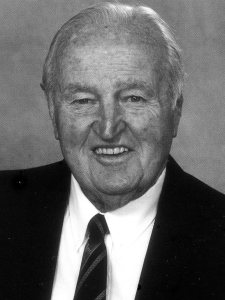
Leo Armstrong
Image Source: The Panthers: Men in Black

Murray Leo Armstrong

Director, Chairman Penrith Rugby League Club Ltd

Murray Leo Armstrong — Leo — was one of the most significant and well-respected figures in Panthers history. A distinguished World War II veteran, respected community leader and long-serving chairman, he helped guide Panthers through some of the most important and turbulent years in its development.

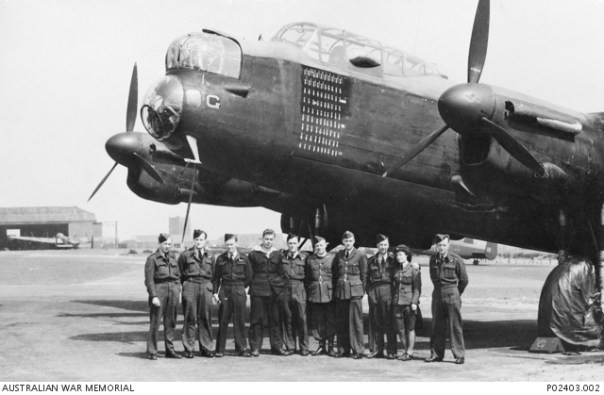
Leo Armstrong (2nd from left) and crew in front of Lancaster bomber G for George. On an “away” to Canberra, the 2003 Panthers squad visited the Australian War Memorial and were inspired by this photo and the story of Leo’s service. (Photo: Australian War Memorial)

Armstrong served on the Panthers board from 1980 and became chairman in 1984, following the unification of the licensed club and football club boards. He remained chairman until 2000, making him the longest-serving chairman in the club’s history.

His chairmanship spanned many of the defining events of the modern Panthers era, including the move to Mulgoa Road, the club’s first premiership in 1991, the Super League conflict, the transition to the NRL, and significant growth in both the football and licensed club operations.

Role in the Narrative

Leo Armstrong appears throughout the Panthers, Passion & Politics narrative as chairman during many of the events described in the Roger Cowan years.

His relationship with Roger Cowan was generally characterised by mutual respect and trust. Armstrong frequently found himself chairing the organisation through periods of intense debate, organisational change and external pressure. His calm demeanour and measured approach were important stabilising influences during some of the club’s most challenging periods.

He was also instrumental in supporting the unified governance model that ultimately transformed the management of Panthers.

Background

Born: 4 November 1922, Gayndah, Queensland
Died: 22 June 2015, North Parramatta, New South Wales

Military Service:
• Royal Australian Air Force, World War II
• Served with 460 Squadron RAAF
• Navigator, Bomb Aimer and Front Gunner
• Flew 32 operational missions over Europe
• Flew the final three missions aboard the famous Lancaster bomber G for George

Profession: Commonwealth Bank of Australia, retired (1984) as Manager of the Penrith Branch

Recognition by Panthers
• Life Membership, Penrith Panthers (1991)

Relevance to Events Described

Armstrong became chairman at a pivotal moment in Panthers history. The newly unified board had adopted a radically different management structure, the Mulgoa Road development was underway, and the football club was struggling both financially and competitively.

Throughout the following sixteen years, Armstrong chaired the organisation during a period of extraordinary transformation. Under his leadership, Panthers grew into one of Australia’s most successful licensed clubs while simultaneously establishing itself as a competitive force in first-grade rugby league.

His tenure was not without controversy. Board disputes, the Super League war, questions about governance and growing political tensions within the organisation all occurred during his chairmanship. Yet Armstrong’s personal dignity and steady leadership earned him widespread respect from many who worked with him.

For many involved with Panthers during this period, Leo Armstrong represented a style of leadership that was thoughtful, measured and deeply committed to both the club and the wider Penrith community.

Related Topics


Related Themes:

Board Decisions · Governance


To receive new Parts and occasional project updates by email, you may subscribe below.

Readers who hold recollections, documents, or material relevant to this history are welcome to contribute via the Commentary & Contributions page.

Project Updates

Receive updates when new parts are published.


Editorial Note

This profile is presented as contextual background.
Additional material may be introduced as the narrative progresses.


Why One Board, One CEO?

Readers of Parts 19–21 may wonder why Roger Cowan spent more than sixteen years arguing for what appeared to be a relatively simple administrative reform. Why did the issue matter so much to him? Why did he keep returning to it despite repeated setbacks, opposition and criticism?

The answer lies in a question that had troubled Panthers almost from the beginning:

The issue was not new.

Readers familiar with the events of 1971 may recognise some familiar themes. The removal of football club secretary Merv Cartwright and treasurer Ron Partridge arose from concerns about the administration of rugby league affairs and accountability for financial decisions. Although the circumstances were different, the disputes that emerged again in the late 1970s centred on many of the same questions. Who should make decisions? Who should be accountable for those decisions? And what happened when agreements were not honoured?

From the time Penrith entered first grade rugby league in 1967, the football club and licensed club operated under separate governance structures. The arrangement was common in rugby league, but Roger increasingly came to believe it created problems that could never be fully resolved.

It would be easy to assume the conflict was simply about money. Certainly finances played a part. Rugby league required increasing investment, while the licensed club was trying to strengthen its financial position and pursue long-term development projects. Yet Roger’s frustration was not that football sought resources. In his view, the licensed club had repeatedly demonstrated a willingness to support rugby league and invest heavily in its future.

The real problem arose after decisions had been made.

Budgets would be negotiated. Agreements would be reached. Plans would be approved. Yet time and again, football expenditure exceeded agreed limits or new commitments were entered into without the knowledge or approval of those responsible for managing the Club’s overall finances.

From Roger’s perspective, this was not simply a financial problem. It made long-term planning almost impossible.

A licensed club board could approve a football budget, commit to major development projects and make decisions based upon expected cash flows. If those assumptions later proved incorrect because spending commitments had changed, the consequences extended well beyond rugby league. The entire organisation could be affected.

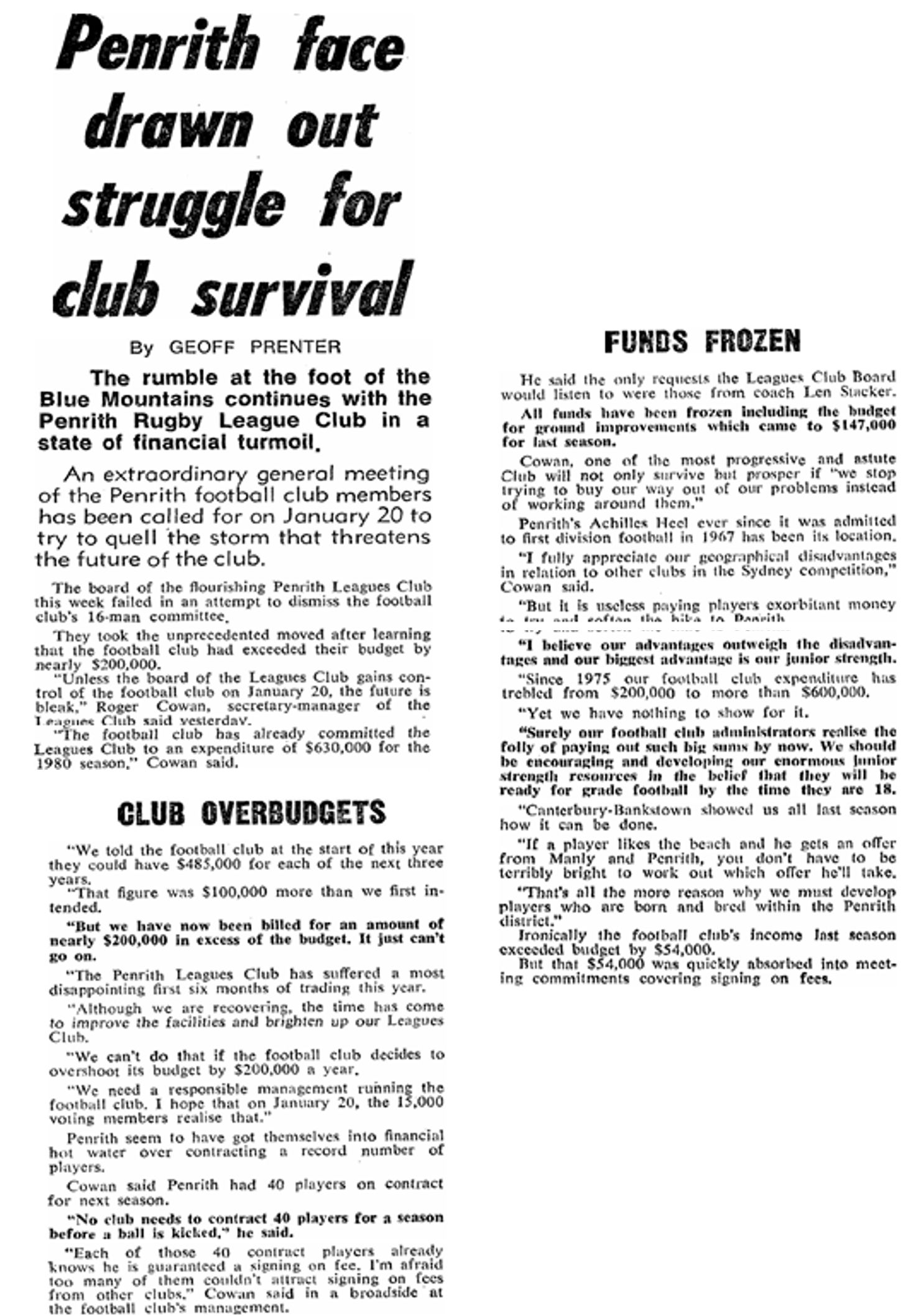
By the late 1970s, these tensions had become increasingly public. In December 1979, the Sydney Morning Herald reported on financial difficulties and disagreements between the football and licensed club administrations. Around the same time, Panthers was preparing for the enormous financial challenge of constructing its new Mulgoa Road complex.

SMH 1979 Dec 9 – click image for full article.

Reports to members in 1980 revealed the extent of the concern. Directors reported that the football club had exceeded an agreed annual budget of $485,000 by more than $100,000 during 1979, while additional commitments had already been entered into for the following season. To the licensed club board, the issue was not simply the amount involved. It was that decisions affecting the future of the entire organisation had been made outside the framework that had previously been agreed.

These events helped bring the governance debate to a head, but they do not fully explain Roger’s determination.

For him, the issue was ultimately one of organisational unity.

He believed Panthers would never achieve its potential while parts of the organisation operated according to different priorities, different assumptions and different lines of accountability. A football club and licensed club could share the same colours, the same members and the same ambitions, yet still find themselves working against each other.

His solution was straightforward.

One board would determine policy and direction for the entire organisation. Management would then be responsible for implementing those decisions. Everyone would work towards the same agreed objectives and everyone would be accountable to the same governing body.

Not everyone agreed.

Some viewed Roger’s campaign as an attempt to centralise power. The perception is understandable. After all, he was advocating a structure that would eventually place responsibility for football and licensed club operations under a single administration. His persistence over sixteen years inevitably raised questions about motive.

Yet there is another interpretation.

Roger was not arguing that football should receive less support. Nor was he arguing that rugby league was less important than the licensed club. Rather, he believed the entire organisation should operate according to a common plan and that all parts of Panthers should be accountable to that plan.

Many years later, Panthers would use concepts such as “twin citizenship” to describe the idea that people belonged not only to their immediate team but also to the wider organisation. While that language did not exist in the 1970s, the philosophy behind it helps explain Roger’s thinking. He wanted rugby league, club management, directors and staff to see themselves as contributors to a single enterprise rather than separate interests competing for influence.

The first major breakthrough came in 1980 when a single board was finally established. Yet even then, the model remained incomplete. Rugby league and the licensed club continued under separate chief executives. As described in Parts 20 and 21, the compromise produced its own difficulties and did not resolve the underlying tensions.

It was not until the end of 1983 that the structure Roger had advocated for so long was fully implemented. One board and one chief executive became responsible for the entire organisation.

Whether that decision alone explains the improvements that followed is impossible to know. Organisations are rarely transformed by a single reform. Nevertheless, the years that followed saw a stronger emphasis on cooperation, planning and shared ownership. The workshops that led to the Five by Five program, closer relationships throughout the rugby league district and a more integrated approach to football and club operations all emerged during this period.

Reasonable people may still disagree about whether Roger was right. They may also disagree about the extent to which later successes flowed from the governance reforms he championed.

What is difficult to dispute is that he regarded the issue as fundamental. For more than sixteen years he returned to the same argument, often in the face of resistance and disappointment.

Ironically, that persistence contributed to one of the enduring myths about Roger Cowan — that he was somehow anti-rugby league.

The evidence suggests a more complex reality.

His long campaign for “One Board, One CEO” was not driven by a desire to diminish rugby league, but by a belief that Panthers could only achieve lasting success when every part of the organisation was working towards the same goals and operating under the same commitments.

Whether one agrees with that belief or not, it became one of the defining ideas in the history of Panthers.


Source Material*

The following documents are extracts of the relevant sections of larger reports:


Related Topics


Related Themes

Financial Management · Governance · Board Decisions · Culture · Club Structure


* Resource material courtesy of The Ausburn Collection


To receive new Parts and occasional project updates by email, you may subscribe below.

Readers who hold recollections, documents, or material relevant to this history are welcome to contribute via the Commentary & Contributions page.

Project Updates

Receive updates when new parts are published.


A Solution — Of Sorts

This article forms part of the serialised republication of Panthers, Passion & Politics – The Roger Cowan Years.

Start · Reader’s Guide · All Parts


Despite the promise shown in 1974, the underlying problems did not go away. Ashurst and Stephenson had settled in — the team had shown promise by reaching the finals of the Amco Cup and the budgeting and financial controls were in place. Cowan recommended that it was time for him to hand over to ex-player, Ron Workman.1

The committee agreed and Cowan stepped aside to concentrate on the management of the licensed club.

The potential shown in 1974 was never realised. The first-grade team finished in the bottom four of the competition for most of the seventies.

Cowan’s growing frustration with a system that he considered wasteful, inefficient and noted only for a succession of failures fuelled his determination to convince both clubs of the advantages of a united effort.

If I analyse that history, I can see that the real cause of a lot of the internal problems through the seventies and early eighties was my unequivocal belief that Penrith would never achieve success as a rugby league competitor while it had separate administrations. I harped and nagged boards for ten years before I finally won the argument, and even then, the win was only because of the involvement of the NSWRL [New South Wales Rugby League] executive.

Later critics would portray Roger Cowan as a CEO surrounded by yes-men. The events of the 1970s suggest otherwise. They must have been either unaware of or had forgotten those years. It was an ongoing battle to achieve his ‘one board, one CEO’ ambition. He often thought he would never win. Neither side was willing to make the concessions necessary to bring the two together. Cowan laughs at the ‘yes-men’ tag.

For more than ten years, I did my very, very best – put my absolute best efforts into getting one board, one management. I kept going back, and going back, and it didn’t happen.  So, no – they definitely weren’t yes-men.

One time in the late seventies, I was getting so frustrated, I thought I’m really going to make the effort here. I prepared a 19-page booklet for the next board meeting. It had graphs, and charts – every piece of information I could pull together to try and convince them.  I was determined to make them see that “this is the only way this club is going to succeed”. I gave it to them a couple of weeks before the meeting to give them time to read it.

On the night of the board meeting, I made sure it was on the agenda. The item came up, and the deputy chairman, Murray Clarke, said: “I move that this document be received”. Somebody else said, “I second that”.

And that was it, there was no discussion, nothing – they just moved on to the next item! I blew my top, lost my temper completely.

It was really stupid putting a 19-page document before a board anyway – boards need concise documents. But I’d tried those for years and they hadn’t worked either.

It took me another couple of years, and a lot more frustrations to win that argument. And we haven’t looked back since. Many other clubs now operate the same way.

Cowan’s commitment to the cause was also used by his opponents to brand him as anti-rugby-league. This is one of the major Cowan myths, and it would be used against him many times by many people. It was also another factor that contributed to his appearance before Ian Temby in 2004. That one small trickle that began as a frustration with failure in rugby league in 1971 combined with some other small trickles along the way, became a raging torrent 33 years later.

Editor’s Note: Roger’s long campaign for “One Board, One CEO” was about far more than administrative structure. It reflected a deeply held belief about accountability, organisational unity and the future direction of Panthers. Readers seeking additional background may wish to read Why One Board, One CEO?

Barry Hubbard says that at one time, Cowan and the board executive even travelled down to the NSW rugby league office in Sydney to talk to Kevin Humphreys [then NSWRL president] to see if there was some way for the licensed club to take over the rugby league club. Hubbard was dead against the idea but still felt it should be explored. Humphreys told them in no uncertain terms that it was impossible. It was unconstitutional, and if they tried, they could be expelled from the game.

Local butcher and prominent cricketing identity, the late Trevor Wholohan OAM2 interpreted Cowan’s trip to rugby league headquarters very differently. His opinion, expressed with his characteristic passion and vehemence, was aligned with those branding Cowan as anti-rugby-league. He declared with his characteristic passion and vehemence, that Cowan’s meeting with Humphreys was “to get rid of rugby league”.

Cowan’s reaction to this was disbelief. He wonders how any rational person could come to such a conclusion.

Imagine meeting with Kevin Humphreys to talk to him about getting rid of rugby league. Any sane, logical person would know that you wouldn’t do that. Humphries would chew you up and spit you out.

Hubbard said Cowan had returned from the meeting with Humphreys undaunted.

Roger was never one to take no for an answer. He had tunnel vision. He went back to the club and resolved to have a meeting with the football committee to decide on holding a joint election for a board that would have responsibility for both clubs.

In discussion, the football committee had agreed, in principle, to hold the election But when the actual motion was put to a vote, a division was called, and people were asked to vote by moving to opposite sides of the room. It was narrowly defeated. A couple of the committeemen who had agreed to an election now crossed the floor and voted against it.

The internal squabbling at Penrith – and the poor performance of the team – was becoming an embarrassment to rugby league administrators. The executive of the NSWRL offered to help, bringing in Alec Mackie, a highly respected rugby league administrator, who was chairman of St George and a vice president of the NSWRL. A committee – dubbed the Super Six3 – was set up to find a way forward, with three representatives from each board. Roger Cowan was also a part of the committee. Mackie chaired the meetings, which eventually concluded that there should only be one board at Penrith. The two committees, for the second time, came to an agreement.4

When the joint election was held in 1980, the new board comprised all the directors of the licensed club. No-one from the football committee had been successful. It became the first board in rugby league history to handle the affairs of both a licensed club and a football club. However, it was only halfway towards the model that Cowan had been recommending.

I believed that a structure comprising one board employing two chief executives would be just as difficult as having two boards dealing with two chief executives.

In many ways it could even be worse. It missed the whole point of the recommendation.  

When the boards came together, that is what they did. Rugby league was controlled through a newly appointed chief executive, Charlie Gibson, while I retained responsibility for the licensed club.

A promising coaching strategy for the 1974 season was derailed by a committee modifying it for the wrong reasons. It was years before its time and it might have been successful had it been given a chance. Here we were in 1980 and I had a feeling it was happening again. The system I had been advocating was being half introduced and again the modifications were for all the wrong reasons. You can’t half bake a cake.

And that was exactly the position the Club found itself in.


To receive new Parts and occasional project updates by email, you may subscribe below.

Readers who hold recollections, documents, or material relevant to this history are welcome to contribute via the Commentary & Contributions page.

Project Updates

Receive updates when new parts are published.


  1. Ron Workman is Panthers player number 13, a member of the 1967 foundation team, he retired as a player in 1973 after playing 93 1st Grade matches. In 1975 he was appointed as the Secretary of the Football Club, a role he held until 1978.
    ↩︎
  2. Trevor Wholohan was a long-standing critic of Roger Cowan, with tensions between the two dating back to 1974 when Wholohan’s butchery supplied the Club. A dispute over an account led Wholohan to claim that Cowan had impugned his honesty. He later attended most sittings of the 2004 Temby Inquiry as an observer.
    ↩︎
  3. The committee was in fact: Kevin Humphreys (NSWRL), Alec Mackie (NSWRL), John Jennings (Penrith Distric Club), Tom Ellis (Penrith District Club), John Hewett (Penrith Leagues Club) Rocky Davis (Penrith Leagues Club) — that’s the “Super Six” — and Roger Cowan. Keith Rhind (Penrith Legues Club) was on the bench for this team.
    ↩︎
  4. To get to this point had been difficult — there were 14 on the football club board and 12 on the licensed club board. Many seats were in jeopardy. It was Barry Walsh who convinced the football club board that, for the sake of the organisation, sacrifices had to be made. Barry lost his seat but would regain it a few years later and go on to contribute to Panthers for close to four decades. See: Beyond the Book — Major Player: Barry Walsh. ↩︎

← Part 18 · All Parts · Part 20 →

Commentary and Contributions

A Solution Kept Quiet

This article forms part of the serialised republication of Panthers, Passion & Politics – The Roger Cowan Years.

Start · Reader’s Guide · All Parts


Cowan continues with further thoughts on the bad decision to place Clare as head coach:

It was a ridiculous decision. Jack had some strange ideas about the strategies of the game and started clashing with the captain, Mick Stephenson. Mick was a passionate competitor and was quick to argue with Jack if he thought the coach was talking nonsense. Jack said he would take him out the back of the grandstand and sort him out.

My response was something like: “Jack, if you think the answer is to fight our captain, I want you to know that you will be doing it over my dead body”.

It was one of the many signs that we had made a bad decision.

This episode reinforced Cowan’s belief that Rugby League decision-making should be seated in one body, looking after the interests of the entire club.

Tom Wilson gives an example of the way the football committee worked at the time.

Les Boyd was a brilliant newcomer at the time, only a very young kid. The coaching committee had invited him and his father to come to the club to talk to us. His father was a little short stocky bloke. Les wasn’t much bigger, but he was a very strong looking, solid boy. And he had already started to make a name for himself.

We’re all standing around talking, and Pat Russell — who was on the football committee —  is down at the end of the bar, holding court. He says to me, ‘Look Tom, look at the kid’s old man, the size of him. This kid will never grow up to be any decent sort of a footballer.

That’s what we were up against. Les Boyd did grow up, and he became an outstanding footballer — a mongrel, but a great footballer. It was only one man’s opinion, but that’s all it needed back then. It was like that all the time — how would the bloody schoolteachers know?

Appointing Jack Clare as head coach, the football committee cited Masters’ lack of first grade experience, saying he only had coached school football. In fact, his credentials were very similar to Jack Clare’s, but Masters had a far better CV.

So, the 1974 season began with Clare in the driving seat. Masters was to look after tactics, Harris coached the forwards, and Wilson the backs.

It soon became apparent that there was a problem, says Masters. The team lost its first four games and conceded a total of 107 points.

So on a wet Sunday at Warragamba, after a club family day up there, Roger gathered all four coaches in his car, and gave us an ultimatum. He said, “It’s obvious that this is not working, and I’m going to appoint Roy as head coach. You can accept it, or we go back to the board – who will no doubt go to the media, and wherever else it goes from there.

Cowan made it clear it was up to them — handle it quietly and confidentially or suffer the glare of media coverage and the uncertainty of how the committee would handle making a new decision.

For the remainder of the season, Harris became second grade coach, Wilson coached third grade and as far as the world knew, Clare was the head coach. None of us ever revealed to the press what the situation really was. We maintained that situation only to preserve Jack Clare’s dignity, but the reality was that I was first grade coach for that season.

The entire Penrith experience is one that Masters would prefer to forget. He felt very let down at the time.

My significant problem was that Roger … didn’t give me any support … I had to make my own arrangements … I just had to cop it sweet.

I thought that I had made a significant investment in a life change and ended up being dumped pretty much high and dry

In a recent exercise to select Penrith’s best team and coach of the past 40 years, Masters is named as the first-grade coach for 1974, but it’s taken 40 years to acknowledge it. Cowan told a meeting held in 2006 to discuss that 40-year team, that Panthers has treated Roy Masters abominably.

Masters speaks highly of Cowan,

I have a very great affection for Roger. But my admiration for him is based on what he’s done for the club since I left, not any problem that I had at the time with him.

See, you’ve got to be measured in this world – you just don’t define your personal history in terms of a couple of years you spent somewhere, and that forever influences your view of a person. You also make observations as you go down the track. And I can’t deny the fact that he, selflessly, with massive amounts of hard work, has built a vast empire.

Roger’s model introduced a revolutionary coaching plan It was a good model, but it was too far ahead of its time in terms of the politics that existed at the club in those times.

It didn’t matter what you tried to do with those people. If you came up with something new — like trying to develop match plans or produce videos — or had any kind of scientific training, you were completely alien. You belonged to a culture they didn’t like, and couldn’t accept. Yet look at the game now, it’s all scientific, all research and video analysis.

The politics during those days of two boards was treacherous … and it was very destructive and soul destroying. Merv Cartwright wasn’t on the committee at the time, but he was still a powerful force behind the scenes.

My experience at Penrith steeled me for the future.

In 1974, the year that Roy Masters came to Penrith, Mike Stephenson and Bill Ashurst also came — from England, to play with the team. Under the direction of Roy Masters, the team made the final of the new mid-week competition, the Amco Cup.  They finished in ninth position in the first-grade competition, and had come close to making the semi-finals.

Although the team had its best yet success under Masters, he opted to remove himself from the politics and coach the Under 23 side the following year.


To receive new Parts and occasional project updates by email, you may subscribe below.

Readers who hold recollections, documents, or material relevant to this history are welcome to contribute via the Commentary & Contributions page.

Project Updates

Receive updates when new parts are published.


← Part 17 · All Parts · Part 19 →

Commentary and Contributions

The Walls Come Down

This article forms part of the serialised republication of Panthers, Passion & Politics – The Roger Cowan Years.

Start · Reader’s Guide · All Parts


Clubland in the fifties and sixties was overwhelmingly a male domain — more a bastion than a business.

When Roger Cowan arrived, the ‘Long Bar’ extended the length of the building, and it was for men only. There was also the Sports Lounge, with its dartboards and pool tables. It too was restricted to men.

As in most clubs and hotels in those days there was The Ladies Lounge.  This small room was the only place in the entire club where women — or couples — could go.  It had poker machines and couches but didn’t have its own bar. The women were served by stewards from the other bars. In those very early days of the women’s liberation movement, the room had acquired the unflattering nickname, the ‘sow pen’.

Women were only admitted to the club as associate members. Full membership was restricted to men. Keith Rhind, who was a young director at the time, recalls:

One of Roger’s early pushes against the Board was to allow women into the bar, but there was a lot of resistance. One of the directors at the time was Lou Brown. Lou was real old school, a man’s man, and he used to growl, “Women! They’re like white ants. Once you let ‘em in, you’ll never get rid of ‘em”.

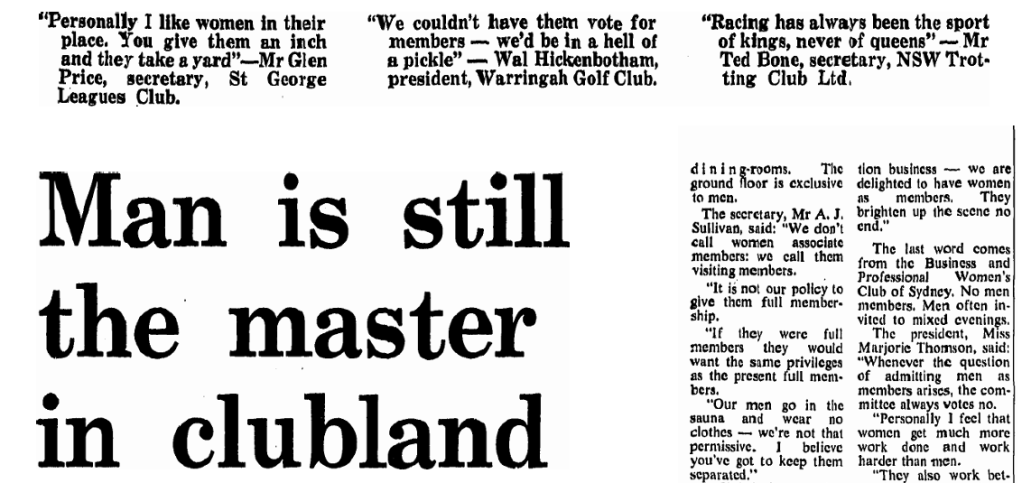
Contemporary attitudes within the licensed club industry could still be remarkably conservative. A 1971 Sydney Morning Herald article captured some of the prevailing assumptions of the era:

Read the full article: PDF

Bryn Miller also remembers that time.

Cowan had analysed the figures — the men’s bar took up 80 per cent of the space but only brought in 20 per cent of the revenue.

By 9 o’clock at night, there might be only three people in the men’s bar and the ladies area would be full to overflowing to the point that some couples would just leave and go to the RSL.

This was especially so on Saturday night — traditionally the time for couples to have a night out – or on big trading nights like New Year’s Eve.

The revenue figures were common knowledge, but the men were very possessive of their space, and this certainly carried through to most of the directors.

Roger used to wander around every night, often quite late, keeping an eye on things. One late Thursday night after the trots at the local showground, he and a duty manager were watching a couple of men. One had big pockets inside his coat, the other was keeping watch while he cleaned out the drawers. They caught them and went to their car which was full of calico bags filled with ten and twenty cent pieces.

Kevin McGrath recalls how this played out in practice,

When a football game was on, it was stand aside or be swept up in the rush.

On game days they would pull the shutters down in the men’s bar so that the drinkers would go over the road to the game. After the game was finished, they would pour dozens and dozens of half schooners and have them lined up. There would be a mad rush from the football ground as hundreds of thirsty fans descended on the bar.The schooners were filled and the shutters went up. If you only wanted a middy — or perish the thought, a scotch — you just had to wait.

Cowan later said the changes were not a conscious move to overcome discrimination, but simply, a commercial reality.

We were trying to make ourselves more popular. We had to be all the time working out what was needed and then responding. The demand at the time was for much bigger accommodation for mixed company. We were squeezing them into one tiny corner of the club, where they were uncomfortable. There was no space, people were pushing and shoving each other, and often there would be fights in there.

I always thought that to run a club, or any business, you have to give the people what they want. At that time, it was being run for the convenience of a fairly small group of men who wanted to protect it for themselves.

The real shift came one New Year’s Eve — Cowan had convinced the Board to do a one-off and allow women into the Long Bar.

The Board finally relented, at first creating a small, partitioned area of the bar where women could go. “Roger persisted, and they were eventually persuaded to have a proper mixed bar, and the sales increased dramatically”, says Rhind.

“It took women a while to really want to go in there,” Miller says, “because that whole male bastion thing was all so entrenched. But the barriers were starting to come down.”

As those barriers began to shift, the club was changing not just who it welcomed, but what it offered — and how people experienced it.


To receive new Parts and occasional project updates by email, you may subscribe below.

Readers who hold recollections, documents, or material relevant to this history are welcome to contribute via the Commentary & Contributions page.

Project Updates

Receive updates when new parts are published.


← Part 9 · All Parts · Part 11 →

Commentary and Contributions