Early in 2001 the Board approved Mark Levy’s recommendation that Royce Simmons be re-signed for a further two years. The decision ultimately led to his departure in a way that, to Cowan, was both regrettable and unnecessary.
Royce Simmons was an icon in Penrith. He had come from the country as a young player and had shown enormous commitment to the club for close to twenty years. He was – justifiably – looked upon as one of the heroes of the Panthers’ 1991 Grand Final win. He was extremely popular with sponsors and supporters.
Levy approached the board in early 2001, saying that Simmons believed that some high-profile players would not sign new contracts until they knew Simmons’ contract had been extended. Cowan remembers there was mixed reaction from the Board. Significantly, the five directors who so often voted together were themselves divided on the issue.
Cowan believed the mechanisms that had previously allowed for detailed discussion and analysis were no longer operating in the same way, making the situation even more difficult. Most importantly, it had to be handled carefully. Because of Simmons’ popularity, if word leaked that the board was reluctant to extend his contract, a strong backlash was likely.
He had been quite successful as a coach, which increased the pressure. Although the club had been badly damaged by the Super League wars, Simmons had taken the team to the finals in 1997 and again in 2000. In 2000, the club had also broken records for attendance and sponsorship.
Taking all this into account, the Board agreed with Levy’s proposal and signed the two year contract. Cowan says the 2001 season was a disaster.
The team was not just losing; it was barely competitive in many games. It finished the season in last place. In Royce’s defence, he had been at the club for a very long time compared with the usual coaching careers. A rigid salary cap had prevented the club from adding any new players to the team. However, we still had a good solid base from the previous year, and we had faced the new season with high hopes.
But it does not work that way in rugby league. Having no new blood served to dampen the morale and enthusiasm of the coach, the staff, and the team. The continual losses hit Royce particularly hard. They sapped his confidence, which didn’t help the situation. By the middle of the season, it was obvious that we were in trouble.
In my own mind I was trying to work out how we could overcome the problem at the end of the year. Royce had a two-year contract, and the decision-making processes of the club were basically in the hands of five directors.
By the second half of the season, Cowan had reached the view that the only way to restore spirit to the team was to replace the coach and several members of the football staff.
He could see no value in making drastic changes halfway through the season. It was his plan to spend the remainder of the season collecting as much information as possible, and to work with some trusted staff to try to analyse the problems and come up with solutions.
Had things been different, part of the process would have been consultations with the Board, but he says that by this time, breaches of confidentiality were a fact of life at that level. The last thing the coach and team needed was to have their problems publicly debated in newspapers, and on television and radio. Cowan adds that it often seemed that Ron Mulock and the WesternWeekender knew things before he did.
Around the same time, and unbeknown to the rest of the Board, Dennis Coffey and John Bateman were meeting privately with some senior Panthers players. They later said that players had expressed dissatisfaction with the coach during those meetings.
To Cowan, the meetings presented a serious governance problem. He believed concerns of that significance should have been brought back to the full Board and management rather than pursued independently by individual directors. This was particularly difficult for him to reconcile with Bateman’s frequently expressed concerns about corporate governance.
It was also extremely naïve to think that the meetings would remain secret.1
Soon there was a blaze of publicity. Instead of being handled with discretion and objectivity, Simmons’ future became an emotional public issue that further undermined his position.There were divisions among sponsors and fans. The players, already suffering because of the bad season, were caught in the crossfire.
Cowan says he backed away from making a recommendation but suggested that they consider moving back to the old system, where the responsibility for hiring and firing rested with management.
Greg Evans was vehemently opposed to handing back this power. I was equally obstinate, believing that it was the only way to fix the problem without causing more conflict in the community.
Finally, the Board agreed that Cowan should handle the matter, effectively returning responsibility for the coaching decision to management. Royce Simmons was sacked as coach, to be followed soon after by most of the coaching staff.
As a result, Greg Evans resigned from the Board, to be reinstated about six months later.
Substantial changes followed within the rugby league operation. John Lang was appointed coach, and two seasons later Penrith won its second premiership.
Cowan reflects on the problem:
The phenomenon of coaches reaching a year of failure is not unusual. It is not because a good coach suddenly becomes a bad coach. Had Royce Simmons left Panthers one year earlier, he would have left on a very high note. He gave much to the club over many years. As a coach he was virtually a workaholic and would probably have cheerfully donated his right arm in return for a successful Panthers team. The way he left was sad and did not do justice to his service with the club. What is even more sad is that it could have been avoided.
Recognition should also be accorded to many others from that era, including Mark Levy and all of Royce’s coaching and support staff. Unfortunately, timing in these matters is all-important – a club full of heroes at the end of 2000 and most of them sacked by the end of 2001.
To receive new Parts and occasional project updates by email, you may subscribe below.
Readers who hold recollections, documents, or material relevant to this history are welcome to contribute via the Commentary & Contributions page.
Project Updates
Receive updates when new parts are published.
Max Cowan recalls speaking to some players about what was happening. “Some were furious that other players were, as they saw it, putting the skids under Royce; others were despondent at the prospect of continuing with him as coach. It seemed clear to me that Bateman and Coffey had unwittingly undermined the coach and added to the instability of the team. ↩︎
Cowan’s ‘hands on’ approach to rugby league saw him step into the role of rugby league CEO a number of times. He was involved in some monumental rugby league decisions in the club’s history, including engaging some very successful coaches.
Strangely though, he says his passion about rugby league resulted in him sometimes being less tolerant of people than he should have been. This brought him into conflict with people,
I should have been able to handle the rugby league issues better than I did. The number of people who think I was anti-rugby-league is an indication that I was not communicating well. There is plenty of evidence to show that I was passionate about having a successful team. But I resented seeing waste arising from irresponsible decisions.
I could also never cope with people who kept prattling on about the Club not putting enough money into rugby league to make it successful. To my way of thinking they were just ratbags who did not have the common sense to see that if we put unlimited money into rugby league it would only last a few years and then there would be none. To me all this was obvious. The most important thing was good management of the resources that we had, rather than having to spend our way out of trouble because of poor management. It frustrated me that some people just couldn’t see it, and there were probably many times I showed how I felt — which is not the way to win friends and influence…
But when people suggested initiatives that presented a chance to build success,I was never opposed to spending the money. On one occasion I had a call from rugby league commentator Frank Hyde, suggesting we consider getting players from South Africa. His rationale seemed very logical, and the idea looked promising. The Board agreed to my recommendation to try it, despite the expense.
FROM THE ARCHIVES Looking Further Afield — Penrith’s South African Recruitment Mission In 1972, a four-man Panthers delegation travelled to South Africa looking for players who might strengthen the struggling first-grade team. The venture became a rather more unusual recruitment story than that simple description suggests. Read the original account
Another time Alan Clarkson told me of a terrific English player who would probably come to Australia if invited. His name was Bill Ashurst. I reached an agreement with Bill, and we agreed to pay a very large transfer fee to his club. When another club tried to get under our guard, we sent two directors to England to make sure we clinched the deal. The two directors rang from England saying that we could also get the English captain, Mick Stephenson, if we were willing to pay another large transfer fee. We paid record money for thoseplayers, and I supported it all the way. The success of those two choices is part of Panthers’ folklore.1
The fact is that I cannot recall one occasion when a request for money to fund a well-thought-out rugby league initiative was refused by the board or opposed by me. In addition to that, the criticism that I would not give rugby league enough money shows an ignorance of the procedure. The football club would present a budget to the board of the licensed club at the beginning of each season. On most occasions it was approved. But sometimes – and particularly in the Cartwright era – we would be confronted with a huge deficit at the end of the season, and that’s when I would go off my brain.
After ‘one board, one CEO’ became reality in 1984, Cowan led or participated in most of the important plans and decisions for coaching the Panthers.
The change was followed by a much more deliberate approach to football development. Among the initiatives was the Five-by-Five Plan, which set the ambitious goal of having five locally developed players representing Australia within five years. Within six years of the structural change, Penrith reached its first Grand Final; a year later, the Panthers won their first premiership.2
Those decisions also included included the eventual decision to replace Royce Simmons and the contract Cowan negotiated with John Lang, who would take the club to its second premiership. At this time Cowan had once again taken over responsibility for rugby league after a major restructure that saw most of the club’s rugby football staff depart, including rugby league CEO Mark Levy.
Although there had been a number of dramatic rugby league upheavals over the years, Cowan says that, until the Simmons episode, major changes had generally been made with minimal adverse publicity. He attributed much of that to the club’s participative approach to decision-making.
It all seemed to operate quite smoothly, and a lot of that could be attributed to our participative style of management. Any changes were thoroughly discussed and explored before they were made. For example, the final meeting with Ron Willey was preceded by a meeting of the rugby league chief executive and about six other managers. Their brief was to help me analyse the problem, and decide what should be done about it, and how adverse publicity could be avoided. The Board Executive was also brought in before any action was taken.
Similarly, the decision to join Super League followed months of analysis and discussion involving key staff and the Board.
Cowan strongly rejected claims that he ran the Club as a dictatorship.
He maintained that the five directors who later complained about his management had themselves participated for years in the Club’s consultative decision-making processes. His involvement in the departure of some high-profile rugby league personalities nevertheless provided further ammunition for his critics.
Around 1999, the Board began to become more directly involved in the management of rugby league — a development Cowan regarded as a backward step.
It started with a very simple request from the board that Simmons and Levy should attend the start of every second meeting to deliver a football report.
The Simmons/Levy visits soon moved beyond their rugby league reports. What had begun as a straightforward reporting arrangement gradually altered the decision-making structure. In Cowan’s view, it was a step back towards the arrangement of the Charlie Gibson years: one Board dealing directly with separate executives responsible for the registered club and rugby league.
It was a subtle shift away from the model of discussion and analysis that had operated for about fifteen years, towards more direct decision-making structure by the Board.
Cowan cites an example:
At one meeting, Simmons proposed a payment of $100,000 to a player who was exempted from the salary cap. It took all of one minute for the Board to agree, despite a couple of strong dissenters. Previously, something like this would have been analysed carefully by a team. Only then would it have been referred to the board. It was a very poor decision, and fortunately – because of other reasons – it did not happen.
A decision by the Board early in 2001 had massive repercussions.
To receive new Parts and occasional project updates by email, you may subscribe below.
Readers who hold recollections, documents, or material relevant to this history are welcome to contribute via the Commentary & Contributions page.
For Roger Cowan, a problem was rarely just the incident that brought it to attention.
His instinct was to pull it apart. What was actually going wrong? Who was affected? What outcome was required? And, most importantly, could a system be designed that would produce that outcome more consistently?
It was an approach to problem-solving and decision-making he was embedding across the Panthers organisation throughout the 1990s — and one he believed was important to its continuing success.
Few examples illustrate that approach better than his work on rugby league’s judiciary.
The problem had bothered him for decades.
“Sit down, Mr Cowan”
As Roger recalled in Panthers, Passion & Politics, when he served on the NSW Rugby League executive committee in the early 1970s, judiciary decisions regularly created controversy. Penalties appeared inconsistent and clubs sometimes believed others were receiving more favourable treatment.
Eventually he tried to raise the issue at an executive meeting.
“I want to make a suggestion about the judiciary system,” he told chairman Bill Buckley.
“Sit down, Mr Cowan, you’re not here to talk about judiciary.”
Roger tried again.
“Sit down Mr Cowan or leave the meeting. You are out of order.”
That was the end of the discussion.
More than twenty years later, rugby league had changed dramatically — and was in the process of changing even more.
During the planning for Super League, the judiciary came up for discussion. Roger said he had “always had a passion for judiciary” and offered to prepare a paper.
This time the response was different.
“Terrific! Go ahead, do it.”
So he did.
Start with the outcome
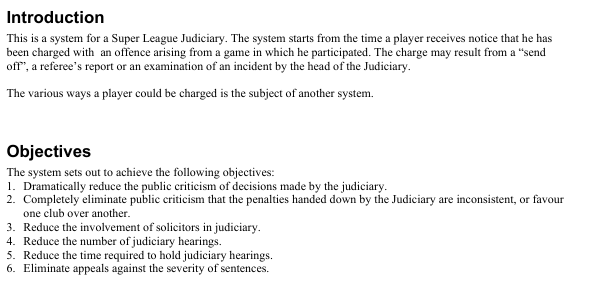
The surviving working paper is dated 24 November 1995.
Its opening is revealing.
Roger did not begin by deciding who should sit on the judiciary or what punishment should apply to a high tackle.
He began by identifying what a better judiciary system should achieve. What is the outcome — what evidence will demonstrate the system is a success?
Among a list of outcomes were: reduced levels of public criticism of judiciary decisions; elimination of the perception that penalties were inconsistent or favoured particular clubs; less involvement of solicitors; reduced number of hearings and shorter duration; and elimination of appeals based simply on the severity of a sentence.
Before designing the machinery, he defined what the machinery was supposed to accomplish.
That changed the nature of the problem.
It wasn’t simply a question of whether an individual judiciary panel made the right or wrong decision. A system could produce perfectly defensible individual decisions and still create inconsistency, expense, delay and a perception of unfairness.
Roger’s proposal therefore attempted to move responsibility for consistency away from the discretion of whichever individuals happened to be sitting on a particular night and place much more of it within the system itself.
Separate guilt from penalty
At the centre of the proposal was a relatively simple distinction.
The judiciary should determine whether a player was guilty and, if so, what offence had been committed.
Ordinarily, it should not then decide the penalty from scratch.
Offences would instead be divided into clearly defined categories carrying predetermined penalties. Discounts and additional penalties could be applied according to defined circumstances.
A player whose guilt was clear could plead guilty, receive the appropriate discount and avoid a hearing altogether. A player maintaining innocence retained the right to have the case heard.
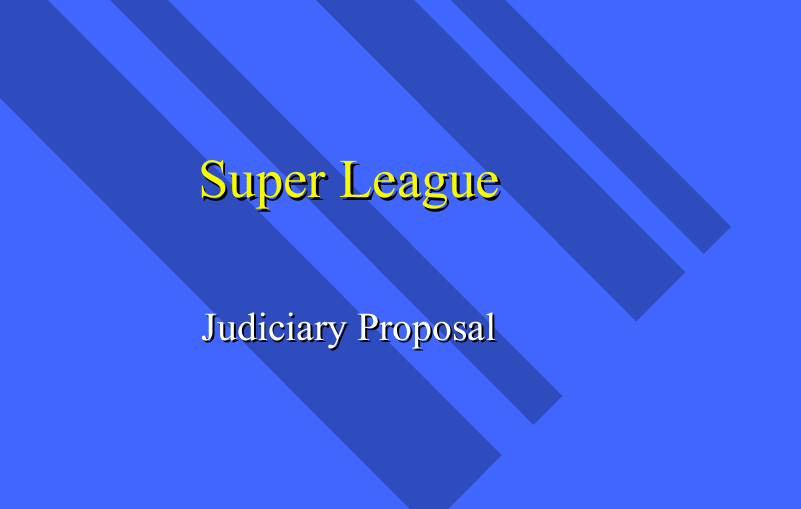
By January 1996, when Roger presented the proposal to Super League, the concept had been distilled into five principal elements:
experts should be used where necessary;
a Head of Judiciary should control the process;
there should be incentives for guilty pleas;
penalties should be predetermined, with the judiciary principally deciding guilt rather than sentence; and
hearings should generally occur only where a player pleaded not guilty.
The objective was not simply tougher or softer penalties.
It was greater consistency.
Design the process, not just the idea
Roger’s November paper went well beyond the broad concept.
It worked through what should happen from the time an incident occurred.
The Head of Judiciary would identify an appropriate charge and notify the player. Where necessary, expert analysis could be obtained. If that evidence exonerated the player, the matter ended. If it supported the charge, the player had another opportunity to plead guilty. If the player continued to maintain innocence, a judiciary hearing followed.
The proposal dealt with who should pay for expert evidence. It considered appeals and appeal fees. It provided for records of previous offences, discounts for guilty pleas and additional penalties in defined circumstances.
Roger even tried to anticipate the objections to what he was proposing.
One obvious objection to predetermined penalties was that no two incidents were exactly alike.
Surely a judiciary panel needed discretion to recognise the difference?
Roger’s answer wasn’t to ignore those differences and he produced the principle that offences a more precisely defined and graded.
A high tackle, for example, might be divided into 20 or more categories, each carrying its own penalty.
He also recognised the potential danger in relying upon expert analysis. If a new system placed greater weight on expert evidence and that evidence was subsequently shown to be wrong, confidence in the entire system could be damaged.
One proposed safeguard was a second expert opinion in controversial cases.
Even the media were considered part of the process.
Journalists and editors should have access to the schedules of offences, penalties, discounts and additions. Expert reports should be available and journalists invited to see the video evidence supporting them.
Public understanding wasn’t something to worry about after a decision had been made.
It was part of the system.
From weeks to points
Perhaps one of the most interesting ideas appears under the rather modest heading “Future Considerations.”
Roger had identified another problem.
If suspensions were expressed only in whole weeks, a carefully graded series of offences could still end up producing the same penalty. Several different levels of seriousness might all result in a one-week suspension.
So he considered a points system.
One hundred points could represent a one-week suspension. A penalty of 275 points could produce an immediate two-week suspension, with 75 points carried forward. Discounts and additions could also be expressed as points.
It allowed much finer distinctions between offences and circumstances.
The significance for this story is not simply the points themselves.
The working paper captures Roger’s thought process while it was happening:
If we solve this problem, what new problem might our solution create? And how might we solve that?
Not entirely Roger’s system
The proposal did not simply emerge from Roger’s office and become the Super League judiciary unchanged.
Roger himself was quite clear about that.
Many people became involved in developing the final system and compromises were made. His original submission was not adopted in its entirety, although he believed most of its principles survived.
That distinction becomes particularly important when the story reaches 1998.
By then Super League and the Australian Rugby League had come together in the new National Rugby League, and a decision had to be made about which judiciary system the unified competition would use.
The two systems were fundamentally different.
Roger attended meetings between representatives of the ARL and Super League attempting to reach agreement. According to his later account, those meetings achieved little and the question was eventually referred to the chief executives of the 20 clubs.
They heard submissions supporting both alternatives.
The result, Roger recorded, was 18 votes to two in favour of the Super League system — including support from 10 of the 12 former ARL clubs.
It appeared that the argument had been won.
Roger soon became convinced that something very different had happened.
The system meets the real world
By June 1998, the new NRL judiciary was attracting considerable public criticism.
This was the first season of the unified competition and the clubs had overwhelmingly chosen the Super League judiciary model. Yet some early decisions were already raising questions about whether the system being implemented was actually operating according to the principles the clubs had endorsed.
Two cases involving prominent players became particularly contentious.
Glenn Lazarus, playing for the Melbourne Storm on the eve of a State of Origin match, had received 130 points for a high tackle. With 100 points producing an automatic one-match suspension, the penalty would have ruled him out of State of Origin. The penalty was reduced to 99 points — allowing Lazarus to play Origin, leaving the 99 points to be carried forward.
Geoff Toovey’s circumstances were different. Due to his past judicial recorded any offences attracted a loading on a standard penalty. He — again enough for an automatic one-match suspension. Toovey’s points were reduced back to 75 Concerned that suspending a prominent and respected captain for such a minor offence would appear unreasonable, the authorities reduced his points to 75.2
Whatever the merits of either decision, both exposed a problem at the heart of a system intended to produce consistency.
If Lazarus’s circumstances justified reducing 130 points to 99, what would happen when the next player accumulated 130 points but did not have a State of Origin match approaching?
If Toovey’s standing in the game, or the relatively minor nature of the offence that triggered his suspension, justified reducing his accumulated points, would the same consideration be available to a less prominent player?
These were among the controversies being discussed publicly by radio broadcaster Ray Hadley.
Roger had been listening.
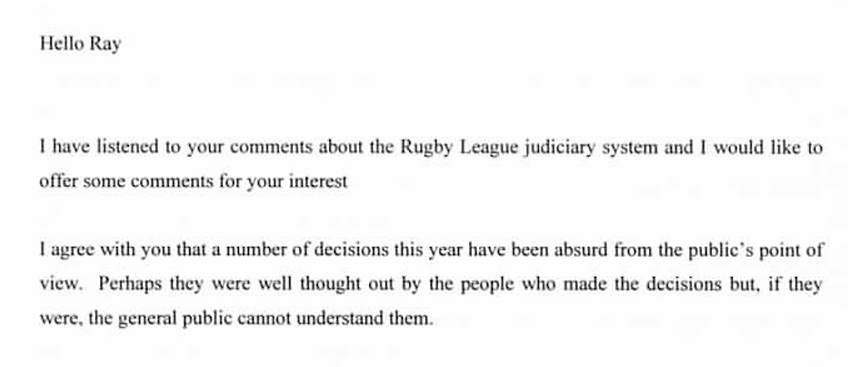
On 15 June 1998, he wrote Hadley a five-page letter. He agreed that a number of decisions during the season appeared “absurd from the public’s point of view”.
But Roger believed the controversy was being blamed on the wrong thing.
The problem, as he saw it, was not that the principles developed for the Super League judiciary had failed. It was that the NRL judiciary had departed from what he regarded as the most fundamental of those principles.
The difference came down to a deceptively simple question:
Who was responsible for consistency?
Under the old system, that responsibility rested substantially with the judiciary panel. Change the people and the interpretation — and potentially the outcomes — could change with them.
The Super League philosophy put much greater responsibility upon the administrators of the game.
The judiciary determined guilt. The rules and schedules provided consistency in penalty.
Those rules could be changed.
But when they changed, they changed for everyone.
Learn from the bad decision
This is where the Hadley letter perhaps reveals more about Roger’s thinking than the original proposal.
He did not suggest that his system would prevent every bad or controversial outcome.
Quite the opposite:
“No judiciary system will ever be perfect.”
What mattered was what happened when an imperfection became apparent.
A good system, he wrote, should produce greater consistency and generate its own improvements.
If a particular case exposed an unfair penalty, the administrators could change the schedule.
The next player committing the same or a closely comparable offence would then receive the new penalty.
The lesson from the controversial decision had been captured by the system.
That was fundamentally different from allowing a panel to produce a different result next time simply because its members regarded the circumstances differently.
The first approach changed the rule for everyone.
The second changed the decision for one person.
Lazarus, Toovey — and the next player
Roger’s response to the Lazarus and Toovey controversies was revealing.
He was not necessarily arguing that the concessions made to either player were wrong.
His concern was what happened the next time.
If there was a legitimate reason why Lazarus’s 130-point penalty should be reduced to 99, that reason should be identified and incorporated into the rules. Every future player satisfying the same conditions should then receive the same treatment.
The same principle applied to Toovey. If there was a legitimate reason why his circumstances warranted reducing the points that would otherwise have resulted in suspension, define that circumstance and make the concession available to every player who subsequently qualified for it.
The individual decision therefore became evidence.
If it revealed something wrong with the existing rules, fix the rules.
If it revealed a legitimate circumstance that had not previously been anticipated, incorporate that circumstance into the rules.
Either way, the system became better.
But not a system without judgement
Roger was not arguing for a completely mechanical judiciary.
His letter makes that clear.
Under the Super League system, the judiciary retained discretion to alter a penalty where it considered the circumstances of a particular case genuinely unusual. As far as Roger knew, that discretion had not been used during the Super League season.
The distinction is important.
His objective was not to eliminate judgement.
It was to prevent routine decisions from depending unnecessarily upon individual judgement — while retaining discretion for the genuinely exceptional case.
Consistency was the default.
Departure from it needed a reason.
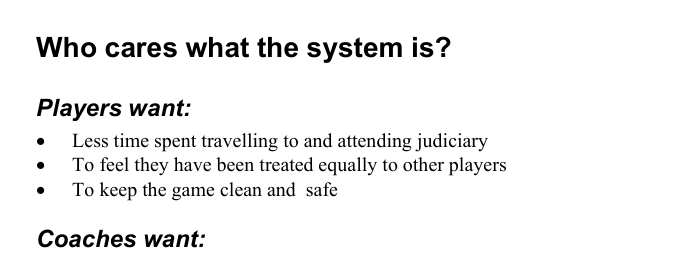
Who cares what the system is?
Another surviving set of Roger’s notes from 1998 approaches the same issue from a different direction.
At the top of the page he posed a simple question:
Players cared. They wanted less time spent travelling to and attending hearings, equal treatment and a safer game.
Coaches cared. Judiciary appearances interfered with training; they wanted their players treated fairly and protected from dangerous play.
Chief executives cared about the time consumed by judiciary matters and the treatment of their players.
Financial managers cared about the cost of solicitors, witnesses and travel.
Supporters wanted confidence that their team was being treated equally. They also wanted the game’s best players playing rather than injured or suspended.
And the media?
Roger’s assessment was characteristically dry:
“As many opportunities as possible to create controversy.”
There is humour in the line, but the exercise itself is revealing.
Before judging whether a system was working, Roger was asking what the different people affected by it actually required from it.
Don’t fix the decision. Fix the system.
The surviving judiciary papers stretch from the original Super League proposal in November 1995, through its presentation and development in 1996, to Roger’s defence of its underlying principles in 1998.
Together they provide something more interesting than a claim about who devised rugby league’s judiciary.
They provide a small window into how Roger Cowan approached a problem.
Start by defining what you are trying to achieve.
Identify who is affected.
Separate the problem from the personalities involved.
Design a process rather than relying upon good intentions.
Build incentives into that process.
Anticipate objections.
Allow for exceptional circumstances.
And when the system produces an outcome that exposes a weakness, don’t simply correct the outcome.
Learn from it.
Change the system.
Then apply the improvement consistently to everyone who comes next.
It was an approach Roger applied repeatedly during his years at Panthers — to organisational structures, financial controls, strategic planning and football administration.
The judiciary happens to leave behind an unusually clear documentary trail showing that approach at work.
There is also a certain symmetry to the story.
In the early 1970s, Roger tried to suggest there might be a better way to administer rugby league’s judiciary.
He was told to sit down.
More than twenty years later, he was finally invited to develop the idea.
And when the new National Rugby League had to choose between two fundamentally different approaches, 18 of its 20 clubs voted for the system that had grown from that proposal.
For Roger, however, winning that argument was never quite the point.
The system still had to work.
And if it didn’t, the answer was not to abandon the principles behind it.
It was to find out why — and make the system better.
From the Panthers Passion Politics Digital Archives
The surviving documents behind this story provide an unusual opportunity to follow the development of Roger Cowan’s thinking about the rugby league judiciary — from his original proposal, through its presentation to Super League, to his response when he believed the principles behind the system were being compromised.
November 1995 — The Original Judiciary Proposal
Roger Cowan, 24 November 1995
Roger’s original working paper setting out the objectives of a proposed Super League judiciary system, its procedures and safeguards, and the problems it was intended to overcome. The document also includes his early consideration of replacing suspensions expressed solely in weeks with a points-based system.
The presentation prepared from the earlier working paper, distilling the proposal into its principal elements for consideration by Super League. It shows how the more detailed November proposal was developed into a practical model for discussion and implementation.
These working notes approach the judiciary from another direction: who is affected by the system, and what does each group need from it? Roger considers the interests of players, coaches, chief executives, financial managers, supporters, administrators and the media.
Written during controversy surrounding the judiciary in the first NRL season, this five-page letter explains Roger’s concern that the system being implemented had departed from a fundamental principle of the Super League model: consistency should reside principally in the rules and procedures rather than depend upon individual decisions. The letter discusses the Glenn Lazarus and Geoff Toovey cases and explains how Roger believed apparent anomalies should be used to improve the system.
To receive new Parts and occasional project updates by email, you may subscribe below.
Readers who hold recollections, documents, or material relevant to this history are welcome to contribute via the Commentary & Contributions page.
Project Updates
Receive updates when new parts are published.
This was another technique Roger encouraged in the decision-making process throughout Panthers — this took various forms and names depending on the specific circumstance. One was use deBono’s “Six Hat Thinking” where the Black Hat was engaged to argue against the idea. Using the process developed by Mike Basch of Federal Express, there was a section title “Things We Must Overcome” where the challenges were listed and anything that “killed” the diea identified. ↩︎
In Round 1 of the 1998 unified season Brisbane played Manly in Brisbane. Bill Harrigan was the referee. Early in the match Harrigan sent Toovey to the sin-bin for dissent about a decision. In the last 30 seconds of the game John Hopoate was sent of for referee abuse. Wtin seconds Toovey was also sent and the charge was also abuse. ↩︎
In the aftermath of Mulock’s advertisement1, a mythology built around a distorted version of events began to take hold in Penrith. It was strongest perhaps among readers of the Western Weekender, but by word of mouth it spread widely. People came to believe that four of the nine Panthers directors had voted for a merger with Parramatta, even though no such vote had been taken.
I made it clear from the start that there was no way I would ever vote for a merger with Parramatta. But we had to investigate it. We were in trouble; we could have lost our team completely. We had a duty as directors to look at the position and investigate the options and the opportunities.
In 2002, the five directors who had opposed signing the letter placed another full-page ad in the Weekender. Again, it referred to the merger, and the ‘vote’ on it. In part it reads:
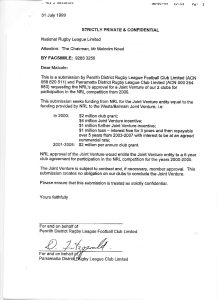
On 31 July 1999 a special board meeting was held at Roger Cowan’s request at which he tabled a written submission by the Penrith and Parramatta clubs to the NRL requesting the NRL’s approval for a joint venture of the two clubs for participation in the NRL competition from 2000.
It notes that the document had been signed by the Parramatta CEO.
The vote taken in July 1999 was not a vote on whether to merge, but on whether to sign and send the letter to the NRL.
The assertion was that the document was a submission for a joint venture between the two clubs — a description that did not accurately reflect what the letter said. The letter sought the NRL’s approval for Penrith and Parramatta to continue discussions about a possible joint venture, while expressly stating that neither club was under any obligation to proceed.
The ad did not mention that the letter clearly spelled out that there was no obligation to merge.
The ad was run as part of the Five’s campaign for the October 2002 election for the Board of Directors2. Cowan says it followed their controversial “Board Wars” front page headline in the newspaper a week earlier.
For Cowan, the advertisement was more than simply an inaccurate account of what had occurred. He saw it as part of a deliberate attempt to portray him and the other three directors as being prepared to sacrifice Penrith’s independence:
By this time, I hadseen plenty of behaviour from these directors that should have prepared me for this, but it still surprised me a bit. Here in print was the evidence that they were prepared to stretch the facts in order to take over the Board of the Club3. If the ticket they ran at that election had been successful, the Board would have contained the so-called Footy Five, and two other affiliatesof Greg Evans.
Ron Mulock ran his own separate ad at the time of that election. What surprised me most was that a well-known local solicitor, a prominent local newspaper owner and businessman, and a high-profile Labor politician – who was also the club patron – would put their name to ads that were obviously designed to mislead the Club’s members and the public. The participation of the other three did not surprise me.
Particularly damaging were some misleading statements in the Footy Five ad.
Readers would be left with the impression that I had signed away the club and that they had saved it. Also untrue was that four directors had voted to merge with Parramatta.
The belief that Roger Cowan signed a document to merge, and that without the actions of these five people and Ron Mulock, there would be a team called the Parramatta Panthers in the competition – remains with many in the Penrith community to this day. A number of long-time Panthers supporters interviewed for this book were definitely under this belief.
Roger Cowan says that the merger saga solidified the anti-football perceptions that he believes started many years earlier.
In the mid-1960s, Penrith won a place in the first division competition, but Cowan was continually frustrated by the football committee’s inability to stay within budget. The tensions between the two administrations eventually contributed to the removal of district club secretary Merv Cartwright4.
As a player I had been quite friendly with Merv and supported him.
Once we were both in administrative positions, we came into conflict. We did not work well together as secretary and treasurer.
He was on the registered club committee when I offered to manage the Club on the three-month trial. He spoke against it. The committee accepted the offer and Cartwright was furious.
After the meeting I went down to help behind the bar and he followed me, abusing me all the way.
“What a hide I had to take on such a role without previous club management experience”, he said. “What would a schoolteacher know about running a club?”
When promotion to first division was raised, I supported it totally. The bad blood that existed between Cartwright and me was never a factor. I was excited by the prospect.
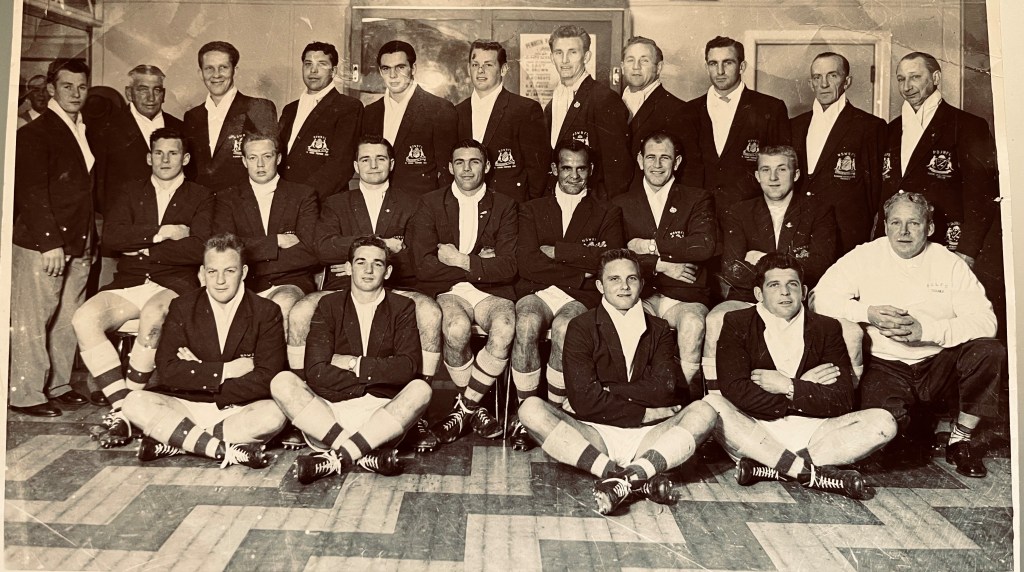
Penrith 1st Grade circa 1959 — Cartwright and Cowan are teammates. (photo courtesy of David Ellks) Back row: Gordon Roberts (2nd from left), Don Ellks (centre), Merv Cartwright (4th from right), Noel ‘Doc’ East (far right). Middle row: Roger Cowan (far left), Leo Trevena (centre) If you can help identify any others please contact admin@pantherspassionpolitics.com
Cowan had realised that promotion to the top level would be made much more difficult while it was struggling financially. He and some of his team were working seven days a week to turn the registered club around.
The rugby league competition was very different in the 60s. It was Sydney-based, most players were employed in other jobs, and it did not require the kind of money it does today to participate. A small club could aspire to do it – provided it was run efficiently. But Penrith was by far the smallest, by every measure — licensed club turnover, profitability, membership, football operations, financial resources and assets. Even Newtown was larger. St George, Norths, Easts, Balmain were all giants in comparison. Cowan realised it was going to be difficult to compete with them in rugby league without significant financial gains.
Up until that time I doubt if anyone could have said that I was anything other than a committed rugby league supporter for Penrith. However, reputations are often built on rumour rather than fact, and I had made a ferocious enemy.
Cartwright was well known in the district and had built his own reputation as a rugby league man through and through. Considering our conflict, it is unlikely that he would have been singing my praises around the junior league and other league circles.
To receive new Parts and occasional project updates by email, you may subscribe below.
Readers who hold recollections, documents, or material relevant to this history are welcome to contribute via the Commentary & Contributions page.
Project Updates
Receive updates when new parts are published.
This refers to the advertisment run in the Western Weekender in 1999. You can read it in full in A Campaign of Letters, a PDF archive of public dispute of late 1999. ↩︎
By this time the Penrith Panthers had already competed in three NRL seasons — the prospect of being excluded no longer existed, there was no danger, no prospect, no thought of mergers. ↩︎
The five directors signing this ad would contend their aim was to protect the Penrith club. ↩︎
Solicitor; Penrith City Councillor and Mayor; Panthers Director; Member of the “Footy Five”
John Bateman was a highly prominent public figure in Penrith during the 1990s and early 2000s. A respected solicitor, local government leader and long-serving councillor, he combined legal expertise with extensive community and political experience. His appointment to the Panthers Board reflected both his professional standing and the growing stature of Panthers as one of Western Sydney’s largest and most influential organisations.
Within Panthers, Passion & Politics, Bateman emerges as one of the principal figures in the governance conflicts that reshaped the organisation during the closing years of Roger Cowan’s administration. Initially appointed to strengthen the Board, he later became one of the leading advocates of an alternative direction for Panthers during the Super League era, the merger debates and the internal disputes that followed.
Role in the Narrative
John Bateman’s involvement in the narrative spans much of the conflict that dominates the latter half of Panthers, Passion & Politics.
Appointed to the Panthers Board in the mid-1990s, he entered the organisation at a time when Panthers had grown from a successful licensed club into one of the largest community organisations in New South Wales. Board membership had become both influential and prestigious, attracting individuals whose professional experience and public standing could contribute to the increasingly complex governance of the organisation
Bateman quickly became an influential director. During the Super League conflict and the subsequent National Rugby League rationalisation process, he emerged as one of the strongest advocates for Panthers pursuing a stand-alone future rather than preparing contingency plans involving merger discussions. He became closely associated with the group of directors later known as the “Footy Five.”
As disagreements between management and sections of the Board intensified, Bateman became one of the central figures in debates surrounding merger negotiations, governance, Board authority and the future direction of Panthers — in particular the governance arrangements associated with Panthers’ club amalgamations. He was a prominent witness in the Temby Inquiry and he categorically denies playing any part in its calling. Bateman in one of the most significant individuals in the later chapters of this story.
Background
Profession: Solicitor
John Bateman established a legal practice in Penrith that became one of the region’s best-known firms. Admitted as a solicitor of the Supreme Court of New South Wales, he built a reputation in both legal practice and community leadership, later becoming a founding partner of Bateman Battersby Lawyers.
Community Leadership:
Bateman’s public life extended well beyond the legal profession. He served for many years as a Penrith City Councillor, Deputy Mayor (1997–98) and Mayor of Penrith (1998–2000), leading the city during preparations for and staging of the Sydney 2000 Olympic Games, when Penrith hosted rowing and canoe/kayak events.
His community involvement also included service with the Nepean Medical Research Foundation, the Penrith Valley Economic Development Corporation, the Joan Sutherland Performing Arts Centre, the Penrith Olympic Torch Relay Committee and numerous sporting and community organisations. He also served on the boards of Panthers, Penrith Rugby Club and the Western Sydney Academy of Sport, reflecting his long-standing commitment to the Penrith region.
Honours: • Australian Sports Medal (2000) • Centenary Medal (2001) • Penrith Citizen of the Year (2008) • Medal of the Order of Australia (OAM) (2018) • Western Sydney University Community Fellow (2019) • Honoured Citizen of the City of Penrith (2022)
Appointment to the Panthers Board of Directors:
By the mid-1990s Panthers had become the largest licensed club in New South Wales, one of the largest employers in Western Sydney and one of the region’s most influential organisations. An appointment to the Panthers Board had become one of the most prestigious voluntary positions in the Penrith region, reflecting the organisation’s extraordinary growth and influence.
Bateman was appointed to fill a casual vacancy on the Panthers Board rather than being elected by members. Board appointments increasingly reflected the need for professional expertise alongside traditional community representation. His appointment reflected the confidence directors placed in his legal expertise, political experience and public profile. He also had longstanding interests in sport and established relationships with several existing directors.
Bateman therefore arrived at Panthers not as an unknown community volunteer, but as one of the region’s best-known civic and professional leaders. The Board regarded his appointment as strengthening its capacity to deal with the increasingly complex strategic challenges confronting Panthers.
John Bateman was appointed because he was exactly the sort of director Panthers needed — and the appointment was exactly the sort of position Bateman desired.
Relevance to Events Described
John Bateman’s importance to Panthers, Passion & Politics lies not simply in the positions he held, but in the influence he exercised during one of the most turbulent periods in the club’s history.
During the Super League conflict he became a leading advocate for the view that Panthers should focus on remaining an independent club rather than pursue merger negotiations with another organisation. Although management regarded merger discussions as prudent contingency planning in response to an uncertain future, Bateman believed that even a non-binding declaration of intent could ultimately place Panthers on a path towards losing its independence.
His position reflected a fundamentally different assessment of the risks facing the club.
As the governance conflict deepened, Bateman became one of the most influential members of the group that became known as the “Footy Five.” Together they challenged aspects of the existing governance structure and increasingly opposed Roger Cowan’s leadership on several major issues.
Roger Cowan initially regarded Bateman as a valuable addition to the Board. Over time, however, their relationship deteriorated as their views on governance, strategic planning and the future direction of Panthers diverged. In later reflections Cowan came to believe that Bateman’s growing public profile and political ambitions influenced some of his decisions within Panthers. That interpretation forms part of Cowan’s perspective presented throughout this work rather than an established historical fact.
Bateman was also a key player in disputes centred on the governance of clubs amalgamating with Panthers and the subsequent Temby Inquiry making him one of the most consequential participants in the latter stages of the narrative.
Legacy
John Bateman’s contribution to Penrith extends beyond his involvement with Panthers. As a solicitor, councillor and Mayor, he played an important role in the civic development of the city and was widely recognised for his commitment to the local community.
Within Panthers, however, his legacy is inseparable from one of the organisation’s most divisive periods.
Some sections of the Penrith community regarded him as an independent director prepared to challenge existing leadership and defend the club’s independence during an uncertain period for rugby league. Others saw him as one of the principal figures behind governance disputes that consumed the organisation during the closing years of Roger Cowan’s administration.
Whatever view readers ultimately take, John Bateman’s influence on the events described in Panthers, Passion & Politics was substantial. His decisions, alliances and leadership helped shape the governance conflicts that defined a critical chapter in Panthers’ history.
Sources used to prepare this profile: Advocacy Australia Website; Bateman Battersby Website;
With only days remaining before the deadline for NRL amalgamations, the club appeared destined to miss the cut for the new fourteen-team competition. Then, unexpectedly, a possible lifeline arrived.
It required nothing more than the signing of a non-binding letter.
The Board rejected it.
Through the first half of 1999, Penrith continued to sit at number fifteen in the NRL criteria. The deadline for amalgamations was midnight on 31 July.1
Commentators had labelled a merger between Parramatta and Penrith was a ‘done deal’. Community concern was mounting. Two Panthers directors with ambitions in local politics, John Bateman and Greg Evans, were sitting between a rock and a hard place.2
Late in July, Cowan received a call from rugby league headquarters concerning the deadline.
Penrith was still highly regarded in the Super League circles,3and they were trying to do anything possible to assist us. It was obvious to everyone that we were in dire trouble. We sat solidly at number fifteen, and that didn’t look like changing. Nobody knew what was happening at Norths.
The call suggested that we could at least maintain a fallback position if we were prepared to sign a letter saying that we were still considering a merger with Parramatta and requesting more time. The letter would very clearly state that it was not to be taken as any commitment to a merger. It would be a non-binding document, aimed solely at keeping our options alive.
In his evidence to the Inquiry, John Bateman spoke of the events of July 1999. He said that when Cowan presented this offer to the board on 31 July, the Board resolved not to sign the letter. Bateman also spoke of his frustration concerning a paper that Cowan presented to the Board on 20 July, with the latest information on joint ventures.
Bateman said:
In the previous September we had resolved to stand alone. That was our view, and then Roger tabled this paper giving us more information and basically telling us that we were in a risky position standing alone.
From a corporate governance perspective, directors are expected to receive and consider information that may materially affect the organisation. Why, then, would the presentation of updated information about such an important issue become a source of frustration? A CEO who withheld such vital information would be guilty of poor corporate governance.4
On 31 July Cowan called a special meeting to advise the Board that there had been an offer that would overcome the need to comply with the 31 July deadline. Panthers would simply need to sign a non-binding letter addressed to NRL Chairman, Malcolm Noad. Cowan suggested to the Board that there was nothing to lose by signing it.
The document at the centre of the 31 July 1999 special Board meeting. Click image to read.
Bateman was not the only one who was angered by the presentation of the non-binding letter. The ex-wife of Greg Evans remembers how very stressed her husband was before leaving for that 31 July meeting.
Why these two directors reacted angrily to a non-binding proposal that would keep the Club’s options open remains a deep mystery. Cowan developed an interesting theory about it, which seems to be borne out by some seemingly unrelated events of the 1990s.
He came to believe that the concern could not have had anything to do with merging because it was a non-binding letter and the Footy Five had the numbers to prevent any merger any time they liked. He started to wonder if the problem was just the publicity.5
Greg Evans shed some unexpected light on the events of July 1999. He was adamant that none of the Five had believed that the document was actually non-binding.
I really believed that signing that letter was signing to merge with Parramatta. So did the others.
I believe if it walks like a duck, and quacks like a duck, then that’s what it is. It might have said non-binding, but once we signed it, we were going to merge. The NRL were putting enormous pressure on everyone, standing over teams, trying to force amalgamations. It was very bad PR for teams to die completely, so it was in their interest to push.
There was debate and discussion that night, but when the letter was discussed by the entire board, the fact that it was non-binding did not come into the discussion. Every member of that board believed it was an agreement to amalgamate.
Another of the Five, Geoff James, agreed with Evans, saying his view was ‘dead right’.
It might seem difficult for some readers to believe that anyone could misread such a letter. It was a simple one-page document. There it is on the opposite page! Leo Armstrong, Barry Walsh, Keith Rhind and Terry Heidtmann had no doubt that it really was a non-binding agreement.
The committee had representation from local councils, and from local community organizations and businesses, as well as people from Panthers management and Board. The purpose of the committee was to devise strategies that would convince the league decision makers that they could not drop Penrith.
The other three members of the Footy Five group were asked in writing if they agreed with Greg Evans’ view. Dennis Coffey did not respond.
Craig Terry says he had a different perspective on the incident. The document said non-binding, he recalls.
But my view was that signing that document would signal that we were prepared to reopen the issue
It was an important document, and we had no legal advice to say what it actually meant. It did say ‘non-binding’, but what it said was not the main issue. We had made policy determinations that said ‘no’.
Later John Bateman wrote that whilst the document was non-binding, he felt that signing it would bring about a merger. Cowan says it would be easy to jump to conclusion about Evans and James when they claimed that the document was a binding agreement, but he believes it is possible they actually believed what they were saying.
If Evans and James genuinely believed the document committed Panthers to a merger, then an obvious question follows. How could intelligent and experienced people read a document that repeatedly described itself as “non-binding” and nevertheless conclude it required a merger?
The contradiction is difficult to ignore. The letter before the Board imposed no immediate legal obligation and expressly preserved Panthers’ ability to make future decisions. Yet some directors clearly believed it represented something much more significant.
Before considering one possible explanation for this apparent contradiction, it is worth pausing to appreciate just how differently the same document was being interpreted.
Cowan suggests an explanation comes from the author Joel Barker whose book The Business of Paradigms, explains that people interpret information through mental frameworks — beliefs and patterns of thinking. These mental frameworks, or paradigms, cause people to fail to see evidence that goes against their beliefs.
Barker says that even experienced scientists sometimes fail to see clear evidence, although it might be right before their eyes, if it is in conflict with what they expected to see, or what they believed.6
According to Cowan if directors came to that special meeting with the firm belief that they were being asked to vote on merging with Parramatta they could have been “trapped by their own paradigms”.
My argument that it was non-binding and that we had nothing to lose would have fallen on deaf ears.
From the Footy Five point of view, a decision not to sign may have had certain advantages, no matter what different reasons each of them had for not signing. Perhaps it was just plain old-fashioned good luck — make a silly mistake and it comes back to reward you.
Had they analysed the situation and concluded there was nothing to lose except some unwanted media speculation, it would have been difficult to justify not signing it. As directors they had a duty to do what was best for the business, and what rational argument could there be against keeping all the options open for as long as possible?
To receive new Parts and occasional project updates by email, you may subscribe below.
Readers who hold recollections, documents, or material relevant to this history are welcome to contribute via the Commentary & Contributions page.
Project Updates
Receive updates when new parts are published.
Only the top 14 ranked teams were to be included, amalgamated entities were guaranteed a spot – so this deadline had great relevance for Penrith. ↩︎
Roger Cowan believed the political ambitions of both John Bateman and Greg Evans may have influenced the way they approached issues surrounding the merger debate. His reasoning is explored further in the accompanying Removed Section — Political Ambition. ↩︎
Although Roger refers to “Super League circles”, he is really referring to senior figures associated with News Limited and the Super League organisation. ↩︎
The Australian Institute of Company Directors identifies keeping directors informed of matters that may materially affect the organisation as one of the CEO’s fundamental governance responsibilities. ↩︎
Roger Cowan eventually developed an alternative explanation for why this apparently harmless document generated such strong opposition. It is explored in the accompanying Removed Section — Political Ambition. ↩︎
“Paradigms” was a subject often covered in training sessions at Panthers thoughout the 1990s. One of the videos consistently used is available on YouTube was Joel Barker’s Discovering the Future: The Business of Paradigms. It runs for about 40 minutes and shows how easy it is for thinking patterns to create perceptions that don’t match the evidence. ↩︎
The information night on 7th September 1998 was intended to provide clarity. Instead it intensified the debate. Media coverage and public reaction quickly hardened positions and narrowed the club’s options even further.
A front-page account of the meeting in The Western Weekender opens with a blatantly false statement:
In a historic announcement, the Panthers board of directors told the rugby league world that the mighty Penrith Panthers were to compete in the National Rugby League competition as an elite and single identity.
The article quotes Cowan as saying that ‘the stand-alone option was always the preference of senior management and the Board’.
Inside the paper in a double page spread, Mick Kelly lets rhetoric run riot. He quotes Mulock, the club patron — and its saviour, according to Kelly — as saying that Cowan and Levy’s efforts ‘have been skewed towards a merger with Parramatta’.
Editor’s Note: The way the meeting was subsequently presented in the local media is examined further in Following the Merger Debate, which reproduces the principal newspaper coverage from the period together with historical commentary.
Looking back, Cowan still found the events of that period difficult to understand. Why was Mulock so attached to arguments that were not reflecting the truth? Either he was being misinformed or his passion for Panthers was clouding his judgement.
After the public meeting and the subsequent newspaper coverage, feeling in the community was galvanised.
At the next board meeting, a resolution was passed that the club ‘cease all joint negotiations and stand-alone’. The Board also resolved to form a committee to promote the stand-alone position.
In Cowan’s eyes, this was a totally blinkered attitude. If there was to be a committee, its focus should have been to make sure Panthers was represented in the competition. Forming a committee with the sole purpose of supporting and propagating this one idea was ridiculous. It did not acknowledge the great danger that Panthers could be dropped from the competition.
The feeling at the time echoed the sentiments expressed by John Bateman in a Western Weekender front page story of 24 July:
Panthers brings too many aces to the table to be considered a weak link in the NRL competition.
He used the ‘largest junior league in the world’ as a reason why the club was safe from relegation, but, as we know, the junior league component was never a factor. Roger Cowan explained the NRL’s rationale for this.
The size of the junior league at any club is an asset to the entire league, whether it is centred around the Penrith club, or Parramatta, or any other club. If it is divided amongst a whole lot of other clubs, it evens out the distribution of junior talent. In other words, it would have been an advantage to the other clubs chosen for the competition for Penrith not to have ownership of its junior league. All that young talent would have been there for the taking.
We tried, very early in the process of setting criteria, to have junior league strengths given some recognition. There was no support for that proposition. Most clubs have believed that Penrith and Parramatta had an unfair advantage by having such large areas of juniors. They would hardly support something they saw as unfair being given an advantage under the criteria.’
Bateman and the other directors admit to being bombarded with information and reports from management during this period, so it is difficult to understand him making comments indicating the NRL would not dare discard the Panthers. Cowan says it was very frustrating to read this kind of statement, especially from someone like Bateman, who had been given all the facts.
Once the ‘Stand Alone’ Committee was formed,1 Cowan says he was absolutely appalled to hear Bateman, Mulock and other leading citizens of Penrith parroting the South Sydney line — that the NRL ‘would never drop us’.
The committee had representation from local councils, and from local community organizations and businesses, as well as people from Panthers management and Board. The purpose of the committee was to devise strategies that would convince the league decision makers that they could not drop Penrith.
Souths were using the same strategy – make lots of noise, build emotion, get the people marching in the streets – and it failed them miserably. Souths had far more emotion and tradition on their side than Penrith, being one of the foundation clubs in 1908 and having an outstandingly successful record. They also had the support of some very high profile people, yet they were dropped. Even though they were eventually reinstated, the loss of a year’s competition was damaging. Ultimately the courts supported the NRL’s right to drop them from the competition. Souths is only there because News Limited softened its stance, just for Souths. Without that, Souths would have been gone forever.
But in 1998, the powers that be at Souths had chosen to ignore the determination of News Limited to have a fourteen-team competition. Panthers was doing the same. News Limited had already conceded its original position of 12 teams, and agreed on 14, but Cowan could see that they would not go to 16.
Despite his reservations, Cowan agreed to join the committee. Ron Mulock was also on it, as were Leo Armstrong and Terry Heidtmann. Former Panthers operations manager Tony Lackey attended the meetings, which he says were held every second Friday. ‘They were always bad, there was lots of conflict. It got very uncomfortable.’2
Cowan found the situation very difficult. To him, it was a counterproductive exercise.
At every meeting he [Mulock] was repeating word for word things that I had said in the boardroom a week earlier. Worse, he was using things I had said in those board meetings out of context.
In the committee meetings I continued to push the fact that the agreement between NRL and ARL was written in stone. We would not be in the competition unless we could take our place in that fourteen under the criteria. There was never any doubt of that in my mind.
David Gallop confirms that the NRL was serious about its selection procedure.
There’s no doubt that the criteria process was a genuine exercise. And even though Souths was readmitted, the High Court ultimately found that we had behaved legally in eliminating them in the first place.
And Penrith were down the bottom, if you like, in terms of the way they were running under the criteria, so there’s no doubt they were in trouble. They were facing a serious threat of being excluded from the 14-team competition.
By now, independent voices from very different perspectives were reaching much the same conclusion: Penrith had been in genuine danger of exclusion.
Journalist Roy Masters believes Penrith went perilously close to being eliminated. He adds that the Board’s stand-alone resolution had effectively closed any doors that might save the team.
In fact, if it hadn’t rained non-stop in Gosford in 1999, there would be no Penrith team today. My view is that Roger had an obligation as chief executive to put it to his board as an option, and he would have been culpable if he had not.
Soon after Super League and the ARL had agreed on the new 14 team competition, it became clear that thirteen teams were pretty much secure in their positions in the new competition. Through 1998, Penrith continued to monitor the statistics week by week, and nothing changed. They were still sitting at number sixteen. The two teams ahead of them were Adelaide and North Sydney.3
On 1 December 1998, News Limited and the NRL announced they were pulling their financial support for the Adelaide Rams. From Cowan’s perspective, the announcement brought both encouragement and disappointment. It moved Penrith into fifteenth position. But it also sent a message that decision would be made regardless of political noise. The South Australian premier and the CEO of News Limited in Adelaide appealed for Adelaide to stay in the competition. They were supported by leading businesspeople. It made no difference. In relation to the criteria, however, Penrith was still well behind North Sydney, as Cowan explains —
During the year leading up to the ARL/Super League merger, North Sydney had negotiated relocation to Gosford. Their ground and facilities at North Sydney were out of date. The demographics of their area had changed dramatically, greatly diminishing their supporter base. On top of this, the Central Coast of NSW is a very strong rugby league area and had been crying out for its own team for years.
I watched this strategy evolve with a sinking feeling. The relocation was a disaster for Penrith. The state and federal governments had combined to provide grants of $20 million to build a modern stadium at Gosford. Norths had made a brilliant move. Their claim to a place in the competition now seemed to be considerably strengthened. Panthers had no hope of leap- frogging them under those circumstances.
If we could have read the future, we could have all relaxed and there would have been no conflict. Our crystal ball was not that good, and I suspect that Norths’ crystal ball was not giving them much more at that stage.
The damage suffered by Norths weakened it position, and by the end of the year, Penrith might have been slightly ahead. However, the influence of the new ground at Gosford was an unknown factor. For Norths, it went deeper than points on the criteria. But as far as the world knew, in mid-1999, Norths was in an unassailable position.
By July that year, Panthers had no strategy in place other than to demand selection based on arguments that had already been discredited. The Footy Five, with their numbers on the Board, and supported publicly by Ron Mulock, had moved to gag all discussion. There was an orchestrated campaign to make sure that Panthers could not even discuss contingencies at board level. It is difficult to understand their actions. It can never be in a company’s best interests for a board to suppress discussion of a threat that could have enormous repercussions for the business.
Cowan feels angry looking back at that period and remembers how bad the outcome might have been.
Had Norths survived, both Souths and Penrith would have been eliminated. Penrith would have had no bargaining power, and we would have been forced into a takeover by Parramatta or a year fighting alongside Souths for reinstatement. Having two clubs fighting for re-instatement would have probably hardened the resolve of the NRL to let the courts decide. Otherwise, it would have been signalling that the whole strategy of using criteria to reduce the number of teams was just a farce. The court, which ruled for the NRL against Souths, would inevitably have ruled the same way with Penrith.
Through all this, there were the thousands of members who had no idea of what was going on behind the scenes. I wonder how they would have felt when they suddenly found that they had no team playing in the top competition?
By the middle of 1999, the position appeared bleak. The contingency planning had ceased, discussions with Parramatta had ended, and the Board had committed itself to a stand-alone strategy. Having exhausted every practical option available to it, Panthers could do little more than wait for the NRL’s decision.
To receive new Parts and occasional project updates by email, you may subscribe below.
Readers who hold recollections, documents, or material relevant to this history are welcome to contribute via the Commentary & Contributions page.
Project Updates
Receive updates when new parts are published.
Well before this Stand-Alone Committee was formed the Panthers Marketing Team had started work on boosting those categories in the Criteria where Panthers was struggling — home game attendances, gate revenues and sponsorship income. Concept had already been planned, budgeted and were already active. The Our City, Our Team campaign was financed secretly by Panthers as it needed to be a grass roots campaign demonstrating the support of the community for the Club — neither the Board nor the Stand Alone Committee were made aware of this. ↩︎
Other members of the committee were Tony Ferguson (who chaired the meetings), Phil Morehead (from Panthers advertising agency), Max Cowan (Panthers Marketing Team). ↩︎
Two weeks later, Penrith Council joined the fight. A resolution was passed at a council meeting to send a letter to Panthers urging them to stand alone. Several councillors spoke in support of the motion, emphasising both the importance of the football team to Penrith’s identity and the economic value it brought to the city. One councillor suggested that the council ‘should let the NRL know where we are and urge Panthers to stand firm’.1
Council’s stance created a whole new dynamic. Two Panthers directors had council links. One, John Bateman, was already on council and it was common knowledge that he had his eye on the mayoral seat for the following year. His ally, Greg Evans had been a councillor in the early 90s, and was campaigning to be re-elected in the next council election.
Throughout most of the Penrith community, the issue sparked passion and emotion, and massive amounts of rhetoric, but there seemed to be little understanding or acceptance of the reality of the situation.
Ron Mulock, a former deputy premier of NSW and Penrith mayor, had been the club patron since its early days. He passionately opposed even the thought of a merger with any other team. He is quoted many times as saying he ‘would rather die on his sword’, than merge.
Through the club’s early days, Cowan had enjoyed a friendly relationship with Mulock. They were joint architects of the project to establish Penrith’s Police Citizens Boys’ Club as a joint venture between the council and the club. It was the first boys’ club of its kind in Australia to be built without the need for public fund-raising.
Board chairman Barry Walsh had also been a longtime friend of Mulock. When the Parramatta merger became an issue, this all changed. Walsh speaks of a day when Mulock arrived at his house, very upset and behaving in a rude and aggressive manner. It was a side to his character that Walsh had not seen. It was also a shock to Walsh’s wife who had always been a staunch Mulock supporter.
Walsh tried to explain the situation to Mulock. He understood the patron’s concerns, and wanted to reassure him. He suggested that if he would attend a board meeting, he would see for himself that the directors had no intention whatsoever of approving a merger. Mulock refused the invitation.
The Board decided to hold a public meeting to inform the members – and the team’s fans and supporters exactly what was going on. Its purpose was not to seek a decision, but to explain the situation facing the club and answer questions from members and supporters.
Cowan was to address the meeting held on 7 September 1998, but was quite unprepared for what happened.
I was aware of the controversy out in the community. We had just come through the whole Super League saga and people were very emotional about any possibility of merging with another club. But there was so much misinformation flying around. The board had agreed that our members and supporters should be given a factual analysis of the situation.
I decided to test my address on about eight of our managers. I was going to speak from notes to make sure that the message would not change on the night, no matter what. I asked them to look for any possible bias in what I was saying. I wanted to present both sides of the problem. They needed to understand that it was essential to fully investigate the situation.
If we decided to remain as a stand alone club there was, at that time, a very strong chance we would have no team in the NRL competition. If we decided to merge with another club, there would be a different set of negative results. They needed to have the full story.
I made a few changes on the advice of the management team, but we were confident that the message was objective and honest.
Rather than reducing uncertainty, the meeting fundamentally changed the course of the debate.
Cowan has described the meeting as an ambush. He says he and the board executive were completely caught by surprise. After Cowan addressed the meeting, Ron Mulock took the podium. Cowan says it was a moment he will never forget.
He was shouting and ranting about lies and corruption and saying all sorts of crazy stuff, and it seemed to be mostly aimed at me. He attacked four members of the board, carrying on that they had 80 years experience between them. He was even adding up their ages. The tirade went on and on. He made the “rather die on my sword” comment, and told the meeting that the league would never drop Penrith from the competition. Souths used the same questionable rationale and were dropped from the competition a few months later.
This was a public forum, and Cowan says he could not believe Mulock’s extraordinary behavior.
Later, I wondered about the reasons for the personal attacks. He was speaking as if he had come prepared for a debate, and it sounded as if he believed that I would be advocating a merger, and that I would be supported by some directors. If this really was the case, he had been badly misled.
This wasthe most troubling aspect of the whole thing. The Board had voted unanimously against any merger, but he was acting as if he had been told something very different.
His behaviour on that night was just another piece of a jigsaw puzzle.
There was another strange aspect to this forum.
John Bateman, responding to written questions sent in late 2006, said that the decision by members at the 7 September meeting was the reason he had continued his ‘stand alone’ stance.2
But this was not a proper members’ meeting.
A meeting of members for the purpose of making decisions would have required notices being mailed to all members three weeks in advance. This was nothing more than an information forum. Non-members were allowed to attend. Less than 350 people attended. There was no vote taken.
At the meeting the Five took the opportunity to declare their determination to stand alone despite a few weeks earlier having agreed to look at all options.
The following night’s board meeting virtually ensured there would be no further discussion on the subject. The continuing rationale for such a closed stance was that the members had spoken and that was what the members wanted. The fact is that many thousands of members would not even have been aware the meeting was held. The Board had taken no measure of members’ views. .
To receive new Parts and occasional project updates by email, you may subscribe below.
Readers who hold recollections, documents, or material relevant to this history are welcome to contribute via the Commentary & Contributions page.
Project Updates
Receive updates when new parts are published.
The position adopted by the Council was very interesting. Since at least 1994, research had been regularly done and the exposure and value the Penrith Rugby League team brought to the local community was an integral part of that research. Yet until this point the Council had failed to acknowledge that value in any way. In fact, it often seemed that certain councillors and council officers resented the thought that it was Panthers bringing Penrith growing visibility. ↩︎
This belief was express in correspondence from John Bateman to Jennie Bentley dated 7th Januray 2007. On tis issue Bateman says: … it was my view that the members “had spoken” on 7 September 1998 and I was happy to uphold their direction to the board to “stand alone”. ↩︎
Considering the possible contingency responses was one thing. Recommending a course of action to the Board was another. By early 1998 management believed it could no longer treat the issue as a theoretical exercise.
By early 1998, Cowan says he and Levy had reached an unavoidable conclusion.
We came to the conclusion – we just have to do something, otherwise Panthers is going to disappear off the face of the earth as far as rugby league is concerned
We were in a weak bargaining position because it was quite obvious that we could not make it under the criteria. If we started negotiations early enough, we could use the strength of the Panther brand and our junior league to reinforce our position. Waiting until we missed selection would leave us nothing more than a takeover target. If we had to merge it should be as an equal partner. Then, at least, half of our games would still be played in Penrith and the Panther brand would continue to strengthen.
Together they prepared their first formal recommendation to the Board—that Panthers should at least begin exploring the possibility of a merger with Parramatta.
Every chief executive has a duty to advise the Board of risks that may threaten the organisation’s future. Failing to do so would represent a serious dereliction of responsibility. Equally important is the obligation to identify available options and make appropriate recommendations. If Panthers genuinely faced exclusion from the national competition, management had a duty to ensure the Board understood both the risks and the possible responses.
Management’s recommendation was not that Panthers should merge with another club. Rather, it was that the Board should investigate every realistic contingency before circumstances removed those choices. If the club’s worst fears were realised, directors would then be able to make an informed decision from a position of preparation rather than desperation.
Between 1995 and1999, the structure of the Panthers board changed dramatically. John Bateman, who had been elected to Penrith Council in 1995, was appointed to a board vacancy in the same year. He had worked well in what had been a strong and cohesive board. But between 1997 and 1999, three seats became available on the Board. They were filled by Craig Terry, Greg Evans and Dennis Coffey, some of whom had social and business ties with Bateman.
Cowan began to feel a change in the attitude of long-term director Geoff James who seemed to be developing a close alliance with the other four. Before long, the removal of long-serving Chairman Leo Armstrong would point to the existence of a faction for the first time in the Panthers history. In answer to a question in 2007, John Bateman insisted that there never was a faction, except in his final year on the Board, 2002.
Despite the changed board dynamics at Penrith, both Penrith and Parramatta were willing to discuss all options in the early stages of negotiations. Neither board really wanted to amalgamate, as Cowan explains,
Had there been a vote at Parramatta the outcome may have been a small minority in favour. We know what the vote at Penrith would have been and there is absolutely no doubt about it – nine directors against amalgamation and none in favour. That never, ever changed.
So, if that was the case, what was the point of discussing it at all? And why was there a softer attitude towards amalgamation at Parramatta than there was at Penrith? Probably, the main reason was that for Parramatta, it was never a life and death decision.
For us, it was. All the facts that Mark and I had presented to the board showed that we were in critical danger of not being in the competition. We were way behind in the criteria stakes and the teams would be only selected on the basis of criteria points. Confronted by such evidence, it would have been totally irresponsible for a board to sit back and do nothing. All the directors were prepared to look at options, but not one of them would have voted in favour.
Mark and I believed we had a responsibility to make sure the board was fully informed about the risks. We could keep putting off any decision until the last possible moment but if we had nothing planned by the time the axe started to fall it would be too late.
There was some strong logic behind the Penrith directors’ total opposition to amalgamation. Parramatta was in a much stronger negotiating position and some felt that it would be more of a takeover than an amalgamation.
My discussions with Denis Fitzgerald were never in that vein, however. In fact, our discussions were only ever about how we could set up a new club with equal ownership that would be the strongest club in the competition. If we were to be simply taken over, the option of buying naming rights would be a better commercial decision because it would leave open the possibility of fighting for reinstatement through the courts
So, all nine Panthers directors were adamantly opposed to any such idea, but they generally agreed that there could be no harm in opening discussions with Parramatta.
Significantly, there were no objections, even from the five directors who would eventually claim recognition as the ‘Footy Five’. A couple of joint board meetings of the two clubs were held around August that year. The first was hosted in the Panthers boardroom over dinner. Everything went reasonably smoothly, and it was decided that Parramatta would host the next meeting.
It was clear at these meetings that neither directors nor managers from either club were over the moon about the prospect of amalgamating. At that stage, both clubs were still prepared to examine the possibilities rationally. That would soon change.
To receive new Parts and occasional project updates by email, you may subscribe below.
Readers who hold recollections, documents, or material relevant to this history are welcome to contribute via the Commentary & Contributions page.
Leaving the ARL and signing with Super League was one of the most difficult decisions in the Club’s history. It was difficult for the Board, Cowan, the management team, the players, and the staff of both the football and licensed clubs.
It was also difficult for the members, fans and the local community. The extreme reaction of some individuals reflected the depth of feeling that existed within parts of the Panthers community. Many saw the decision as a betrayal driven by greed.
The administration building of the Club had faeces smeared across the glass entry, Roger Cowan was sent an envelope filled with nail clippings, and at the next Penrith Panthers home game fans displayed a sign that read “Betrayed”.
More sober reactions included critical letters and phone calls to the club and some staff resigned in protest. A Penrith Press telephone poll also reported overwhelming opposition, with around 90% of respondents opposing the decision.
Cowan’s response to the divisive environment was to schedule a forum in which the reasoning behind Panthers’ decision would be presented to club members and fans who could then seek answers to any questions they may have.
The meeting took place in Reactor 1 — the very popular nightclub downstairs in Panthers World of Entertainment — on 28th May 1995.
It was a Sunday morning. It was game day — the Panthers were scheduled to play the Gold Coast at Penrith Stadium. Reactor was a very dark, enclosed area – large enough to comfortably hold over 500 people. Only a few hours earlier, more than 500 people had probably filled the room. The air and even the carpet still carried the unmistakable signs of a busy Saturday night.
Several hundred people attended to hear why the Board had taken Panthers into Super League after previously declaring its loyalty to the ARL. It was tense, you could feel the anger about the decision and anger that members were not consulted.
Penrith Press Back Page 26 May 1995 – click image to read articles
As I write this, I’m reminded of the Panthers song Go the Mighty Panthers. Its opening line is:
Tension’s running high, it shows on nevery face.
While those attending were overwhelmingly against the Super League decision, the opposition was emotional but not hostile … and there were pockets of support for the Club’s move. The presence of some players perhaps took the edge off the sentiment and those present listened intently to Cowan’s explanation of the Club’s position.
The final word came from Club Captain, John Cartwright who spoke of his own doubts about the move, doubts persisting up until the meeting which had finally convinced him he’d made the right decision and so had the club.
Even the supporters who had displayed the “Betrayed” banner left expressing support for the Club’s position.
The forum did not eliminate disagreement, but it appears to have reduced some of the anger by allowing members to hear directly from those responsible for the decision.
Penrith Press 30 May 1995 — click image to read article
It would, however, be wrong to suggest that the community’s opposition had completely turned to support. Some supporters maintained a deep sense of betrayal by Panthers’ decision, others, after reflecting on the events, reached a different conclusion. One letter published in the Penrith Press in early 1996 acknowledged discomfort with the way Super League had unfolded, yet concluded that Panthers’ administrators had acted out of concern for the club’s future rather than self-interest. Steve Wharton’s letter was published in the Penrith Press on 12 March 1996, in part he said:
I am still not comfortable with what happened. But through it all I saw only concern for what was best for Panthers, when it came to the efforts of our team and administrators.
Steve Wharton’s letter is not evidence that community opinion had swung decisively behind the Board. Rather, it is a reminder that community opinion was more varied and nuanced than later accounts sometimes suggest.
Continue Exploring the Super League Story
These companion Historical Context articles examine different aspects of Panthers’ decision to join Super League:
The Panthers Move — How the Penrith Panthers came to join the new competition.
The Real Money Fight — The corporate battle that lay behind the Super League War.
When Panthers Faced the Community — How Panthers’ decision affected its members, supporters and the wider Penrith community.