The Iconic Panthers Scoreboard

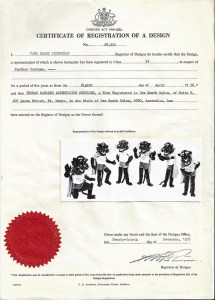
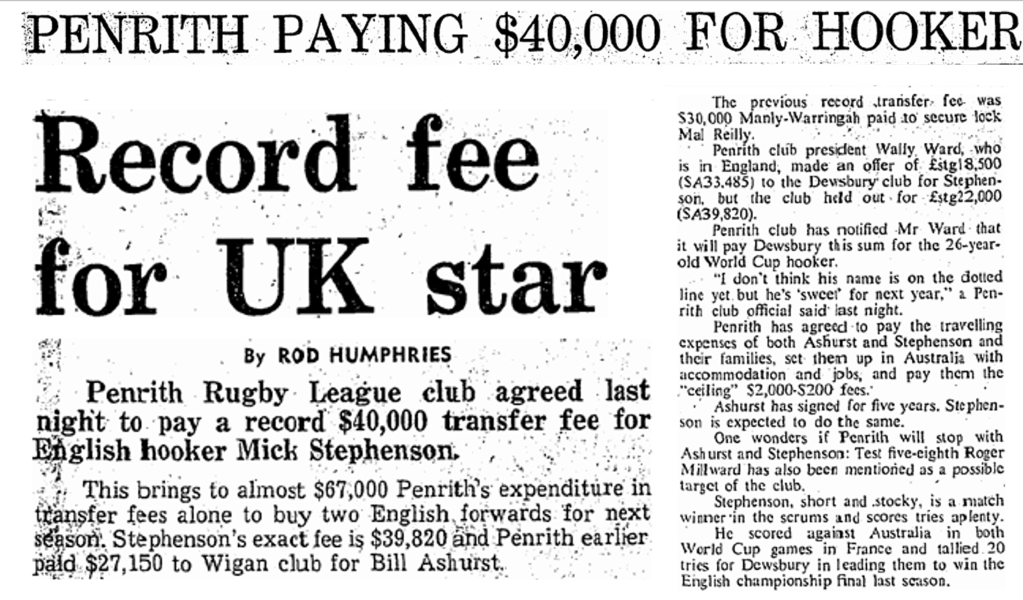
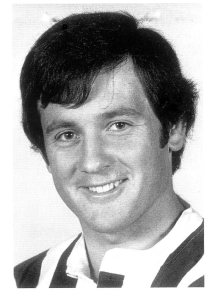
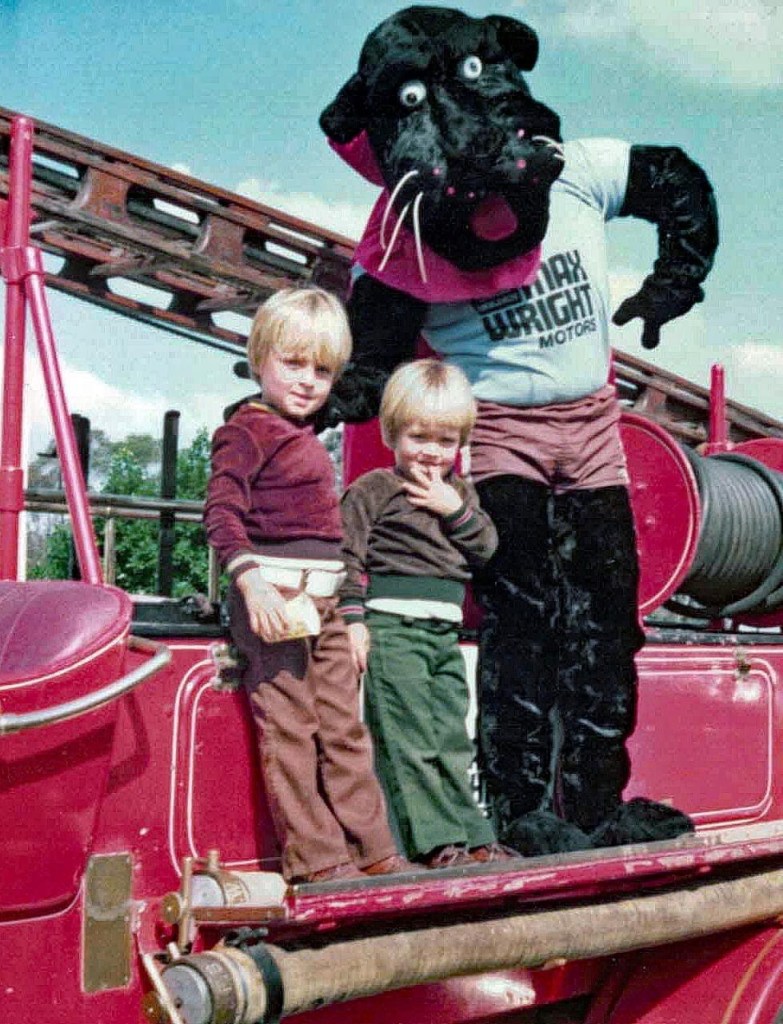
The Panthers scoreboard became one of the most distinctive features of Penrith Stadium — or any rugby league ground at the time. Its origins can be traced to the club’s early think-tank culture.

In the early days of Penrith Rugby League Club, Roger Cowan used think-tanks to encourage participation and generate ideas for the club’s development.

According to Kevin McGrath, the unique scoreboard installed at Penrith Park in 1979-80 had its origins in one of those sessions.

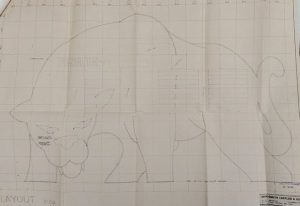
An idea for creating a Luna Park style feature for the club entry was eventually re-imagined as a football scoreboard. The concept was developed further by the architects Dick-Smith Leffler & Gill, who drafted the concept.

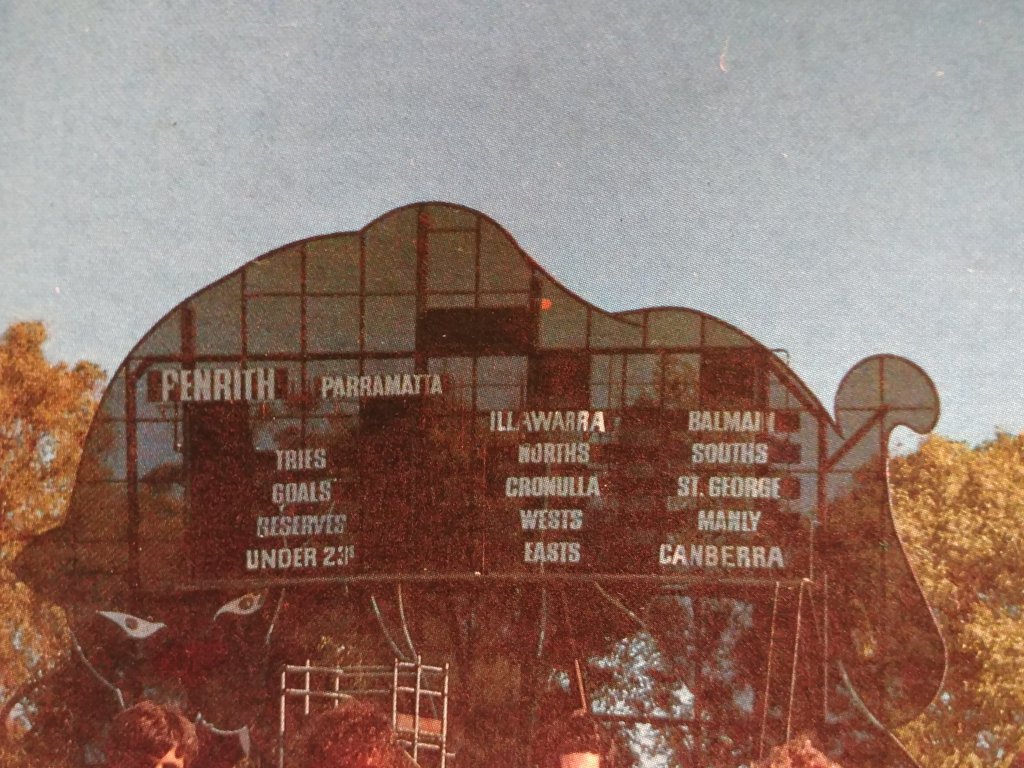
Finally, that original idea was brought to life at the southern end of Penrith Park as an innovative scoreboard.

The scoreboard displayed the score of the Panthers game, as well as progress scores from other matches being played on the day. A score by the home team triggered a response from the structure — flashing eyes and a Panther’s roar marking the moment.

Over time, modifications were made as the structure aged and operational demands changed.

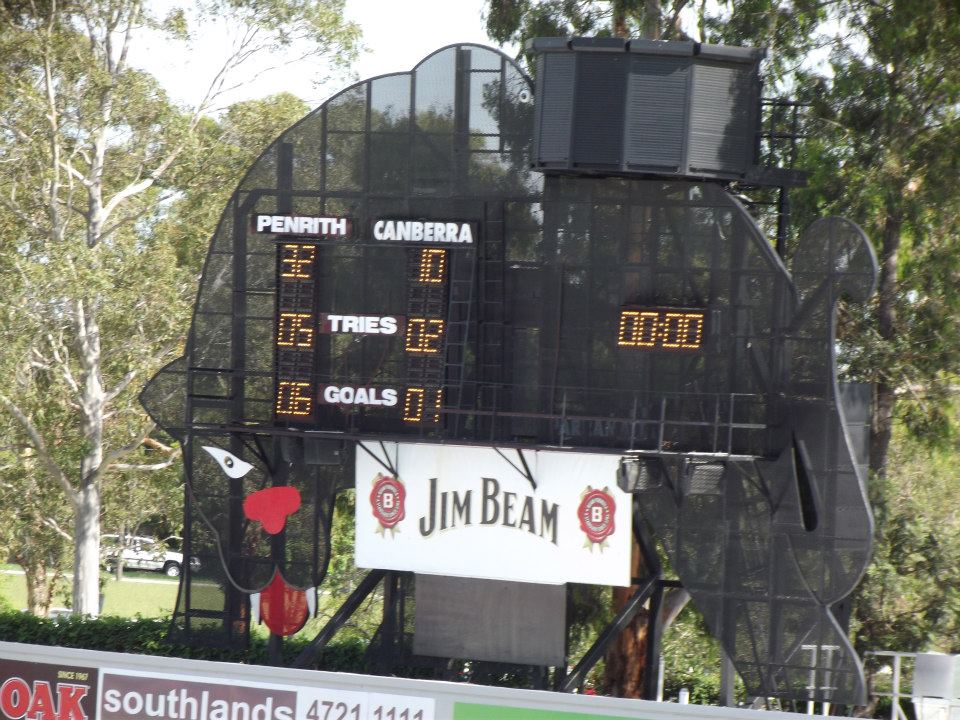
The iconic scoreboard had its operational flaws, as it aged there were many breakdowns and failures and eventually could not deliver what was required at a modern sporting stadium … but still it was loved by Panthers fans and visitors alike.

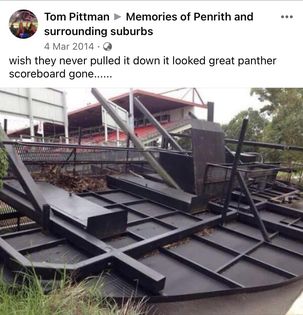
In 2013 it met a fate unbefitting of a trusted, if unreliable, friend:

This Facebook post is dated 4 March 2014, the photo (source unknown) was taken in 2013.

In 2013, the scoreboard was removed.

At the time, it was suggested that the structure had been carefully dismantled and placed into storage, with the possibility of future restoration. Other accounts indicated that it had instead been destroyed during the removal process.

Regardless of the circumstances, its disappearance marked the end of one of the most recognisable symbols of the Panthers experience.


Related Topics


Related Themes

Culture · Innovation


To receive new Parts and occasional project updates by email, you may subscribe below.

Readers who hold recollections, documents, or material relevant to this history are welcome to contribute via the Commentary & Contributions page.

Project Updates

Receive updates when new parts are published.

Culture — An Early Instance at Panthers

A removed section from the original Chapter 6: Building a Culture — by Accident and Design. This is Roger Cowan’s descirption of the culture of the licensed club in te early days.

The following reflection from Roger Cowan describes how elements of that culture were already taking shape in the early years — often without formal structure.

The importance of managing the culture arose out of the efforts to find better ways of managing Panthers after its rapid growth from 1984 on, and our difficulties coping with it.

Before that, whatever was happening in the culture was happening quite naturally with no thought of planning it. No matter who takes the position of CEO, the culture of the organisation will reflect many of that person’s values, behaviours and beliefs.

The one thing I believed in most strongly was that getting results required hard work and long hours. I think I probably went a little bit overboard, and the family paid the price. But I led the way and before long I had a management team prepared to give a lot of time to chasing the club’s goals.

Don Ellks, Leo Trevena and Bob Donaghy were the key drivers of the business in the early days, and they were prepared to put in whatever time was necessary to make sure they got things done. Leo left after a few years, but Don and Bob were linchpins for many years.

An interesting story shows how recruitment plays a part in building culture in a team. It concerns the promotion of Don Ellks. He came to Panthers as a casual barman, and it was not long before his qualities started to shine through. He was promoted to a supervisory position.

At that time Bob Donaghy and Leo Trevena were the club’s two assistant managers. We needed another assistant to help cover the long hours of operation and Don was suggested. But I was not sure whether he was the sort of person who could handle the hours. I did not want anyone on the management team who would crumble if asked to work long hours, sometimes for a seven-day week. We were a small club and there were a lot of demands.

I asked Bob and Leo to give Don a really tough roster for a couple of months to see how he would handle it. He came through with flying colours and was promoted to assistant manager – where he continued to shine for more than 25 years.

This is a good example of how a culture builds. By that time there were four of us leading the way and you might imagine that the expectations and beliefs of staff was that you would not get far in Panthers if you were not prepared to give a bit extra in time and effort. In those years none of us had ever heard of culture in a business sense but we were building one anyway.

There was another thing I learned in those early days. Most people are more comfortable when they know there are good controls in place. There was a lot of dishonesty in the culture before I arrived – people believing the game was to get what you could without getting caught.

As the controls started to take effect, employees would sometimes very privately give me the tip where something was still going wrong. The culture was changing. The honest people were starting to dominate. They knew that what was happening was wrong and wanted to do something about it, wanted to stop others from getting what they could.

Most people were willing to work together to make the club successful. All they needed was someone to show the way.

Later accounts from those who worked within the Club at the time reinforce this description of the early culture — particularly the expectation that staff would contribute beyond defined roles, and that leadership was demonstrated through action rather than hierarchy.


Related Topics


Related Themes

Culture


To receive new Parts and occasional project updates by email, you may subscribe below.

Readers who hold recollections, documents, or material relevant to this history are welcome to contribute via the Commentary & Contributions page.

Project Updates

Receive updates when new parts are published.

The Thomas Paynter Story

A removed section from the original Chapter 6: Building a Culture — by Accident and Design.

At the time of publication (2006), around 25 CEOs of clubs in NSW had spent their ‘formative’ career years at Panthers.

Thomas Paynter is one of those managers.

Now the CEO of Port Macquarie Panthers1, he started at Penrith in 1987, working in the bars, picking up glasses. As he began to work his way up, he was given a couple of opportunities early in the piece, which he says he ‘stuffed up’.

I was lucky enough to be given another chance, and I think that’s why I am here today.

Bathurst was the first of the Panthers amalgamations to be finalised. Paynter was sent there as caretaker for three months, but ended up staying a couple of years, before taking on the job at Port Panthers.

It was a huge learning curve for me. The culture of Penrith was really open. People did their job and knew what was expected of them. Coming into an organisation where there were no systems or procedures in place was very difficult. Everything at Bathurst had been quite dictatorial. People would come up and say, “Well, what should we do?”, and I would answer: “Well, what do YOU think you should do?”  I persevered, and a lot of those people picked up and ran with it.

Coming from the culture of Panthers — with its teams, and systems, that sense of natural ownership — and then walking into the other clubs was like stepping back in time.

Bathurst was a bit of a baptism of fire, especially once I knew I was staying. I had never dealt with a board before, never dealt with the community, or even outside suppliers.

But Roger puts very big shoes on people, so you wear them. The fact that Panthers, and Roger – believe that you can do it — you believe you can too.

Janette Hyde2 is the marketing manager of Port Macquarie Panthers. She is one of the original Port staff and has worked at the club for more than 20 years. Panthers amalgamated with the club in 2002. In a classic example of the way that a culture filters through an organisation, Hyde speaks about the management style of her boss, Thomas Paynter. Her words are almost an echo of the words he used to describe the Cowan management philosophy.

Thomas gets the best out of all of us, because he gives us autonomy, he allows us to grow and use our own initiative. He believes we can do it. Underneath the business thing, which is a very big part of it all, there’s also a strong sense of caring about people.

Thomas Paynter’s journey from bar staff at Penrith to CEO of Port Macquarie Panthers illustrates how the club’s culture of trust, responsibility and opportunity translated into leadership beyond the organisation.


Related Topics


Related Themes

Culture


To receive new Parts and occasional project updates by email, you may subscribe below.

Readers who hold recollections, documents, or material relevant to this history are welcome to contribute via the Commentary & Contributions page.

Project Updates

Receive updates when new parts are published.


  1. Thomas left the Panthers organisation in November 2008. He spent a further four years in the club industry before moving into the insurance sector, where he has continued in specialist and leadership roles.
    ↩︎
  2. Janette Hyde retired from Panthers in 2011. She has continued to contribute to the Port Macquarie region through leadership roles in Business Port Macquarie and the Greater Port Macquarie Tourism Association, and was named 2019 Citizen of the Year. ↩︎

Negotiating with Council — The Station St Road Closures

A removed section from the original Chapter 5: Building the Basics — Business Principles and Property. This examines the challenges faced in negotiating with Council over the Station Street site.

Roger reflected that certain individuals within Council held the view — and perhaps the expectation — that he would eventually be taken down a notch or two. To this day one aspect of this attitude irks Cowan, describing it as one of his worst memories.

While others involved in the negotiations may have viewed the issues differently, Roger believed the Club received little recognition for its contribution to the community. In his view, the charges and conditions imposed during the sale and development process reflected a lack of support for what Panthers was attempting to achieve.

I think the Club was treated very unfairly by Council. Before we could start building on Mulgoa Road, we had to sell the Station Street site. Council made it extraordinarily difficult. One of the conflicts related to two roads on the Station Street property. One of them was no more than a line on a map. It had never been a road. But the only way we were going to be able to sell that property was to negotiate with Council. The price Council sought was $850,000 — around a quarter of the total amount the Club expected to receive for the entire property.

I tried everything to get a better deal. I told them of a similar case where a club had been able to negotiate an agreement with its local council to close a road for the nominal sum of $1, as a sign of support for the club.

Our involvement in our community was far greater than that of the other club. For instance, we had previously agreed to a joint venture with Council to build a Police Citizen’s Boys Club in Penrith. It was the first boys club ever built without the need to raise funds from the public. We were sponsoring most sports in the area. On top of this the Club’s work to get Penrith to the elite level of rugby League had dramatically increased the city’s profile. I thought we had earned the right to support from Council, rather than obstruction. The city was benefiting on a number of levels from the work we had done, and it was giving nothing back. In fact it was profiteering from our planning.

I told them what we were planning to do would be a tremendous boost for Penrith. But all they saw were the problems, rather than the advantages.

The roads incident was not the only problem imposed on us by Council over that property sale. Another episode contributed to a very nasty police investigation a few years later.

One of the key issues underlying these negotiations related to what are known as paper roads. Paper roads are sections of land set aside by councils for roads in the future. According to Pat Sheehy:

Council planners had discovered the paper road in earlier negotiations for the property. It meant that Panthers did not own the whole site, with the result that Council said “OK, if you want to buy that land back from us, this is what we’re going to charge. All this happened before I was on council, but as far as Panthers was concerned it was absolutely exorbitant.

Robinsons 1957 Street Directory showing Frederick St ( a “paper road”) between Station & Wooddriff Sts. The other street in the negotiation was Park St.

Cowan said the problems extended beyond the property sale and continued into the approval process for the new site:

Council imposed a per hectare sewerage fee on the property based on the total area of land we owned. We were planning to build the club on an area of about 8 hectares. Most of the land was flood-prone, so you couldn’t build on it anyway. But we were hit with this huge bill, based on 86 hectares.

We had to negotiate to defer the payment, but this also became an issue. Even though we eventually came to an agreement, there are still people on Council who believe that Panthers ripped off the Council over that sewerage fee. Under the circumstances, that’s quite laughable

These issues illustrate the complexity of the negotiations and the differing perspectives that would continue to shape relations between the Club and Council.


Related Topics


Related Themes

Governance · Growth · Board Decisions · Licensed Club · Conflict


To receive new Parts and occasional project updates by email, you may subscribe below.

Readers who hold recollections, documents, or material relevant to this history are welcome to contribute via the Commentary & Contributions page.

Project Updates

Receive updates when new parts are published.

Feeney Electronics – Ahead of its Time

The following material draws upon club publications from the early and mid-1970s, later interviews and recollections from former Panthers staff and executives.

By the mid-1970s, Penrith Rugby League Club was doing something few licensed clubs in Australia would even have contemplated — experimenting with computerised gaming and security systems.

The project emerged from a practical problem. As poker machine revenue increased across the club industry, so too did concerns about theft, scams, inefficient cash handling and poor operational oversight. Panthers had already experienced some of these issues directly. Roger Cowan believed tighter systems and better information could reduce losses and improve efficiency.

What followed was an ambitious venture into electronics and computer technology through a company known as F.C. Electronics Pty Ltd.

Contemporary club material described F.C. Electronics as producing “probably the world’s most sophisticated poker machine security system”. While that language reflected the promotional enthusiasm of the period, there is little doubt the system was unusually advanced for an Australian club environment of the 1970s.

The system attempted to electronically monitor poker machine activity from a central control point.

According to material published by the club, poker machine events were coded and transmitted to television monitors around the club, allowing supervisors to immediately identify jackpots and machine activity. The system also attempted to monitor irregularities including abnormal wheel movement, door openings and jackpot inconsistencies.

The operation relied on technology that, at the time, would have appeared extraordinary to most club employees and patrons. The club’s own promotional material featured computer consoles, printers, monitoring screens and electronic reporting systems — all at a time when many organisations still relied entirely on manual record keeping.

Former Panthers executive Bryn Miller later recalled that the system was “so far ahead of its time” that most clubs did not even possess a computer when Panthers was experimenting with electronic monitoring and reporting.

The project extended beyond poker machine security. F.C. Electronics also produced industrial control equipment and commercial products including lighting dimmers and environmental control systems. Club publications noted that the company’s capabilities had expanded sufficiently for it to seek work beyond the club industry itself.

Yet the venture also carried substantial cost and risk.

Club material acknowledged that F.C. Electronics operated at a financial loss during part of this period, while Roger Cowan later conceded that Panthers may have persisted with the project longer than it should have. Had the technology evolved commercially the way he hoped, the rewards may have been significant. Instead, the project became one of several ambitious experiments that pushed the club into areas rarely explored by licensed clubs of the era.

Even so, many who observed the system believed its core ideas eventually became standard throughout the gaming industry. Automated monitoring, centralised reporting, electronic jackpot recording and machine data analysis are now routine parts of modern club gaming operations.

In that sense, the Feeney Electronics project reflected something larger about the Panthers administration during the Cowan years. The club was rarely content simply to follow established practice. Whether the experiments succeeded or failed, there was often a willingness to try ideas that others considered unrealistic, premature or unnecessarily ambitious.

Feeney Electronics was one of the clearest examples of that philosophy in action.


Related Topics


Related Themes

Financial Management · Innovation


Image Credits: All images in this post — including the feature image — are from Panthers Annual Reports. These were kindly provided by The Ausburn Collection.


To receive new Parts and occasional project updates by email, you may subscribe below.

Readers who hold recollections, documents, or material relevant to this history are welcome to contribute via the Commentary & Contributions page.

Project Updates

Receive updates when new parts are published.


Panther Stamps

In modern clubs, loyalty systems are everywhere.

Members accumulate points through gaming, dining and entertainment spending, redeeming them for meals, prizes, discounts or benefits through sophisticated computerised systems linked to membership cards and databases.

Security surrounding gaming operations was often basic, particularly in smaller or rapidly growing clubs where staffing and oversight systems struggled to keep pace with expansion.

Long before those systems became standard across the club industry, Panthers experimented with an early version of the same idea.

It was called Panther Stamps.

Introduced in 1972, the scheme rewarded patrons — with bonus stamps that could later be exchanged for prizes and trophies. While simple by modern standards, the concept reflected a surprisingly advanced understanding of customer loyalty, repeat visitation and member engagement

The Panthers Annual Report for 1972 described the program as:

“one of the most outstanding successes we have ever had.”

The scheme had officially commenced on 10 July 1972 after several months of delay caused by what the club described as “security and administrative problems involved.”

Even at this early stage, Panthers recognised that a rewards system required careful operational controls, stock management and accounting procedures.

Within less than six months:

  • and prizes worth approximately $22,000 at cost price had been distributed.
  • members had collected more than 150,000 stamps
  • over 90,000 had already been redeemed

The prizes ranged from trophies and sporting awards through to toys and household items. The report noted that demand became particularly intense in the weeks before Christmas, with thousands of dollars’ worth of toys redeemed by members.

Importantly, Panthers did not present the scheme simply as generosity or entertainment.

Club management acknowledged that while the program carried significant administrative costs — including staffing, storage, stationery and prize purchasing — they believed the increased engagement from members more than justified the expense.

In effect, Panthers had identified an idea that would later become central to the modern club and gaming industries: reward loyalty, encourage repeat visitation, and strengthen the relationship between the member and the venue.

The system also demonstrated the increasingly sophisticated operational mindset developing within Panthers during the early 1970s. By this period, the club was not merely expanding physically — it was experimenting with new forms of marketing, patron engagement and gaming promotion that were relatively advanced for the time.

Although Panther Stamps relied on physical booklets and manual administration rather than computers and swipe cards, the underlying principle was remarkably familiar to modern readers.

Today’s digital loyalty programs — with their points systems, rewards catalogues and member incentives — are built upon many of the same ideas.

While modest by modern standards, Panther Stamps reflected the growing importance of structured member engagement within the evolving licensed club industry of the period.

Panther Stamps were simply an early analogue version of that future.


Related Topics


Related Themes

Financial Management · Innovation


To receive new Parts and occasional project updates by email, you may subscribe below.

Readers who hold recollections, documents, or material relevant to this history are welcome to contribute via the Commentary & Contributions page.

Project Updates

Receive updates when new parts are published.

Wires, Magnets and Monitoring

During the 1960s and 1970s, poker machine operations were still relatively primitive by modern standards. Machines were largely mechanical, heavily cash-based and vulnerable to manipulation.

Across the NSW club industry, stories circulated of patrons using wires, magnets, lead discs being used as coins, and other improvised devices in attempts to interfere with machine mechanisms or influence payouts.

Security surrounding gaming operations was often basic, particularly in smaller or rapidly growing clubs where staffing and oversight systems struggled to keep pace with expansion.

At the same time, the sheer volume of coins moving through gaming rooms created operational difficulties of its own. Machines required constant clearing, counting and refilling. Cash handling was labour intensive and exposed clubs to risks ranging from simple human error to outright theft.

These problems were not unique to Panthers. They reflected broader challenges facing the club industry as poker machine revenue expanded rapidly during this period.

For administrators such as Roger Cowan, such vulnerabilities highlighted the need for tighter operational systems and greater technological oversight. At Panthers, this gradually led to innovations in surveillance, accounting controls, machine monitoring and broader administrative systems designed to improve both security and efficiency.

Part of Cowan’s reputation within the club industry stemmed from his willingness to embrace technology earlier than many contemporaries. What later became sophisticated electronic monitoring and integrated management systems began, in part, as practical responses to very immediate operational problems.

The issue was not simply dishonesty. It was scale.

As clubs grew larger and gaming operations expanded, informal methods that may once have worked in smaller suburban venues became increasingly inadequate. Stronger systems, better monitoring and more professional management structures became essential to running modern licensed clubs.

Seen in that light, the technological innovations discussed in Part 9 were not merely about efficiency or modernisation. They were also responses to a rapidly changing gaming environment in which security, accountability and operational control had become central concerns for the industry.


Related Topics


Related Themes

Financial Management · Innovation


To receive new Parts and occasional project updates by email, you may subscribe below.

Readers who hold recollections, documents, or material relevant to this history are welcome to contribute via the Commentary & Contributions page.

Project Updates

Receive updates when new parts are published.

Removing the Football Club Secretary and Treasurer

The removal of Merv Cartwright (Secretary) and Ron Partridge (Treasurer) from their respective roles with the Penrith District Rugby League Football Club occurred against the backdrop of a broader and more complex set of issues than is immediately apparent in the main narrative.

While Cartwright became the central public focus of the dispute, the Board’s concerns also extended to the financial administration of the football club more broadly, including the role of Treasurer Ron Partridge.

Contemporaneous Board papers and meeting records from the period indicate a growing concern among Directors regarding both the financial management of the Club’s football operations and the processes by which financial commitments were being made.

At the centre of these concerns was the relationship between the Licensed Club — which generated the revenue — and the District Rugby League Club, which was responsible for football operations. While this arrangement had supported the Club’s early growth, it also created a structural tension: financial responsibility and operational control were not always aligned.

By the late 1960s, the Board had become increasingly uneasy that commitments were being entered into without sufficient oversight, and in some cases without formal authority. This was not framed as a single incident, but as a pattern that had developed over time.

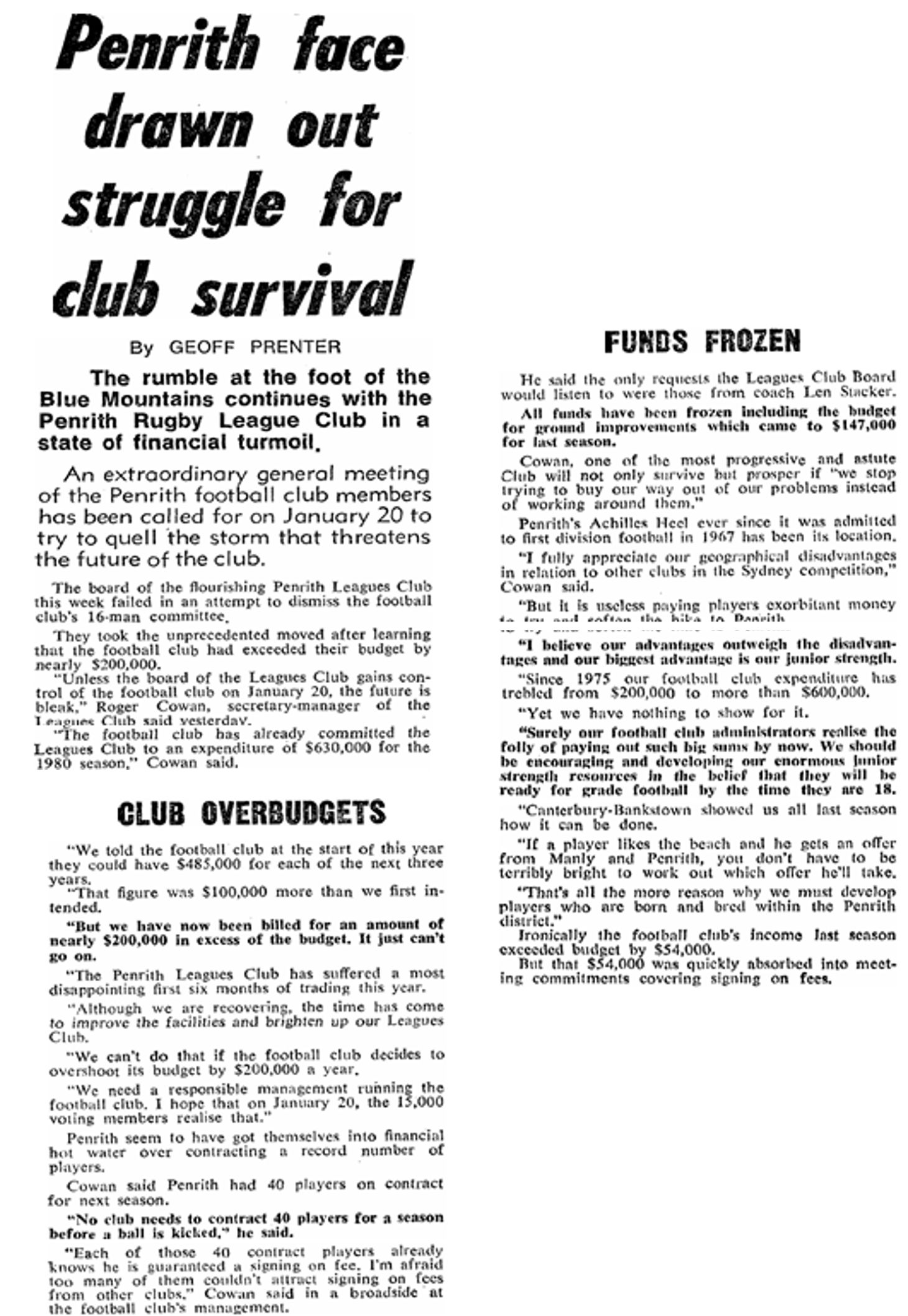
Internal analysis presented to the Board suggested that the Club’s financial position was more fragile than it appeared. Liabilities associated with player payments, bonuses and sign-on fees were, in the Board’s view, not being fully or consistently reflected in financial reporting. When assessed against normal operating income, there was concern that the Club could not meet its existing commitments without significant restraint.

These concerns were reinforced by a pattern of escalating expenditure. Board discussions from the period refer to sharp increases in allocations to football operations, alongside uncertainty as to how those figures had been determined. Directors questioned both the reliability of the budgeting process and the basis upon which commitments had been made.

In response, the Board moved to assert clearer control over financial decision-making. Proposals and subsequent resolutions emphasised that:

  • no contracts or financial commitments were to be entered into without explicit Board approval;
  • committees operating within the football structure were to act within clearly defined limits;
  • and all funds were to be subject to centralised oversight and reporting.

These measures were not presented as routine administrative adjustments, but as necessary steps to address what was seen as a deteriorating financial and governance position.

At the time the NSW Rugby Football League (NSWRFL) was responsible for the debts of all District Clubs — and should Penrith Rugby League Club Ltd (Licensed Club) stop funding the Penrith District Rugby League Football Club (District Club), the Board was confident it would not prevent the District Club from operating. It could, however, trigger intervention by the NSWRFL as administrators of the Penrith District Club.

Within this context, the recommendation to cease funding unless Secretary Merv Cartwright and Treasurer Ron Partridge resigned can be understood not as an isolated or sudden decision, but as the culmination of these concerns. This was not an easy decision for the Board, a fact reflected in the final paragraph of the Board Resolution.


Resource Material*

The following documents can be seen as PDFs:


Related Material


Related Themes

Conflict · Governance · Financial Management


* Resource material courtesy of The Ausburn Collection


To receive new Parts and occasional project updates by email, you may subscribe below.

Readers who hold recollections, documents, or material relevant to this history are welcome to contribute via the Commentary & Contributions page.

Project Updates

Receive updates when new parts are published.

Major Player: Ken “Poker” Ausburn

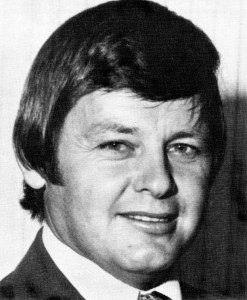
Merv Cartwright

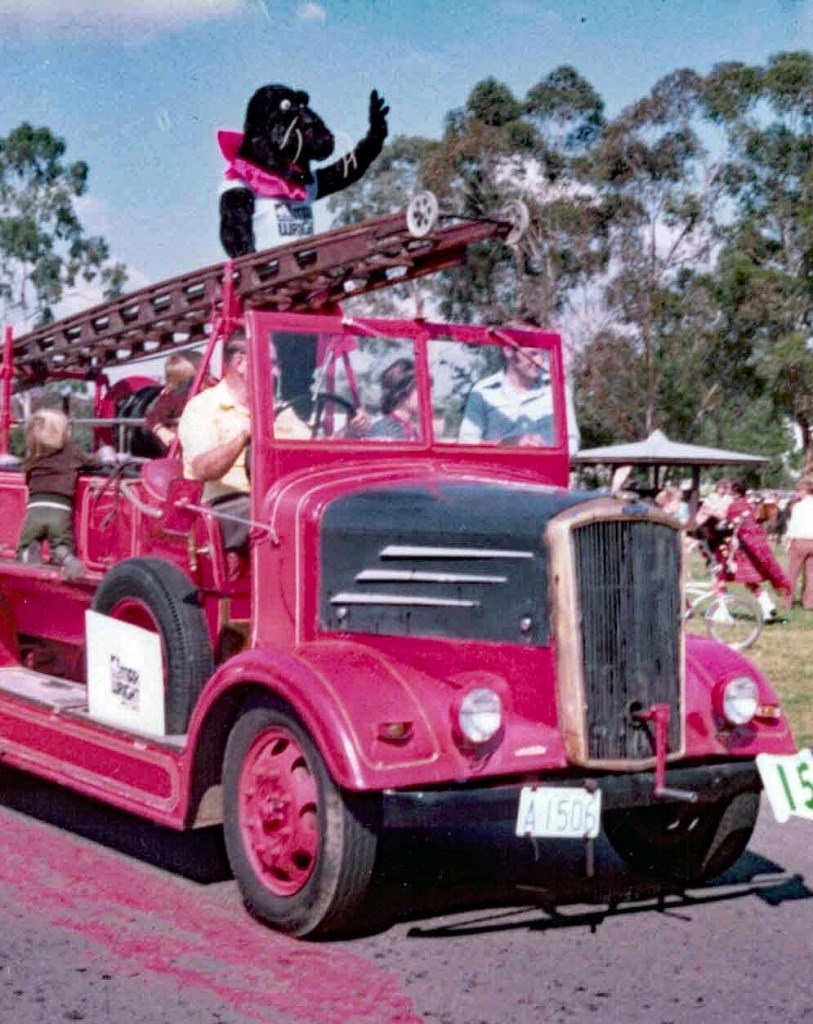
Ernest Kenneth “Poker” Ausburn

Foundation Member, Chairman and Long-time Penrith Clubman

Ken “Poker” Ausburn was one of the foundational figures of Penrith Rugby League Club and among the generation of local volunteers who helped transform Panthers from a small district football organisation into a major community institution.

A lifelong Penrith resident, Ausburn served the club across many years as a committee member, director and eventually chairman. Remembered for his humour, warmth and strong community spirit, he became one of the best-known personalities associated with Panthers’ formative decades.

Though he died in 1976 before the club’s later expansion into the entertainment giant it would become, Ausburn remained widely respected within Panthers history as one of the men who helped establish the culture and identity of the early club.

Role in the Narrative

Ken Ausburn appears within the early development period of the Panthers, Passion and Politics narrative — the years in which Panthers evolved from modest local beginnings into an increasingly ambitious football and licensed club organisation.

He represents the generation of volunteers and local administrators who laid the foundations upon which later Panthers success would be built.

Ausburn is closely connected to Panthers’ long campaign for admission to the NSW Rugby League first grade competition, and to the club culture that developed during the 1950s, 1960s and early 1970s. His involvement reflects an era when Panthers depended heavily upon local personalities willing to contribute time, energy and leadership to both football and licensed club activities.

His life and reputation also provide insight into the strong community identity that surrounded Panthers during its formative decades.

Background

Born: 9 February, 1921, Penrith
Died: 6 May, 1976, Penrith

Profession: Boilermaker; long-time employee at the St Marys Munitions Factory

Panthers Roles:
• Foundation member
• Director
• Chairman
• Hon. Secretary Penrith Rugby League Golf Club

Community Involvement:
• Supporter of local sporting and youth activities
• Associate with support for Police Boys Club initiatives.
• Long-time Penrith community volunteer

Recognition by Panthers:
• Life Membership, Penrith Panthers (1964)
Poker Ausburn Award – for most improved Panthers player (now discontinued).

In 2017 Penrith City Council named Ausburn Reserve — between Nepean St and Annett St, Emu Plains — to honour the contributions to the Penrith region from the Austbun family and specifically “Poker” and his brother, Bob.

Known As: “Poker” — a nickname reportedly derived from the poker face he adopted while telling stories, joking with friends or “spinning a yarn”.

Relevance to Events Described

Ausburn belonged to the generation that guided Panthers through its difficult formative years.

He witnessed — and helped contribute to — the club’s evolution from football played at very basic local facilities to the construction of larger licensed club premises and ultimately the development ambitions that would reshape Panthers in later decades.

Bruce Turner’s Footprints on the Banks of the Nepean reproduces the cover of Ausburn’s copy of the proposal supporting Penrith’s elevation to first grade competition in 1967. Although the full submission itself does not appear to have survived publicly, the surviving cover reflects the determination among local administrators to secure top-level rugby league representation for the growing Penrith district.

Contemporaries consistently remembered Ausburn not simply as an administrator, but as a personality. Family members and friends recalled his humour, generosity and capacity to engage people socially. Those qualities appear repeatedly in recollections of early Panthers culture.

His life was also marked by resilience. Following a serious motor vehicle accident, Ausburn endured long-term injuries and health complications, yet continued working and remained active in club affairs.

When he died unexpectedly in 1976 at the age of 55, Panthers tributes described him as one of the “small band of men who pushed the club onto its feet in the very beginning.”

Legacy

Ken “Poker” Ausburn is remembered as one of the local figures who helped give early Panthers its personality and community identity.

He represented an era when the club relied heavily upon volunteers, local businessmen, tradesmen and sporting enthusiasts whose commitment extended well beyond formal administrative duties.

Although later Panthers history would become associated with major commercial development, political influence and large-scale expansion, figures like Ausburn reflected the grassroots community culture from which the organisation originally emerged.

His reputation for humour, sincerity and loyalty ensured that his contribution remained warmly remembered long after his death.


Related Material


Related Themes

First Division Admission · Licensed Club · Football Club


Editorial Note

This profile is presented as contextual background.
Additional material may be introduced as the narrative progresses.
To receive new Parts and occasional project updates by email, you may subscribe below.

Readers who hold recollections, documents, or material relevant to this history are welcome to contribute via the Commentary & Contributions page.

Project Updates

Receive updates when new parts are published.

The Panthers Magazine Arrangement

In February 1966, the Penrith Rugby League Football Club published the first edition of its official members’ journal.

The publication, issued monthly, was introduced at a critical point in the club’s development — as it sought admission to the New South Wales Rugby League First Division.

A central feature of the journal was a column titled From the Secretary’s Desk, written by Roger Cowan in his role as Secretary-Manager. In the opening issue, Cowan outlined club activities, membership growth and upcoming events, and referred to the club’s ambition of securing promotion to First Division.

The magazine was largely written and produced by Cowan and served as a means of communicating with members during the club’s First Division campaign.

In June 1968, Phyro Holdings Pty Ltd was registered, with Roger and Phyllis Cowan as directors. The name itself was derived from their first names — Phy from Phyllis and Ro from Roger.

In the years that followed, responsibility for publishing the club’s magazine — The Panthers Magazine — was transferred to Phyro Holdings under an arrangement approved by the club committee. The structure included conditions relating to profit limits, auditing of accounts and the remuneration deetails of Cowan’s role.

The arrangement formalised the transfer of publication responsibilities from the club to Phyro Holdings, under agreed financial and audit conditions.

The magazine arrangement — and the broader financial relationship between the club and Phyro Holdings — was later subject to scrutiny. Questions raised in subsequent decades focused on governance, transparency and the management of related-party transactions.

The Panthers Magazine became much more than a publication for PRLC members – it was a powerful community voice and was distributed to over 200,000 households in the Penrith Junior Rugby League District – Katoomba to Blacktown.

Those issues are examined in more detail in later sections of this project.


Related Topics


Related Themes

Financial Management · Strategic Planning


To receive new Parts and occasional project updates by email, you may subscribe below.

Readers who hold recollections, documents, or material relevant to this history are welcome to contribute via the Commentary & Contributions page.

Project Updates

Receive updates when new parts are published.