By the end of July 1999, many believed the public debate over a possible joint venture between Penrith and Parramatta had finally run its course.
On 31 July, the Panthers Board rejected the National Rugby League’s invitation to lodge a non-binding joint venture submission. Although such a submission would not have committed Panthers to a merger, it would have extended the deadline and preserved Panthers’ access to the substantial financial incentives being offered by the NRL. By declining the invitation, the Board effectively closed that avenue.
This decision did not remove the uncertainty surrounding Panthers’ future. At that stage the club still faced the possibility of exclusion from the reduced national competition. Questions about the club’s long-term future therefore remained unresolved, even though the merger proposal itself appeared to have been settled.
Five weeks later, the issue unexpectedly returned to the public arena.
On 6 September 1999, former Panthers Patron Ron Mulock issued a press release predicting that another attempt would soon be made to pursue a merger with Parramatta. The statement prompted General Manager Roger Cowan to write directly to Panthers sponsors, responding to a number of Mulock’s claims and explaining both the Board’s position and the reasons behind his earlier recommendation that merger options should be investigated.
The exchange did not end there. Ron Mulock subsequently published a full-page paid advertisement in the Western Weekender and later circulated a detailed response to Roger Cowan’s letter. Together, these documents provide a revealing insight into how the debate was conducted during one of the final stages of the merger controversy.
More importantly, they demonstrate that although the Board had made its decision, there remained a significant difference in management philosophy. While the objective of remaining a stand-alone club was widely shared, opinion differed over whether responsible governance required contingency planning for adverse outcomes or an exclusive focus on achieving the preferred result.
The community’s favoured position was well-known but the atmosphere had quieted after the July 31st confirmation.
Rather than allowing the issue to fade from public view, the correspondence starting with the Mulock Press Release of 6th Spetember reignited debate at a time when the club’s future was still uncertain.
The accompanyingDigital Archive — A Campaign of Letters reproduces these documents in chronological order as contemporary source material. They are presented without alteration, allowing readers to examine the original correspondence and advertisements and draw their own conclusions.
Few Board decisions carried greater significance than the one made late in July 1999. Panthers’ place in the national competition may have depended upon it. It was life or death in rugby league, says Cowan
Panthers losing its place in the NRL competition would have been a disaster, yet here we have a board refusing to talk about it, and refusing to sign something that would have given the club more time.
Sometimes I would have daydreams about the Footy Five attitude1. I imagined them deciding to dive into a pool from the high tower. They would climb to the top, look down and discover that all the water had drained out of the pool. This was new information. But they had already made a decision, and why would they change it just because of new information? So they had dived anyway. As they plummeted downwards, they were studying a book entitled Corporate Governance. It was open at the chapter about considering all the available information and making decisions in the best interests of the organisation.
There was only one downside to signing that letter. Extending the deadline would have allowed the media to continue its speculations, and this, in turn, would have continued to foster divisions in community attitude.
If it had been signed, it is certain that the subject would have been raised again in Penrith Council, perhaps with some questions to Bateman and aspiring councillor Evans, who had previously served and was known to many on council.2
If it had been signed, there would have been no Footy Five campaign, no full-page ads from Ron Mulock attacking Cowan and the other four directors. And there would never have been what Cowan regarded as the biggest myth of all — that the Footy Five and Mulock had saved the Panthers.
There would never have been a ‘Board Wars’ story on the front-page of the Western Weekender. And the Footy Five may never have lost their seats on the Board.
Panthers Board, management, and staff – including the Five themselves – would have avoided much pain.
It is also likely that Panthers would have been spared the enormous costs – in money, time, spirit and lost business – of the Temby inquiry. The NSW government might have been spared a useless exercise which cost it millions of dollars, and the respect of the club industry.
It never occurred to Cowan that there could have been any misunderstanding about the non-binding nature of the document.
Despite all the encouragement I had given the management team trying to have open minds and think creatively, and my own understanding of the powerful impact paradigms can have, it never entered my mind that anyone could fail to understand. I tried so hard to explain it. The document itself seemed so plain.
In September 1999, Ron Mulock sought to publish a full-page advertisement in two local newspapers. It supported his position on the merger situation and was highly critical of Cowan. The Penrith Press declined to run the ad, saying they considered it defamatory. The Western Weekender ran it.
The ad described a document that had ‘fallen off the back of a truck’ to come into his hands. It was a copy of the letter to NRL chairman Malcolm Noad, signed by Denis Fitzgerald – and with a space for Roger Cowan’s signature. The Mulock ad quotes from the document:
‘This submission creates no obligation on our clubs to conclude the joint venture’.
The ad also noted the document to be confidential.
Editor’s Note:Following the Board’s July 1999 decision, the merger issue unexpectedly returned to public debate — the full-page advertisment mentioned here was not what sparked the return, three weeks earlier a press release lit the fire. The Historical Context article — Resurrecting the Merger Debate— examines the exchange of letters and public statements between Roger Cowan and Ron Mulock and links to the Digital Archive containing the original documents.
So, how did this confidential document get from the Panthers boardroom into his hands?
Greg Evans told the Inquiry there had been a split in the Board between those who didn’t want to merge at any cost, and those that were willing to accept the merger. Ian Temby asked if ‘the former group would have rather seen the Panthers cease to compete in the top competition than merge?’
Evans answers: ‘I can’t speak for them, but I probably would have.’
Yet the theme that resounds through Evans’ evidence is his passion for rugby league. This, he claims, first prompted him to stand for the board, and to lobby board members when vacancies became available. Yet his evidence appears difficult to reconcile with that passion. He told the Inquiry he would probably have preferred Panthers to leave the competition rather than merge to ensure top grade games continues to be played by a Panthers team at Penrith Stadium.
Mulock’s attack in the Weekender initiated the myth of the Footy Five, as Cowan explains:
He divided the Board into two groups and labelled one group the Footy Five. He was claiming the high ground for them, saying it was they who would save the club. He denigrated the three directors who had voted in favour of signing the non-binding letter.
So the very concept of a Footy Five, from the first day it was invented, was a total misconception. I call it Mulock’s myth.
As for his other claims, there was no split on the Board about retaining our identity in rugby league. Chairman Barry Walsh has said many times, there was no vote on a merger. The only vote was about signing a non-binding letter.
What did Evans have in mind when he told the inquiry that there were some directors willing to accept a merger? Did he really believe something for which there is no evidence anywhere, or was he just having difficulty in breaking out of his paradigms?
A myth that Cowan had signed the letter grew in the wake of Mulock’s attack, linked to claims he wanted a merger and that Cowan was anti-rugby-league.
Roy Masters disagrees.
I saw that letter, and it was signed by one person, and it was not Roger Cowan. I don’t know how hard he pushed it, but he didn’t push it so far that he signed that document.
The claims by Mick Kelly and others that Ron Mulock and/or the Footy Five had saved the Panthers from extinction are not borne out by the events of the time. The dogmatic stance taken by the Five could easily have spelled the end for the Panthers team.
North Sydney’s misfortunes during 1999 ultimately played a decisive role in saving Penrith. Norths’ stadium on the Central Coast was supposed to open for the 1999 season, but it rained in Gosford almost non-stop for months. The club had vacated its home ground at North Sydney oval, so all its home games had to be played as away games. What should have been a bumper season became a financial disaster for them.
It had been a well-kept secret that North Sydney had financial problems. Towards the end of the 1999 Season, they announced they were going into receivership, and thus had no chance of competing in the NRL on their own. The club formed a joint venture with Manly, and Penrith moved into 14th position. That day, for the first time, Penrith became assured of its place. For some months Cowan had been aware that Norths’ misfortune was helping to close the gap for Penrith. It was a tight tussle on the criteria ladder.
Cowan remained apprehensive right up until the final decision that ensured Panthers’ place in the fourteen-team competition. Three possibilities worried him. Firstly, Norths could – and probably would – finish in front of Penrith on the criteria score. Secondly, even if Penrith was only slightly ahead, grants of $20 million by two governments — given the political push to have a team at Gosford – might have somehow been included in the formula to push the advantage back to Norths. Finally, if Norths merged with Souths it would create an entirely new entity to take the 14th spot.
Each of those possibilities would have been the end of Panthers.
Cowan finally breathed a sigh of relief when Norths chose Manly as its partner. Manly had long been assured of a place, and Norths’ place became vacant for Penrith.
Panthers had survived — but only because events entirely outside the club’s control had unexpectedly changed the criteria race.
To receive new Parts and occasional project updates by email, you may subscribe below.
Readers who hold recollections, documents, or material relevant to this history are welcome to contribute via the Commentary & Contributions page.
Project Updates
Receive updates when new parts are published.
Editorial note:Footy Five is used here — and elsewhere — as retrospective shorthand. The name became associated with these five directors during the later Board conflict and election, rather than during the events being described here. See Beyond the Book — The Footy Five: A Name That Rewrote the Story. ↩︎
This paragraph refers to John Bateman and Greg Evans two of the Panthers Board who were included, by Ron Mulock, in a group he called the Footy Five. ↩︎
Football fans are always looking for defining moments in their team’s history. A new coach arrives. A star player signs. A premiership follows. The story writes itself.
For Penrith, one of those defining moments was the appointment of Phil “Gus” Gould as first-grade coach in late 1989.
The most common version of this story is simple. Ron Willey departs, Gould returns, and within two seasons the Panthers are premiers.
A simple story that rings truth when told — but, really, the story is only partly told. And, so, does not hold the whole truth
The return of Phil Gould to Penrith, as coach, was undoubtedly one of the most significant decisions in the Club’s history. His influence on standards, preparation, selection and tactical innovation would prove decisive. Yet his appointment was not the beginning of Penrith’s rise. Rather, it was the culmination of a long organisational journey that had transformed the club over more than two decades but most dramatically during the seven years preceding his appointment.
Understanding why Gould succeeded at Penrith requires understanding the club he inherited.
Building a club capable of winning
When Roger Cowan became General Manager in 1965, Penrith was little more than an ambitious newcomer attempting to survive in Sydney’s fiercely competitive rugby league landscape.
The years that followed were devoted to building foundations — foundations of financial stability, sound governance, operational capability and an increasingly professional culture.
The club established administrative systems where few had previously existed. It strengthened its financial position, developed licensed club operations, invested in junior rugby league and gradually created an organisation capable of supporting elite football.
Many of these changes attracted little public attention — and some internal pain and conflict — yet each became another piece of the structure upon which future success would rest.
At the same time, a remarkable generation of local footballers was emerging.
From hopefuls to contenders
Tim Sheens deserves enormous credit for changing the direction of Penrith football.
His young side reached the club’s first semi-final in 1985 and, perhaps more importantly, changed what players and supporters believed was possible.
For the first time, Penrith expected to compete rather than merely participate.
When Ron Willey succeeded Sheens in 1987, he inherited a talented but still developing football team. Over the following three seasons he consolidated much of the progress already achieved — he also instilled a harder competitive edge — what many describe as ‘mongrel’ — that had previously been missing.
The Panthers’ consistency ramped up a couple of pegs, reaching the semi-finals again in 1988 before finishing second on the ladder in 1989, only to bow out in “straight sets” — a loss to Balmain (12-24) in Major Preliminary Semi-Final followed by a loss to Canberra (18-27) in the Minor Semi-final. Canberra went on to win the Grand Final over Balmain.
Willey’s contribution is often overshadowed by what followed, but history should remember that he coached Penrith through an important stage of its development. He inherited an emerging football side and left behind a genuine premiership contender.
By the end of 1989, however, there was a sense that the club had reached an important crossroads. Penrith’s next coach would need to be fully devoted to the Panthers and build upon the foundations already laid. In this late 1989 article Roger Cowan tells Roy Masters:
We need a coach who can devote four or five hours a day to our best juniors and then supervise the Panthers’ three grades in the evenings.
Sydney Morning Herald 28 Sep 1989 — click image to enlarge and read
While the club had become more competitive, the question was whether it could become the best.
The right coach at the right time
Phil Gould did not arrive to rescue a struggling football club.
He arrived at a club already pounding on the door. Today, you’ll often hear the expression “premiership window” — well, Gus joined when that window was wide open.
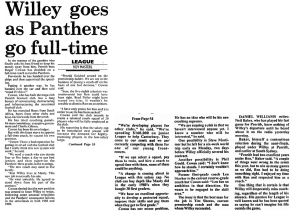
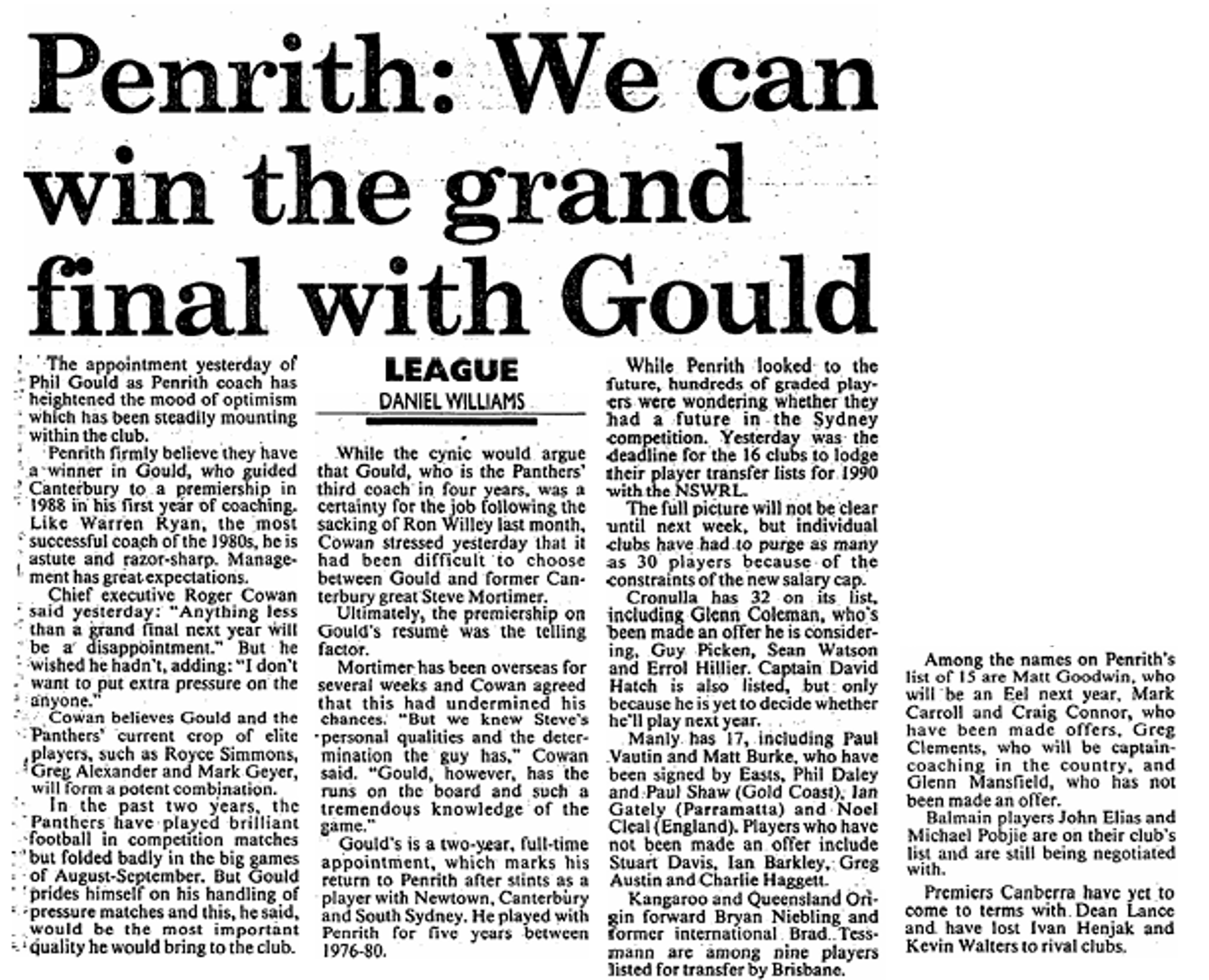
Sydney Morning Herald Headline 14 Oct 1989 — click image to read full article.
His coaching philosophy was uncompromising. Fitness standards rose. Preparation became more meticulous.
Selection became ruthless when necessary. Reputation alone offered no protection. Gould was prepared to make difficult decisions if he believed they improved the team, even when they involved respected senior players.
The controversial decisions surrounding Royce Simmons during both 1990 and 1991 illustrated both the personal cost and Gould’s willingness to place team performance ahead of sentiment. Those decisions were fiercely debated at the time but reflected the standards he expected throughout the organisation. Bound for Glory recounts Gould’s insistence that difficult decisions were necessary if Penrith was to push through that premiership window and transform from contenders to champions.
His greatest contribution may not have been introducing entirely new ideas, but demanding that every aspect of the football operation meet a higher standard.
Royce Simmons, in Hooked on League, describes some of the changes in 1990:
With Phil Gould at the helm … Weight coaches came to the club for the first time, there was a bit more money in the game and you were able to get away from work a little earlier and get fitter. The game was becoming semi-professional. … Phil was much more structured in his approach with not as much emphasis on skills but certainly a lot more education on how to play a more structured game.
Importantly, he inherited players capable of responding to those demands.
Greg Alexander, Royce Simmons, Mark Geyer, John Cartwright, Brad Izzard, Brad Fittler, Colin van der Voort, Col Bentley and others had largely developed together through Penrith’s football system. Gould refined them into a premiership side.
Just as importantly, he inherited a club capable of supporting elite football.
Behind the scenes, Penrith’s administration continued to expand sponsorship, strengthen finances, modernise marketing and deepen its connection with the wider district. As Bound for Glory records, the Club’s transformation extended well beyond the playing field, with new sponsorships, a new black playing strip for 1991, a rapidly growing marketing operation and increasing community engagement all reinforcing the confidence of an organisation entering the 1990s with growing belief.
The football team was improving because the club itself was improving.
More than one architect
It is tempting to view premierships through the lens of individuals.
Roger Cowan, Tim Sheens, Ron Willey, Phil Gould. Greg Alexander, Royce Simmons — each individually occupies an important place in the history of the Penrith Panthers that led to the 1991 Winfield Cup heading west to Penrith.
Yet focusing too heavily on any one figure risks missing the broader story.
Successful organisations rarely emerge because of one appointment or one season. They are built through hundreds of decisions, made by countless people over many years.
Roger Cowan with successive boards and countless staff built the organisation.
Tim Sheens rebuilt belief.
Ron Willey consolidated competitiveness.
Phil Gould delivered the final refinement.
Each stage depended upon the one before it.
The Final Piece
Looking back on those days, Gould’s appointment appears inevitable.
It was anything but.
It is now well-known that Steve Mortimer was a very strong contender for the Panthers role — and had he not been on a world trip at the crucial time discussions were being held, he may have landed the job. Sliding doors.
Had the Board chosen differently at the end of 1989, Penrith may still have remained one of the competition’s strongest clubs. Whether it would have climbed the final step can never be known.
What history can say with confidence is that Gould arrived at precisely the moment when Penrith was ready for him.
The Panthers did not become premiers simply because they appointed Phil Gould.
They became premiers because, after twenty-five years of organisational development, administrative reform, financial strengthening, football rebuilding and cultural change, the club had finally become capable of making the most of a coach of his calibre.
That is the story. It is a more complete story than the “Gould arrives — Panthers become premiers — Gould is the hero” popular narrative.
Phil Gould’s return was not the beginning of Penrith’s rise — it was the moment when years of patient preparation found their final catalyst.
A removed section from the original Chapter 11: A Strange Response to a Lifeline.The following section presents one theory Roger Cowan developed as he tried to understand decisions that had never fully made sense to him. It is an invitation into his thinking on the puzzle and should be read as his interpretation rather than an established historical conclusion.
Relatively speaking, John Bateman was a figure in the public eye in Penrith. In 1993, Sydney won the right to stage the Olympic Games in 2000. Just over a year later, John Bateman was elected to Penrith council. Soon after that he was appointed to fill a vacancy on the Penrith Rugby League Club board. At first glance these events appear unrelated. To Roger Cowan, however, they gradually formed part of a much larger picture.
Bateman, a member of the Labor Party, ran as an independent against Pat Sheehy – an endorsed Labor candidate. As a result, Bateman was expelled from the Party. Pat Sheehy is a long-time Penrith councillor. He believes there is little doubt that Bateman’s great ambition at the time was to be mayor at the time of the Olympics.
By all accounts, Bateman did an excellent job in that position.
Penrith councillor Jackie Greenow said the Olympics were a wonderful opportunity for Penrith, and Bateman was a good choice at the time.
John is a sporting nut, and he did an outstanding job representing council, Penrith and the entire community. He was meeting with dignitaries such as Princess Anne and Juan Antonio Samaranch, and he put in an enormous amount of work.
Roger Cowan agrees. ‘John Bateman was one of the best mayors we ever had’, he says.
While Pat Sheehy questions Cowan’s judgement on this point, he says ‘Other people could have done it, but probably not with the pizzazz that John Bateman did.’
For many years, mayors of Penrith had been restricted to a one-year term, following a ten-year stint by one mayor in the 70s. After Bateman had served his one year in 1999, he would normally have stepped aside for someone else.
Pat Sheehy explains.
John Bateman became mayor when he did simply because he had the numbers, and it was the year before the Olympics. There was a full council election in September 1999, and the Labor party effectively gained control. But the party decided that it was in the city’s best interest for John to continue as mayor in 2000, if that’s what he wanted to do, because of all the lead-up work he’d been involved in, and all the things that would carry over from September 1999 to the Olympics in September 2000. The other thing was that at that time, there was no-one else on council that could have done the job as well as he did it.
In my mind, there is absolutely no doubt that this is what John wanted more than anything in the world.
The events surrounding the emerging conflict in the Panthers boardroom naturally caused Cowan to search for reasons.
Over time I came to suspect that the real problem with signing it was that the media would start speculating again about ‘done deals’, for the purpose of grabbing headlines. It struck me that publicity indicating Panthers was about to merge with Parramatta, no matter how untrue, was not in the interests of either Bateman or Evans. With council elections looming and a decision to be made about who would be mayor in the Olympics year, it was probably the last thing they would want.
Statements that they believed signing the letter would have resulted in a merger leave a big question mark. How could it have ever led to a merger if the Five were against it? They had the majority vote.
I tried at the time to come up with an alternative to my growing belief that this whole rugby league issue, right from the time it was reported that Panthers was at serious risk, had been about political ambitions.
Their refusal to discuss strategies for reducing the risk generated powerful negative feelings in me. The feeling that it was all about politics and not about Panthers became a deep-seated festering sore in my psyche, even though I had no way of knowing if I was correct. It was this suppressed anger and frustration that caused me to explode in meetings from time to time.
Even in retrospect, I struggle to clean such a cynical view from my mind. I realise that if my interpretation had been correct, it would mean the catalyst for the enormous cost over the last few years to Panthers and to me had nothing to do with rugby league.
I can see one major flaw in my cynicism. To be a complete theory it would need an explanation of Mulock’s involvement. Having agonised over this one question for six or seven years, I could not find any explanation that made sense.
There is no solid evidence. The more objective view of a reader who was not closely involved may help find more generous conclusions.
With only days remaining before the deadline for NRL amalgamations, the club appeared destined to miss the cut for the new fourteen-team competition. Then, unexpectedly, a possible lifeline arrived.
It required nothing more than the signing of a non-binding letter.
The Board rejected it.
Through the first half of 1999, Penrith continued to sit at number fifteen in the NRL criteria. The deadline for amalgamations was midnight on 31 July.1
Commentators had labelled a merger between Parramatta and Penrith was a ‘done deal’. Community concern was mounting. Two Panthers directors with ambitions in local politics, John Bateman and Greg Evans, were sitting between a rock and a hard place.2
Late in July, Cowan received a call from rugby league headquarters concerning the deadline.
Penrith was still highly regarded in the Super League circles,3and they were trying to do anything possible to assist us. It was obvious to everyone that we were in dire trouble. We sat solidly at number fifteen, and that didn’t look like changing. Nobody knew what was happening at Norths.
The call suggested that we could at least maintain a fallback position if we were prepared to sign a letter saying that we were still considering a merger with Parramatta and requesting more time. The letter would very clearly state that it was not to be taken as any commitment to a merger. It would be a non-binding document, aimed solely at keeping our options alive.
In his evidence to the Inquiry, John Bateman spoke of the events of July 1999. He said that when Cowan presented this offer to the board on 31 July, the Board resolved not to sign the letter. Bateman also spoke of his frustration concerning a paper that Cowan presented to the Board on 20 July, with the latest information on joint ventures.
Bateman said:
In the previous September we had resolved to stand alone. That was our view, and then Roger tabled this paper giving us more information and basically telling us that we were in a risky position standing alone.
From a corporate governance perspective, directors are expected to receive and consider information that may materially affect the organisation. Why, then, would the presentation of updated information about such an important issue become a source of frustration? A CEO who withheld such vital information would be guilty of poor corporate governance.4
On 31 July Cowan called a special meeting to advise the Board that there had been an offer that would overcome the need to comply with the 31 July deadline. Panthers would simply need to sign a non-binding letter addressed to NRL Chairman, Malcolm Noad. Cowan suggested to the Board that there was nothing to lose by signing it.
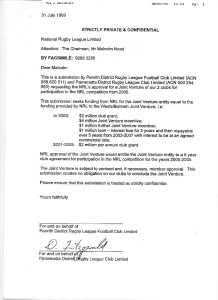
The document at the centre of the 31 July 1999 special Board meeting. Click image to read.
Bateman was not the only one who was angered by the presentation of the non-binding letter. The ex-wife of Greg Evans remembers how very stressed her husband was before leaving for that 31 July meeting.
Why these two directors reacted angrily to a non-binding proposal that would keep the Club’s options open remains a deep mystery. Cowan developed an interesting theory about it, which seems to be borne out by some seemingly unrelated events of the 1990s.
He came to believe that the concern could not have had anything to do with merging because it was a non-binding letter and the Footy Five had the numbers to prevent any merger any time they liked. He started to wonder if the problem was just the publicity.5
Greg Evans shed some unexpected light on the events of July 1999. He was adamant that none of the Five had believed that the document was actually non-binding.
I really believed that signing that letter was signing to merge with Parramatta. So did the others.
I believe if it walks like a duck, and quacks like a duck, then that’s what it is. It might have said non-binding, but once we signed it, we were going to merge. The NRL were putting enormous pressure on everyone, standing over teams, trying to force amalgamations. It was very bad PR for teams to die completely, so it was in their interest to push.
There was debate and discussion that night, but when the letter was discussed by the entire board, the fact that it was non-binding did not come into the discussion. Every member of that board believed it was an agreement to amalgamate.
Another of the Five, Geoff James, agreed with Evans, saying his view was ‘dead right’.
It might seem difficult for some readers to believe that anyone could misread such a letter. It was a simple one-page document. There it is on the opposite page! Leo Armstrong, Barry Walsh, Keith Rhind and Terry Heidtmann had no doubt that it really was a non-binding agreement.
The committee had representation from local councils, and from local community organizations and businesses, as well as people from Panthers management and Board. The purpose of the committee was to devise strategies that would convince the league decision makers that they could not drop Penrith.
The other three members of the Footy Five group were asked in writing if they agreed with Greg Evans’ view. Dennis Coffey did not respond.
Craig Terry says he had a different perspective on the incident. The document said non-binding, he recalls.
But my view was that signing that document would signal that we were prepared to reopen the issue
It was an important document, and we had no legal advice to say what it actually meant. It did say ‘non-binding’, but what it said was not the main issue. We had made policy determinations that said ‘no’.
Later John Bateman wrote that whilst the document was non-binding, he felt that signing it would bring about a merger. Cowan says it would be easy to jump to conclusion about Evans and James when they claimed that the document was a binding agreement, but he believes it is possible they actually believed what they were saying.
If Evans and James genuinely believed the document committed Panthers to a merger, then an obvious question follows. How could intelligent and experienced people read a document that repeatedly described itself as “non-binding” and nevertheless conclude it required a merger?
The contradiction is difficult to ignore. The letter before the Board imposed no immediate legal obligation and expressly preserved Panthers’ ability to make future decisions. Yet some directors clearly believed it represented something much more significant.
Before considering one possible explanation for this apparent contradiction, it is worth pausing to appreciate just how differently the same document was being interpreted.
Cowan suggests an explanation comes from the author Joel Barker whose book The Business of Paradigms, explains that people interpret information through mental frameworks — beliefs and patterns of thinking. These mental frameworks, or paradigms, cause people to fail to see evidence that goes against their beliefs.
Barker says that even experienced scientists sometimes fail to see clear evidence, although it might be right before their eyes, if it is in conflict with what they expected to see, or what they believed.6
According to Cowan if directors came to that special meeting with the firm belief that they were being asked to vote on merging with Parramatta they could have been “trapped by their own paradigms”.
My argument that it was non-binding and that we had nothing to lose would have fallen on deaf ears.
From the Footy Five point of view, a decision not to sign may have had certain advantages, no matter what different reasons each of them had for not signing. Perhaps it was just plain old-fashioned good luck — make a silly mistake and it comes back to reward you.
Had they analysed the situation and concluded there was nothing to lose except some unwanted media speculation, it would have been difficult to justify not signing it. As directors they had a duty to do what was best for the business, and what rational argument could there be against keeping all the options open for as long as possible?
To receive new Parts and occasional project updates by email, you may subscribe below.
Readers who hold recollections, documents, or material relevant to this history are welcome to contribute via the Commentary & Contributions page.
Project Updates
Receive updates when new parts are published.
Only the top 14 ranked teams were to be included, amalgamated entities were guaranteed a spot – so this deadline had great relevance for Penrith. ↩︎
Roger Cowan believed the political ambitions of both John Bateman and Greg Evans may have influenced the way they approached issues surrounding the merger debate. His reasoning is explored further in the accompanying Removed Section — Political Ambition. ↩︎
Although Roger refers to “Super League circles”, he is really referring to senior figures associated with News Limited and the Super League organisation. ↩︎
The Australian Institute of Company Directors identifies keeping directors informed of matters that may materially affect the organisation as one of the CEO’s fundamental governance responsibilities. ↩︎
Roger Cowan eventually developed an alternative explanation for why this apparently harmless document generated such strong opposition. It is explored in the accompanying Removed Section — Political Ambition. ↩︎
“Paradigms” was a subject often covered in training sessions at Panthers thoughout the 1990s. One of the videos consistently used is available on YouTube was Joel Barker’s Discovering the Future: The Business of Paradigms. It runs for about 40 minutes and shows how easy it is for thinking patterns to create perceptions that don’t match the evidence. ↩︎
Contemporary newspaper coverage from the Western Weekender, July- September 1998
Editors Note: The articles selected for this Beyond the Book entry are those that best illustrate the major stages in the public debate as it evolved between July and September 1998.
The following newspaper articles are presented in chronological order. Together they allow readers to follow one of the most significant episodes in Panthers’ history as it unfolded during 1998. Rather than viewing events with the benefit of hindsight, they invite readers to experience the uncertainty, competing arguments and rapidly changing public debate that surrounded the proposed merger discussions.
These articles illustrate how the debate gradually expanded — from Board deliberations, to community campaigns, to local government, to the wider media — before eventually reaching the public information meeting that proved to be a turning point in the story
24 July 1998 — Stand Alone
Commentary
This was one of the first major reports after discussion of a possible merger became widely known. The article captures the immediate emotional response within the Penrith community and reflects the strength of the emerging “Stand Alone” campaign.
At the same time, it provides readers with Roger Cowan’s explanation of why management believed every contingency needed to be examined if Panthers was to maximise its chances of remaining in the National Rugby League.
Reading the article today, one feature stands out. The emotional and practical arguments were already beginning to diverge. While much of the public discussion centred on loyalty and identity, management continued to focus on risk, planning and the long-term survival of the club.
Despite Cowan and his management team being as passionate and loyal — as emotionally invested — as the most fervent supporter, these qualities were already being overshadowed by the emerging public narrative.
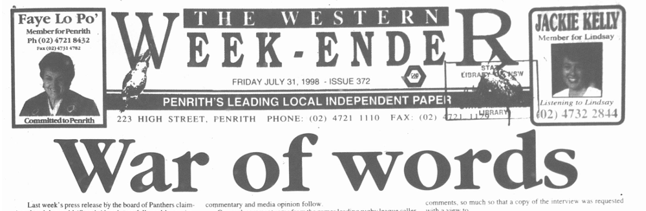
31 July 1998 — War of Words
Commentary
Within a week the debate had expanded well beyond Penrith itself. Sydney’s leading radio commentator, Ray Hadley, had broadcast damaging misinformation about Panthers prompting the Club to respond with an open letter published in the Sydney Morning Herald and the Western Weekender.
This exchange illustrates how quickly the discussion moved from private Board deliberations to public debate. Importantly, it also demonstrates that Roger Cowan’s explanation of the club’s position was being expressed publicly at the time. The account presented throughout Parts 29–35 is therefore not a reconstruction created years later, but reflects the position being articulated as events unfolded.
Readers may wish to compare this article with the discussion in Part 33 of The Series — A Good Story Trumps Truth — where the relationship between public perception and documented fact is explored in greater detail.
7 August 1998 — Merger Decision Deferred
Commentary
This article is significant because it records Panthers’ management describing its decision-making process while events were still unfolding. It’s headline — Damned if you do … — echoes the difficulties being encountered by those responsible for the Club. Roger Cowan repeatedly emphasises that the Board was analysing the risks, considering several possible scenarios and attempting to avoid making decisions based purely on emotion.
It is also a reminder that the future remained highly uncertain. Today it is easy to assume that Panthers’ eventual survival was inevitable. In August 1998 it was anything but certain — indeed, the uncertainty persisted until North Sydney and Manly announced their merger more than a year after the events chronicled here.
21 August 1998 — Council Enters the Debate
Commentary
By late August the merger debate had expanded well beyond Panthers’ Boardroom. Penrith City Council formally resolved to urge the club to remain a stand-alone participant in the National Rugby League, arguing that the Panthers name had become an important part of the city’s identity and economic development.
The article is of particular significance because it captures the complex position occupied by Deputy Mayor John Bateman, who was both a Panthers director and a councillor. Speaking in his capacity as a councillor, Bateman publicly praised the professionalism of Panthers’ management, confirmed that no merger agreement had been reached and acknowledged that the economic case being examined by management was a strong one. At the same time, he explained why he personally believed the socio-economic arguments for retaining an independent Penrith team were ultimately more compelling.
With hindsight, the article demonstrates that the debate had become far more sophisticated than a simple contest between “for” and “against”. Competing economic, governance and community considerations were all being weighed, even by people who ultimately reached different conclusions.
The public information meeting marked an important turning point in the merger debate. As described in Part 34, Roger Cowan later recalled the meeting as having become an “ambush”, while many supporters regarded it as the defining moment in the campaign to remain a stand-alone club.
The reporting that followed is interesting for another reason. Rather than simply recording the arguments presented, the article framed the debate as one of “Passion” versus “Practical”. Ron Mulock’s position appeared under the heading The Passion, while Roger Cowan’s appeared under …the Practical.
Whether intentional or not, this framing invites an interesting question. Was the debate really between passion and practicality, or were both men expressing different forms of commitment to the same objective — the long-term future of Panthers?
Readers who have followed Parts 29–35 may notice a striking irony. Throughout those chapters, management’s practical approach — risk analysis, contingency planning and exploring every available option — was itself driven by a determination to preserve Panthers’ place in the National Rugby League. The practical and the passionate were not necessarily opposing ideas; they were different philosophies for pursuing what each believed was in the club’s best interests.
It is obvious that both sides of this debate were driven by people holding strong loyalty and devotion to the Penrith Panthers.
Looking Back
Reading these articles nearly three decades later, several observations stand out.
The uncertainty of the time is unmistakable. Decisions that now seem obvious were anything but obvious in 1998. Much of the debate took place before supporters had access to the information available today.
The articles also reveal how rapidly public narratives developed. As discussions moved from the Boardroom into newspapers, radio and public meetings, the story acquired a momentum of its own. Perceptions often became as influential as documented facts.
Perhaps most interesting of all is the consistency of Roger Cowan’s public position. Whether speaking through interviews, open letters or Board statements, the central themes remained remarkably consistent: the risks were real, the future uncertain, and management had a responsibility to examine every realistic option before events overtook the club.
These articles go beyond being simple contemporary newspaper clippings. They are historical documents that allow readers to experience events as they unfolded, before hindsight shaped later interpretations.
Readers wishing to explore these articles in full can download the accompanying PDF containing the complete Western Weekender collection reproduced in this Beyond the Book entry.
The information night on 7th September 1998 was intended to provide clarity. Instead it intensified the debate. Media coverage and public reaction quickly hardened positions and narrowed the club’s options even further.
A front-page account of the meeting in The Western Weekender opens with a blatantly false statement:
In a historic announcement, the Panthers board of directors told the rugby league world that the mighty Penrith Panthers were to compete in the National Rugby League competition as an elite and single identity.
The article quotes Cowan as saying that ‘the stand-alone option was always the preference of senior management and the Board’.
Inside the paper in a double page spread, Mick Kelly lets rhetoric run riot. He quotes Mulock, the club patron — and its saviour, according to Kelly — as saying that Cowan and Levy’s efforts ‘have been skewed towards a merger with Parramatta’.
Editor’s Note: The way the meeting was subsequently presented in the local media is examined further in Following the Merger Debate, which reproduces the principal newspaper coverage from the period together with historical commentary.
Looking back, Cowan still found the events of that period difficult to understand. Why was Mulock so attached to arguments that were not reflecting the truth? Either he was being misinformed or his passion for Panthers was clouding his judgement.
After the public meeting and the subsequent newspaper coverage, feeling in the community was galvanised.
At the next board meeting, a resolution was passed that the club ‘cease all joint negotiations and stand-alone’. The Board also resolved to form a committee to promote the stand-alone position.
In Cowan’s eyes, this was a totally blinkered attitude. If there was to be a committee, its focus should have been to make sure Panthers was represented in the competition. Forming a committee with the sole purpose of supporting and propagating this one idea was ridiculous. It did not acknowledge the great danger that Panthers could be dropped from the competition.
The feeling at the time echoed the sentiments expressed by John Bateman in a Western Weekender front page story of 24 July:
Panthers brings too many aces to the table to be considered a weak link in the NRL competition.
He used the ‘largest junior league in the world’ as a reason why the club was safe from relegation, but, as we know, the junior league component was never a factor. Roger Cowan explained the NRL’s rationale for this.
The size of the junior league at any club is an asset to the entire league, whether it is centred around the Penrith club, or Parramatta, or any other club. If it is divided amongst a whole lot of other clubs, it evens out the distribution of junior talent. In other words, it would have been an advantage to the other clubs chosen for the competition for Penrith not to have ownership of its junior league. All that young talent would have been there for the taking.
We tried, very early in the process of setting criteria, to have junior league strengths given some recognition. There was no support for that proposition. Most clubs have believed that Penrith and Parramatta had an unfair advantage by having such large areas of juniors. They would hardly support something they saw as unfair being given an advantage under the criteria.’
Bateman and the other directors admit to being bombarded with information and reports from management during this period, so it is difficult to understand him making comments indicating the NRL would not dare discard the Panthers. Cowan says it was very frustrating to read this kind of statement, especially from someone like Bateman, who had been given all the facts.
Once the ‘Stand Alone’ Committee was formed,1 Cowan says he was absolutely appalled to hear Bateman, Mulock and other leading citizens of Penrith parroting the South Sydney line — that the NRL ‘would never drop us’.
The committee had representation from local councils, and from local community organizations and businesses, as well as people from Panthers management and Board. The purpose of the committee was to devise strategies that would convince the league decision makers that they could not drop Penrith.
Souths were using the same strategy – make lots of noise, build emotion, get the people marching in the streets – and it failed them miserably. Souths had far more emotion and tradition on their side than Penrith, being one of the foundation clubs in 1908 and having an outstandingly successful record. They also had the support of some very high profile people, yet they were dropped. Even though they were eventually reinstated, the loss of a year’s competition was damaging. Ultimately the courts supported the NRL’s right to drop them from the competition. Souths is only there because News Limited softened its stance, just for Souths. Without that, Souths would have been gone forever.
But in 1998, the powers that be at Souths had chosen to ignore the determination of News Limited to have a fourteen-team competition. Panthers was doing the same. News Limited had already conceded its original position of 12 teams, and agreed on 14, but Cowan could see that they would not go to 16.
Despite his reservations, Cowan agreed to join the committee. Ron Mulock was also on it, as were Leo Armstrong and Terry Heidtmann. Former Panthers operations manager Tony Lackey attended the meetings, which he says were held every second Friday. ‘They were always bad, there was lots of conflict. It got very uncomfortable.’2
Cowan found the situation very difficult. To him, it was a counterproductive exercise.
At every meeting he [Mulock] was repeating word for word things that I had said in the boardroom a week earlier. Worse, he was using things I had said in those board meetings out of context.
In the committee meetings I continued to push the fact that the agreement between NRL and ARL was written in stone. We would not be in the competition unless we could take our place in that fourteen under the criteria. There was never any doubt of that in my mind.
David Gallop confirms that the NRL was serious about its selection procedure.
There’s no doubt that the criteria process was a genuine exercise. And even though Souths was readmitted, the High Court ultimately found that we had behaved legally in eliminating them in the first place.
And Penrith were down the bottom, if you like, in terms of the way they were running under the criteria, so there’s no doubt they were in trouble. They were facing a serious threat of being excluded from the 14-team competition.
By now, independent voices from very different perspectives were reaching much the same conclusion: Penrith had been in genuine danger of exclusion.
Journalist Roy Masters believes Penrith went perilously close to being eliminated. He adds that the Board’s stand-alone resolution had effectively closed any doors that might save the team.
In fact, if it hadn’t rained non-stop in Gosford in 1999, there would be no Penrith team today. My view is that Roger had an obligation as chief executive to put it to his board as an option, and he would have been culpable if he had not.
Soon after Super League and the ARL had agreed on the new 14 team competition, it became clear that thirteen teams were pretty much secure in their positions in the new competition. Through 1998, Penrith continued to monitor the statistics week by week, and nothing changed. They were still sitting at number sixteen. The two teams ahead of them were Adelaide and North Sydney.3
On 1 December 1998, News Limited and the NRL announced they were pulling their financial support for the Adelaide Rams. From Cowan’s perspective, the announcement brought both encouragement and disappointment. It moved Penrith into fifteenth position. But it also sent a message that decision would be made regardless of political noise. The South Australian premier and the CEO of News Limited in Adelaide appealed for Adelaide to stay in the competition. They were supported by leading businesspeople. It made no difference. In relation to the criteria, however, Penrith was still well behind North Sydney, as Cowan explains —
During the year leading up to the ARL/Super League merger, North Sydney had negotiated relocation to Gosford. Their ground and facilities at North Sydney were out of date. The demographics of their area had changed dramatically, greatly diminishing their supporter base. On top of this, the Central Coast of NSW is a very strong rugby league area and had been crying out for its own team for years.
I watched this strategy evolve with a sinking feeling. The relocation was a disaster for Penrith. The state and federal governments had combined to provide grants of $20 million to build a modern stadium at Gosford. Norths had made a brilliant move. Their claim to a place in the competition now seemed to be considerably strengthened. Panthers had no hope of leap- frogging them under those circumstances.
If we could have read the future, we could have all relaxed and there would have been no conflict. Our crystal ball was not that good, and I suspect that Norths’ crystal ball was not giving them much more at that stage.
The damage suffered by Norths weakened it position, and by the end of the year, Penrith might have been slightly ahead. However, the influence of the new ground at Gosford was an unknown factor. For Norths, it went deeper than points on the criteria. But as far as the world knew, in mid-1999, Norths was in an unassailable position.
By July that year, Panthers had no strategy in place other than to demand selection based on arguments that had already been discredited. The Footy Five, with their numbers on the Board, and supported publicly by Ron Mulock, had moved to gag all discussion. There was an orchestrated campaign to make sure that Panthers could not even discuss contingencies at board level. It is difficult to understand their actions. It can never be in a company’s best interests for a board to suppress discussion of a threat that could have enormous repercussions for the business.
Cowan feels angry looking back at that period and remembers how bad the outcome might have been.
Had Norths survived, both Souths and Penrith would have been eliminated. Penrith would have had no bargaining power, and we would have been forced into a takeover by Parramatta or a year fighting alongside Souths for reinstatement. Having two clubs fighting for re-instatement would have probably hardened the resolve of the NRL to let the courts decide. Otherwise, it would have been signalling that the whole strategy of using criteria to reduce the number of teams was just a farce. The court, which ruled for the NRL against Souths, would inevitably have ruled the same way with Penrith.
Through all this, there were the thousands of members who had no idea of what was going on behind the scenes. I wonder how they would have felt when they suddenly found that they had no team playing in the top competition?
By the middle of 1999, the position appeared bleak. The contingency planning had ceased, discussions with Parramatta had ended, and the Board had committed itself to a stand-alone strategy. Having exhausted every practical option available to it, Panthers could do little more than wait for the NRL’s decision.
To receive new Parts and occasional project updates by email, you may subscribe below.
Readers who hold recollections, documents, or material relevant to this history are welcome to contribute via the Commentary & Contributions page.
Project Updates
Receive updates when new parts are published.
Well before this Stand-Alone Committee was formed the Panthers Marketing Team had started work on boosting those categories in the Criteria where Panthers was struggling — home game attendances, gate revenues and sponsorship income. Concept had already been planned, budgeted and were already active. The Our City, Our Team campaign was financed secretly by Panthers as it needed to be a grass roots campaign demonstrating the support of the community for the Club — neither the Board nor the Stand Alone Committee were made aware of this. ↩︎
Other members of the committee were Tony Ferguson (who chaired the meetings), Phil Morehead (from Panthers advertising agency), Max Cowan (Panthers Marketing Team). ↩︎
Two weeks later, Penrith Council joined the fight. A resolution was passed at a council meeting to send a letter to Panthers urging them to stand alone. Several councillors spoke in support of the motion, emphasising both the importance of the football team to Penrith’s identity and the economic value it brought to the city. One councillor suggested that the council ‘should let the NRL know where we are and urge Panthers to stand firm’.1
Council’s stance created a whole new dynamic. Two Panthers directors had council links. One, John Bateman, was already on council and it was common knowledge that he had his eye on the mayoral seat for the following year. His ally, Greg Evans had been a councillor in the early 90s, and was campaigning to be re-elected in the next council election.
Throughout most of the Penrith community, the issue sparked passion and emotion, and massive amounts of rhetoric, but there seemed to be little understanding or acceptance of the reality of the situation.
Ron Mulock, a former deputy premier of NSW and Penrith mayor, had been the club patron since its early days. He passionately opposed even the thought of a merger with any other team. He is quoted many times as saying he ‘would rather die on his sword’, than merge.
Through the club’s early days, Cowan had enjoyed a friendly relationship with Mulock. They were joint architects of the project to establish Penrith’s Police Citizens Boys’ Club as a joint venture between the council and the club. It was the first boys’ club of its kind in Australia to be built without the need for public fund-raising.
Board chairman Barry Walsh had also been a longtime friend of Mulock. When the Parramatta merger became an issue, this all changed. Walsh speaks of a day when Mulock arrived at his house, very upset and behaving in a rude and aggressive manner. It was a side to his character that Walsh had not seen. It was also a shock to Walsh’s wife who had always been a staunch Mulock supporter.
Walsh tried to explain the situation to Mulock. He understood the patron’s concerns, and wanted to reassure him. He suggested that if he would attend a board meeting, he would see for himself that the directors had no intention whatsoever of approving a merger. Mulock refused the invitation.
The Board decided to hold a public meeting to inform the members – and the team’s fans and supporters exactly what was going on. Its purpose was not to seek a decision, but to explain the situation facing the club and answer questions from members and supporters.
Cowan was to address the meeting held on 7 September 1998, but was quite unprepared for what happened.
I was aware of the controversy out in the community. We had just come through the whole Super League saga and people were very emotional about any possibility of merging with another club. But there was so much misinformation flying around. The board had agreed that our members and supporters should be given a factual analysis of the situation.
I decided to test my address on about eight of our managers. I was going to speak from notes to make sure that the message would not change on the night, no matter what. I asked them to look for any possible bias in what I was saying. I wanted to present both sides of the problem. They needed to understand that it was essential to fully investigate the situation.
If we decided to remain as a stand alone club there was, at that time, a very strong chance we would have no team in the NRL competition. If we decided to merge with another club, there would be a different set of negative results. They needed to have the full story.
I made a few changes on the advice of the management team, but we were confident that the message was objective and honest.
Rather than reducing uncertainty, the meeting fundamentally changed the course of the debate.
Cowan has described the meeting as an ambush. He says he and the board executive were completely caught by surprise. After Cowan addressed the meeting, Ron Mulock took the podium. Cowan says it was a moment he will never forget.
He was shouting and ranting about lies and corruption and saying all sorts of crazy stuff, and it seemed to be mostly aimed at me. He attacked four members of the board, carrying on that they had 80 years experience between them. He was even adding up their ages. The tirade went on and on. He made the “rather die on my sword” comment, and told the meeting that the league would never drop Penrith from the competition. Souths used the same questionable rationale and were dropped from the competition a few months later.
This was a public forum, and Cowan says he could not believe Mulock’s extraordinary behavior.
Later, I wondered about the reasons for the personal attacks. He was speaking as if he had come prepared for a debate, and it sounded as if he believed that I would be advocating a merger, and that I would be supported by some directors. If this really was the case, he had been badly misled.
This wasthe most troubling aspect of the whole thing. The Board had voted unanimously against any merger, but he was acting as if he had been told something very different.
His behaviour on that night was just another piece of a jigsaw puzzle.
There was another strange aspect to this forum.
John Bateman, responding to written questions sent in late 2006, said that the decision by members at the 7 September meeting was the reason he had continued his ‘stand alone’ stance.2
But this was not a proper members’ meeting.
A meeting of members for the purpose of making decisions would have required notices being mailed to all members three weeks in advance. This was nothing more than an information forum. Non-members were allowed to attend. Less than 350 people attended. There was no vote taken.
At the meeting the Five took the opportunity to declare their determination to stand alone despite a few weeks earlier having agreed to look at all options.
The following night’s board meeting virtually ensured there would be no further discussion on the subject. The continuing rationale for such a closed stance was that the members had spoken and that was what the members wanted. The fact is that many thousands of members would not even have been aware the meeting was held. The Board had taken no measure of members’ views. .
To receive new Parts and occasional project updates by email, you may subscribe below.
Readers who hold recollections, documents, or material relevant to this history are welcome to contribute via the Commentary & Contributions page.
Project Updates
Receive updates when new parts are published.
The position adopted by the Council was very interesting. Since at least 1994, research had been regularly done and the exposure and value the Penrith Rugby League team brought to the local community was an integral part of that research. Yet until this point the Council had failed to acknowledge that value in any way. In fact, it often seemed that certain councillors and council officers resented the thought that it was Panthers bringing Penrith growing visibility. ↩︎
This belief was express in correspondence from John Bateman to Jennie Bentley dated 7th Januray 2007. On tis issue Bateman says: … it was my view that the members “had spoken” on 7 September 1998 and I was happy to uphold their direction to the board to “stand alone”. ↩︎
As discussions quietly continued between Penrith and Parramatta, a very different story was beginning to circulate publicly.
It was not long after the two clubs began their talks that the media speculation began. Cowan says there was a great deal of misinformation, with many comments proving to be wide of the mark.
On one occasion someone announced on Ray Hadley’s rugby league radio show that the merger of Penrith and Parramatta was a ‘done deal’. There was no truth in that statement, but it stirred up a hornet’s nest in Penrith. People believed if they heard it on the Hadley program it must be true.
Denis Fitzgerald bears this out. ‘It was never a done deal,’ he says. ‘Far from it.’
As the old media adage goes, “don’t let the facts get in the way of a good story.” In this case, rumour was rapidly overtaking reality.
Editor’s Note: The merger debate was reported week by week through local newspapers, particularly the Western Weekender. Readers interested in following the controversy as it unfolded at the time can do so in the Historical Context article Following the Merger Debate.
Rumours flew that Cowan had already made a secret agreement with Parramatta. The rumours were soon repeated by others, including some who understood how football clubs operated and should have appreciated that no chief executive could make such a decision alone.
Perhaps the most surprising assumption was that I could somehow make such a decision on my own. Businesses simply do not operate that way. The board of directors has total power over decisions that affect the members they represent.
Mick Kelly, who writes for the Western Weekender, still pushes the story that I was the one who had to be defeated to avoid the merger.1 While the agendas of some people would later become obvious, Kelly’s rigid stance is still difficult to understand. He has some experience in the way clubs work, so he must have known that what he was saying was untrue. At the time of merger discussions, he was well aware of the alliance of five directors. This was the group who would later claim to be the Footy Five and it included the owner of the newspaper that employed him. They held a majority of five of the nine votes, so nothing could happen that they did not support. Kelly had to know that.
The truth is, they only needed four votes to stop a merger.
There is one little known fact about this episode. Cowan had suggested a further safeguard — instead of a decision by simple majority, the votes of at least six directors should be required for a decision in favour of merging with another club. Of course, the alliance of five could have used its majority to strengthen this even further had they deemed it necessary — they could have made a unanimous vote as the safeguard.
It was a practical safeguard that made it even less plausible that a merger could occur without overwhelming Board support.
Kelly’s ‘rigid stance’ on the issue continues to this day. During the course of the research for this book, the author was told by a couple of people that he [Kelly] had some important evidence to present that would prove that Cowan wanted a merger with Parramatta. Apparently, the evidence is in the form of a taped interview in which the Panthers CEO had said he thought that a merger with Parramatta was the way to go.
Questioned on this point, Cowan says depending on the time of the interview, and the circumstances — and of course the context — it is very possible.
They were some very desperate moments during those years. I have said all along that a merger was preferable to seeing Panthers disappear from the rugby league scene altogether. I never stepped back from that belief. I could not understand the opposing belief that it would be better to “die on our swords”. When the board would not even discuss such an important issue, it made me very suspicious that something strange was going on behind the scenes.
Panthers group chairman Barry Walsh calls the merger story a ‘storm in a teacup’, because — as far as he and the rest of the Board was concerned — it was never going to happen. There was no need for the high drama and the media beat-ups. Attempts to investigate the options carefully, maintain a low profile and not raise controversy in the community were being undermined by media speculation that had no foundation in fact.
In July, the Western Weekender, a local newspaper owned by director Greg Evans, ran a story on its front page advocating a ‘stand alone’ position for the Club. On 2 August, the story broke in the Sunday Telegraph. It said that a merger between the two clubs was ‘set to become reality next year’. It said the team would be called the Parramatta Panthers, and would play in blue and gold, the Parramatta colours. The story featured quotes from Denis Fitzgerald, but none from Roger Cowan, or indeed anyone from the Panthers club. But it was enough to set things in motion in the city of Penrith .
To receive new Parts and occasional project updates by email, you may subscribe below.
Readers who hold recollections, documents, or material relevant to this history are welcome to contribute via the Commentary & Contributions page.
Project Updates
Receive updates when new parts are published.
Mick Kelly no longer writes for the Western Weekender. like many of the protagonists in this chapter of the Panthers story he undoubdtedly maintains his view. ↩︎
Considering the possible contingency responses was one thing. Recommending a course of action to the Board was another. By early 1998 management believed it could no longer treat the issue as a theoretical exercise.
By early 1998, Cowan says he and Levy had reached an unavoidable conclusion.
We came to the conclusion – we just have to do something, otherwise Panthers is going to disappear off the face of the earth as far as rugby league is concerned
We were in a weak bargaining position because it was quite obvious that we could not make it under the criteria. If we started negotiations early enough, we could use the strength of the Panther brand and our junior league to reinforce our position. Waiting until we missed selection would leave us nothing more than a takeover target. If we had to merge it should be as an equal partner. Then, at least, half of our games would still be played in Penrith and the Panther brand would continue to strengthen.
Together they prepared their first formal recommendation to the Board—that Panthers should at least begin exploring the possibility of a merger with Parramatta.
Every chief executive has a duty to advise the Board of risks that may threaten the organisation’s future. Failing to do so would represent a serious dereliction of responsibility. Equally important is the obligation to identify available options and make appropriate recommendations. If Panthers genuinely faced exclusion from the national competition, management had a duty to ensure the Board understood both the risks and the possible responses.
Management’s recommendation was not that Panthers should merge with another club. Rather, it was that the Board should investigate every realistic contingency before circumstances removed those choices. If the club’s worst fears were realised, directors would then be able to make an informed decision from a position of preparation rather than desperation.
Between 1995 and1999, the structure of the Panthers board changed dramatically. John Bateman, who had been elected to Penrith Council in 1995, was appointed to a board vacancy in the same year. He had worked well in what had been a strong and cohesive board. But between 1997 and 1999, three seats became available on the Board. They were filled by Craig Terry, Greg Evans and Dennis Coffey, some of whom had social and business ties with Bateman.
Cowan began to feel a change in the attitude of long-term director Geoff James who seemed to be developing a close alliance with the other four. Before long, the removal of long-serving Chairman Leo Armstrong would point to the existence of a faction for the first time in the Panthers history. In answer to a question in 2007, John Bateman insisted that there never was a faction, except in his final year on the Board, 2002.
Despite the changed board dynamics at Penrith, both Penrith and Parramatta were willing to discuss all options in the early stages of negotiations. Neither board really wanted to amalgamate, as Cowan explains,
Had there been a vote at Parramatta the outcome may have been a small minority in favour. We know what the vote at Penrith would have been and there is absolutely no doubt about it – nine directors against amalgamation and none in favour. That never, ever changed.
So, if that was the case, what was the point of discussing it at all? And why was there a softer attitude towards amalgamation at Parramatta than there was at Penrith? Probably, the main reason was that for Parramatta, it was never a life and death decision.
For us, it was. All the facts that Mark and I had presented to the board showed that we were in critical danger of not being in the competition. We were way behind in the criteria stakes and the teams would be only selected on the basis of criteria points. Confronted by such evidence, it would have been totally irresponsible for a board to sit back and do nothing. All the directors were prepared to look at options, but not one of them would have voted in favour.
Mark and I believed we had a responsibility to make sure the board was fully informed about the risks. We could keep putting off any decision until the last possible moment but if we had nothing planned by the time the axe started to fall it would be too late.
There was some strong logic behind the Penrith directors’ total opposition to amalgamation. Parramatta was in a much stronger negotiating position and some felt that it would be more of a takeover than an amalgamation.
My discussions with Denis Fitzgerald were never in that vein, however. In fact, our discussions were only ever about how we could set up a new club with equal ownership that would be the strongest club in the competition. If we were to be simply taken over, the option of buying naming rights would be a better commercial decision because it would leave open the possibility of fighting for reinstatement through the courts
So, all nine Panthers directors were adamantly opposed to any such idea, but they generally agreed that there could be no harm in opening discussions with Parramatta.
Significantly, there were no objections, even from the five directors who would eventually claim recognition as the ‘Footy Five’. A couple of joint board meetings of the two clubs were held around August that year. The first was hosted in the Panthers boardroom over dinner. Everything went reasonably smoothly, and it was decided that Parramatta would host the next meeting.
It was clear at these meetings that neither directors nor managers from either club were over the moon about the prospect of amalgamating. At that stage, both clubs were still prepared to examine the possibilities rationally. That would soon change.
To receive new Parts and occasional project updates by email, you may subscribe below.
Readers who hold recollections, documents, or material relevant to this history are welcome to contribute via the Commentary & Contributions page.